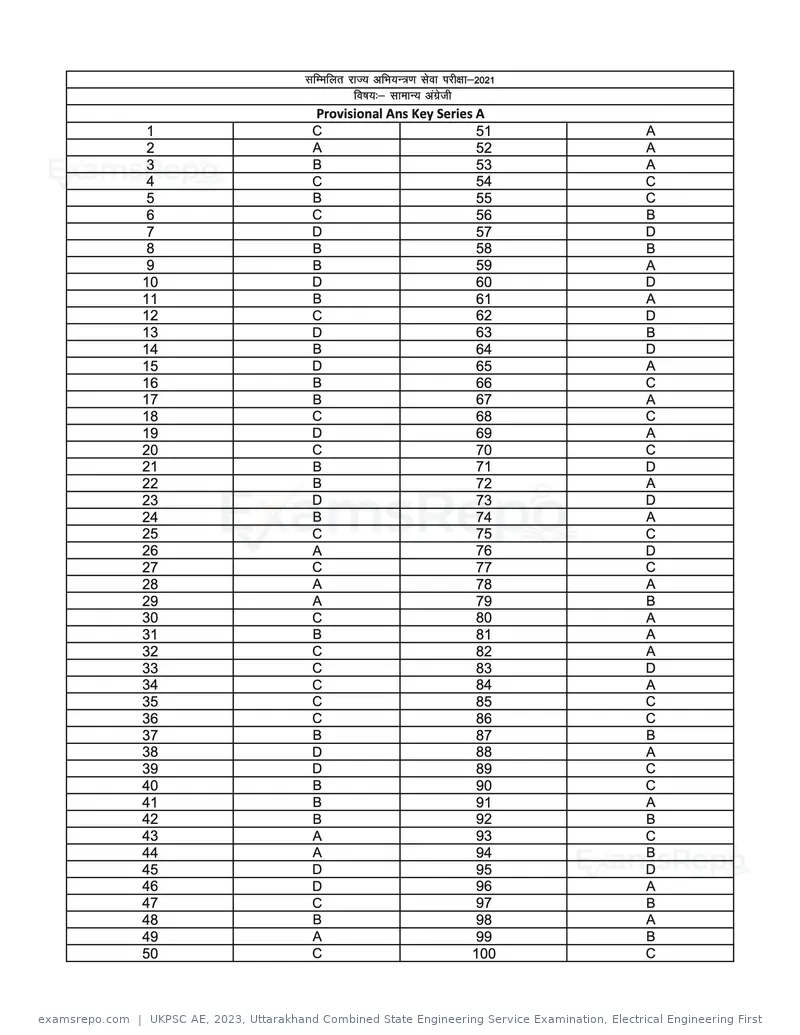
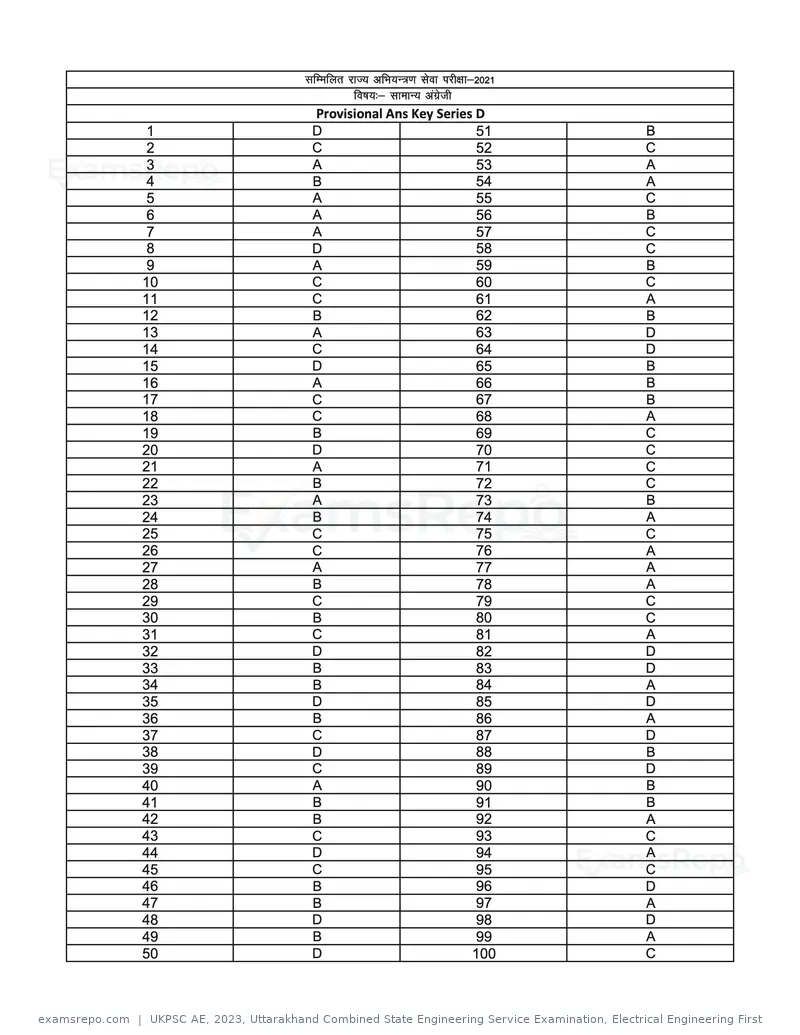
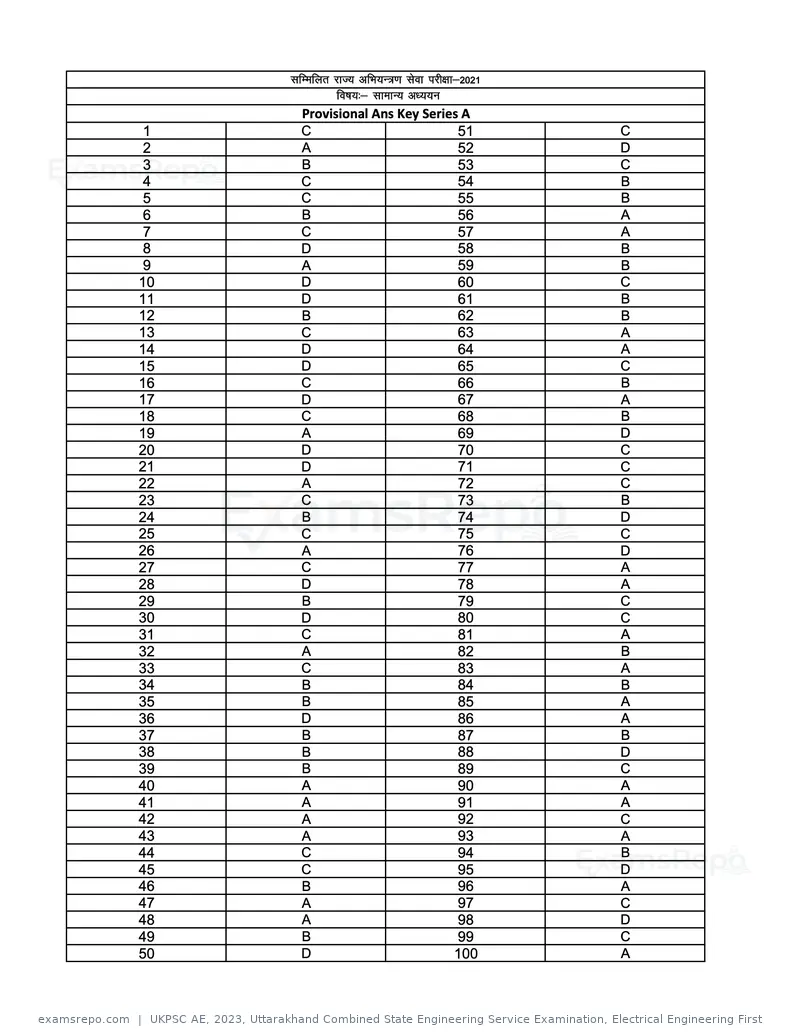
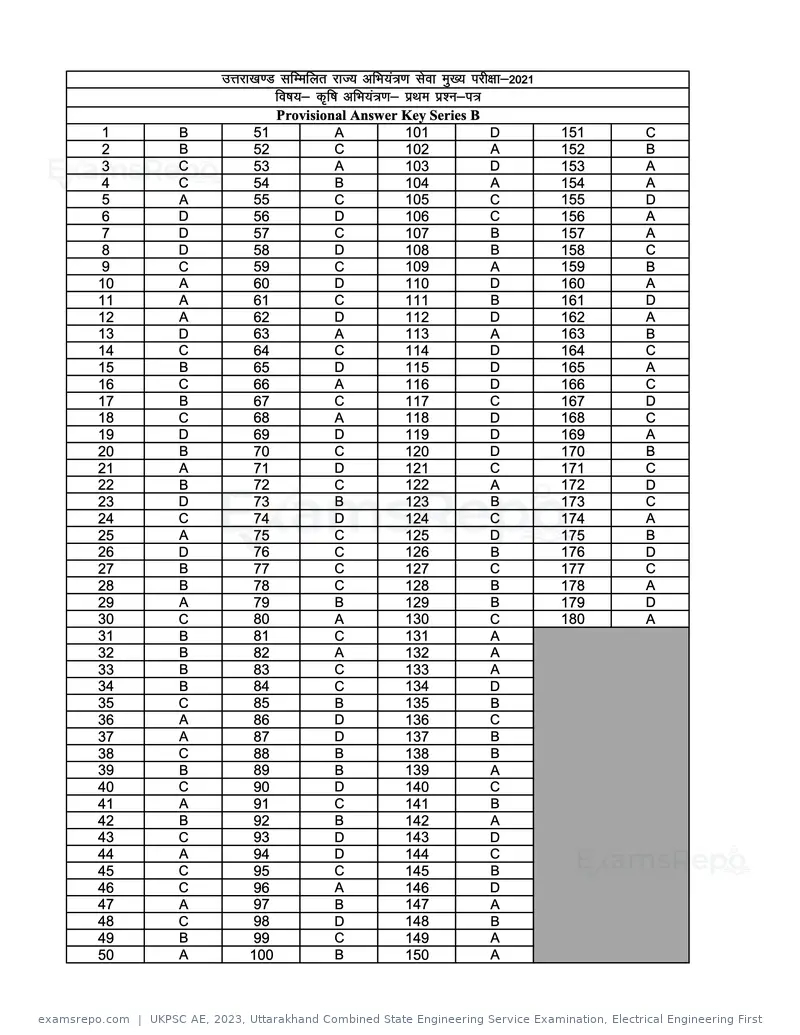
Machine-translated by Google. Questions are authored in English.
Top

UKPSC AE 2023: Uttarakhand Combined State Engineering Service Examination, Electrical Engineering First

  • Language: Bilingual
  • 32 pages
UKPSC AE 2023 question paper, Uttarakhand Combined State Engineering Service Examination, Electrical Engineering First, page 1 of 32
Page 1 of 32
UKPSC AE 2023 question paper, Uttarakhand Combined State Engineering Service Examination, Electrical Engineering First, page 2 of 32
Page 2 of 32
Text of page 2
Electrical Engineering-I
1.   The circuit shown in the figure given below is critically damped. The value of R is


     (a) 40              (b) 60                  (c) 120                (d) 180
2.   In a Y-connected circuit between each line voltage and the nearest phase voltage, there is a phase
     angle of
     (a) 0 degree         (b) 30 degree             (c) 90 degree            (d) 120 degree
                                                                2jw  5
3.   Determine the inverse Fourier transform of X(w) =
                                                               (jw  2) 2
     (a) (2e–2t – te–2t) u(t)                         (b) (2e–2t + te–2t) u(t)
            –2t     2t
     (c) (2e – te ) u(t)                              (d) (2e+2t – te–2t) u(t)
4.   Determine the Fourier series co-efficient of the periodic signal x(t) as shown below :


            j                     1                              1                           1
     (a)      [1 – e–jk] (b)        [1 + e–jk]         (c)        [1 – e–jk]    (d)          [1 + ejk]
           kπ                    jkπ                            jkπ                         jkπ
                                                       1
5.   If Laplace transform of a signal is Y(s) =             then its final value will be
                                                    s(s  1)
     (a) 1                  (b) –1                       (c) 0                     (d) 
6.   Unit step response of a system starting from rest is given by C(t) = 1 – e–2t, for t  0. The transfer
     function of the system is
            s                   1                                s                        2
     (a)                   (b)                           (c)                       (d)
          s2                  s2                              s2                      s2
7.   The potential difference Vxy in the circuit shown below is


     (a) 6.7 V              (b) –3.7 V                   (c) 1.3 V                 (d) –4.3 V
8.   Two similar coils are connected in series, it gave total inductance of 600 mH and when one is
     reversed, the total inductance is 300 mH. The co-efficient of coupling will be
     (a) 0.33                (b) 0.22                (c) 0.44                   (d) 0.5

                                2s 1
9.   The final value of 4                     is
                        s  8s3  16s2  s
     (a) infinity           (b) 2                        (c) zero                  (d) 1

EEN-01                                               2                                                 Series-A
UKPSC AE 2023 question paper, Uttarakhand Combined State Engineering Service Examination, Electrical Engineering First, page 3 of 32
Page 3 of 32
Text of page 3
  ( -)
1.               R    


     (a) 40                    (b) 60                        (c) 120                 (d) 180
2.   -                 ?
     (a) 0                   (b) 30                   (c) 90                    (d) 120 

                2jw  5
3.   X(w) =                    
              (jw  2) 2
     (a) (2e–2t – te–2t) u(t) (b)     (2e–2t + te–2t) u(t)      (c) (2e–2t – te2t) u(t)   (d) (2e+2t – te–2t) u(t)
4.     , x(t)       


            j                           1                              1                          1
     (a)      [1 – e–jk]       (b)        [1 + e–jk]          (c)       [1 – e–jk]     (d)        [1 + ejk]
           kπ                          jkπ                            jkπ                        jkπ
                                                                   1
5.    इस िस नल का      Y(s) =                  इसका     ?
                                                                s(s  1)
     (a) 1                      (b) –1                          (c) 0                     (d) 
6.                : C(t) = 1 – e–2t, t  0      
     
            s                          1                               s                          2
     (a)                        (b)                             (c)                       (d)
           s2                        s2                             s2                        s2
7.         Vxy   


     (a) 6.7 V                  (b) –3.7 V                      (c) 1.3 V                 (d) – 4.3 V
8.       ,    600 mH           
          300 mH        ?
     (a) 0.33                   (b) 0.22                        (c) 0.44                  (d) 0.5
                  2s  1
9.    4                          
           s  8s3  16s2  s
     (a)                    (b) 2                           (c)                   (d) 
EEN-01                                                      3                                               Series-A
UKPSC AE 2023 question paper, Uttarakhand Combined State Engineering Service Examination, Electrical Engineering First, page 4 of 32
Page 4 of 32
Text of page 4
10.   The characteristic equation of the series RLC circuit is
                               R                                                1    R
      (a) S2 + (LC)S +           =0                                (b) S2 +        +   =0
                               L                                              (LC)S L
                        R                                                                 R
      (c) S2 +            S + LC = 0                                  (d)            S2 +   S+ 1 =0
                        L                                                                  L
                                                                                                 LC
         ––                                               ––
11.   If E is the electric field intensity,  · ( × E) is equal to
              ––                         ––
      (a) E                       (b) | E|                         (c) Null vector     (d) zero
12.   In cylindrical co-ordinate system, the potential produced by a uniform ring charge is given by f = f(r, z),
                                                                   ––
      where f is a continuous function of r and z. Let E be the resulting electric field. Then the magnitude
                   ––
      of  × E
      (a) increases with r (b) is 0                                (c) is 3            (d) decreases with z
13.   In a uniform electric field, the field lines and equipotential surface are
      (a) parallel to one another                        (b) intersect at 45º
      (c) intersect at 30º                               (d) orthogonal
14.   A parallel plate capacitor filled with two dielectrics as shown in fig. below. If the electric field in the
      region A is 4 kV/cm, then the electric field in the region B, in kV/cm, is


      (a) 1                       (b) 2                            (c) 4               (d) 16
15.   A hollow metallic sphere of radius r is kept at potential of 1 volt. The total electric flux coming out
      of the concentric spherical surface of radius R(R  r) is
      (a) 40r             (b) 40r2               (c) 40R                  (d) 40R2
16.   Consider a solid sphere of radius 5 cm made up of a perfect electric conductor. If one million
      electrons are added to this sphere, these electrons will be distributed
      (a) uniformally over the entire volume of sphere
      (b) uniformally over the outer surface of the sphere
      (c) concentrated around the centre of the sphere
      (d) along a straight line passing through the centre of the sphere
17.   The energy stored in a magnetic field of solenoid 30 cm in length and having 3 cm diameter wound
      with 1000 turns of wire carrying a current of 10 A, is
      (a) 0.015 J           (b) 0.15 J                 (c) 0.5 J               (d) 1.15 J
18.   The flux density at a point in sphere is given by B = 4x ax + 2 ky ay + 8 az Wb/m2. The value of
      constant, k must be equal to
      (a) –2                (b) –0.5                  (c) +0.5                 (d) +2
19.   Four point charges of 1, –2, –3 and 4 c are located on the X-axis at X = 1, 2, 3 and 4 m respectively.
      The energy stored in the field is
      (a) 0 Joule            (b) 1 Joule                (c) 10 Joule               (d) 100 Joule
20.   For a static electromagnetic field in a linear homogeneous medium, which equation is not Maxwell’s
      equation ?
      (a)  × D = 0               (b)     B  dl = 0I            (c)   B = 0       (d) 2A = 0J
EEN-01                                                         4                                       Series-A
UKPSC AE 2023 question paper, Uttarakhand Combined State Engineering Service Examination, Electrical Engineering First, page 5 of 32
Page 5 of 32
Text of page 5
10.    RLC     
                            R                                            1     R
      (a) S2 + (LC)S +        =0                              (b) S2 +       +    =0
                            L                                          (LC)S L
                 R                                                   R      1
      (c) S2 +     S + LC = 0                               (d) S2 +   S +    =0
                 L                                                   L     LC
           ––                                        ––
11.    E    ,    ( × E)  
           ––                          ––
      (a) E                      (b) | E|                     (c) Null vector               (d) 
12.    -  ,           = f(r, z),  f 
                                              ––                                   ––
        r  z     E       × E  
      (a) r            (b) 0                         (c) 3                   (d) z     
13.      ,     
      (a)                                   (b) 45°    
      (c) 30°                                            (d)    
14.                    A-    4 kV/cm
      ,    B  kV/cm      ?


      (a) 1                      (b) 2                         (c) 4                           (d) 16
15.        r  1               
           R (R  r)  
      (a) 40r                 (b) 40r2                  (c) 40R                    (d) 40R2
16.        5 cm      -   ,  10     ,
        
      (a)      
      (b)      
      (c)       
      (d)               
17.    ,   30 cm   3 cm, 1000           10 A  
                 ?
      (a) 0.015 J                (b) 0.15 J                   (c) 0.5 J                     (d) 1.15 J
18.          B = 4x ax + 2 ky ay + 8 az   Wb/m2      k      ?
      (a) –2                     (b) – 0.5                    (c) +0.5                      (d) +2
19.      1, –2, –3  4 c, X-  X = 1, 2, 3  4   :       
        ?
      (a) 0                   (b) 1                  (c) 10                    (d) 100 
20.            ,        ?
      (a)  × D = 0              (b)    B  dl = 0I         (c)   B = 0                 (d) 2A = 0J

EEN-01                                                    5                                                  Series-A
UKPSC AE 2023 question paper, Uttarakhand Combined State Engineering Service Examination, Electrical Engineering First, page 6 of 32
Page 6 of 32
Text of page 6
21.   If r = x ax + y ay + z az, the position vector of point (x, y, z) and r = | r |, which of the following is
      incorrect ?
      (a) 2(r  r) = 6       (b)  × r = 0              (c)   r = 1                 (d) None of these
22.   Upto which frequency ground wave propagation is used ?
      (a) 300 MHz             (b) 30 GHz                 (c) 3 GHz                     (d) 2 MHz
23.   The transmitter-receiver combination in the satellite is known as
      (a) relay               (b) transponder            (c) repeater                  (d) duplexer
24.   The satellite, which is used as a relay for extending the communication distance is called
      (a) relay satellite                                (b) repeater satellite
      (c) geo-synchronous satellite                      (d) communication satellite
25.   Which of the following is the expression of Lorentz force ?
      (a) q(v × B)            (b) ma + qE                (c) qE + q(v × B)             (d) qE
26.   For an electromagnetic wave in free space, the root mean square value of the electric field is 6 V/m.
      The peak value of the magnetic field is
      (a) 2.83 × 10⁻⁸ T       (b) 1.51 × 10⁻⁸ T          (c) 0.80 × 10⁻⁸ T             (d) 4.0 × 10⁻⁸ T
27.   Which component of magnetic flux density is continuous at the point of discontinuity ?
      (a) Normal              (b) Tangential             (c) Horizontal                (d) Curve
28.   If electric and magnetic field are perpendicular to each other then the velocity of a charged particle
      to keep moving in the same direction will be
            B                       E                         B      B                     E      E
      (a) E                   (b) B                      (c) E + q E                   (d) B + q B
29.   If the energy of the electromagnetic wave is of the order of 15 k eV then this wave belongs to which
      part of the spectrum ?
      (a) Infrared rays       (b) X-rays                 (c) Gamma rays                (d) Ultra-violet rays
30.   Which of the following rays are not electromagnetic waves ?
      (a) X-rays              (b) Gamma rays             (c) Beta rays                 (d) Heat rays
31.   Which of the following systems has tendency to oscillate ?
      (a) Open loop system                               (b) Closed loop system
      (c) Both (a) and (b)                               (d) Neither (a) nor (b)
32.   A car is running at a constant speed of 50 km/h, which of the following is the feedback element for
      the driver ?
      (a) Clutch                                         (b) Steering wheel
      (c) Needle of the Speedometer                      (d) Eyes
33.   Which of the following is a part of human temperature control system ?
      (a) Leg movement (b) Ear                           (c) Perspiration system (d) Digestive system
34.   The initial response when output is not equal to input is called
      (a) Error response                               (b) Transient response
      (c) Dynamic response                             (d) None of these
35.   Which of the following increases the steady state accuracy ?
      (a) Differentiator                              (b) Integrator
      (c) Phase lead-lag compensator                  (d) Phase lag compensator
36.   Which of the following is an open loop control system ?
      (a) Stroboscope                                 (b) Ward-Leonard control
      (c) Meta dyne                                   (d) Field controlled DC motor
                                                                                   k
37.   The open loop transfer function of a system is given by G(s) =                        . The value of k,
                                                                            s(s  2)(s  4)
      which will cause sustained oscillations in the closed loop unity feedback system is
      (a) 16                (b) 32                      (c) 48                   (d) 64
EEN-01                                                 6                                              Series-A
UKPSC AE 2023 question paper, Uttarakhand Combined State Engineering Service Examination, Electrical Engineering First, page 7 of 32
Page 7 of 32
UKPSC AE 2023 question paper, Uttarakhand Combined State Engineering Service Examination, Electrical Engineering First, page 8 of 32
Page 8 of 32
Text of page 8
38.   Indicate which one of the following transfer functions represents phase lead compensator ?
      (a) (s + 1)/(s + 2)   (b) (s + 5)/(3s + 2)      (c) (6s + 3)/(6s + 2)      (d) (s + 8)/(s2 + 5s + 6)
                                                                                       k
39.   A unity feedback system with forward path transfer function G(s) =                            is stable,
                                                                             s(1  sT1 ) (1  sT2 )
      provided the value of k is given by
                T1  T2                T1T2                       T1  T2                    T1T2
      (a) k <               (b) k <                     (c) k >                   (d) k >
                 T1T2                 T1  T2                      T1T2                     T1  T2
40.   The open loop transfer function with unity feedback is given below :
                      2
           G(s) = 2
                  s (s  2)
      The system is
      (a) marginally stable                             (b) stable
      (c) unstable                                      (d) conditionally stable
41.   If ramp input is applied to a Type-2 system, the steady state error is
      (a) positive constant (b) negative constant (c) zero                       (d) positive infinity
                                                        d X(t)
42.   The solution of first order differential equation          3X(t), X(0)  5 is :
                                                          dt
      (a) X(t) = 5e–3t        (b) X(t) = 5(1 – e–3t)    (c) X(t) = 5e–t/3        (d) X(t) = 5e–t
43.   For the signal flow graph shown below, X3/X1 is equal to


      (a) 20                (b) 25                     (c) 30                     (d) 35
44.   For a second order system, the settling time for  2% band is
      (a) 3/ wn            (b) 5/ wn                 (c) 2 wn                  (d) 4/ wn
45.   The time constant of the circuit shown below is :


           3                        2
      (a)      RC             (b)     RC               (c) 2 RC                  (d) 3 RC
           2                        3
46.   When a P-N junction is forward biased
      (a) the width of depletion layer is decreased
      (b) the width of depletion layer is increased
      (c) the width of depletion layer remains the same
      (d) None of these
47.   Which diode is often used for voltage regulation in electronic circuits ?
      (a) Silicon             (b) Germanium            (c) Varactor              (d) Zener
48.   The term ‘Fermi Level’ is mainly related to
      (a) Conductor           (b) Semi-conductor       (c) Insulator             (d) None of these
49.   What does a critical inductance do in case of L-section filters ?
      (a) It ensures that no cut-out take place        (b) It ensures that no cut-in take place
      (c) It acts as a pure resistance                 (d) It acts as a pure capacitor
EEN-01                                              8                                               Series-A
UKPSC AE 2023 question paper, Uttarakhand Combined State Engineering Service Examination, Electrical Engineering First, page 9 of 32
Page 9 of 32
UKPSC AE 2023 question paper, Uttarakhand Combined State Engineering Service Examination, Electrical Engineering First, page 10 of 32
Page 10 of 32
Text of page 10
50.   The junction capacitance of a linearly graded junction varies with the applied reverse bias (VR) as
             1                      1                          1                     1
      (a) VR                 (b) VR 2                    (c) VR 3                (d) VR2
51.   Avalanche breakdown is primarily dependent on the phenomenon of
      (a) Collision      (b) Doping                (c) Iionisation               (d) Recombination
52.   Without a DC source clipper acts like a
      (a) Rectifier        (b) Clamper                   (c) De modulator        (d) Chopper
53.   For a half wave rectifier with capacitor as input filter, what will be the maximum voltage that will
      appear across the diode for an input AC of 10 volts ?
      (a) 10.2 V              (b) 14.2 V                (c) 28.2 V                (d) 56.4 V
54.   For a silicon diode, the incremental resistance at room temperature for a current of 26 mA is (given
      VT = 0.026 V)
      (a) 2                 (b) 1                      (c) 10                 (d) 20 
55.   Given, RS = R1 = 200 , RL = 50 k and VS = 400 sin wt.
      The diode is ideal with reverse saturation current I0 = 2 A and PIV rating of VR = 100 V


      For the above circuit, determine the diode operating region
      (a) Saturation                                  (b) Avalanche breakdown
      (c) Zener breakdown                             (d) Forward bias
56.   The common-emitter forward current gain of the transistor shown below is
           F = 100


      The transistor is operating in
      (a) Saturation region                          (b) Cut-off region
      (c) Reverse active region                      (d) Forward active region
57.   In BJT, which of the following factors changes with temperature ?
      (a)                   (b) VBE                 (c) ICO                 (d) All of these
58.   The point of intersection of load line on the current axis is :
      (a) R/V                (b) 1/R                    (c) V/R                  (d) IDQ
59. Common-base configuration is little used because
    (a) it has low input resistance                (b) it does not heat up
    (c) it has high input impedance                (d) it has very high gain
EEN-01                                          10                                                Series-A
UKPSC AE 2023 question paper, Uttarakhand Combined State Engineering Service Examination, Electrical Engineering First, page 11 of 32
Page 11 of 32
Text of page 11
50.          (VR)         ?
              1                          1                             1                           1
      (a) VR                     (b) V 2                         (c) V 3                     (d) V 2
                                      R                               R                           R

51.              ?
      (a)             (b)                  (c)                     (d) 

52.    DC        ?
      (a)             (b)                         (c)              (d) 

53.               ,          
      10 V  (AC)    ?
      (a) 10.2 V                 (b) 14.2 V                      (c) 28.2 V                  (d) 56.4 V
54.               26 mA  (  VT = 0.026 V) ?
      (a) 2                     (b) 1                          (c) 10                     (d) 20 

55.        RS = R1 = 200 , RL = 50 k  VS = 400 sin wt       
        , I0 = 2 A  PIV , VR = 100 V ,


          ड का    
      (a)                (b)            (c)                  (d)  

56.                   F = 100      
         ?


      (a)            (b) -                 (c)           (d)   

57.   BJT ,         ?
      (a)                         (b) VBE                       (c) ICO                     (d)  

58.    ,        ?
      (a) R/V                    (b) 1/R                         (c) V/R                     (d) IDQ

59.   -         ?
      (a)                          (b)      
      (c)                        (d)       

EEN-01                                                      11                                                Series-A
UKPSC AE 2023 question paper, Uttarakhand Combined State Engineering Service Examination, Electrical Engineering First, page 12 of 32
Page 12 of 32
Text of page 12
60.   For the diagram shown below, what is the value of stability factor(s) ?


      (a) 100                 (b) 99                   (c) 101                       (d) None of these
61.   In the circuit given below, VB = –1 V, calculate the value of 


      (a) 103.4               (b) 135.5                    (c) 108.5                 (d) 102.5
62.   For the circuit given below, VB = VC and  = 75. The value of VB is


      (a) 0.9 V               (b) 2.27 V                   (c) 2.14 V                (d) 1.84 V
63.   Assuming that the diodes are ideal in the following circuit, the current in D1 is


      (a) 8 mA                 (b) 5 mA                   (c) 0 mA                   (d) –3 mA
64.   In the intrinsic silicon, the carrier’s concentration is given by
             2        2  EGo                                   2        3      EGo 
      (a) ni  AoT exp                                   (b) ni  AoT exp            
                        kT                                                     kT 
           2     2      EGo                                                    EG o 
      (c) ni  Ao T exp                                  (d) n i2  A o T 2ex p     
                        kT                                                     kT 
65.   Thermal velocity of an electron in silicon is given by
             3kT                     3m                           3kT                       3m
      (a)                     (b)                          (c)                       (d)
             nm                      nkT                           m                        kT
66.   The Fermi level in Tunnel diodes is found
      (a) within the band-gap                              (b) within the valance band
      (c) within the conduction band                       (d) Both (b) & (c)
EEN-01                                                12                                            Series-A
UKPSC AE 2023 question paper, Uttarakhand Combined State Engineering Service Examination, Electrical Engineering First, page 13 of 32
Page 13 of 32
UKPSC AE 2023 question paper, Uttarakhand Combined State Engineering Service Examination, Electrical Engineering First, page 14 of 32
Page 14 of 32
Text of page 14
67.   Negative resistance oscillators are also known as
      (a) Harmonic oscillator                         (b) Relaxation oscillator
      (c) Tunnel diode oscillator                     (d) Pierce oscillator
68.   Out of the following which one uses capacitive feedback ?
      (a) Hartley oscillator (b) Colpitt oscillator   (c) Clapp oscillator          (d) Armstrong oscillator
69.   Hartley oscillator is used for generating
      (a) very low frequency oscillations               (b) radio-frequency oscillations
      (c) microwave oscillations                        (d) audio-frequency oscillation
70.   A number system that uses numbers and letters as symbols.
      (a) Decimal             (b) Binary                (c) Octal                 (d) Hexadecimal
71.   If the height of transmission tower is decreased, the inductance of the line will
      (a) increase            (b) decrease              (c) remain same           (d) increase proportionally
72.   Which of the following turbine is impulse turbine ?
      (a) Francis turbine (b) Propeller turbine         (c) Kaplan turbine        (d) Pelton wheel turbine
73.   A string insulator has 5 units. The voltage across the bottom most unit is 35%. Its string efficiency is
      (a) 57.14%              (b) 30.76%                 (c) 69.24%                (d) 42.86%
74.   Bus admittance matrix of a power network is given as
               1      2       3
        1     –j50 +j20      +j5
        2    +j20 –j30 +j20
        3     +j5 +j20 – j25
      The impedance of line between bus 2 and 3 will be equal to
      (a) –j0.05           (b) +j0.2                 (c) –j0.2                      (d) +j0.05
75.   The power angle characteristic of machine-infinite bus system is
            P = 2 sin pu
      It is operating at  = 30º. Which one of the following is the synchronising power co-efficient at the
      operating point ?
                                                                                           1
      (a) 1.0                (b)     3                       (c) 2.0                (d)
                                                                                           3
76.   Skin effect exists in
      (a) ac transmission only                        (b) dc transmission only
      (c) ac as well as dc transmission               (d) None of these
77.   If a generator of 250 MVA rating has an inertia constant of 6 MJ/MVA, its inertia constant on a 100
      MVA base is
      (a) 15 MJ/MVA          (b) 10.5 MJ/MVA          (c) 6 MJ/MVA             (d) 2.4 MJ/MVA
78.   Sag is independent of
      (a) Length of span                              (b) Line voltage
      (c) Weight of conductor                         (d) Tension in the conductor
79.   The span of transmission line between towers takes the form of
      (a) hyperbola          (b) parabola             (c) catenary             (d) None of these
80.   Shunt capacitance is neglected while considering a
      (a) long transmission line                     (b) short transmission line
      (c) medium transmission line                   (d) None of these
                                                  V
81.   If string efficiency,  is given by  =          , then n is the
                                                n  vn
      (a) no. of lines                                       (b) no. of discs
      (c) no. of line conductors                             (d) None of these

EEN-01                                                  14                                            Series-A
UKPSC AE 2023 question paper, Uttarakhand Combined State Engineering Service Examination, Electrical Engineering First, page 15 of 32
Page 15 of 32
Text of page 15
67.              ?
      (a)   (b)                (c)      (d)  
68.              ?
      (a)           (b)        (c)               (d)  
69.                ?
      (a)                                (b)   
      (c)                                    (d)   
70.               ?
      (a)                 (b)                       (c)                    (d) 
71.              
      (a)                   (b)                       (c)               (d)    
72.          (Impulse)   ?
      (a)               (b)              (c)            (d)   
73.       5         -  35%      
      (a) 57.14%                  (b) 30.76%                    (c) 69.24%                   (d) 42.86%
74.            :
                1       2       3
        1     –j50 +j20        +j5
        2     +j20 –j30 +j20
        3      +j5 +j20 – j25
       2  3       () 
      (a) –j0.05              (b) +j0.2                   (c) –j0.2                          (d) +j0.05
75.    -       
           P = 2 sin pu
        = 30°                
                                                                                                    1
      (a) 1.0                     (b)      3                    (c) 2.0                      (d)
                                                                                                      3
76.       :
      (a)  ..                          (b)  ..  
      (c) ..  ..                      (d)    
77.     250 MVA       6 MJ/MVA     , 100 MVA  , 
      (a) 15 MJ/MVA               (b) 10.5 MJ/MVA               (c) 6 MJ/MVA                 (d) 2.4 MJ/MVA
78.        :
      (a)            (b)          (c)            (d)    
79.           
      (a)                (b)              (c)                 (d)    
80.           
      (a)     (b)     (c)     (d)    
                                    V
81.       ,  =           ,  n 
                                  n  vn
      (a)            (b)              (c)     (d)          
EEN-01                                                     15                                                   Series-A
UKPSC AE 2023 question paper, Uttarakhand Combined State Engineering Service Examination, Electrical Engineering First, page 16 of 32
Page 16 of 32
Text of page 16
82.   The surge impedance of a 400 km long overhead transmission line is 400 . For a 200 km length of
      the same line, the surge impedance will be
      (a) 200                (b) 800                 (c) 400                 (d) 100 
83.   The Corona loss on a particular transmission line at 50 Hz is 1 kW/km per phase. The Corona loss
      at 60 Hz would be
      (a) 1 kW/km per phase                            (b) 0.83 kW/km per phase
      (c) 1.2 kW/km per phase                          (d) 1.13 kW/km per phase
84.   A lossless transmission line having Surge Impedance Loading (SIL) of 2280 MW is provided with
      a uniformly distributed series capacitance compensation of 30%. Then SIL of compensated
      transmission line will be
      (a) 1835 MW             (b) 2280 MW              (c) 2725 MW              (d) 3257 MW
85.   For the system shown in the fig. SD1 and SD2 are complex power demand at bus 1 and bus 2
      respectively. If |V2| = 1.0 pu then the VAR rating of capacitor (QG2) connected at bus 2 is


      (a) 0.2 pu              (b) 0.268 pu               (c) 0.312 pu             (d) 0.4 pu
86.   A 110 kV three core co-axial XLPE insulated power cable delivering power at 50 Hz has a
      capacitance of 125 nF/km. If dielectric loss tangent of XLPE is 2  10–4, then dielectric power loss
      in this cable in W/km/phase is
      (a) 5.0                 (b) 31.7                   (c) 37.8                 (d) 189.0
87.   The severity of line to ground and 3-phase fault at the terminals of an unloaded synchronous
      generator is to be same. If the terminal voltage is 1.0 pu and X1 = X2 = j0.1 pu, X0 = j0.05 pu for the
      alternator, then the required inductive reactance for neutral ground is
      (a) 0.0166 pu           (b) 0.05 pu                (c) 0.1 pu               (d) 0.15 pu
88.   The parameters of transposed transmission line are given below :
      Self-inductance Xs = 0.4 /km, mutual inductance Xm = 0.1 /km. The positive sequence reactance
      x1 and zero sequence reactance x0 respectively in /km are
      (a) 0.3, 0.2                (b) 0.5, 0.2               (c) 0.5, 0.6               (d) 0.3, 0.6
89.   The sequence components of the fault current are as follows :
      Ipositive = j1.5 pu, Inegative = –j0.5 pu and Izero = –J1pu The type of fault in the system is
      (a) L-G                     (b) L-L                    (c) L-L-G                  (d) L-L-L-G
90.   During disturbance of a synchronous machine, the rotor swings from A to B before finally settling
      down to a steady state at point C on the power angle curve. The speed of the machine during
      oscillation is synchronous at points
      (a) A and B                 (b) A and C                (c) B and C                (d) only at C
91.   Steady state stability of a power system is ability of the power system to
      (a) maintain voltage at the rated voltage              (b) maintain frequency exactly at 50 Hz
      (c) maintain spinning reserve margin at all time (d) maintain synchronism
92.   Two generators delivering a total of 220 MW and have their incremental cost characteristics as under :
           dF1                    dF2
               = 1 + 0.15 P1          = 4.0 + 0.1 P2
           dP1                    dP2
      For economical operation P1 and P2 should be
      (a) P1 = 120 MW, P2 = 100 MW                 (b) P1 = 100 MW, P2 = 120 MW
      (c) P1 = 80 MW, P2 = 140 MW                  (d) P1 = 140 MW, P2 = 80 MW
EEN-01                                               16                                            Series-A
UKPSC AE 2023 question paper, Uttarakhand Combined State Engineering Service Examination, Electrical Engineering First, page 17 of 32
Page 17 of 32
UKPSC AE 2023 question paper, Uttarakhand Combined State Engineering Service Examination, Electrical Engineering First, page 18 of 32
Page 18 of 32
Text of page 18
93.   If the receiving end voltage and current are numerically equal to the sending end voltage and current
      respectively, then such a line is called
      (a) natural line       (b) infinite line         (c) tuned line             (d) loss-less line
94.   The critical clearing time of a fault in power system is related to
      (a) short circuit limit (b) reactive power flow (c) transient stability    (d) steady state stability
95.   Stringing chart is used for
      (a) deciding tower location                      (b) finding out sag of conductor
      (c) designing insulators                         (d) None of these
96.   The inertia constant by the two machines, which are not swinging together, are M1 and M2. The
      equivalent inertia constant of the system will be
      (a) M1M2/(M1 + M2) (b) M1M2/(M1 – M2) (c) M1 + M2                     (d) M1 – M2
97.   In load flow analysis, the load bus represents
      (a) constant current drawn from the bus
      (b) constant impedance connected to the bus
      (c) constant real and reactive power drawn from the bus
      (d) constant voltage and frequency at the bus
98.   In an H.V.D.C. transmission line, there is
      (a) no charging current but skin effect          (b) charging current but no skin effect
      (c) both charging current and skin effect        (d) neither charging current nor skin effect
99.   A 75 MVA, 10 kV synchronous generator has Xd = 0.4 pu. The value of Xd in pu to a base of 100
      MVA, 11 kV is
      (a) 0.578 pu      (b) 0.279 pu            (c) 0.412 pu              (d) 0.44 pu
100. Which among the following represents the precise condition of reciprocity for transmission
     parameters ?
     (a) AB – CD = 1   (b) AD – BC = 1        (c) AC – BD = 1          (d) None of these
101. The size of the feeder is determined primarily by
     (a) the amount of current flow                   (b) the percent variation of voltage in the feeder
     (c) the voltage across the feeder                (d) the distance of transmission
102. Zero sequence current is absent in
     (a) Single L-L-G fault (b) L-L fault              (c) Double L-G fault      (d) None of these
103. The insulation resistance of a 3 km long cable is 200 M. For length of 15 km, the insulation
     resistance will be
     (a) 40 M             (b) 200 M              (c) 1000 M            (d) 50 M
104. In load flow studies, the PV bus is treated as a PQ bus when
     (a) phase angle becomes high                      (b) voltage becomes high
     (c) reactive power goes beyond limit              (d) Both (b) and (c) are correct
105. In hydro power plant, spill way is used
     (a) to reduce pressure of water in penstock.      (b) to discharge excess water in reservoir.
     (c) to reduce water pressure at turbine valve.    (d) to discharge excess water in surge tank.
106. A DC generator is supplying rated load at 230 V. If the terminal voltage observed on reducing the
     load to zero is still 230 volt, then it is a –
     (a) Under compound generator                      (b) Series generator with large number of field turns
     (c) Differentially compound generator             (d) Level compound generator
107. A single phase transformer has maximum efficiency of 90% at full load and unity power factor.
     Efficiency at half load and at the same power factor is
     (a) 86.7%                (b) 88.26%               (c) 87.8%                 (d) 88.9%
EEN-01                                              18                                            Series-A
UKPSC AE 2023 question paper, Uttarakhand Combined State Engineering Service Examination, Electrical Engineering First, page 19 of 32
Page 19 of 32
Text of page 19
93.     -        -      :     
          
       (a)                  (b)                 (c)             (d)   
94.                :
       (a)     (b)             (c)    (d)    
95.          :
       (a)                                    (b)     
       (c)                                     (d)    
96.      ,       ,   : M1  M2       
         –
       (a) M1M2/(M1 + M2) (b) M1M2/(M1 – M2)                    (c) M1 + M2                   (d) M1 – M2
97.        -    ?
       (a)                             (b)      
       (c)             (d)      
98.     ....   
       (a)    ,       (b)    ,      
       (c)            (d)             
99.     75 MVA, 10 kV,    Xd = 0.4 pu    , 100 MVA, 11 kV   ,  Xd 
        pu    ?
       (a) 0.578 pu                (b) 0.279 pu                 (c) 0.412 pu            (d) 0.44 pu
100.                  ?
     (a) AB – CD = 1            (b) AD – BC = 1               (c) AC – BD = 1           (d)    
101.            ?
     (a)                           (b)      
     (c)                                       (d)   
102.           ?
     (a)  L-L-G  (b) L-L                           (c)  L-G           (d)    
103. 3 km      200 M   15 km       
     (a) 40 M                    (b) 200 M                   (c) 1000 M                    (d) 50 M
104.     PV   PQ         
     (a)                                    (b)     
     (c)  ,                      (d) (b)  (c)    
105.     -    
     (a)                        (b)  ()       
     (c)                      (d)         
106.  ..     230 V                   
     230 V ,    _______  
     (a)                                        (b)        
     (c)                                  (d)   
107.             90%         
        
       (a) 86.7%                   (b) 88.26%                   (c) 87.8%                     (d) 88.9%
EEN-01                                                     19                                                  Series-A
UKPSC AE 2023 question paper, Uttarakhand Combined State Engineering Service Examination, Electrical Engineering First, page 20 of 32
Page 20 of 32
Text of page 20
108. The impedance seen by the source in the circuit given below is


      (a) (0.54 + j0.313)  (b) (4 – j2)                (c) (4.54 – j1.69)       (d) (4 + j2) 
109. For a single phase, two winding transformer the supply frequency and voltage are both increased by
     10%. The percentage change in the hysteresis loss and eddy current loss respectively are
     (a) 10 and 21          (b) –10 and 21           (c) 21 and 10             (d) –21 and 10
110. Which motor has a permanent magnet rotor ?
     (a) DC commutator motor                             (b) Brushless DC motor
     (c) Stepper motor                                   (d) Reluctance motor
111. When the supply voltage to an induction motor is reduced by 10%, the maximum torque will decrease
     by approximately
     (a) 5%               (b) 10%                    (c) 19%                  (d) 40%
112. If the field of a synchronous motor is under-excited, the power factor will be
     (a) leading             (b) lagging              (c) unity                  (d) more than unity
113. Airgap at the pole tips of a DC machine is kept more than that at the centre of the pole mainly to reduce
     (a) reactance voltage                             (b) effect of armature reaction
     (c) losses of armature core                       (d) noise of the machine
114. In d.c. generators, the residual magnetism is approximately of the order of
     (a) 2.5%                (b) 10%                  (c) 15%                   (d) 25%
115. A dc series motor develops a torque of 20 Nm at 3 A of load current. If the current is increased to
     6 A, the torque developed will be
     (a) 10 Nm             (b) 20 Nm              (c) 40 Nm                   (d) 80 Nm
116. Which of the following connection of transformer will give the highest secondary voltage ?
     (a) Delta primary, delta secondary            (b) Delta primary, star secondary
     (c) Star primary, star secondary              (d) Star primary, delta secondary
117. The DC series motor should never be started at no load because
     (a) the field current is zero                  (b) it will take too long to accelerate
     (c) the machine does not pick up               (d) the speed becomes dangerously high
118. A distribution transformer should be selected on the basis of
     (a) efficiency         (b) voltage regulation (c) all-day efficiency           (d) None of these
119. While starting a 3-phase synchronous motor, its field winding should be
     (a) kept open                                   (b) connected to dc source
     (c) connected to ac source                      (d) short-circuited
120. The starting torque in case of centrifugal pumps is generally
     (a) less than running torque                     (b) slightly more than running torque
     (c) double the running torque                    (d) same as running torque
121. A 3-phase star connected alternator generates 230 V emf per phase as fundamental with 10% third
     harmonic and 6% fifth harmonic content of fundamental. The rms value of line emf is
     (a) 230 V            (b) 240 V                 (c) 270 V                (d) 399 V
122. The distribution factor for a 36-slot, 4 pole, single layer 3-phase ac armature winding is
         (Given sin 10º = 0.174)
     (a) 0.92               (b) 0.96                     (c) 1.00                 (d) 0.98
EEN-01                                                20                                             Series-A
UKPSC AE 2023 question paper, Uttarakhand Combined State Engineering Service Examination, Electrical Engineering First, page 21 of 32
Page 21 of 32
Text of page 21
108.       ()      –


       (a) (0.54 + j0.313)  (b) (4 – j2)                        (c) (4.54 – j1.69)       (d) (4 + j2) 
109.   ,           10%        
              : 
       (a) 10  21              (b) –10  21                (c) 21  10             (d) –21  10
110.          ?
     (a) ..   (b)  ..              (c)              (d)  
111.        10%    ,        –
     (a) 5%                       (b) 10%                      (c) 19%                     (d) 40%
112.         ,     :
     (a)  ()                                       (b)  ()
     (c)  ()                                           (d)    (  )
113.  ..      ,        ,       
     (a)                (b)     (c)     (d)   
114. ..          :
     (a) 2.5%                     (b) 10%                      (c) 15%                     (d) 25%
115.  ..  , 3A    20 Nm           6A   , 
         
       (a) 10 Nm                  (b) 20 Nm                    (c) 40 Nm                   (d) 80 Nm
116.        ,     ?
     (a)  ,                             (b)  ,  
     (c)  ,                               (d)  ,  
117. ..             , 
     (a)                                   (b)         
     (c)                                    (d)           
118.           :
     (a)                    (b)        (c) -        (d)    
119.  3-       ,     
     (a)              (b) ..       (c) ..                  (d)  
120.         :
     (a)                                            (b)     
     (c)                                       (d)    
121.       230 V ...           10%  
        6%         ...     (rms)   –
     (a) 230 V                  (b) 240 V                     (c) 270 V                  (d) 399 V
122.  3-,      36   4  ,     
         (  sin 10º = 0.174)
     (a) 0.92                  (b) 0.96                   (c) 1.00                      (d) 0.98
EEN-01                                                       21                                               Series-A
UKPSC AE 2023 question paper, Uttarakhand Combined State Engineering Service Examination, Electrical Engineering First, page 22 of 32
Page 22 of 32
Text of page 22
123. An eight pole wound rotor induction motor operating at 60 Hz supply is driven at 1800 rpm by a prime
     mover in the opposite direction of revolving magnetic field. The frequency of motor current is
     (a) 60 Hz              (b) 120 Hz                (c) 180 Hz                (d) 2 Hz
124. The maximum flux in a transformer is m when the primary voltage is V and the frequency is f. If
     the primary voltage is 2 V and the frequency is f/2, the maximum flux will be
     (a) 0.5 m             (b) m                    (c) 2 m                  (d) 4 m
125. Which one of the following can be obtained by the equivalent circuit of an electrical machine ?
     (a) Temperature rise in the core                    (b) Complete performance characteristic of the machine
     (c) Types of protection used in the machine (d) Design parameters of the winding
126. Which of the following is the advantage of electric braking ?
     (a) Motors continue to remain loaded during braking.
     (b) It avoids wear of tracks.
     (c) More heat is generated during braking.
     (d) It is instantaneous.
127. For given maximum axle load, tractive efforts of AC locomotive will be
     (a) more than that of DC locomotive                 (b) less than that of DC locomotive
     (c) equal to that of DC locomotive                  (d) None of these
128. Series motor is not suited for traction duty due to which of the following reasons ?
     (a) self-relieving property
     (b) less current drain on the heavy load torque
     (c) current surges after temporary switching off supply
     (d) commutating property at heavy load
129. The rate of acceleration on sub-urban or urban services is restricted by the consideration of
     (a) Track curves         (b) Track size             (c) Engine power             (d) Passenger discomfort
130. In tramways which of the motor is used ?
     (a) DC series motor                                 (b) AC three-phase motor
     (c) DC shunt motor                                  (d) AC single phase capacitor start motor
131. An AC induction motor is used for speed control application. It is driven by an inverter with constant V/f
     control. The motor name plate details are V = 415 V, Ph = 3, f = 50 Hz, N = 2850 rpm. The motor is run
     with inverter output frequency set at 40 Hz and with half the rated slip. The running speed of the motor is
     (a) 2400 rpm             (b) 2280 rpm               (c) 2340 rpm                 (d) 2790 rpm
132. Which of the following methods is used to control speed of 25 kV, 50 Hz single phase traction ?
     (a) Reduced current method                          (b) Series parallel operation of motors
     (c) Tap changing control of transformers            (d) All of these
133. A single phase, one pulse controlled circuit has resistance and counter emf load and 400 sin 314 t as
     the source voltage. For a load counter emf of 200 V, the range of firing angle will be
     (a) 30º to 150º          (b) 30º to 180º            (c) 60º to 120º              (d) 60º to 180º
134. Which method of heating is likely to give leading power factor ?
     (a) Electric arc heating                            (b) Resistance heating
     (c) Induction heating                               (d) Dielectric heating
135. In Cycloconverter speed control of induction motor, cycloconverter frequency
     (a) is equal to that of supply frequency 50 Hz
     (b) is higher than the supply frequency
     (c) can be higher and lower than the supply frequency
     (d) is always less and about one third of supply frequency
136. A single phase half controlled rectifier is driving a separately excited DC motor. The DC motor has
     a back emf constant of 0.5 V/rpm. The armature current is 5 A without any ripple. The armature
     resistance is 2 . The converter is working from a 230 V, single phase AC source with a firing angle
     of 30º. Under this operating condition the speed of motor will be
     (a) 339 rpm              (b) 359 rpm                (c) 366 rpm                  (d) 386 rpm
137. AC voltage regulators are widely used in the following.
     (a) Fan drives
     (b) Traction drives
     (c) Synchronous motor drives
     (d) Slip power recovery scheme of slip ring induction motor
138. Which of the following types of heating process is used for surface hardening of steel ?
     (a) Dielectric heating (b) Infrared heating         (c) Induction heating        (d) Resistance heating
EEN-01                                                22                                                Series-A
UKPSC AE 2023 question paper, Uttarakhand Combined State Engineering Service Examination, Electrical Engineering First, page 23 of 32
Page 23 of 32
UKPSC AE 2023 question paper, Uttarakhand Combined State Engineering Service Examination, Electrical Engineering First, page 24 of 32
Page 24 of 32
Text of page 24
139. When E is the voltage impressed on a dielectric, the dielectric loss will be proportional to
     (a) E                 (b) E2                    (c) 1/E                     (d) 1/E2
140. For heavy duty applications, dc series motors are more suitable because,
     (a) machine requires less maintenance           (b) machine provides high starting torque
     (c) machine provides better speed control       (d) machine runs at nearly constant speed
141. The main application of load equilization is required in
     (a) Crane and Lifts                              (b) AC and refrigerating plant
     (c) Rolling mills, Press machine                 (d) Lathe machine
142. For four quadrant operation of a drive, it requires
     (a) Two full converter in series                  (b) Two semi-converter in series
     (c) Two full converter in parallel                (d) Two full converter connected back to back
143. In which type of braking does the back emf exceed the supply voltage ?
     (a) Plugging                                   (b) Regenerative breaking
     (c) Dynamic breaking                           (d) None of these
144. How many switches are used to construct a three-phase to three-phase cycloconverter ?
     (a) 18                (b) 12                   (c) 6                     (d) 3
145. Out of the following which motor is generally used for domestic washing machines ?
     (a) split-phase motor                          (b) 3- induction motor
     (c) reluctance motor                           (d) capacitor start and capacitor run motor
146. Instrument having four-point probe is used for the measurement of
     (a) Voltage          (b) Resistance             (c) Current                  (d) Temperature
147. Which of the following equation is correct to give the value of unknown resistance, R ?


          P Q                    R Q                      P Q                           P       S
      (a)                  (b)                      (c)                    (d)           
          R S                    P S                      S R                           R       Q
148. The loss angle of a capacitor can be accurately measured by using
     (a) Kelvin’s Double bridge                       (b) Schering bridge
     (c) Anderson bridge                              (d) Carey Foster bridge
149. Which of the following bridges is used for the measurement of frequency ?
     (a) Wien’s bridge                                   (b) Maxwell’s bridge
     (c) Schering bridge                                 (d) Heavy side Campbell bridge
150. What will happen if the detector is suddenly taken off from a bridge under balanced condition while
     measuring an unknown impedance ?
     (a) Measured value will be higher.                  (b) Measured value will be same.
     (c) Measured value will be lower.                   (d) Measurement will not be possible.
151. Headphones, used as detectors, operate at what frequency range ?
     (a) 20 Hz to 20 kHz (b) 250 Hz to 4 kHz             (c) 10 kHz to 1 MHz       (d) 10 MHz to 1 GHz
152. A moving coil (PMMC) voltmeter has uniform scale with 100 divisions, the full scale reading is 200
              1
     V and        of a scale can be estimated with fair degree of certainty. The resolution of the instrument
             10
     in volt is :
     (a) 0.02                  (b) 0.01                  (c) 0.1                   (d) 0.2
EEN-01                                               24                                             Series-A
UKPSC AE 2023 question paper, Uttarakhand Combined State Engineering Service Examination, Electrical Engineering First, page 25 of 32
Page 25 of 32
Text of page 25
139.       E ,    
     (a) E                    (b) E2                        (c) 1/E                           (d) 1/E2
140.     , ..         
     (a)                           (b)       
     (c)                         (d)        
141.         
     (a)                                          (b) ..    
     (c)  ,                                (d)   
142.         
     (a)                                     (b)     
     (c)                                    (d)        
143.       ...       ?
     (a)                                                  (b)  () 
     (c)  ()                                (d)    
144.                   ?
     (a) 18                        (b) 12                       (c) 6                         (d) 3
145.               ?
     (a)                                           (b)   
     (c)                                            (d)      
146.               ?
     (a)                    (b)                   (c)                       (d) 
147.        , R    ?


             P Q                            R Q                      P Q                             P S
       (a)                          (b)                      (c)                           (d)     
             R S                            P S                      S R                             R Q
148.    -            ?
     (a)    (b)                           (c)                 (d)   
149.                ?
     (a)                  (b)                 (c)                 (d)   
150.                ,    ?
     (a)                                    (b)     ()  
     (c)                                      (d)     
151.         ,        ?
     (a) 20   20                               (b) 250   4  
     (c) 10    1                           (d) 10    1  
                                                                                          1
152.  PMMC     100       200 V                 :   
                                                                                         10
                ?
    (a) 0.02                         (b) 0.01                  (c) 0.1                        (d) 0.2
EEN-01                                                    25                                                Series-A
UKPSC AE 2023 question paper, Uttarakhand Combined State Engineering Service Examination, Electrical Engineering First, page 26 of 32
Page 26 of 32
Text of page 26
153. A 0-10 A ammeter has guaranteed accuracy of 1% of full scale deflection. The limiting error while
     reading 2.5 A is –
     (a) 2%                  (b) 4%                     (c) 6%                   (d) 8%
154. A current i = (10 + 10 sin t) A is passed through an ideal Moving Iron (MI) type Ammeter. Its reading
     will be
     (a)    125 A            (b)     150 A              (c) 125 A                (d) 150 A
155. All resistances in the circuit given below are R ohms. The switch is initially open. What happens to
     the lamp intensity when the switch is closed ?


     (a) decreases          (b) increases              (c) remains same    (d) may increase or decrease
156. If an energy meter disc makes 10 revolutions in 100 seconds when a load of 450 W is connected
     through it, the meter constant (in rev./kWh) is –
     (a) 800                (b) 400                    (c) 200             (d) 1600
157. Which one of the following is a function of Meggar ?
     (a) To measure power                               (b) To measure energy
     (c) To measure insulation resistance               (d) To measure conductor resistance
158. Creeping in energy meter implies
     (a) a slow rotation of rotor with only voltage coil excited
     (b) slow rotation of rotor with only current coil excited
     (c) fast rotation of rotor with current coil excited
     (d) None of these
159. A current of –8 + 6 2 (sin wt + 30º) A is passed through three meters. They are centre zero PMMC
     meter, a true rms meter and a moving iron instrument. The respective reading (in ampere) will be
     (a) 8, 6 and 10 A     (b) 8, 6 and 8 A          (c) –8, 10 and 10 A      (d) –8, 2 and 2 A
160. An ammeter reads 6.7 A and true value of current is 6.5 A. The correction factor is
     (a) 0.62             (b) 0.81                 (c) 0.97                   (d) 1.23
161. The power in a 3-phase circuit is measured with the help of 2-Watt meters, the reading of one
     wattmeter is positive and that of the other is negative. The magnitude of reading is different. It can
     be concluded that power factor of the circuit will be
     (a) unit               (b) zero                   (c) 0.5 lag              (d) less than 0.5 lag
162. Two resistances 100   5  and 150   15  are connected in series. If the deviations are standard
     deviations, the resultant resistance can be expressed as
     (a) 250   20  (b) 250   10                  (c) 250   15.8       (d) 250   15 
163. A 250 V moving iron voltmeter takes a current of 0.05 A when connected to a 250 V dc supply. The coil has
     an inductance of 1 H. What will be the reading of meter when connected to a 250 V, 100 Hz ac supply ?
     (a) 240 V               (b) 245 V                  (c) 248 V                  (d) 250 V
164. A moving coil meter having a resistance of 4.5  gives a full scale deflection of 30 mA. It is desired to
     convert the meter into voltmeter of 60 V range. The resistance to be connected in series with meter is
     (a) 2995.5             (b) 2000                  (c) 1995.5                (d) 3000 
165. A piezo-electric crystal having dimensions of 5 mm  5 mm  1.5 mm and voltage sensitivity of 0.055
     V-m/N is used for pressure measurement. What will be pressure if voltage developed is 100 V ?
     (a) 1.5  106 N/m2 (b) 1.2  105 N/m2              (c) 1.2  106 N/m2         (d) 1.5  105 N/m2
EEN-01                                               26                                             Series-A
UKPSC AE 2023 question paper, Uttarakhand Combined State Engineering Service Examination, Electrical Engineering First, page 27 of 32
Page 27 of 32
Text of page 27
153.  0-10A        1%     2.5 A        –
     (a) 2%                   (b) 4%                     (c) 6%                      (d) 8%
154.   i = (10 + 10 sin t)      (MI)           
       ?
       (a)     125 A               (b)     150 A                 (c) 125 A                     (d) 150 A
155.        R                   
          ?


       (a)               (b)              (c)                (d)       
156.      10  100  (seconds)      450 W      
     (rev./kWh )   ?–
     (a) 800                    (b) 400                  (c) 200                    (d) 1600
157.          ?
     (a)                 (b)                     (c)        (d)   
158.      
     (a)           (b)          
     (c)                (d)    

159. –8 + 6 2 (sin wt + 30º) A                    ,
        ...             : 
     (a) 8, 6  10 A        (b) 8, 6  8 A              (c) –8, 10  10 A           (d) –8, 2  2 A
160.    6.7 A         6.5 A     
       (a) 0.62                    (b) 0.81                      (c) 0.97                      (d) 1.23
161.                        
               
     (a)                       (b)              (c) 0.5               (d) 0.5   
162. 100   5   150   15                
       (a) 250   20             (b) 250   10               (c) 250   15.8             (d) 250   15 
163.     0.05 A      250 V ..           1 H  
            250 V, 100 Hz  ..     ?
     (a) 240 V                     (b) 245 V                  (c) 248 V                      (d) 250 V
164.       4.5       30 mA      60 V     
                     ?
     (a) 2995.5                 (b) 2000                     (c) 1995.5           (d) 3000 
165.       -    (5 mm  5 mm  1.5 mm )   
     0.055 V-m/N    100 V         ?
     (a) 1.5  106 N/m2           (b) 1.2  105 N/m2          (c) 1.2  106 N/m2     (d) 1.5  105 N/m2
EEN-01                                                      27                                                  Series-A
UKPSC AE 2023 question paper, Uttarakhand Combined State Engineering Service Examination, Electrical Engineering First, page 28 of 32
Page 28 of 32
Text of page 28
166. The parameter Y12 of the two port network shown below will be


      (a) ya                 (b) yb                        (c) –ya               (d) –yb

167. Which of the following is an odd function ?
     (a) x2               (b) x3                           (c) tan x2            (d) cos x
168. Which of the following function does not have a Fourier Transform ?
     (a) te–3t u(t)       (b) | t | u(t)            (c) 1/t                      (d) et u(–t)
169. Which of the response is oscillatory in nature ?
     (a) over damped      (b) under damped            (c) critically damped      (d) None of these
170. The network given below is symmetrical if  is


      (a) 2                  (b) –1                        (c) –2                (d) 0
171. Thevenin voltage across X-Y is


      (a) 1 V                (b) –1 V                      (c) 1.5 V             (d) –0.5 V
                                         s(s  2)
172. A function is given by Z(s) =                   . It represents a
                                      (s  1)(s  3)
      (a) R-C function       (b) R-L function              (c) L-C function      (d) R-L-C function
173. If the following network is synthesized by foster-I form, then location of zeroes for its function are


      (a) s = –3, –5         (b) s = 0, –1, –4             (c) s = 0, –3, –5     (d) s = –2, –4
174. The graph of a network has 11 nodes and 6 independent loops. The number of branches of the graph
     is
     (a) 13               (b) 14                   (c) 15                  (d) 16

EEN-01                                                28                                          Series-A
UKPSC AE 2023 question paper, Uttarakhand Combined State Engineering Service Examination, Electrical Engineering First, page 29 of 32
Page 29 of 32
Text of page 29
166.     Y12     ?


       (a) ya                     (b) yb                       (c) –ya                     (d) –yb

167.         ?
       (a) x2                     (b) x3                       (c) tan x2                  (d) cos x
168.           ?
       (a) te–3t u(t)             (b) | t | u(t)               (c) 1/t                     (d) et u(–t)
169.          ?
     (a)               (b)                  (c)          (d)    

170.         


       (a) 2                      (b) –1                       (c) –2                      (d) 0
171.   X–Y   


       (a) 1 V                    (b) –1 V                     (c) 1.5 V                   (d) – 0.5 V
                   s(s  2)
172. Z(s) =                             
                (s  1)(s  3)
       (a) R-C                 (b) R-L                   (c) L-C                  (d) R-L-C 

173.     -I             


       (a) s = –3, –5             (b) s = 0, –1, – 4           (c) s = 0, –3, –5           (d) s = –2, – 4
174.      11   6        ()   
     (a) 13                     (b) 14                         (c) 15                      (d) 16
EEN-01                                                    29                                                Series-A
UKPSC AE 2023 question paper, Uttarakhand Combined State Engineering Service Examination, Electrical Engineering First, page 30 of 32
Page 30 of 32
Text of page 30
175. In the given circuit, switch is closed at t = 0. The capacitor initially has value Vab (O–) = –20 V. The
     current response i(t) will be


      (a) 5e–3t A            (b) 3e–3t A                  (c) 7e–3t A             (d) 10e–3t A
176. In a parallel a.c. circuit if the value of resistance is decreased, its
     (a) resonance frequency is increased                 (b) resonance frequency is decreased
     (c) dynamic impedance is decreased                   (d) becomes an acceptor circuit
177. The current I flowing in the figure given below is


     (a) 1 A                (b) 2 A                   (c) 3 A                     (d) 4 A
178. In the figure given below, current of 1A flows through the resistance of


     (a) 4                  (b) 20                      (c) 30                 (d) 12 
179. Find the Z(s) in the figure given below :


            3s 2  8s  7             s(5s 6)                  3s 2  7s  6            2s(8s 3)
      (a)                    (b)      2
                                                          (c)                     (d)
             s(5s  6)             3s  8s  7                   s(5s  6)              8s2 10s 3
180. A unit step current of 1 A is applied to a network whose driving point impedance is
                     V(s) (s  2)
            Z(s) =       
                     I(s) (s  1) 2
      The steady state and initial values of the voltage developed across the source would be, respectively
           3                        1      3                                               3
      (a)     V, 1 V         (b)       V,     V         (c) 2 V, zero             (d) 1 V,     V
           4                        4      4                                               4
EEN-01                                               30                                            Series-A
UKPSC AE 2023 question paper, Uttarakhand Combined State Engineering Service Examination, Electrical Engineering First, page 31 of 32
Page 31 of 32
Text of page 31
175.    ,   t = 0           Vab (O–) = –20    
        i(t) 


       (a) 5 e–3t A               (b) 3 e–3t A                (c) 7 e–3t A              (d) 10 e–3t A
176.   ..          
     (a)                                (b)     
     (c)                             (d)      
177.       I 


       (a) 1 A                    (b) 2 A                     (c) 3 A                   (d) 4 A
178.      1A         ?


       (a) 4                     (b) 20                     (c) 30                   (d) 12 
179.      Z(s)   ?


             3s 2  8s  7                 s(5s  6)                 3s 2  7s  6             2s(8s  3)
       (a)                        (b)                         (c)                       (d)
              s(5s  6)                    2
                                        3s  8s  7                   s(5s  6)               8s 2  10s  3
                                                                                      V(s) (s  2)
180.     1A            Z(s) =                     
                                                                                      I(s) (s  1) 2
               : 
              3                       1      3                                                     3
       (a)        V, 1 V          (b)     V,   V              (c) 2 V,              (d) 1 V,     V
              4                        4     4                                                     4
EEN-01                                                   31                                              Series-A
UKPSC AE 2023 question paper, Uttarakhand Combined State Engineering Service Examination, Electrical Engineering First, page 32 of 32
Page 32 of 32
Text of page 32
Space For Rough Work /     


EEN-01                     32                        Series-A
Page 1 of 32

Source: Uttarakhand Public Service Commission. Question paper published by Uttarakhand Public Service Commission.