
Machine-translated by Google. Questions are authored in English.
Top

Permutations & Combinations Questions and Answers

Important Instructions
1.

How many 3-digit numbers can be formed using three distinct single digit prime numbers?

Exam Year(s)

GATE Chemistry - 2026, GATE Physics - 2026, GATE AE - 2026,

Answer: B

The answer is 24.

The single-digit primes are 2, 3, 5 and 7, four in all. A 3-digit number using three distinct ones is an ordered arrangement of 3 of these 4 digits, and none of them is 0, so every arrangement is a valid 3-digit number:

\[ ^{4}P_{3} = 4 \times 3 \times 2 = 24 \]

64 is \(4^{3}\), which allows digits to repeat (22, 233 and so on), against the word 'distinct'. 4 counts only the choice of which three primes to use, \(^{4}C_{3}\), and forgets that each choice can be ordered in 6 ways. 12 counts only two of the three places.

Please log in or register to report this question.
2.

A set of 4 parallel lines intersect with another set of 5 parallel lines. How many parallelograms are formed?

Exam Year(s)

GATE Physics - 2018, GATE AG - 2018,

Answer: C

The number of parallelograms is 60.

Each parallelogram is bounded by two lines from the first set and two lines from the second. The number of ways to choose them is

\[ \binom{4}{2} \times \binom{5}{2} = 6 \times 10 = 60 \]

20 is the number of intersection points (4 × 5), and 48 and 72 do not come from choosing pairs of lines from each set.

Please log in or register to report this question.
3.

A shop has 4 distinct flavors of ice-cream. One can purchase any number of scoops of any flavor. The order in which the scoops are purchased is inconsequential. If one wants to purchase 3 scoops of ice-cream, in how many ways can one make that purchase?

Exam Year(s)

GATE Mathematics - 2025, GATE CS - 2025, GATE AG - 2025,

Answer: B

There are 20 ways.

Since the order does not matter and a flavour may be repeated, a purchase is a selection of 3 scoops from 4 flavours with repetition allowed. The number of such selections is given by the stars-and-bars formula:

\[ \begin{aligned} \binom{n + r - 1}{r} &= \binom{4 + 3 - 1}{3} \\ &= \binom{6}{3} = 20 \end{aligned} \]

As a check: all three of one flavour gives 4 ways, two of one and one of another gives \(4 \times 3 = 12\), and three different flavours gives 4, a total of 20.

4 counts only the choices of three different flavours, 24 counts ordered choices of three different flavours, and 48 counts neither case correctly.

Please log in or register to report this question.

4.

A student needs to enroll for a minimum of 60 credits. A student cannot enroll for more than 70 credits. The credits are divided amongst project and three distinct sets of courses namely, core courses, specialization courses, and elective courses. It is compulsory for a student to enroll for exactly 15 credits of core courses and exactly 20 credits of project. In addition, a student has to enroll for a minimum of 10 credits of specialization courses. The maximum credits of elective courses that a student can enroll for is ___

Exam Year(s)

GATE CS - 2026,

Answer: D

The maximum elective credit is 25.

The compulsory and minimum credits are fixed first:

\[ \begin{aligned} \text{core} + \text{project} + \text{min. spec.} &= 15+20+10 \\ &= 45 \end{aligned} \]

Electives are maximised by taking only the minimum specialization credit and enrolling for the largest total allowed, 70. That leaves 70 - 45 = 25 credits for electives. The total of 70 also satisfies the 60-credit minimum.

15 is what you get by working from the 60-credit minimum instead of the 70-credit maximum, and 10 and 20 leave allowed credits unused.

Please log in or register to report this question.

5.

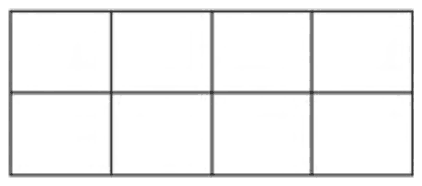
In a 2 × 4 rectangle grid shown below, each cell is a rectangle. How many rectangles can be observed in the grid?

A rectangle divided by straight lines into 2 rows and 4 columns of equal cells

Exam Year(s)

GATE CS - 2016,

Answer: C

30 rectangles can be observed.

A 2 × 4 grid is drawn with 3 horizontal lines and 5 vertical lines. Every rectangle in it is fixed by choosing two of the horizontal lines and two of the vertical lines:

\[ \binom{3}{2} \times \binom{5}{2} = 3 \times 10 = 30 \]

For example, the first row alone contains \(\binom{5}{2} = 10\) rectangles, the second row 10 more, and rectangles spanning both rows another 10. 21 and 27 miss some of these, and 36 is the count for a grid of 3 × 3 cells, not 2 × 4.

Please log in or register to report this question.

6.

Two wizards try to create a spell using all the four elements, water, air, fire, and earth. For this, they decide to mix all these elements in all possible orders. They also decide to work independently. After trying all possible combination of elements, they conclude that the spell does not work.

How many attempts does each wizard make before coming to this conclusion, independently?

Exam Year(s)

GATE Life Sciences - 2024, GATE CS - 2024, GATE XE - 2024,

Answer: A

Each wizard makes 24 attempts.

Mixing all four elements in every possible order means trying every arrangement of 4 distinct items, which is

\[ 4! = 4 \times 3 \times 2 \times 1 = 24 \]

The wizards work independently, so each one tries all 24 orders himself; the count is per wizard, not for the pair.

48 is the total for both wizards together, which the question does not ask for. 16 (\(4^{2}\) or \(2^{4}\)) and 12 (\(4 \times 3\)) do not count the orderings of four elements.

Please log in or register to report this question.

7.

There are 3 Indians and 3 Chinese in a group of 6 people. How many subgroups of this group can we choose so that every subgroup has at least one Indian?

Exam Year(s)

GATE Chemistry - 2017,

Answer: A

There are 56 such subgroups.

Count all subgroups and remove those with no Indian. A group of 6 people has \(2^{6} = 64\) subsets. Those with no Indian are the subsets of the 3 Chinese only, \(2^{3} = 8\) of them (including the empty set). So

\[ 64 - 8 = 56 \]

Equivalently, choose any non-empty set of Indians (\(2^{3} - 1 = 7\) ways) and any set of Chinese (\(2^{3} = 8\) ways): \(7 \times 8 = 56\). The empty subgroup is automatically excluded, since it has no Indian. 52, 48 and 44 come from subtracting further cases that do in fact contain at least one Indian.

Please log in or register to report this question.

8.

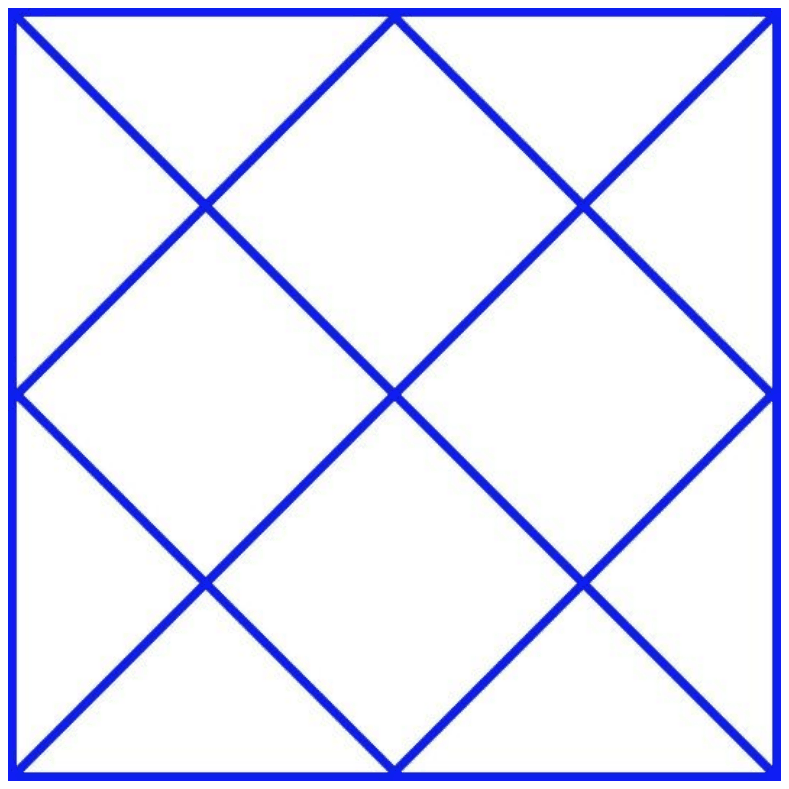
How many rectangles are present in the given figure?

A square with both diagonals drawn, together with the four lines joining the midpoints of adjacent sides, forming a tilted diamond

Exam Year(s)

GATE Chemistry - 2023,

Answer: C

The figure contains 10 rectangles.

The outer square is one. Inside it, the two diagonals and the four lines joining the midpoints of adjacent sides make two families of three parallel lines, one family at +45° and one at -45°, every line of one family crossing every line of the other at right angles. Any two lines from one family together with any two from the other enclose a rectangle (here, a square tilted at 45°), and all their corners lie on drawn segments:

\[ \binom{3}{2} \times \binom{3}{2} = 3 \times 3 = 9 \]

These are the four small tilted squares, the large central diamond, and four tilted rectangles each made of two adjacent small squares. With the outer square the total is 9 + 1 = 10. Forgetting the outer square gives 9, and 8 or 12 come from missing or double-counting some of the tilted rectangles.

Please log in or register to report this question.

9.

How many 4-digit positive integers divisible by 3 can be formed using only the digits {1, 3, 4, 6, 7}, such that no digit appears more than once in a number?

Exam Year(s)

GATE Chemistry - 2024,

Answer: B

There are 48 such numbers.

A number is divisible by 3 when its digit sum is. The five digits sum to 1 + 3 + 4 + 6 + 7 = 21. Choosing four of them means leaving one out, and the remaining sum, 21 minus that digit, is divisible by 3 only if the omitted digit is itself divisible by 3, that is 3 or 6.

So the usable digit sets are {1, 4, 6, 7} and {1, 3, 4, 7}. Each can be arranged in 4! = 24 ways, giving 2 × 24 = 48. 24 counts only one of the two sets, and 72 or 12 do not follow from the count.

Please log in or register to report this question.

10.

Five teams have to compete in a league, with every team playing every other team exactly once, before going to the next round. How many matches will have to be held to complete the league round of matches?

Exam Year(s)

GATE Mathematics - 2015,

Answer: B

The league needs 10 matches.

Each match is a pair of teams, and every pair plays exactly once, so the number of matches is the number of ways to choose 2 teams from 5:

\[ \binom{5}{2} = \frac{5 \times 4}{2} = 10 \]

20 counts each match twice, once from each team's point of view (5 teams \(\times\) 4 opponents). 5 and 8 do not come from any correct count.

Please log in or register to report this question.

Loading…
Tags: Permutations & Combinations Questions and Answers || Permutations & Combinations MCQ Questions and Answers || Permutations & Combinations GK Questions and Answers || Permutations & Combinations GK MCQ Questions || Permutations & Combinations Multiple Choice Questions and Answers || Permutations & Combinations GK || GK on Permutations & Combinations || Quantitative Aptitude Questions and Answers || Quantitative Aptitude MCQ Questions and Answers || Quantitative Aptitude GK Questions and Answers || GK on Quantitative Aptitude