
Machine-translated by Google. Questions are authored in English.
Top

Area Questions and Answers

Important Instructions
11.

The length of a rectangle is twice its breadth. If the perimeter of the rectangle is 66 m, then the area of the rectangle, in m2, is:

Exam Year(s)

DSSSB PGT - 2023,

Answer: C

The area is 242 square metres. Let the breadth be b, so the length is 2b. The perimeter is 2(2b + b) = 6b = 66, so b = 11 m and the length is 22 m. The area is 22 x 11 = 242 square metres. The option 121 is the square of the breadth and 338 and 616 do not come from the given dimensions. The area is length times breadth, 22 x 11 = 242 square metres, and the perimeter is 2(22 + 11) = 66 metres, which agrees with the data. The options 338, 616 and 121 do not give a perimeter of 66 for any rectangle whose length is twice its breadth.

Please log in or register to report this question.
12.

Length of a rectangle is 5 times of its breadth. If the perimeter of rectangle is 300 cm, then what will be the length of the rectangle?

Exam Year(s)

DSSSB - 2023,

Answer: A

Let the breadth be b, so the length is 5b. The perimeter of a rectangle is twice the sum of the length and the breadth, so 2(5b + b) = 12b = 300 cm, and b = 25 cm. The length is then 5 x 25 = 125 cm. Check: 2(125 + 25) = 300 cm, and 125 is five times 25. So the length is 125 cm, option (A). The value 25 cm is the breadth, and 100 cm, 150 cm and 250 cm do not give a perimeter of 300 cm with a length five times the breadth.

Please log in or register to report this question.

13.

The perimeter of a regular hexagon of side 8 cm is:

Exam Year(s)

DSSSB - 2023,

Answer: B

The perimeter is 48 cm.

A regular hexagon has six equal sides, so its perimeter is six times the side.

\[ 6\times8=48\text{ cm} \]

47, 49 and 50 cm are not six times 8.

A regular hexagon has six equal sides and six equal angles of 120 degrees each. Its perimeter is the sum of all six sides, 8 + 8 + 8 + 8 + 8 + 8 = 48 cm. The area would use a different formula, which is not needed here.

Please log in or register to report this question.

14.

The diagonal of a square is \(5\sqrt{2}\) cm. The diagonal of another square whose area is double that of the first square is:

Exam Year(s)

DSSSB - 2023,

Answer: B

The diagonal is 10 cm.

A square with diagonal d has area d2/2. The first square has d = 5√2, so its area is 25. The second has area 50, so its diagonal satisfies d2/2 = 50.

\[ d^{2}=100 \Rightarrow d=10\text{ cm} \]

12, 8 and 7 cm would give areas of 72, 32 and 24.5, none of which is 50.

When the area doubles, the side grows by a factor of root 2, and so does the diagonal. The first diagonal is 5√2, so the new one is 5√2 × √2 = 10 cm. This is a quick way to check the answer.

Please log in or register to report this question.

15.

The area of a rectangular field is 1008 m2. Its shorter side is \(\frac{1}{8}\) of the sum of its longer side and one of its diagonals. What is the cost of fencing the field at ₹ 24 per m?

Exam Year(s)

DSSSB TGT - 2023,

Answer: C

The cost of fencing is ₹ 3,792. Let the longer side be \(l\), the shorter side \(b\) and the diagonal \(d\). The condition says \(b = \frac{l + d}{8}\), so \(d = 8b - l\). Squaring and using \(d^{2} = l^{2} + b^{2}\): \[ 64b^{2} - 16bl + l^{2} = l^{2} + b^{2} \] \[ 63b^{2} = 16bl \Rightarrow l = \frac{63b}{16} \] With area \(lb = 1008\): \[ \begin{aligned} \frac{63b^{2}}{16} &= 1008 \Rightarrow b^{2} \\ &= 256,\ b \\ &= 16,\ l \\ &= 63 \end{aligned} \] Perimeter \(= 2(63 + 16) = 158\) m, and \(158\times 24 = 3792\).

Please log in or register to report this question.

16.

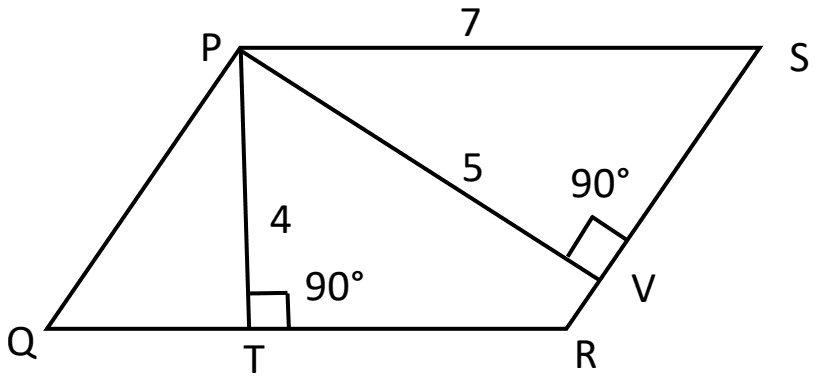
In the given figure, PQRS is a parallelogram with PS = 7 cm, PT = 4 cm and PV = 5 cm. What is the length of RS in cm? (The diagram is representative.)

Parallelogram PQRS with PS = 7 along the top, PT = 4 drawn from P perpendicular to QR meeting it at T, and PV = 5 drawn from P perpendicular to RS meeting it at V, right angles marked at T and V

Exam Year(s)

GATE AE - 2023,

Answer: B

RS is 28/5 cm.

The area of a parallelogram is any side times the perpendicular distance to it from the opposite side, and it is the same whichever pair of sides you use. PT is the height onto base QR, and QR = PS = 7 cm. PV is the height onto side RS.

\[ \begin{aligned} \text{Area} &= QR \times PT = 7 \times 4 = 28 \\ \text{Area} &= RS \times PV = 5\,RS \\ RS &= \frac{28}{5}\ \text{cm} \end{aligned} \]

The distractor 20/7 comes from 4 × 5 / 7, mixing the two heights; 35/4 comes from 7 × 5 / 4, putting the heights the wrong way round; 9/2 is simply (4 + 5)/2.

Please log in or register to report this question.

17.

If the radius of a wheel is 14 cm, the number of revolutions it makes in covering a distance of 1056 cm is?

Answer: D

Each revolution advances the wheel by one circumference.

\[ C = 2\pi r = 2 \times \frac{22}{7} \times 14 = 88 \text{ cm} \]

\[ n = \frac{1056}{88} = 12 \]

A radius that is a multiple of 7 makes the \( \tfrac{22}{7} \) cancel exactly, which is why the circumference lands on a whole 88 cm.

Please log in or register to report this question.

18.

The Diagonals of two squares are in the ratio of 2:5. find the ratio of their areas.

Answer: B

A square's diagonal and side are related by \( d = a\sqrt{2} \), so the area can be written directly in terms of the diagonal:

\[ A = a^{2} = \frac{d^{2}}{2} \]

The factor \( \tfrac{1}{2} \) is common to both squares and cancels:

\[ \frac{A_{1}}{A_{2}} = \frac{d_{1}^{2}}{d_{2}^{2}} = \frac{2^{2}}{5^{2}} = \frac{4}{25} \]

So the ratio is \( 4 : 25 \). Any two similar figures have areas in the square of their linear ratio, whichever length is used to compare them.

Please log in or register to report this question.

19.

The side and one of the diagonals of a rhombus are 13cm and 24cm respectively. The area of the rhombus (in sq.cm.) is

Answer: C

A rhombus's diagonals bisect each other at right angles, so half of each diagonal and a side form a right triangle.

\[ \text{half of the known diagonal} = \frac{24}{2} = 12 \text{ cm} \]

\[ \text{half of the other} = \sqrt{13^{2} - 12^{2}} = \sqrt{169 - 144} = 5 \text{ cm} \]

\[ \text{other diagonal} = 10 \text{ cm} \]

\[ \text{area} = \frac{1}{2} d_{1} d_{2} = \frac{1}{2} \times 24 \times 10 = 120 \text{ cm}^{2} \]

5–12–13 is a Pythagorean triple, which keeps the arithmetic exact. Forgetting the \( \tfrac{1}{2} \) gives 240, the second option.

Please log in or register to report this question.

20.

The length of a rectangular plot is 20 metres more than its breadth. If fencing the plot at Rs. 26.50 per metre costs Rs. 5300, what is the length of the plot in metres?

Answer: D

The fencing runs round the perimeter, so divide the cost by the rate.

\[ \text{perimeter} = \frac{5300}{26.50} = 200 \text{ m} \]

\[ 2\big((b + 20) + b\big) = 200 \quad\Longrightarrow\quad 2b + 20 = 100 \]

\[ b = 40 \text{ m}, \qquad l = 60 \text{ m} \]

The length is 60 m, which appears nowhere among the choices, so the answer is none of these. The 40 m on offer is the breadth - a genuine intermediate value, but not what was asked.

Please log in or register to report this question.

Loading…
Tags: Area Questions and Answers || Area MCQ Questions and Answers || Area GK Questions and Answers || Area GK MCQ Questions || Area Multiple Choice Questions and Answers || Area GK || GK on Area || Quantitative Aptitude Questions and Answers || Quantitative Aptitude MCQ Questions and Answers || Quantitative Aptitude GK Questions and Answers || GK on Quantitative Aptitude