
Machine-translated by Google. Questions are authored in English.
Top

Fourier and Laplace Methods Questions and Answers

1.

The function \(f(x) = \begin{cases} x, & -\pi \lt x \lt 0 \\ -x, & 0 \lt x \lt \pi \end{cases}\) is expanded as a Fourier series of the form \(a_{0} + \sum_{n=1}^{\infty} a_{n}\cos(nx) + \sum_{n=1}^{\infty} b_{n}\sin(nx)\). Which of the following is true?

Exam Year(s)

IIT JAM - 2018,

Answer: A

The answer is \(a_{0} \neq 0, b_{n} = 0\).

The function equals \(-|x|\): it is even, since \(f(-x) = f(x)\). An even function has no sine terms, so every \(b_{n} = 0\).

The constant term is the mean value over the period:

\[ \begin{aligned} a_{0} &= \frac{1}{2\pi}\int_{-\pi}^{\pi} (-|x|)\,dx \\ &= -\frac{\pi}{2} \neq 0 \end{aligned} \]

Treating the function as odd (because each piece is linear in x) would wrongly give \(a_{0} = 0\) and nonzero \(b_{n}\).

Please log in or register to report this question.
2.

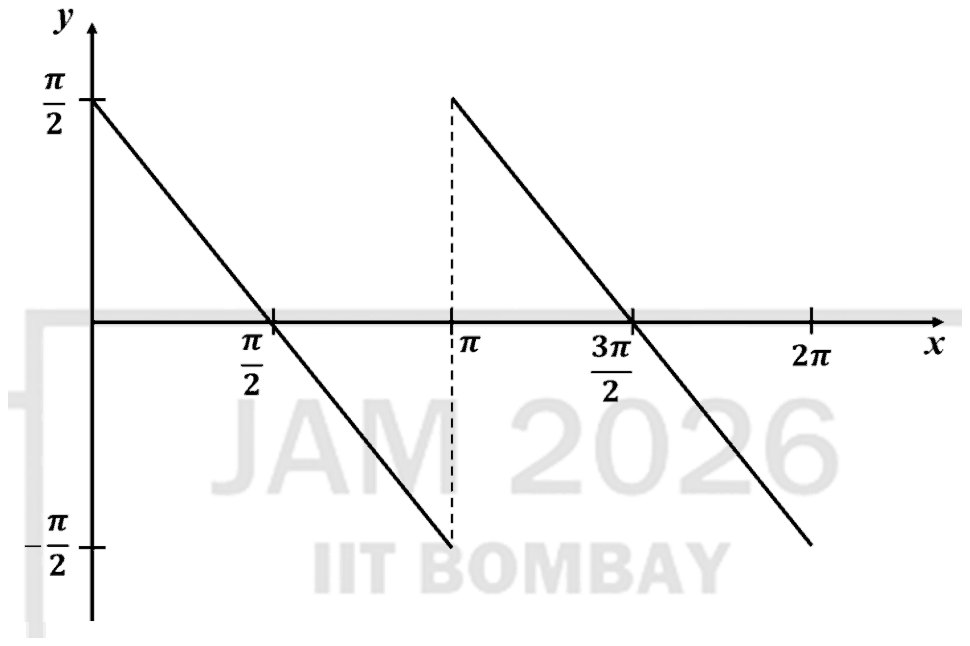
A piecewise regular function \(f(x)\) is shown in the figure. It is expanded in Fourier series given by

\[ \begin{aligned} f(x) = \frac{a_{0}}{2} &+ \sum_{n=1}^{\infty} a_{n}\cos(nx) \\ &+ \sum_{n=1}^{\infty} b_{n}\sin(nx), \end{aligned} \]

where \(a_{0}, a_{n}, b_{n}\)’s are the Fourier coefficients.

Sawtooth y against x: from x = 0 to pi the line falls from pi/2 through zero at pi/2 to -pi/2, jumps back to pi/2 at x = pi, and the same line repeats from pi to 2 pi, crossing zero at 3 pi/2

Which of the following options is correct?

Exam Year(s)

IIT JAM - 2026,

Answer: B

The correct option is that all \(a_n\) are zero.

On \(0 < x < \pi\) the graph is \(f(x) = \frac{\pi}{2} - x\), repeated with period \(\pi\). Shifting one period back, on \(-\pi < x < 0\) it is \(f(x) = -\frac{\pi}{2} - x\). So for \(0 < x < \pi\):

\[ f(-x) = -\tfrac{\pi}{2} + x = -f(x) \]

The function is odd. The cosine coefficients \(a_n = \frac{1}{\pi}\int_{-\pi}^{\pi} f(x)\cos nx\,dx\) integrate an odd function over a symmetric interval, so every one of them, \(a_0\) included, is zero; only sine terms survive.

Since \(a_0\) is twice the average value and the sawtooth averages to zero, \(a_0 = 3\pi\) and \(a_0 = 3\pi/2\) are wrong. The \(b_n\) cannot all vanish, or \(f\) would be identically zero.

Please log in or register to report this question.

3.

The inverse Fourier transform of \(e^{-|k|}\) is :

Exam Year(s)

MH SET - 2018, SET Exam - 2018,

Answer: A

The inverse transform is \(\frac{1}{\pi}\frac{1}{1+x^{2}}\).

With the convention \(f(x) = \frac{1}{2\pi}\int F(k) e^{ikx} dk\), split the integral at \(k = 0\):

\[ \begin{aligned} f(x) &= \frac{1}{2\pi}\Big[\int_{0}^{\infty} e^{-k(1-ix)}dk + \int_{0}^{\infty} e^{-k(1+ix)}dk\Big] \\ &= \frac{1}{2\pi}\Big[\frac{1}{1-ix} + \frac{1}{1+ix}\Big] \\ &= \frac{1}{2\pi}\cdot\frac{2}{1+x^{2}} = \frac{1}{\pi}\frac{1}{1+x^{2}} \end{aligned} \]

This is the Lorentzian (Cauchy) profile. A Gaussian \(e^{-x^{2}}\) is the transform of a Gaussian, not of \(e^{-|k|}\); \(e^{-|x|}\) simply copies the input; and \(1/(1+x)\) is not even an even function, while the transform of an even function must be even.

Please log in or register to report this question.

4.

Given that Fourier integral representation for the function

\[ f(x) = \begin{cases} 0 & \text{if } |x| \gt 1 \\ 1 & \text{if } |x| \lt 1 \end{cases} \]

is \( f(x)=\frac{2}{\pi}\int_0^\infty\frac{\cos\omega x\sin\omega}{\omega}d\omega \)

Which of the following options is correct ?

Exam Year(s)

MH SET - 2018, SET Exam - 2018,

Answer: A

The correct statement is the piecewise result: the integral equals \( \pi/2 \) for \( 0 \le x \lt 1 \), \( \pi/4 \) at \( x = 1 \) and 0 for \( x \gt 1 \).

Rearranging the given representation, the integral is \( \frac{\pi}{2} f(x) \) wherever \( f \) is continuous:

\[ \begin{aligned} &\int_0^\infty \frac{\cos\omega x \sin\omega}{\omega}\, d\omega \\ &= \frac{\pi}{2} f(x) \end{aligned} \]

So it is \( \pi/2 \) inside \( |x| \lt 1 \) and 0 outside. At the jump \( x = 1 \) a Fourier integral converges to the mean of the left and right limits, \( \frac{\pi}{2} \cdot \frac{1 + 0}{2} = \frac{\pi}{4} \).

Putting \( x = 0 \) gives the Dirichlet integral \( \int_{0}^{\infty} \frac{\sin \omega}{\omega} d\omega = \frac{\pi}{2} \), so the options giving \( \pi \) and \( \pi/4 \) are wrong, and the integral is 0 only for \( |x| \gt 1 \), not for every \( x \).

Please log in or register to report this question.

5.

Fourier series for the function

\[ f(\theta) = \begin{cases} +1 & 0 \lt \theta \lt \pi \\ -1 & \pi \lt \theta \lt 2\pi \end{cases} \]

there are :

Exam Year(s)

MH SET - 2019, SET Exam - 2019,

Answer: D

The series contains odd sine terms only.

The square wave is an odd function about \(\theta = 0\) (shifting the second half to \(-\pi \lt \theta \lt 0\) gives \(f(-\theta) = -f(\theta)\)), so every cosine coefficient and the constant term vanish. For the sine coefficients:

\[ \begin{aligned} b_{n} &= \frac{2}{\pi}\int_{0}^{\pi}\sin n\theta\,d\theta \\ &= \frac{2}{n\pi}(1 - \cos n\pi) \end{aligned} \]

This is \(4/n\pi\) for odd n and 0 for even n, giving \(f = \frac{4}{\pi}(\sin\theta + \frac{1}{3}\sin 3\theta + \dots)\). 'Sine terms only' is incomplete because the even harmonics are absent, and the cosine options fail the odd symmetry.

Please log in or register to report this question.

Answer: A

The Fourier series is \(\frac{1}{2} - \frac{4}{\pi^{2}}(\cos \pi x + \frac{1}{9}\cos 3\pi x + \cdots)\), the cosine series with odd harmonics only.

\(|x|\) is even, so it has a cosine series only (which rules out the options with sine terms). On [-1, 1], with period 2:

\[ \begin{aligned} a_{0} &= \int_{-1}^{1} |x|\,dx = 1 \\ a_{n} &= 2\int_{0}^{1} x\cos n\pi x\,dx \\ &= \frac{2((-1)^{n} - 1)}{n^{2}\pi^{2}} \end{aligned} \]

So \(a_{n} = -4/(n^{2}\pi^{2})\) for odd \(n\) and 0 for even \(n\), and the constant term is \(a_{0}/2 = 1/2\). The minus sign is right: at \(x = 0\) the series must give 0, and \(1/2 - (4/\pi^{2})(\pi^{2}/8) = 0\).

Please log in or register to report this question.

7.

Laplace transform of \(J_{0}(a\, t)\) where \(J_{0}\) denotes the Bessel function of zero order is :

Exam Year(s)

MH SET - 2020, SET Exam - 2020,

Answer: B

The Laplace transform is \(\dfrac{1}{\sqrt{s^{2} + a^{2}}}\).

Using the series \(J_{0}(at) = \sum (-1)^{k}(at/2)^{2k}/(k!)^{2}\) and \(L\{t^{2k}\} = (2k)!/s^{2k+1}\), the transform sums to

\[ \begin{aligned} &\frac{1}{s}\left(1 + \frac{a^{2}}{s^{2}}\right)^{-1/2} \\ &= \frac{1}{\sqrt{s^{2} + a^{2}}} \end{aligned} \]

by the binomial series. \(1/(s^{2} + a^{2})\) is (up to a factor \(a\)) the transform of \(\sin at\), and the forms with \(s^{2} - a^{2}\) belong to the modified Bessel function \(I_{0}(at)\) and to \(\sinh at\).

Please log in or register to report this question.

8.

Fourier cosine transform of \(f(t) = e^{-t^{2}}\) is :

Exam Year(s)

MH SET - 2020, SET Exam - 2020,

Answer: D

The Fourier cosine transform is \(\dfrac{1}{\sqrt{2}}e^{-s^{2}/4}\).

With the convention \(F_{c}(s) = \sqrt{2/\pi}\int_{0}^{\infty} f(t)\cos st\,dt\), and the standard integral

\[ \begin{aligned} \int_{0}^{\infty} e^{-t^{2}}\cos st\,dt &= \frac{\sqrt{\pi}}{2}e^{-s^{2}/4} \\ F_{c}(s) &= \sqrt{\frac{2}{\pi}}\cdot\frac{\sqrt{\pi}}{2}e^{-s^{2}/4} = \frac{1}{\sqrt{2}}e^{-s^{2}/4} \end{aligned} \]

The coefficient \(1/\sqrt{2}\) in every option shows this convention. The exponent must be \(-s^{2}/4\); the other exponents come from mis-scaling the Gaussian (\(-s^{2}/2\) is the transform of \(e^{-t^{2}/2}\)).

Please log in or register to report this question.

9.

If \(L\{f(t)\} = F(s)\) and \(L\{g(t)\} = G(s)\), then \(L^{-1}\{(F(s)G(s)\}\) is :

Exam Year(s)

MH SET - 2020, SET Exam - 2020,

Answer: A

\(L^{-1}\{F(s)G(s)\}\) is \(\int_{0}^{t} f(x)\,g(t - x)\,dx\).

This is the convolution theorem: the Laplace transform of the convolution \((f * g)(t) = \int_{0}^{t} f(x)g(t - x)\,dx\) is the product \(F(s)G(s)\). It is proved by changing the order of integration in \(\int_{0}^{\infty} e^{-st}\int_{0}^{t} f(x)g(t - x)\,dx\,dt\) and substituting \(\tau = t - x\).

The inverse transform of a product is not the integral of the product \(f(x)g(x)\), and the arguments \(t + x\) or \(x - t\) in the other options do not give a convolution.

Please log in or register to report this question.

10.

The complex Fourier transform of \(e^{-|x|}\) is :

Exam Year(s)

MH SET - 2020, SET Exam - 2020,

Answer: A

The complex Fourier transform is \(\frac{2}{1 + n^{2}}\).

Using \(F(n) = \int_{-\infty}^{\infty} f(x)e^{inx}dx\) and splitting the range at zero, where \(|x|\) changes sign:

\[ \begin{aligned} F(n) &= \int_{-\infty}^{0} e^{(1 + in)x}dx \\ &\quad + \int_{0}^{\infty} e^{-(1 - in)x}dx \\ &= \frac{1}{1 + in} + \frac{1}{1 - in} \\ &= \frac{2}{1 + n^{2}} \end{aligned} \]

The paper uses the convention without the factor \(1/\sqrt{2\pi}\). With it, the result would be \(\sqrt{2/\pi}/(1 + n^{2})\), which is not offered. The other numerators come from dropping one of the two halves (1) or mishandling the constants (4 or \(\pi\)).

Please log in or register to report this question.

Loading…

Other Subjects

Tags: Fourier and Laplace Methods Questions and Answers || Fourier and Laplace Methods MCQ Questions and Answers || Fourier and Laplace Methods GK Questions and Answers || Fourier and Laplace Methods GK MCQ Questions || Fourier and Laplace Methods Multiple Choice Questions and Answers || Fourier and Laplace Methods GK || GK on Fourier and Laplace Methods || Mathematical Physics Questions and Answers || Mathematical Physics MCQ Questions and Answers || Mathematical Physics GK Questions and Answers || GK on Mathematical Physics