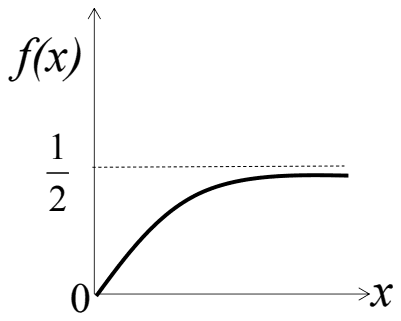
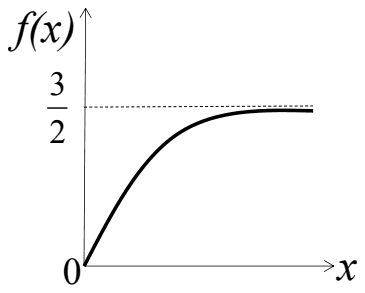
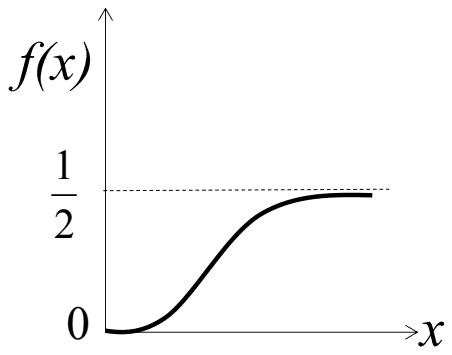
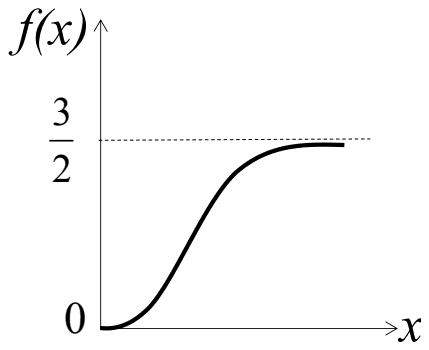
The general solution of the differential equation
\[ xy' = y + \sqrt{x^{2} + y^{2}} \quad \text{for } x \gt 0 \]
is given by (with an arbitrary positive constant \(k\))
GATE Mathematics - 2018,
Answer: C
The general solution is \(kx^{2} = y + \sqrt{x^{2} + y^{2}}\).
The equation is homogeneous, so put \(y = vx\), \(y' = v + xv'\). For \(x \gt 0\), \(\sqrt{x^{2} + y^{2}} = x\sqrt{1 + v^{2}}\):
\[ \begin{aligned} x(v + xv') &= vx + x\sqrt{1+v^{2}} \\ \frac{dv}{\sqrt{1+v^{2}}} &= \frac{dx}{x} \\ \ln\left(v + \sqrt{1+v^{2}}\right) &= \ln x + \ln k \end{aligned} \]
So \(v + \sqrt{1 + v^{2}} = kx\). Multiplying by \(x\) and using \(v = y/x\) gives \(y + \sqrt{x^{2}+y^{2}} = kx^{2}\).
The forms with \(x + \sqrt{x^{2}+y^{2}}\) on the right do not satisfy the equation, and those with \(ky^{2}\) put the wrong variable on the left: the constant multiplies \(x^{2}\) because of the factor \(x\) from \(\ln x\).
Please log in or register to report this question.