
Machine-translated by Google. Questions are authored in English.
Top

Differential Equations Questions and Answers

1.

The general solution of the differential equation

\[ xy' = y + \sqrt{x^{2} + y^{2}} \quad \text{for } x \gt 0 \]

is given by (with an arbitrary positive constant \(k\))

Exam Year(s)

GATE Mathematics - 2018,

Answer: C

The general solution is \(kx^{2} = y + \sqrt{x^{2} + y^{2}}\).

The equation is homogeneous, so put \(y = vx\), \(y' = v + xv'\). For \(x \gt 0\), \(\sqrt{x^{2} + y^{2}} = x\sqrt{1 + v^{2}}\):

\[ \begin{aligned} x(v + xv') &= vx + x\sqrt{1+v^{2}} \\ \frac{dv}{\sqrt{1+v^{2}}} &= \frac{dx}{x} \\ \ln\left(v + \sqrt{1+v^{2}}\right) &= \ln x + \ln k \end{aligned} \]

So \(v + \sqrt{1 + v^{2}} = kx\). Multiplying by \(x\) and using \(v = y/x\) gives \(y + \sqrt{x^{2}+y^{2}} = kx^{2}\).

The forms with \(x + \sqrt{x^{2}+y^{2}}\) on the right do not satisfy the equation, and those with \(ky^{2}\) put the wrong variable on the left: the constant multiplies \(x^{2}\) because of the factor \(x\) from \(\ln x\).

Please log in or register to report this question.
2.

The initial value problem

\[ \begin{aligned} &\frac{dy}{dx} = \cos(xy),\ x \in \mathbb{R}, \\ &y(0) = y_{0}, \end{aligned} \]

where \(y_{0}\) is a real constant, has

Exam Year(s)

GATE Mathematics - 2022,

Answer: A

The problem has a unique solution.

Let f(x, y) = cos(xy). It is continuous, and its partial derivative \(\partial f/\partial y = -x\sin(xy)\) is bounded by |x|, so f is Lipschitz in y on every strip |x| ≤ a. By the Picard-Lindelof theorem a unique local solution exists through (0, \(y_{0}\)).

Since |f| ≤ 1, the solution cannot blow up in finite x, and the strip-wise Lipschitz bound lets the unique solution be continued over all of \(\mathbb{R}\).

Two or infinitely many solutions arise only when uniqueness fails, as for \(y' = \sqrt{|y|}\), where the right side is not Lipschitz. 'No solution' is ruled out by Peano's existence theorem, since f is continuous.

Please log in or register to report this question.
3.

If \(y_{1}\) and \(y_{2}\) are two different solutions of the ordinary differential equation

\(y' + \sin(e^{x})y = \cos(e^{x+1}),\ 0 \le x \le 1,\)

then which one of the following is its general solution on [0, 1]?

Exam Year(s)

GATE Mathematics - 2024,

Answer: B

The general solution is \(y_{1} + c(y_{1} - y_{2}),\ c \in \mathbb{R}\).

The equation is linear and first order but non-homogeneous. The difference \(y_{1} - y_{2}\) of two different solutions is a non-zero solution of the homogeneous equation, which spans its one-dimensional solution space. The general solution is a particular solution plus any multiple of that: \(y_{1} + c(y_{1} - y_{2})\).

\(c_{1}y_{1} + c_{2}y_{2}\) and \(c_{1}(y_{1} + y_{2}) + c_{2}(y_{1} - y_{2})\) are generally not solutions, because a linear combination of solutions of a non-homogeneous equation solves it only if the coefficients of \(y_{1}, y_{2}\) add to 1. \(cy_{1} + (y_{1} - y_{2})\) fails for the same reason unless \(c = 1\).

Please log in or register to report this question.
4.

Consider the initial value problem (IVP)

\(y' = e^{-y^{2}} + 1,\ y(0) = 0.\)

I. IVP has a unique solution on \(\mathbb{R}\).
II. Every solution of IVP is bounded on its maximal interval of existence.

Which one of the following is correct?

Exam Year(s)

GATE Mathematics - 2024,

Answer: B

I is TRUE and II is FALSE.

I: \(F(y) = e^{-y^{2}} + 1\) has bounded derivative \(F'(y) = -2ye^{-y^{2}}\) (its maximum absolute value is \(\sqrt{2/e}\)), so \(F\) is globally Lipschitz. By Picard-Lindelof the IVP has a unique solution defined on all of \(\mathbb{R}\).

II: \(y' = e^{-y^{2}} + 1 \ge 1\), so \(y(x) \ge x\) for \(x \ge 0\) and \(y(x) \le x\) for \(x \le 0\). The solution is unbounded on its maximal interval \(\mathbb{R}\). Options calling II true, or I false, are wrong.

Please log in or register to report this question.
5.

Which one of the following curves correctly represents (schematically) the solution for the equation \(\frac{df}{dx} + 2f = 3;\ f(0) = 0\)?

Exam Year(s)

IIT JAM - 2018,

Answer: B

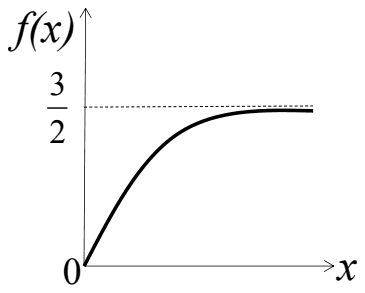
The correct curve is (B).

Solve the linear equation with the integrating factor \(e^{2x}\):

\[ \begin{aligned} f(x) &= \tfrac{3}{2} + Ce^{-2x}, \quad f(0) = 0 \\ f(x) &= \tfrac{3}{2}\left(1 - e^{-2x}\right) \end{aligned} \]

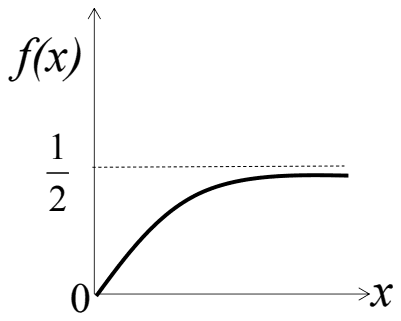
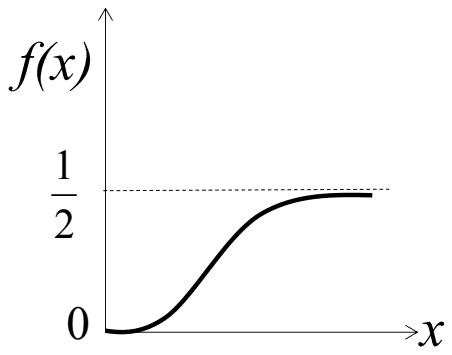
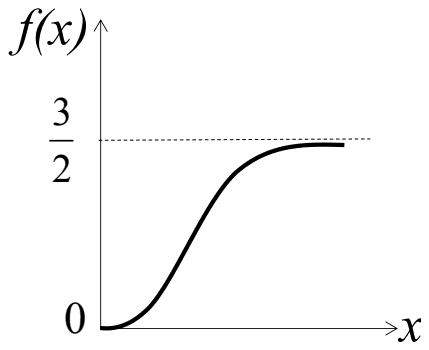
The curve starts at 0 with slope \(f'(0) = 3\), not zero, and rises steadily (always concave down) towards \(\frac{3}{2}\). That is graph (B).

Graphs (A) and (C) level off at \(\frac{1}{2}\), the wrong limit. Graphs (C) and (D) start flat with an S-shape, which would need \(f'(0) = 0\), but the equation gives \(f'(0) = 3 - 2f(0) = 3\).

Please log in or register to report this question.

6.

Let \(f: (1,4) \to \mathbb{R}\) be a differentiable function such that

\[ f'(x) = (f(x) - \pi x)^{2} + \pi \]

for all \(x \in (1,4)\).

Which ONE of the following is a possible value of \(f(3) - f(2)\)?

Exam Year(s)

IIT JAM - 2026,

Answer: A

A possible value is \(\pi + \frac{1}{6}\).

Put \(g(x) = f(x) - \pi x\). Then \(g'(x) = f'(x) - \pi = g(x)^{2}\), and

\[ f(3) - f(2) = \pi + g(3) - g(2). \]

The equation \(g' = g^{2}\) has the solutions \(g \equiv 0\) and \(g(x) = -\frac{1}{x + c}\), provided the pole \(x = -c\) lies outside \((1,4)\). Taking \(c = 0\):

\[ \begin{aligned} g(3) - g(2) &= -\frac{1}{3} + \frac{1}{2} \\ &= \frac{1}{6} \end{aligned} \]

so \(f(3) - f(2) = \pi + \frac{1}{6}\) is attained.

The others are impossible for one reason: \(g' = g^{2} \geq 0\), so \(g\) never decreases and \(f(3) - f(2) \geq \pi\). That rules out \(\pi - \frac{1}{6}\), and also \(\frac{\pi}{2} + \frac{1}{3} \approx 1.90\) and \(\frac{\pi}{2} + \frac{1}{2} \approx 2.07\), both less than \(\pi \approx 3.14\).

Please log in or register to report this question.

Answer: D

The general solution is \(\cos(\frac{y}{x}) + \log_{e}(\sqrt{x}) = K\).

The equation is homogeneous, so substitute \(y = vx\), which gives \(\frac{dy}{dx} = v + xv'\):

\[ \begin{aligned} x \sin v\,(v + xv') &= vx \sin v + \frac{x}{2} \\ x^{2} \sin v\,v' &= \frac{x}{2} \\ \sin v\,dv &= \frac{dx}{2x} \end{aligned} \]

Integrating both sides:

\[ \begin{aligned} -\cos v &= \tfrac{1}{2}\log_{e} x + C \\ \cos(\tfrac{y}{x}) + \log_{e}\sqrt{x} &= K \end{aligned} \]

The options with \(\cos(\frac{x}{y})\) invert the substitution variable. The options with \(\log_{e}(x^{2})\) come from writing \(\frac{dx}{2x}\) as \(\frac{2\,dx}{x}\), turning the factor one half into two.

Please log in or register to report this question.

Answer: C

The orthogonal trajectories are \(x = \frac{-y}{3} + \frac{1}{9} + k\,e^{-3y}\).

First find the differential equation of the family. From \(me^{x} = y + 3x + 3\),

\[ \frac{dy}{dx} = -3 + me^{x} = y + 3x. \]

Orthogonal curves have slope \(-\frac{1}{y + 3x}\), which is linear in \(x\) when \(y\) is the variable:

\[ \begin{aligned} \frac{dx}{dy} &= -(y + 3x) \\ \frac{dx}{dy} + 3x &= -y \end{aligned} \]

Multiply by the integrating factor \(e^{3y}\) and integrate by parts:

\[ \begin{aligned} xe^{3y} &= -\int ye^{3y}\,dy \\ &= -\frac{y}{3}e^{3y} + \frac{1}{9}e^{3y} + k \\ x &= -\frac{y}{3} + \frac{1}{9} + ke^{-3y} \end{aligned} \]

Dropping the minus sign in the orthogonal slope gives \(\frac{y}{3} - \frac{1}{9} + ke^{-3y}\). The options with \(e^{3y}\) multiply the constant by the integrating factor instead of dividing by it.

Please log in or register to report this question.

9.

Let \(\phi: \left(-\frac{\pi}{2}, \frac{\pi}{2}\right) \to \mathbb{R}\) be the solution of the differential equation

\[ (\cos x)\frac{dy}{dx} - y = 2y^{2}(\sin x - 1)\cos x \]

satisfying \(\phi(0) = \frac{1}{2}\). Then \(\phi\left(\frac{\pi}{4}\right) =\) ______.

Exam Year(s)

IIT JAM - 2026,

Answer: D

\(\phi\left(\frac{\pi}{4}\right) = \frac{1}{\sqrt{2}}\).

Dividing by \(\cos x\) gives \(y' - y\sec x = 2y^{2}(\sin x - 1)\), a Bernoulli equation. Divide by \(y^{2}\) and put \(v = \frac{1}{y}\), so \(v' = -\frac{y'}{y^{2}}\):

\[ v' + v\sec x = 2(1 - \sin x). \]

The integrating factor is \(\sec x + \tan x = \frac{1 + \sin x}{\cos x}\), and it turns the right side into \(\frac{2(1 - \sin x)(1 + \sin x)}{\cos x} = 2\cos x\). Hence

\[ \begin{aligned} v(\sec x + \tan x) &= 2\sin x + C \\ v(0) = 2 &\Rightarrow C = 2 \\ v &= \frac{2(1 + \sin x)\cos x}{1 + \sin x} = 2\cos x \end{aligned} \]

So \(\phi(x) = \frac{1}{2}\sec x\), and \(\phi\left(\frac{\pi}{4}\right) = \frac{\sqrt{2}}{2} = \frac{1}{\sqrt{2}}\). Substituting back confirms it: both sides equal \(\frac{\sin x - 1}{2\cos x}\).

\(\frac{1}{2}\) is the starting value \(\phi(0)\), and 2 is \(v(0) = \frac{1}{\phi(0)}\), the substituted variable rather than \(y\). \(\frac{3 + 2\sqrt{2}}{2} \approx 2.91\) is far too large for a solution that only grows like \(\frac{1}{2}\sec x\).

Please log in or register to report this question.

10.

The differential equation :

\[ (x^{3} + xy^{4})\, dx + 2y^{3}\, dy = 0 \]

will become exact on multiplication by :

Exam Year(s)

MH SET - 2018, SET Exam - 2018,

Answer: A

The integrating factor is \(e^{x^{2}}\).

With \(M = x^{3} + xy^{4}\) and \(N = 2y^{3}\), the equation is not exact, since \(M_{y} = 4xy^{3}\) and \(N_{x} = 0\). Test for an integrating factor depending on x alone:

\[ \frac{M_{y} - N_{x}}{N} = \frac{4xy^{3}}{2y^{3}} = 2x \]

This depends only on x, so \(\mu = e^{\int 2x\, dx} = e^{x^{2}}\). Check: after multiplying, \(\partial_{y}(e^{x^{2}}M) = 4xy^{3}e^{x^{2}}\) and \(\partial_{x}(2y^{3}e^{x^{2}}) = 4xy^{3}e^{x^{2}}\), which agree.

\(e^{x}\) and \(e^{-x}\) correspond to the ratio being \(\pm 1\), not \(2x\), and \(e^{x^{2}} + x\) is not of the form \(e^{\int f(x) dx}\) at all.

Please log in or register to report this question.

Loading…
Tags: First Order Ordinary Differential Equations Questions and Answers