
Machine-translated by Google. Questions are authored in English.
Top

Pipes & Cistern Questions and Answers

Important Instructions
1.

12 buckets of water fill a tank when the capacity of each tank is 13.5 litres. How many buckets will be needed to fill the same tank, if the capacity of each bucket is 9 litres?

Answer: C

Capacity of the tank = (12*13.5) litres

= 162 litres

Capacity of each bucket = 9 litres.

So we can get answer by dividing total capacity of tank by total capacity of bucket.

Number of buckets needed = (162/9) = 18 buckets

Please log in or register to report this question.
2.

Three pipes A, B and C are connected to a tank. Working alone, they require 10 hours, 20 hours and 30 hours respectively. After some time, A is closed and after another 2 hours, B is also closed. C works for another 14 hours so that the tank gets filled completely. Find the time (in hours) after which pipe A was closed.

Answer: C

Let the capacity of the tank be LCM (10, 20, 30) = 60
=> Efficiency of pipe A = 60 / 10 = 6 units / hour
=> Efficiency of pipe B = 60 / 20 = 3 units / hour
=> Efficiency of pipe C = 60 / 30 = 2 units / hour
Now, all three work for some time, say ‘t’ hours.
So, B and C work for 2 more hours after ‘t’ hours and then, C works for another 14 hours.
=> Combined efficiency of pipe A, pipe B and pipe C = 11 units / hour
=> Combined efficiency of pipe B and pipe C = 5 units / hour
 
So, we have 11 x t + 5 x 2 + 14 x 2 = 60
=> 11 t + 10 + 28 = 60
=> 11 t = 60 - 38
=> 11 t = 22
=> t = 2
 
Therefore, A was closed after 2 hours.

Please log in or register to report this question.

3.

A pump can fill a tank with water in 2 hours. Because of a leak, it took \( 2\tfrac{1}{3} \) hours to fill the tank. The leak can drain all the water of the tank in:

Answer: D

Work in rates: a pipe that fills a tank in \( n \) units of time fills \( \tfrac{1}{n} \) of it per unit, and rates add (an emptying pipe counting negative).

Without the leak the pump fills the tank at \( \tfrac{1}{2} \) per hour; with it, the effective rate is \( \tfrac{3}{7} \) per hour.

\[ \frac{1}{2} - \frac{1}{L} = \frac{1}{7/3} = \frac{3}{7} \]

\[ \frac{1}{L} = \frac{1}{2} - \frac{3}{7} = \frac{7 - 6}{14} = \frac{1}{14} \]

\[ L = 14 \text{ hours} \]

Please log in or register to report this question.

4.

If a pipe can fill a tank in 6 hours, find the part of tank it fills in one hour.

Answer: A

If the whole tank takes 6 hours, then in one hour the pipe fills

\[ \frac{1}{6} \text{ of the tank} \]

This reciprocal is the basic move in every pipes-and-cisterns problem: times cannot be added, but rates can.

Please log in or register to report this question.

5.

Pipes A and B fill a tank in 5 and 6 hours respectively. Pipe C empties the tank in 12 hours, if you open all the three pipes together this tank will be filled in?

Answer: A

It is given that Pipe A,B and C work simultaneously.

Pipe A and B are filling the tank and Pipe C is emptying it.

In 1 hour volume of tank filled by Pipe A: 1/5th

In 1 hour volume of tank filled by Pipe B: 1/6th

In 1 hour volume of tank emptied by Pipe C: 1/12th

Working together Pipe A B and C fill x volume of tank.

=>1/x = (1/5)+(1/6)-(1/12)

=>x=60/17 hours

Please log in or register to report this question.

6.

A cistern can be filled in 6 hours by taps P and Q. If tap R also joins them, then cistern is filled in 5 hours. Tap P can fill the cistern at twice the rate of tap Q. In what time tap Q and R fill the cistern?

Answer: C

Work in rates: a pipe that fills a tank in \( n \) units of time fills \( \tfrac{1}{n} \) of it per unit, and rates add (an emptying pipe counting negative).

P and Q together fill in 6 hours, and P works at twice Q's rate:

\[ 3q = \frac{1}{6} \quad\Longrightarrow\quad q = \frac{1}{18}, \qquad p = \frac{1}{9} \]

Adding R brings the time to 5 hours:

\[ r = \frac{1}{5} - \frac{1}{6} = \frac{1}{30} \]

\[ q + r = \frac{1}{18} + \frac{1}{30} = \frac{5 + 3}{90} = \frac{4}{45} \]

\[ t = \frac{45}{4} = 11.25 \text{ hours} \]

Please log in or register to report this question.

7.

Taps A and B can fill a bucket in 12 minutes and 15 minutes respectively. If both are opened and A is closed after 3 minutes, how much further time would it take for B to fill the bucket?

Answer: A

Work in rates: a pipe that fills a tank in \( n \) units of time fills \( \tfrac{1}{n} \) of it per unit, and rates add (an emptying pipe counting negative).

For the first 3 minutes both taps run:

\[ 3\left(\frac{1}{12} + \frac{1}{15}\right) = 3 \times \frac{5 + 4}{60} = \frac{27}{60} = \frac{9}{20} \]

B alone must supply the remaining \( \tfrac{11}{20} \):

\[ t = \frac{11}{20} \times 15 = 8.25 \text{ min} = 8 \text{ min } 15 \text{ s} \]

Please log in or register to report this question.

8.

A pump can fill a tank with water in 2 hours. Because of a leak, it took 2 1/3 hours to fill the tank. The leak can drain all the water of the tank in .. ?

Answer: D

Work in tanks per hour. The pump alone fills \( \tfrac{1}{2} \); with the leak draining at \( \tfrac{1}{L} \) the net rate fills the tank in \( 2\tfrac{1}{3} = \tfrac{7}{3} \) hours:

\[ \frac{1}{2} - \frac{1}{L} = \frac{3}{7} \]

\[ \frac{1}{L} = \frac{1}{2} - \frac{3}{7} = \frac{7 - 6}{14} = \frac{1}{14} \quad\Longrightarrow\quad L = 14 \text{ hours} \]

A sanity check: the leak costs only 20 minutes over the fill, so it must be far weaker than the pump - a leak emptying the tank in 4 or even 7 hours would be far too strong.

Please log in or register to report this question.

9.

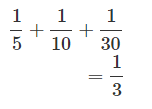
Pipe A can fill a tank in 5 hours, pipe B in 10 hours and pipe C in 30 hours. If all the pipes are open, in how many hours will the tank be filled ?

Answer: D

Part filled by A in 1 hour = 1/5

Part filled by B in 1 hour = 1/10

Part filled by C in 1 hour = 1/30

Part filled by (A+B+C) in 1 hour =

capture1 Dup 4 -65297800

So all pipes will fill the tank in 3 hours.

Please log in or register to report this question.

10.

In 6 hours a tank is filled. After the tank is half filled, 3 more similar taps are opened. Estimate the total time the tank will take to fill.

Answer: D

One tap fills the tank in 6 hours, so the first half takes 3 hours. Three more taps then join it, making four in all and quadrupling the rate:

\[ \text{time for the second half} = \frac{3 \text{ hours}}{4} = 45 \text{ minutes} \]

\[ \text{total} = 3\text{ h} + 45\text{ min} = 3\text{ h }45\text{ min} \]

The three extra taps are added to the original one, not substituted for it - reading it as three taps in total would give an hour for the second half.

Please log in or register to report this question.

Loading…
Tags: Pipes & Cistern Questions and Answers || Pipes & Cistern MCQ Questions and Answers || Pipes & Cistern GK Questions and Answers || Pipes & Cistern GK MCQ Questions || Pipes & Cistern Multiple Choice Questions and Answers || Pipes & Cistern GK || GK on Pipes & Cistern || Quantitative Aptitude Questions and Answers || Quantitative Aptitude MCQ Questions and Answers || Quantitative Aptitude GK Questions and Answers || GK on Quantitative Aptitude