
Machine-translated by Google. Questions are authored in English.
Top

Area Questions and Answers

Important Instructions
1.

If \(f(x) = 2\ln\left(\sqrt{e^{x}}\right)\), what is the area bounded by \(f(x)\) for the interval [0, 2] on the \(x\)-axis?

Exam Year(s)

GATE AE - 2022,

Answer: C

The area is 2.

Simplify the function first. \(\sqrt{e^{x}} = e^{x/2}\), so

\[ \begin{aligned} f(x) &= 2\ln(e^{x/2}) = 2 \cdot \frac{x}{2} = x \\ \int_{0}^{2} x\, dx &= \frac{2^{2}}{2} = 2 \end{aligned} \]

The region is a right triangle with base 2 and height 2, area half of 4. Forgetting the factor 2 in front of the logarithm gives f(x) = x/2 and an area of 1; dropping the square root gives f(x) = 2x and an area of 4. 1/2 matches neither.

Please log in or register to report this question.
2.

Equal sized circular regions are shaded in a square sheet of paper of 1 cm side length. Two cases, case M and case N, are considered as shown in the figures below. In the case M, four circles are shaded in the square sheet and in the case N, nine circles are shaded in the square sheet as shown.

What is the ratio of the areas of unshaded regions of case M to that of case N?

(Figure: in case M the four circles sit in a 2 by 2 arrangement and in case N the nine circles in a 3 by 3 arrangement; in each case the circles touch one another and the sides of the square.)

Exam Year(s)

GATE AE - 2022,

Answer: B

The ratio is 1 : 1.

In case M each circle has diameter 1/2 cm, and in case N each has diameter 1/3 cm. The total shaded area is

\[ \begin{aligned} M &: 4 \times \pi \left(\tfrac{1}{4}\right)^{2} = \frac{\pi}{4} \\ N &: 9 \times \pi \left(\tfrac{1}{6}\right)^{2} = \frac{\pi}{4} \end{aligned} \]

Both shade \(\pi/4\) of the 1 cm2 sheet, so both leave \(1 - \pi/4\) unshaded, and the ratio is 1 : 1. In general, n2 touching circles in an n by n grid always cover \(\pi/4\) of the square. The options 2 : 3 and 3 : 2 come from comparing the numbers of circles instead of their areas.

Please log in or register to report this question.

3.

'P' took 15 seconds to cross a rectangular field diagonally walking at the rate of 56 m/min and 'R' took the same time to cross the same field along its sides walking at the rate of 72 m/min. The area of the field is :

Exam Year(s)

CBSE Assistant Secretary - 2024,

Answer: D

The area is 64 \(\mathrm{m}^{2}\).

In 15 seconds, a quarter of a minute, P covers \(56 \div 4 = 14\) m along the diagonal, and R covers \(72 \div 4 = 18\) m along two sides. With sides l and b:

\[ \begin{aligned} l + b &= 18,\quad l^{2} + b^{2} = 196 \\ 2lb &= (l + b)^{2} - (l^{2} + b^{2}) \\ &= 324 - 196 = 128 \\ lb &= 64 \end{aligned} \]

128 is twice the area, the value of 2lb before dividing by 2.

Please log in or register to report this question.

4.

The side of a square is 5 cm. How many times will the new area become, if the side of the square is doubled ?

Exam Year(s)

CTET - 2023,

Answer: D

The new area becomes 4 times the original.

The area of a square is the square of its side:

\[ \begin{aligned} \text{Original area} &= 5 \times 5 = 25\ \text{cm}^{2} \\ \text{New area} &= 10 \times 10 = 100\ \text{cm}^{2} \\ \frac{100}{25} &= 4 \end{aligned} \]

In general, doubling the side multiplies the area by \(2^{2} = 4\). The answer 2 times is the common error of thinking area grows in the same proportion as the side, and 8 times is what happens to the volume of a cube when its side is doubled.

Please log in or register to report this question.

5.

The distance between the parallel sides AB and CD of a trapezium ABCD is 12 cm. If \(AB \lt CD\), CD = 24 cm and AD = BC = 13 cm, then area of the trapezium (in cm2) is :

Exam Year(s)

CTET - 2024,

Answer: A

The area is 228 cm2.

Since AD = BC = 13 cm, the trapezium is isosceles. Dropping perpendiculars from A and B to CD gives two right triangles with hypotenuse 13 cm and height 12 cm, so each base piece is

\[ \sqrt{13^2 - 12^2} = \sqrt{25} = 5 \text{ cm} \]

So AB = 24 - 5 - 5 = 14 cm, and

\[ \begin{aligned} \text{Area} &= \tfrac{1}{2}(14 + 24) \times 12 \\ &= 228 \text{ cm}^2 \end{aligned} \]

114 is half the correct area, and 247 comes from using 13 cm as the height.

Please log in or register to report this question.

6.

The area of a triangle of sides 24 cm, 45 cm and 51 cm is equal to the area of a rectangle of length 45 cm. Then, the perimeter of the rectangle is

Exam Year(s)

CTET - 2024,

Answer: D

The perimeter of the rectangle is 114 cm.

The triangle is right-angled, since 242 + 452 = 576 + 2025 = 2601 = 512. So its legs 24 cm and 45 cm are base and height:

\[ \begin{aligned} \text{area} &= \tfrac{1}{2} \times 24 \times 45 = 540 \\ \text{breadth} &= 540 \div 45 = 12 \\ \text{perimeter} &= 2(45 + 12) = 114 \end{aligned} \]

57 cm is the half-perimeter (45 + 12), forgetting to double. 110 cm and 55 cm come from a breadth of 10 cm, an arithmetic slip in the area.

Please log in or register to report this question.

7.

From a circular sheet of diameter 16 cm, a circle of radius 6 cm is removed. Then, the area (in cm2) of the remaining sheet is (use \(\pi = \frac{22}{7}\))

Exam Year(s)

CTET - 2024,

Answer: B

The remaining area is 88 cm2.

The sheet has diameter 16 cm, so radius 8 cm. Subtract the area of the circle of radius 6 cm:

\[ \begin{aligned} A &= \pi(8^{2} - 6^{2}) \\ &= \frac{22}{7} \times 28 = 88 \end{aligned} \]

The trap is to use 16 cm, the diameter, as the radius. Of the other options, 176 is twice the correct area and 44 is half of it, and 66 is three quarters; none equals the area of the ring.

Please log in or register to report this question.

8.

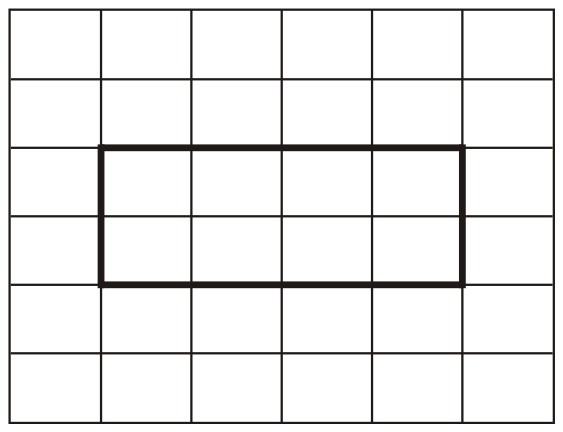
If one small square in the grid is of area 4 sq. units, what is the perimeter of the rectangle drawn on the grid?

A grid of 6 by 6 small squares with a rectangle drawn in bold along the grid lines, 4 squares long and 2 squares high

Exam Year(s)

CTET - 2018,

Answer: C

The perimeter is 24 units.

Each small square has area 4 sq. units, so its side is 2 units. The rectangle drawn on the grid is 4 squares long and 2 squares wide:

\[ \begin{aligned} \text{length} &= 4 \times 2 = 8,\quad \text{breadth} = 2 \times 2 = 4 \\ \text{perimeter} &= 2(8 + 4) = 24\ \text{units} \end{aligned} \]

12 units is the perimeter if each square's side is taken as 1 unit, and 32 units is the rectangle's area (8 squares × 4), not its perimeter. 8 units is just its length.

Please log in or register to report this question.

9.

The area of a quadrilateral is 227.2 cm2 and the length of the perpendiculars from the opposite vertices to a diagonal are 7.2 cm and 8.8 cm. What is the length of the diagonal ?

Exam Year(s)

CTET - 2019,

Answer: B

The diagonal is 28.4 cm.

A diagonal divides the quadrilateral into two triangles with the diagonal as their common base and the two perpendiculars as their heights:

\[ \begin{aligned} \text{Area} &= \tfrac{1}{2} d (h_{1} + h_{2}) \\ 227.2 &= \tfrac{1}{2} d (7.2 + 8.8) = 8d \\ d &= 28.4\ \text{cm} \end{aligned} \]

Forgetting the factor one half gives 14.2 cm, not an option; the other values do not satisfy the area formula (for example 8 × 26.8 = 214.4).

Please log in or register to report this question.

10.

The distance between two parallel sides of a trapezium is 8 cm. If the perimeter of the trapezium is 52 cm and its non-parallel sides are of length 10 cm each, then area of the trapezium (in cm2) is :

Exam Year(s)

CTET - 2026,

Answer: C

The area is 128 cm2.

The perimeter is the two parallel sides plus the two non-parallel sides, so the parallel sides together measure

\[ 52 - (10 + 10) = 32\ \text{cm} \]

The area of a trapezium is half the sum of the parallel sides times the distance between them:

\[ \begin{aligned} \text{Area} &= \tfrac{1}{2} \times 32 \times 8 \\ &= 128\ \text{cm}^{2} \end{aligned} \]

Forgetting the half doubles this to 256, which is not offered, and 64 is half the correct area. The individual lengths of the parallel sides are not needed, only their sum.

Please log in or register to report this question.

Loading…
Tags: Area Questions and Answers || Area MCQ Questions and Answers || Area GK Questions and Answers || Area GK MCQ Questions || Area Multiple Choice Questions and Answers || Area GK || GK on Area || Quantitative Aptitude Questions and Answers || Quantitative Aptitude MCQ Questions and Answers || Quantitative Aptitude GK Questions and Answers || GK on Quantitative Aptitude