
Machine-translated by Google. Questions are authored in English.
Top

Integral Calculus Questions and Answers

61.

The value of the integral \(\int_{-1/3}^{1/3} \sec(x)\,\ln\left|\frac{1+x}{1-x}\right| dx\) is:

Exam Year(s)

DSSSB JE - 2023,

Answer: D

The integrand \(f(x) = \sec x \cdot \ln\left|\frac{1+x}{1-x}\right|\) is an odd function. The factor sec x is even, since cos(-x) = cos x. The logarithm is odd, because replacing x by -x gives \(\ln\left|\frac{1-x}{1+x}\right| = -\ln\left|\frac{1+x}{1-x}\right|\). An even function times an odd function is odd, and the interval -1/3 to 1/3 is symmetric about zero, so the integral is 0. The other values would require a non-zero net area, which is impossible for an odd integrand.

Please log in or register to report this question.
62.

The volume of a solid generated by rotating the region between semi-circle \(y = 1 - \sqrt{1 - x^{2}}\) and straight line y = 1, about x axis, is

Exam Year(s)

GATE AE - 2012,

Answer: A

The volume is \(\pi^{2} - \dfrac{4}{3}\pi\).

The curve \(y = 1 - \sqrt{1 - x^{2}}\) is the lower half of the unit circle centred at (0, 1). The region lies between it and the line \(y = 1\) for \(-1 \le x \le 1\). Rotating about the x axis gives washers of outer radius 1 and inner radius \(1 - \sqrt{1 - x^{2}}\):

\[ \begin{aligned} V &= \pi\int_{-1}^{1}\left[1 - (1 - \sqrt{1 - x^{2}})^{2}\right]dx \\ &= \pi\int_{-1}^{1}\left[2\sqrt{1 - x^{2}} - (1 - x^{2})\right]dx \\ &= \pi\left[2 \cdot \frac{\pi}{2} - \frac{4}{3}\right] \\ &= \pi^{2} - \frac{4}{3}\pi \end{aligned} \]

using \(\int_{-1}^{1}\sqrt{1 - x^{2}}\,dx = \pi/2\) (half the unit circle's area) and \(\int_{-1}^{1}(1 - x^{2})dx = 4/3\). The other options misplace these two terms.

Please log in or register to report this question.

63.

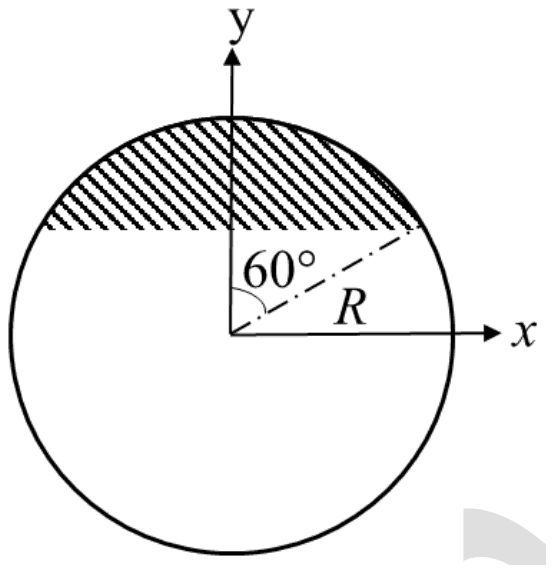
The volume of the solid formed by a complete rotation of the shaded portion of the circle of radius R about the y-axis is \(k\pi R^{3}\). The value of k is:

A circle of radius R centred at the origin with the cap above a horizontal chord shaded; the radius to the chord end makes 60 degrees with the y-axis

Exam Year(s)

GATE AE - 2024,

Answer: B

The value is \(k = \frac{5}{24}\).

The radius to the end of the chord makes 60° with the y-axis, so the chord lies at height \(y = R\cos 60^{\circ} = R/2\). The shaded segment runs from \(y = R/2\) to \(y = R\), and rotating it about the y-axis gives a spherical cap. With discs of radius \(x = \sqrt{R^{2} - y^{2}}\):

\[ \begin{aligned} V &= \pi\int_{R/2}^{R}(R^{2} - y^{2})\,dy \\ &= \pi\left[\frac{2R^{3}}{3} - \frac{11R^{3}}{24}\right] = \frac{5}{24}\pi R^{3} \end{aligned} \]

The cap formula \(\pi h^{2}(3R - h)/3\) with \(h = R/2\) gives the same result. 5/12 is twice the correct value, and 7/12 and 7/24 do not follow from a chord at height R/2.

Please log in or register to report this question.

64.

Integration of \(\int_{0}^{D/2} \frac{2R^{2}x\,dx}{(R^{2} + x^{2})^{2}}\) is

Exam Year(s)

GATE AG - 2018,

Answer: D

The integral equals \(\frac{D^{2}}{4R^{2} + D^{2}}\).

Since \(\frac{d}{dx}(R^{2} + x^{2}) = 2x\), the antiderivative of \(\frac{2x}{(R^{2} + x^{2})^{2}}\) is \(-\frac{1}{R^{2} + x^{2}}\):

\[ \begin{aligned} I &= R^{2}\left[-\frac{1}{R^{2} + x^{2}}\right]_{0}^{D/2} \\ &= R^{2}\left(\frac{1}{R^{2}} - \frac{4}{4R^{2} + D^{2}}\right) \\ &= 1 - \frac{4R^{2}}{4R^{2} + D^{2}} = \frac{D^{2}}{4R^{2} + D^{2}} \end{aligned} \]

\(\frac{4R^{2}}{4R^{2} + D^{2}}\) is the subtracted term alone, and the options with \(R^{2} + D^{2}\) use \(D\) instead of \(D/2\) as the upper limit.

Please log in or register to report this question.

65.

The value of \(I = \int_{0}^{\frac{\pi}{2}} \frac{(sinx+cosx)^{2}}{\sqrt{1+sin2x}}\, dx\) is

Exam Year(s)

GATE AG - 2023,

Answer: C

The integral equals 2.

Since \(sin2x = 2 sinx cosx\), the denominator is \(\sqrt{sin^{2}x + cos^{2}x + 2sinx cosx} = |sinx + cosx|\), and on \([0, \pi/2]\) both functions are non-negative, so it is simply sinx + cosx.

\[ \begin{aligned} I &= \int_{0}^{\pi/2} (sinx + cosx)\, dx \\ &= \big[-cosx + sinx\big]_{0}^{\pi/2} \\ &= (0 + 1) - (-1 + 0) = 2 \end{aligned} \]

1 is the value of either half of the integral alone, and 0 comes from a sign slip, taking the antiderivative of sinx as +cosx so the two parts cancel.

Please log in or register to report this question.

66.

Let \(f(x)\) be a continuous function from \(\mathbb{R}\) to \(\mathbb{R}\) such that

\[ f(x) = 1 - f(2 - x) \]

Which one of the following options is the CORRECT value of \(\int_{0}^{2} f(x)\,dx\) ?

Exam Year(s)

GATE CS - 2024,

Answer: B

The integral equals 1.

Let \(I = \int_{0}^{2} f(x)\,dx\). Substituting \(x \to 2 - x\) maps [0, 2] to itself, so \(\int_{0}^{2} f(2 - x)\,dx = I\) as well. Integrating the given relation over [0, 2]:

\[ \begin{aligned} I &= \int_{0}^{2} [1 - f(2 - x)]\,dx \\ &= 2 - I \\ I &= 1 \end{aligned} \]

The relation says f takes values symmetric about 1/2 around x = 1 (for example \(f(x) = x/2\) works), so the average of f over [0, 2] is 1/2 and the integral is 1. 0, 2 and \(-1\) all fail the equation \(I = 2 - I\).

Please log in or register to report this question.

67.

The value of \(x\) such that \(x \gt 1\), satisfying the equation \(\int_{1}^{x} t\ln t\,dt = \frac{1}{4}\) is

Exam Year(s)

GATE CS - 2025,

Answer: A

The value is \(x = \sqrt{e}\).

Integrate by parts, with u = ln t and dv = t dt:

\[ \begin{aligned} \int t\ln t\,dt &= \frac{t^{2}}{2}\ln t - \frac{t^{2}}{4} \\ \int_{1}^{x} t\ln t\,dt &= \frac{x^{2}}{2}\ln x - \frac{x^{2}}{4} + \frac{1}{4} \end{aligned} \]

Setting this equal to \(\frac{1}{4}\) leaves \(\frac{x^{2}}{2}\ln x = \frac{x^{2}}{4}\), so \(\ln x = \frac{1}{2}\) and \(x = e^{1/2} = \sqrt{e}\).

\(x = e\) gives \(\frac{e^{2}}{2} - \frac{e^{2}}{4} + \frac{1}{4} = \frac{e^{2}+1}{4}\), far more than \(\frac{1}{4}\); \(e^{2}\) is larger still, and \(e - 1\) does not make \(\ln x = \frac{1}{2}\).

Please log in or register to report this question.

68.

A function \(y(x)\) is defined in the interval [0, 1] on the \(x\)-axis as

\[ y(x) = \begin{cases} 2 & \text{if } 0 \le x \lt \frac{1}{3} \\ 3 & \text{if } \frac{1}{3} \le x \lt \frac{3}{4} \\ 1 & \text{if } \frac{3}{4} \le x \le 1 \end{cases} \]

Which one of the following is the area under the curve for the interval [0, 1] on the \(x\)-axis?

Exam Year(s)

GATE CS - 2022,

Answer: C

The area is \(\frac{13}{6}\).

The function is a step function, so the area is the sum of three rectangles, each of height \(y\) and width equal to the length of its interval.

\[ \begin{aligned} \text{area} &= 2 \cdot \tfrac{1}{3} + 3 \cdot \left(\tfrac{3}{4} - \tfrac{1}{3}\right) + 1 \cdot \tfrac{1}{4} \\ &= \tfrac{2}{3} + 3 \cdot \tfrac{5}{12} + \tfrac{1}{4} \\ &= \tfrac{8}{12} + \tfrac{15}{12} + \tfrac{3}{12} = \tfrac{26}{12} = \tfrac{13}{6} \end{aligned} \]

The function never drops below 1 on [0, 1], so the area must exceed 1; that rules out \(\frac{5}{6}\) and \(\frac{6}{13}\) at once. \(\frac{6}{5}\) is too small as well, since the first two pieces alone give \(\frac{2}{3} + \frac{5}{4} \gt 1.9\).

Please log in or register to report this question.

69.

A parametric curve defined by \(x = \cos\left(\frac{\pi u}{2}\right), y = \sin\left(\frac{\pi u}{2}\right)\) in the range \(0 \le u \le 1\) is rotated about the X- axis by 360 degrees. Area of the surface generated is

Exam Year(s)

GATE ME - 2017,

Answer: C

The surface area is \(2\pi\).

As u runs from 0 to 1, the angle \(\pi u/2\) runs from 0 to 90 degrees, so the curve is a quarter of the unit circle from (1, 0) to (0, 1). Rotating it about the x axis sweeps out a hemisphere of radius 1:

\[ \begin{aligned} S &= \int 2\pi y\, ds = \int_{0}^{1} 2\pi \sin\left(\tfrac{\pi u}{2}\right)\tfrac{\pi}{2}\, du \\ &= 2\pi \end{aligned} \]

which matches half of a sphere's \(4\pi r^{2}\). \(4\pi\) is the whole sphere, and \(\pi\) or \(\pi/2\) would be the area of flat discs or fractions of the hemisphere.

Please log in or register to report this question.

70.

Given \(\int_{-\infty}^{\infty} e^{-x^{2}}\,dx = \sqrt{\pi}\).

If \(a\) and \(b\) are positive integers, the value of \(\int_{-\infty}^{\infty} e^{-a(x+b)^{2}}\,dx\) is ________.

Exam Year(s)

GATE ME - 2022,

Answer: B

The value is \(\sqrt{\pi/a}\).

Substitute \(u = \sqrt{a}\,(x + b)\), so \(du = \sqrt{a}\,dx\). The limits stay \(-\infty\) to \(\infty\), because shifting by \(b\) and scaling by a positive \(\sqrt{a}\) does not change an infinite range:

\[ \begin{aligned} \int_{-\infty}^{\infty} e^{-a(x+b)^{2}}\,dx &= \frac{1}{\sqrt{a}}\int_{-\infty}^{\infty} e^{-u^{2}}\,du \\ &= \frac{\sqrt{\pi}}{\sqrt{a}} = \sqrt{\frac{\pi}{a}} \end{aligned} \]

The shift \(b\) only slides the bell curve along the axis, so it cannot change the area: both options with a factor \(b\) are wrong. \(\sqrt{\pi a}\) multiplies by \(\sqrt{a}\) where it should divide; a larger \(a\) makes the curve narrower, so the area must shrink.

Please log in or register to report this question.

Loading…
Tags: Integral Calculus Questions and Answers || Integral Calculus MCQ Questions and Answers || Integral Calculus GK Questions and Answers || Integral Calculus GK MCQ Questions || Integral Calculus Multiple Choice Questions and Answers || Integral Calculus GK || GK on Integral Calculus || Engineering Mathematics Questions and Answers || Engineering Mathematics MCQ Questions and Answers || Engineering Mathematics GK Questions and Answers || GK on Engineering Mathematics