
Machine-translated by Google. Questions are authored in English.
Top

Classification of Signals Questions and Answers

1.

Determine the fundamental period of the signal \(x(t) = \sin 50\pi t\).

Exam Year(s)

DSSSB AE - 2023,

Answer: B

For \(x(t) = \sin \omega_0 t\) the fundamental period is \(T = 2\pi / \omega_0\). Here \(\omega_0 = 50\pi\) rad/s.


\[ T = \frac{2\pi}{50\pi} = \frac{1}{25} = 0.04\ \text{s} \]


The frequency is 25 Hz. The value 0.02 s would be the period of a 50 Hz signal, which is what you get if you take \(\omega_0 = 100\pi\), and 0.06 s and 0.08 s have no basis. The answer is 0.04 sec, option B.

Please log in or register to report this question.
2.

Discrete time sinusoidal signals are identical when their frequencies are separated by the integer multiple of ______.

Exam Year(s)

DSSSB AE - 2023,

Answer: A

A discrete time sinusoid \(x(n) = \cos(\omega n)\) satisfies


\[ \begin{aligned} \cos((\omega + 2\pi k)n) \\ &= \cos(\omega n + 2\pi k n) = \cos(\omega n) \end{aligned} \]


because \(kn\) is an integer. So two sinusoids whose frequencies differ by an integer multiple of \(2\pi\) are the same signal, which is why the frequency of a discrete time signal is only meaningful in an interval of length \(2\pi\). A difference of \(\pi\), \(\pi/2\) or \(\pi/3\) gives different sequences (for example, a difference of \(\pi\) changes the sign of every other sample). The answer is \(2\pi\), option A.

Please log in or register to report this question.

3.

Identify whether the given statements are true or false.

1. Amplitude of antisymmetric signal is always zero at origin.

2. For the discrete time signal, the condition for periodicity is \(x(n) = x(n + N)\).

Exam Year(s)

DSSSB AE - 2023,

Answer: A

Both statements are true. An antisymmetric (odd) signal satisfies \(x(-t) = -x(t)\); putting \(t = 0\) gives \(x(0) = -x(0)\), so \(x(0) = 0\), which means its amplitude is zero at the origin. For a discrete time signal, periodicity means that there is a smallest positive integer \(N\) with \(x(n) = x(n + N)\) for all \(n\), which is the usual definition.


So the pair true and true is correct, and the options calling either statement false are wrong. The answer is option A.

Please log in or register to report this question.

4.

Is the given discrete time signal periodic? If periodic, what is the fundamental period?

\(\cos(3\pi n)\)

Exam Year(s)

DSSSB AE - 2023,

Answer: A

A discrete time sinusoid \(\cos(\omega_0 n)\) is periodic only if \(\omega_0 / 2\pi\) is a rational number, and the fundamental period is the smallest integer \(N\) with \(\omega_0 N = 2\pi k\) for some integer \(k\).


\[ \frac{\omega_0}{2\pi} = \frac{3\pi}{2\pi} = \frac{3}{2} \]


This is a ratio of integers, so the signal is periodic, and the smallest \(N\) is 2, since \(3\pi \times 2 = 6\pi = 2\pi \times 3\). The signal is \(\cos(3\pi n) = (-1)^n\), which repeats every 2 samples. The answer is periodic with fundamental period 2, option A.

Please log in or register to report this question.

5.

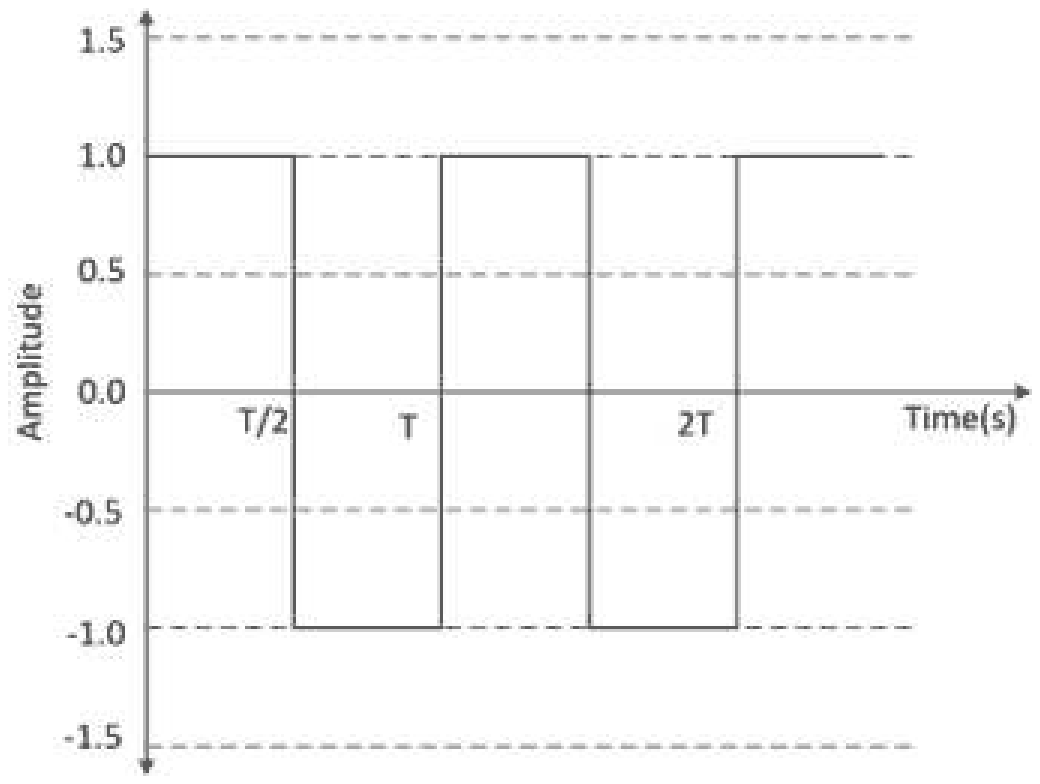
What is the average power of the given signal?

Graph of a square wave signal: amplitude +1.0 for the first interval T/2, then -1.0 until T, alternating between +1 and -1 with the marks T/2, T and 2T on the time axis

Exam Year(s)

DSSSB AE - 2023,

Answer: B

The signal is a square wave that takes only the values +1 and −1 (it is never zero). The average power of a signal is the mean of its squared value over a period.


\[ \begin{aligned} P = \frac{1}{T}\int_0^T x^2(t)\,dt \\ &= \frac{1}{T}\int_0^T (\pm 1)^2\,dt = 1 \end{aligned} \]


Because \((+1)^2 = (-1)^2 = 1\) at every instant, the mean square is 1, whichever the proportion of time spent at each level. The mean value (the dc component) may be zero, but the power is not: a power of 0 would need a zero signal. Powers of 2 and 4 would need amplitudes of about 1.41 and 2. The answer is 1, option B.

Please log in or register to report this question.

6.

Determine whether the given signal is a power or energy signal? What is its power or energy level?

\(X(n) = (1/2)^n u(n)\)

Exam Year(s)

DSSSB AE - 2023,

Answer: C

The signal \(x(n) = (1/2)^n u(n)\) decays to zero, so its total energy is finite and its average power is zero. It is an energy signal.


\[ \begin{aligned} E \\ &= \sum_{n=0}^{\infty} \left|\left(\tfrac12\right)^n\right|^2 \\ &= \sum_{n=0}^{\infty} \left(\tfrac14\right)^n \\ &= \frac{1}{1 - 1/4} = \frac{4}{3} \end{aligned} \]


The sum is a geometric series with ratio 1/4. The options calling the signal a power signal are wrong, since a power signal has finite nonzero power and infinite energy. The value 3/4 is the reciprocal of the energy. The answer is energy signal, 4/3, option C.

Please log in or register to report this question.

Loading…
Tags: Classification of Signals Questions and Answers || Classification of Signals MCQ Questions and Answers || Classification of Signals GK Questions and Answers || Classification of Signals GK MCQ Questions || Classification of Signals Multiple Choice Questions and Answers || Classification of Signals GK || GK on Classification of Signals || Signals and Systems Questions and Answers || Signals and Systems MCQ Questions and Answers || Signals and Systems GK Questions and Answers || GK on Signals and Systems