
Machine-translated by Google. Questions are authored in English.
Top

Electrical Measuring Instruments Questions and Answers

1.

Consider the following statements with respect to current transformers (CTs):

1) Cold-rolled grain-oriented silicon steel is used for protective CTs.
2) Nickel-iron cores are used in CTs used for measurement.
3) CTs used in protection have relatively low core cross-section.
4) Accuracy in protective CTs is not as important as in for metering current transformers.

Which of the given statements are correct?

Exam Year(s)

DSSSB - 2023,

Answer: D

Statement 1 is correct: cold-rolled grain-oriented silicon steel, which has low losses and high permeability, is used for protective current transformers. Statement 2 is correct: nickel-iron cores, which are very accurate at low flux, are used in CTs for measurement. Statement 3 is wrong: protection CTs must not saturate under fault current, so they have a relatively large core cross-section, not a small one. Statement 4 is correct: protective CTs need not be as accurate as the metering ones. So the correct statements are 1, 2 and 4, option (D); the other options include statement 3.

Please log in or register to report this question.

2.

Dynamometer type instrument works on the principle of:

Exam Year(s)

DSSSB - 2023,

Answer: C

A dynamometer type instrument has fixed coils that set up a magnetic field and a moving coil that carries current in that field, so its working is the same as the principle of a DC motor, in which a current-carrying conductor in a magnetic field experiences a force. A power transformer and an induction generator work by electromagnetic induction, and a DC generator produces an emf by a coil cutting flux. The answer is DC motor, option (C).

Please log in or register to report this question.

Answer: A

The brake magnet of an energy meter is a permanent magnet placed so that the aluminium disc rotates between its poles. The eddy currents induced in the moving disc produce a force that opposes the rotation, and this is the opposing, or braking, torque that acts against the turning torque of the disc and makes its speed proportional to the power. A controlling torque belongs to the spring of a pointer instrument, and a deflecting torque is the driving torque from the coils. The answer is option (A).

Please log in or register to report this question.
4.

In an energy meter the friction produced by the rotating aluminium disc is compensated by:

Exam Year(s)

DSSSB - 2023,

Answer: A

In an energy meter, friction of the rotating aluminium disc and of the registering mechanism would make the disc turn too slowly at light loads. To compensate, a shading ring or a shading loop is placed on the central limb of the shunt magnet and adjusted, so that the small extra torque it produces just cancels the friction. The brake magnet gives the braking torque and the control spring is not used in a meter, and the registering mechanism only counts the turns. The answer is shading ring, option (A).

Please log in or register to report this question.

5.

A moving coil ammeter with a range of 0-20 A is connected to read the load current of a DC motor while performing a load test. The rated current of the motor is 10 A. When the motor is loaded up to 50% of the rated load, the top control spring of the ammeter suddenly gets snapped. The reading of the ammeter will be:

Exam Year(s)

DSSSB - 2023,

Answer: A

The control spring of a moving coil instrument carries the current into and out of the coil, as well as giving the controlling torque. If the top control spring snaps, the circuit through the moving coil is broken, so no current flows in it and there is no deflecting torque, and the pointer rests at zero. The reading is therefore 0 A, option (A), and not the motor's actual current of 5 A at half load or any of the values 20 A, 12 A and 6 A.

Please log in or register to report this question.

6.

The given symbol is marked on a measuring instrument. The instrument is of ______ type.

A circuit symbol of a horseshoe magnet with a small rectangle between its poles, drawn in an outline.

Exam Year(s)

DSSSB - 2023,

Answer: A

The symbol of a horseshoe magnet, drawn in a frame, marks a permanent magnet moving coil (PMMC) instrument, which has a permanent magnet and a coil that moves in its field. Moving iron instruments are marked with a different symbol showing an iron vane, and electrodynamic instruments are marked with a symbol of two coils, with the enclosed type having a shield around it. So the instrument is of the moving coil type, option (A).

Please log in or register to report this question.

7.

It is desired to measure the voltage across the 50 KΩ resistor for the given circuit. A voltmeter with a sensitivity of 20,000 Ohms/V is used on its 50 V range. What will be the reading indicated by the voltmeter?

A series circuit of a 150 V supply, a 100 kilo-ohm resistor and a 50 kilo-ohm resistor.

Exam Year(s)

DSSSB - 2023,

Answer: A

A voltmeter of sensitivity 20,000 ohms per volt on its 50 V range has a resistance of 20000 x 50 = 1 mega-ohm. Connected across the 50 kilo-ohm resistor it forms a parallel pair of about 47.6 kilo-ohm. This is in series with the 100 kilo-ohm resistor, so the voltage it reads is

\[ V = 150 \times \frac{47.6}{100 + 47.6} \]

\[ V \approx 48.4\ \mathrm{V} \]

The key gives 48.36 V, option (A). The true voltage without the meter would be 50 V, and the meter loads the circuit and reads less, so 50 V, 53 V and 45.33 V are not what it indicates.

Please log in or register to report this question.

8.

A PMMC instrument is connected in a circuit fed with an AC signal of high frequency, the rms value of the AC signal is \(\sqrt{2}\) V. The PMMC instrument will read ______ V.

Exam Year(s)

DSSSB - 2023,

Answer: D

A permanent magnet moving coil instrument responds to the average value of the current through its coil. For a high-frequency AC signal the average over a cycle is zero, and also the moving system is too slow to follow the rapid changes, so the pointer stays at zero. The rms value of the signal, root 2 volt, does not matter. So the PMMC instrument reads 0 V, option (D). The values root 2, 2 and 1 would apply to an instrument that measures rms or peak values.

Please log in or register to report this question.

9.

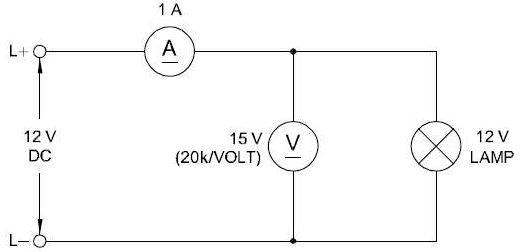
The given circuit arrangement is made to measure the hot resistance of a lamp and the lamp is supplied with its rated voltage. From the readings of the meters the hot resistance of the lamp can be determined by using the formula:

A DC circuit with a 12 V supply between L+ and L-, a 1 A ammeter in series, and a 15 V voltmeter (20k per volt) and a 12 V lamp in parallel.

Exam Year(s)

DSSSB - 2023,

Answer: D

The lamp is supplied at its rated voltage, and the ammeter reads the current through the lamp when it is lit. By Ohm's law the resistance of the lamp when hot is the voltage across it divided by the current through it, that is the voltmeter reading divided by the ammeter reading. The cold resistance is not needed, since the hot resistance is measured directly, so adding it, multiplying by it or subtracting it would give a wrong value. The answer is Hot resistance = Voltmeter reading / Ammeter reading, option (D).

Please log in or register to report this question.

10.

Which of the following parts in the PMMC instrument is responsible for damping?

Exam Year(s)

DSSSB - 2023,

Answer: C

In a PMMC instrument the moving coil is wound on an aluminium former. When the coil moves in the magnetic field, eddy currents are induced in the former, and these produce a force that opposes the motion, which damps the movement of the pointer so it settles quickly. The spring gives the controlling torque, the spindle carries the pointer and the moving coil gives the deflecting torque. The answer is aluminium former, option (C).

Please log in or register to report this question.

Loading…
Tags: Electrical Measuring Instruments Questions and Answers || Electrical Measuring Instruments MCQ Questions and Answers || Electrical Measuring Instruments GK Questions and Answers || Electrical Measuring Instruments GK MCQ Questions || Electrical Measuring Instruments Multiple Choice Questions and Answers || Electrical Measuring Instruments GK || GK on Electrical Measuring Instruments || Basic Electrical Engineering Questions and Answers || Basic Electrical Engineering MCQ Questions and Answers || Basic Electrical Engineering GK Questions and Answers || GK on Basic Electrical Engineering