
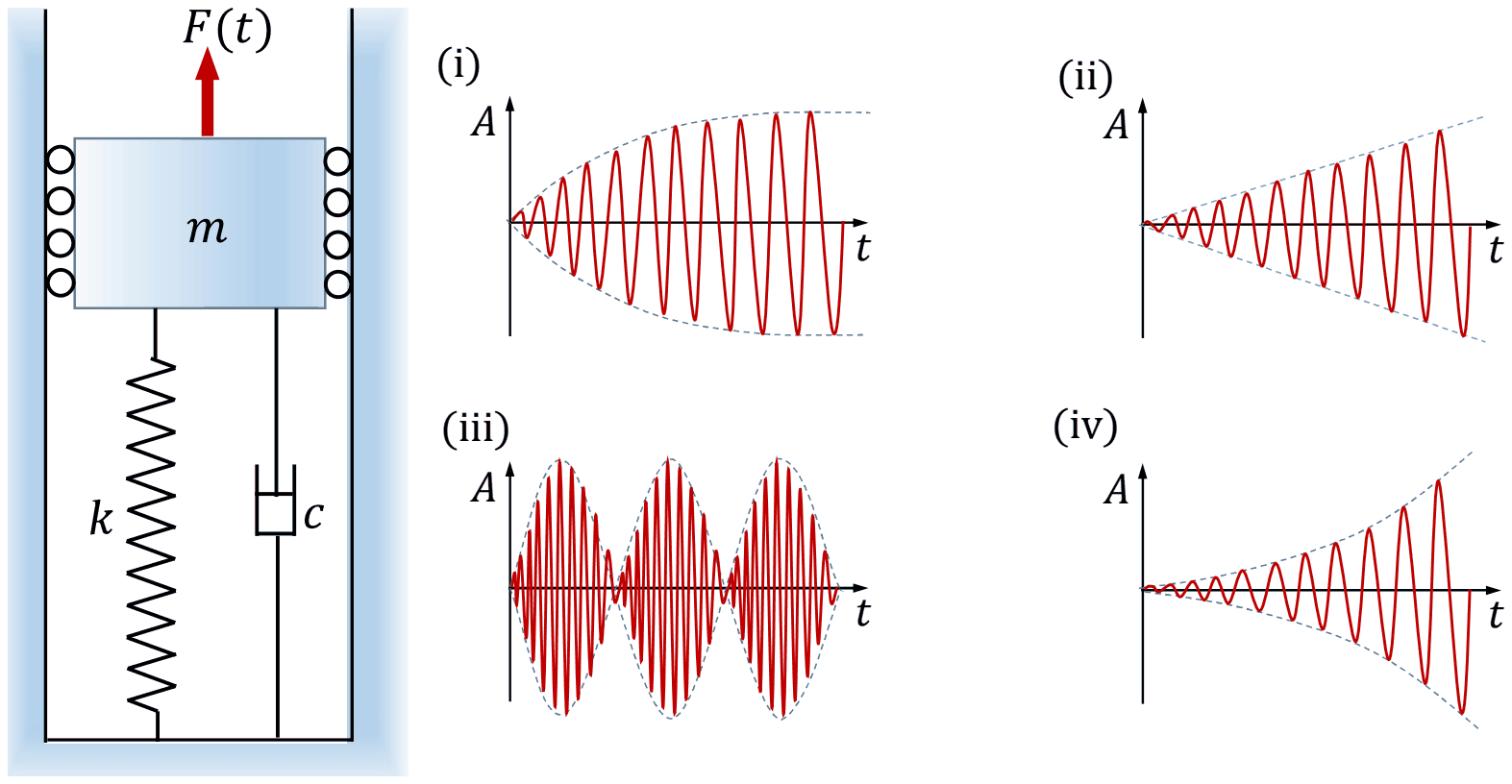
Four different parameter and forcing conditions are mentioned below.
(P) \(c \gt 0\) and \(\omega = \sqrt{k/m}\)
(Q) \(c \lt 0\) and \(\omega \ne 0\)
(R) \(c = 0\) and \(\omega = \sqrt{k/m}\)
(S) \(c = 0\) and \(\omega \cong \sqrt{k/m}\)
Which one of the following options gives correct match (indicated by arrow →) of the parameter and forcing conditions to the responses?
GATE ME - 2022,
Answer: C
The match is (P) → (i), (Q) → (iv), (R) → (ii), (S) → (iii).
- (P) \(c \gt 0\), \(\omega = \sqrt{k/m}\): damped resonance. The amplitude grows and then settles at a finite steady value, \(B/(c\omega)\), because damping removes energy as fast as the force supplies it. That is response (i), whose envelope levels off.
- (Q) \(c \lt 0\): negative damping feeds energy in, so the free response grows exponentially whatever the forcing frequency. That is (iv), whose envelope curves outwards.
- (R) \(c = 0\), \(\omega = \sqrt{k/m}\): undamped resonance. The particular solution is \(x \propto t\cos\omega_{n}t\), so the amplitude grows linearly without limit. That is (ii), with straight-line envelopes.
- (S) \(c = 0\), \(\omega \cong \sqrt{k/m}\): forcing close to, but not at, the natural frequency. The free and forced vibrations drift in and out of phase, producing beats. That is (iii).
The other options swap these pairs; the quickest check is that the beat pattern (iii) can only belong to the near-resonance case (S), which leaves only one option.
Please log in or register to report this question.