
Machine-translated by Google. Questions are authored in English.
Top

Ideal and Real Gases Questions and Answers

Direction for [ Question No: 1 To 3 ] :

Notation used:
P : pressure, V : volume, T : temperature, s : specific entropy, h : specific enthalpy, Cp : molar heat capacity at constant pressure, Cv : molar heat capacity at constant volume, R : universal gas constant

1.

The value of the compressibility factor at the critical point evaluated using the van der Waals equation of state is

Exam Year(s)

GATE XE - 2018,

Answer: C

The critical compressibility factor is \(\frac{3}{8}\).

For the van der Waals equation, the conditions \((\partial P/\partial V)_{T} = 0\) and \((\partial^{2}P/\partial V^{2})_{T} = 0\) at the critical point give

\[ \begin{aligned} V_{c} &= 3b, \quad T_{c} = \frac{8a}{27Rb} \\ P_{c} &= \frac{a}{27b^{2}} \end{aligned} \]

\[ \begin{aligned} Z_{c} &= \frac{P_{c}V_{c}}{RT_{c}} \\ &= \frac{(a/27b^{2})(3b)}{8a/27b} = \frac{3}{8} \end{aligned} \]

The value 0.375 is the same for every van der Waals gas, higher than the 0.23 to 0.31 measured for real gases. The fractions 2/7, 5/8 and 1/7 do not come out of these critical constants.

Please log in or register to report this question.
2.

Consider the following statements for an ideal gas undergoing a reversible non-flow process:

P. If the process is adiabatic, the change in enthalpy of the gas is necessarily zero.
Q. If the process is adiabatic, the change in entropy of the gas is necessarily zero.
R. If the process is isothermal, the change in enthalpy of the gas is necessarily zero.
S. If the process is isothermal, the change in entropy of the gas is necessarily zero.

Which one of the following options is valid?

Exam Year(s)

GATE XE - 2018,

Answer: C

The valid option is only Q and R are correct.

  • P is false: in a reversible adiabatic process the temperature changes, and for an ideal gas dh = cpdT, so the enthalpy changes.
  • Q is true: ds = δqrev/T, and with no heat transfer in a reversible process the entropy change is zero (the process is isentropic).
  • R is true: the enthalpy of an ideal gas depends on temperature alone, so an isothermal process leaves it unchanged.
  • S is false: a reversible isothermal process exchanges heat, so Δs = q/T is not zero (it is R ln(V2/V1) per mole).

The options naming P or S therefore cannot be right.

Please log in or register to report this question.

3.

Methane has compressibility factor value of 0.9 at reduced pressure of 1.0 and reduced temperature of 1.5. For propane, the critical temperature and pressure are 369.8 K and 42.48 bar, respectively. Take R = 8.314 kJ/kmol.K. Applying the principle of corresponding states, the molar volume of propane (in m3/kmol) at the same reduced pressure and temperature is

Exam Year(s)

GATE XE - 2018,

Answer: D

The molar volume of propane is 0.977 m3/kmol.

By the principle of corresponding states, gases at the same reduced pressure and temperature have the same compressibility factor, so propane also has Z = 0.9. Its actual conditions are

\[ \begin{aligned} T &= 1.5 \times 369.8 = 554.7\ \text{K} \\ P &= 1.0 \times 42.48\ \text{bar} = 4248\ \text{kPa} \end{aligned} \]

\[ \begin{aligned} \bar{v} &= \frac{ZRT}{P} = \frac{0.9 \times 8.314 \times 554.7}{4248} \\ &= 0.977\ \text{m}^{3}\text{/kmol} \end{aligned} \]

Treating propane as an ideal gas (Z = 1) would give 1.086, and 0.355, 0.526 and 0.791 do not follow from Z = 0.9 at these conditions.

Please log in or register to report this question.

Direction for [ Question No: 4 To 4 ] :

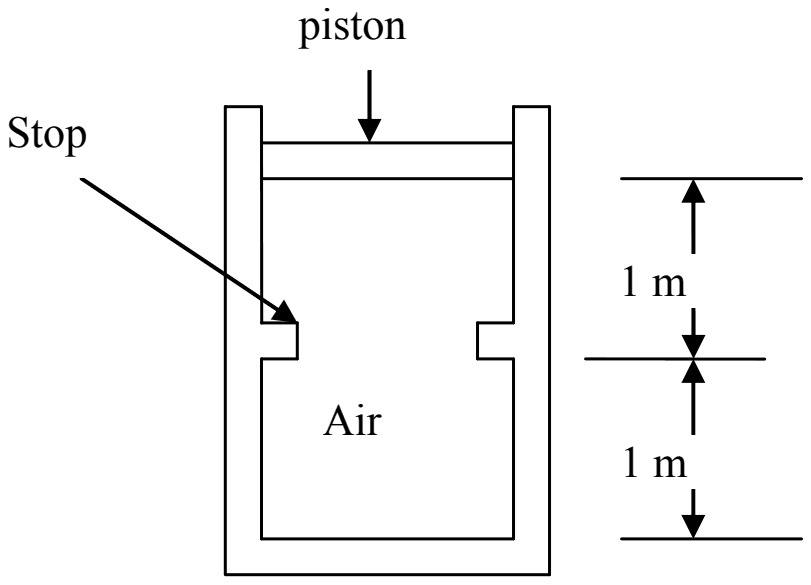
A piston-cylinder arrangement as shown in the figure initially contains air at 150 kPa and 400°C. The arrangement is allowed to cool to the ambient temperature of 20°C. The characteristic gas constant for air is 0.287 kJ/kg.K. The cylinder wall has stops of negligible thickness that can prevent the piston from moving down. The stops are 1 m from the inner side of the base surface of the cylinder. At the initial state, the piston is resting 1 m above the stops.

Vertical cylinder of air closed by a piston, with stops on the wall 1 m above the base and the piston 1 m above the stops

4.

The final pressure in the cylinder is

Exam Year(s)

GATE XE - 2012,

Answer: A

The final pressure is 130.7 kPa.

The cooling happens in two stages. First the piston descends at constant pressure, 150 kPa, until it lands on the stops, which halves the volume (from 2 m to 1 m of height):

\[ T_{stop} = 673.15 \times \tfrac{1}{2} = 336.6\ \text{K} \]

That is still above 293.15 K, so the air keeps cooling at constant volume with the piston on the stops:

\[ p_{2} = 150 \times \frac{293.15}{336.6} = 130.7\ \text{kPa} \]

150 kPa would be right only if the piston never reached the stops. The higher pressures would require heating, not cooling.

Please log in or register to report this question.

Direction for [ Question No: 5 To 6 ] :

Note: Usual notations have been used for thermodynamic variables.

Useful Data: Unless otherwise specified, the following data may be assumed. Universal gas constant, \(\bar{R}\) = 8.314 kJ/kmol.K; Acceleration due to gravity, g = 9.81 m/s2; Molecular mass of air, Mair = 29 kg/kmol; Specific heat of air at constant pressure, cp = 1.005 kJ/kg.K; Ratio of specific heats of air, γ = 1.4. Assume air to be a perfect gas unless specified otherwise.

5.

A certain mass of gas at 0°C is expanded to 81 times its original volume under adiabatic conditions. If ratio of specific heats of the gas, \(\gamma = 1.25\), the final temperature of the gas is

Exam Year(s)

GATE XE - 2012,

Answer: B

The final temperature is -182°C.

For a reversible adiabatic process \(TV^{\gamma - 1}\) is constant:

\[ \begin{aligned} T_{2} &= T_{1}\left(\frac{V_{1}}{V_{2}}\right)^{\gamma - 1} = 273\left(\frac{1}{81}\right)^{0.25} \\ &= \frac{273}{3} = 91\ \text{K} \end{aligned} \]

since \(81^{0.25} = 3\). In Celsius, 91 - 273 = -182°C.

-91°C comes from writing 91 K as -91°C without converting, and 0°C would mean no cooling, which an adiabatic expansion cannot give. -235°C does not follow from the adiabatic relation.

Please log in or register to report this question.

6.

A sample of gas with initial average kinetic energy, E is heated from 27°C to 327°C. The average kinetic energy after heating is

Exam Year(s)

GATE XE - 2012,

Answer: B

The average kinetic energy becomes 2E.

The average translational kinetic energy of a gas molecule is \(\tfrac{3}{2}kT\), proportional to the absolute temperature.

\[ \begin{aligned} \frac{E_{2}}{E_{1}} &= \frac{327 + 273}{27 + 273} \\ &= \frac{600}{300} = 2 \end{aligned} \]

The options 27E and 327E wrongly use Celsius temperatures, and the ratio 327/27 (about 12) is meaningless physically. E would be correct only if the temperature did not change.

Please log in or register to report this question.

7.

For an ideal gas, the specific heat at constant pressure is 1147 J/kg K and the ratio of specific heats is equal to 1.33. What is the value of the gas constant for this gas in J/kg K?

Exam Year(s)

GATE AE - 2024,

Answer: A

The gas constant is 284.6 J/kg K.

For an ideal gas \(R = c_{p} - c_{v}\) and \(\gamma = c_{p}/c_{v}\), so

\[ \begin{aligned} R &= c_{p}\left(1 - \frac{1}{\gamma}\right) = 1147 \times \frac{0.33}{1.33} \\ &= 284.6\ \text{J/kg K} \end{aligned} \]

862.4 J/kg K is \(c_{v} = 1147/1.33\), not \(R\). 1005 J/kg K is the usual \(c_{p}\) of air, a different gas from this one, and 8314 J/kmol K is the universal gas constant, which still has to be divided by the molar mass.

Please log in or register to report this question.

8.

An ideal gas is compressed adiabatically (Adiabatic exponent γ =1.4) from 98 kPa to 480 kPa and the specific volume of the gas at the beginning of the compression stroke is 0.45 m3 kg-1. The specific work done on the gas in kJ kg-1 is _________.

Exam Year(s)

GATE AG - 2022,

Answer: D

The specific work done on the gas is 63.3 kJ/kg.

For a reversible adiabatic process \(pv^{\gamma}\) is constant, so the final specific volume is

\[ \begin{aligned} v_{2} &= v_{1}(p_{1}/p_{2})^{1/\gamma} \\ &= 0.45 \times (98/480)^{0.714} \\ &= 0.1446\ \text{m}^{3}/\text{kg} \end{aligned} \]

The work done on the gas in a closed (non-flow) adiabatic compression is

\[ \begin{aligned} w &= \frac{p_{2}v_{2} - p_{1}v_{1}}{\gamma - 1} \\ &= \frac{480(0.1446) - 98(0.45)}{0.4} \\ &= \frac{69.4 - 44.1}{0.4} = 63.3\ \text{kJ/kg} \end{aligned} \]

25.4 is close to the numerator \(p_{2}v_{2} - p_{1}v_{1}\) (25.3) left undivided by \(\gamma - 1\), and 12.6 and 18.5 are smaller still; none of them accounts for the full adiabatic work.

Please log in or register to report this question.

9.

An ideal gas of mass m and temperature T1 undergoes a reversible isothermal process from an initial pressure P1 to final pressure P2. The heat loss during the process is Q. The entropy change ΔS of the gas is

Exam Year(s)

GATE ME - 2012,

Answer: B

The entropy change is \(mR\ln(P_{1}/P_{2})\).

For an ideal gas:

\[ \Delta S = mc_p\ln\frac{T_2}{T_1} - mR\ln\frac{P_2}{P_1} \]

The process is isothermal, so the temperature term vanishes and \(\Delta S = mR\ln(P_{1}/P_{2})\). Since heat is lost, the gas is being compressed (P2 > P1) and \(\Delta S\) is negative, as it must be for a reversible process with heat leaving.

\(mR\ln(P_{2}/P_{1})\) has the wrong sign. Subtracting Q/T1 counts the heat transfer twice, because for a reversible process the expression already equals the heat transfer over T. Zero applies to a reversible adiabatic process, not to an isothermal one.

Please log in or register to report this question.

Answer: B

The FALSE statement is the one claiming that a real gas in an adiabatic reversible process follows \(PV^{\gamma}\) = constant.

The relation \(PV^{\gamma}\) = constant is derived from the first law using \(PV = mRT\) and constant specific heats, so it holds for an ideal (perfect) gas only. A real gas, whose equation of state and specific heats differ from the ideal ones, does not follow it in general.

The other statements are true. An ideal gas's enthalpy depends on temperature alone, so it is independent of pressure. The equation \(P/R = mT/V\) is just \(PV = mRT\) rearranged; the ideal gas equation holds at every state, whatever polytropic process (here \(PV^{1.5}\) = constant) connects them. And any real gas approaches ideal behaviour at low pressure or high temperature, where molecular volume and attraction become negligible.

Please log in or register to report this question.

Loading…
Tags: Ideal and Real Gases Questions and Answers || Ideal and Real Gases MCQ Questions and Answers || Ideal and Real Gases GK Questions and Answers || Ideal and Real Gases GK MCQ Questions || Ideal and Real Gases Multiple Choice Questions and Answers || Ideal and Real Gases GK || GK on Ideal and Real Gases || Thermodynamics Questions and Answers || Thermodynamics MCQ Questions and Answers || Thermodynamics GK Questions and Answers || GK on Thermodynamics