
Machine-translated by Google. Questions are authored in English.
Top

Polarization and Optical Activity Questions and Answers

1.

A quarter wave plate introduces a path difference of \(\lambda/4\) between the two components of polarization parallel and perpendicular to the optic axis. An electromagnetic wave with \(\vec{E} = (\hat{x} + \hat{y})E_{0}e^{i(kz - \omega t)}\) is incident normally on a quarter wave plate which has its optic axis making an angle 135° with the \(x\)-axis as shown.
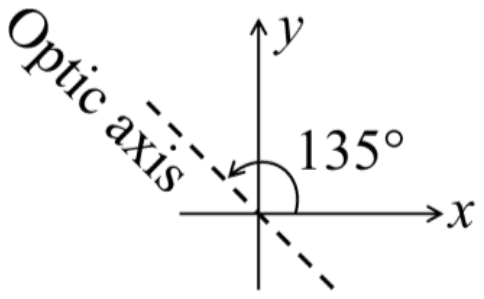
x-y axes with a dashed optic axis through the origin at 135 degrees measured from the positive x axis

The emergent electromagnetic wave would be

Exam Year(s)

GATE Physics - 2018,

Answer: C

The emergent wave is linearly polarized with polarization as that of incident wave.

The incident field \((\hat{x} + \hat{y})E_{0}\) is linearly polarized at 45° to the \(x\)-axis. The optic axis is at 135°, which is exactly perpendicular to that direction.

A wave plate only changes the polarization when the field has components both parallel and perpendicular to the optic axis, because the plate delays one relative to the other. Here the field has no component along the optic axis: it lies entirely along the perpendicular direction, so the plate merely delays it as a whole and the polarization is unchanged.

Circular polarization would need equal components along and across the optic axis (field at 45° to it), and other angles give elliptical polarization. A rotation by 90° is what a half-wave plate does to light at 45° to its axis, not a quarter-wave plate with the field along an eigen-axis.

Please log in or register to report this question.

2.

For the electric field of an electromagnetic wave given below, which of the following statements is correct?

\[ \begin{aligned} \vec{E} = &\hat{x}\, E_{0} cos(\omega t) \\ &+ \hat{y}\, 2E_{0} cos\left(\omega t + \frac{\pi}{2}\right) \end{aligned} \]

Exam Year(s)

GATE Physics - 2026,

Answer: C

The field is elliptically polarised with a ratio of major to minor axis of 2.

Write the components: \(E_{x} = E_{0}\cos\omega t\) and \(E_{y} = 2E_{0}\cos(\omega t + \pi/2) = -2E_{0}\sin\omega t\). Then

\[ \begin{aligned} &\frac{E_{x}^{2}}{E_{0}^{2}} \\ &+ \frac{E_{y}^{2}}{4E_{0}^{2}} = 1 \end{aligned} \]

The tip of \(\vec{E}\) traces an ellipse with semi-axes \(2E_{0}\) along y and \(E_{0}\) along x, so the axis ratio is 2. Linear polarisation needs the components in phase or opposite in phase. Circular polarisation needs a quarter-period shift and equal amplitudes, which these are not. A wave with a fixed phase difference between its components is polarised, not unpolarised.

Please log in or register to report this question.

3.

Which one of the following arrangements of optical components can be used to distinguish between an unpolarised light and a circularly polarised light?

[In each option the light passes through the listed components in order, from left to right.]

Exam Year(s)

IIT JAM - 2018,

Answer: C

The arrangement is light, \(\lambda/4\) plate, analyser.

A quarter-wave plate turns circularly polarised light into plane polarised light, because it adds a further \(\pi/2\) between the two components that were already \(\pi/2\) apart. Rotating the analyser then gives complete extinction at one position. Unpolarised light remains unpolarised after the plate, so its intensity through the analyser stays constant. The two can therefore be told apart.

A half-wave plate turns circular light into circular light of the opposite hand, so the analyser shows no variation for either beam. Putting a polariser first destroys the difference, since both beams become plane polarised before reaching the plate.

Please log in or register to report this question.

4.

The plane of polarisation of a plane polarized light rotates by 60° after passing through a wave plate. The pass-axis of the wave plate is at an angle \(\alpha\) with respect to the plane of polarisation of the incident light. The wave plate and \(\alpha\) are

Exam Year(s)

IIT JAM - 2018,

Answer: B

The plate is \(\lambda/2\), with \(\alpha = 30^\circ\).

A half-wave plate reflects the plane of polarisation about its axis: light polarised at angle \(\alpha\) to the axis comes out at \(-\alpha\), a rotation of \(2\alpha\). A rotation of \(60^\circ\) therefore needs \(\alpha = 30^\circ\).

A quarter-wave plate does not rotate a plane of polarisation; in general it produces elliptically polarised light, so both \(\lambda/4\) options fail. A pass-axis at \(120^\circ\) is the same line as one at \(-60^\circ\); it turns the plane by \(-120^\circ\), which lands on the same line only because a plane of polarisation is defined to within \(180^\circ\). The key takes the direct reading, the smallest axis angle giving a \(60^\circ\) rotation, \(30^\circ\).

Please log in or register to report this question.

5.

Light of wavelength 632 nm is passing through an optically active medium of thickness 20 cm. The optical rotation exhibited by the medium is 18°.
Which of the following options correctly states the magnitude of the difference in refractive indices corresponding to the left and the right circularly polarized light?

Exam Year(s)

IIT JAM - 2026,

Answer: B

The difference in refractive indices is \(3.16 \times 10^{-7}\).

In an optically active medium the two circular components travel with indices \(n_L\) and \(n_R\). Over a thickness \(d\) they build up a phase difference \(\frac{2\pi}{\lambda}(n_L - n_R)d\), and the plane of polarisation turns through half of it:

\[ \begin{aligned} \theta &= \frac{\pi d}{\lambda}\,|n_L - n_R| \\ |n_L - n_R| &= \frac{\theta \lambda}{\pi d} \end{aligned} \]

With \(\theta = 18^\circ = \pi/10\) rad, \(\lambda = 632 \times 10^{-9}\) m and \(d = 0.20\) m:

\[ \begin{aligned} |n_L - n_R| &= \frac{(\pi/10)(632 \times 10^{-9})}{\pi \times 0.20} \\ &= 3.16 \times 10^{-7} \end{aligned} \]

Putting the angle in as 18 degrees instead of radians gives \(1.81 \times 10^{-5}\), and the other two options are exactly double these two values, so they do not satisfy the rotation formula either.

Please log in or register to report this question.

6.

Consider the superposition of two electromagnetic waves with their electric field vectors given by \(\vec{E}_{1}(z,t) = \hat{\imath} A_{1} \cos(kz - \omega t)\) and \(\vec{E}_{2}(z,t) = \hat{\jmath} A_{2} \sin(kz - \omega t + \phi)\), where \(A_{1}\) and \(A_{2}\) are the amplitudes, \(k\) is the wavenumber, \(\omega\) is the angular frequency, and \(\phi\) is the relative phase. Which of the following options represents a resultant elliptically polarized wave with its semi-major axis either along \(\hat{\imath}\) or \(\hat{\jmath}\)?

Exam Year(s)

IIT JAM - 2026,

Answer: A

The wave is elliptically polarised with its axes along \(\hat{\imath}\) and \(\hat{\jmath}\) when \(\phi = 0\) and \(A_1 \neq A_2\).

Write \(\theta = kz - \omega t\). With \(\phi = 0\) the components are \(E_x = A_1 \cos\theta\) and \(E_y = A_2 \sin\theta\), so

\[ \frac{E_x^{2}}{A_1^{2}} + \frac{E_y^{2}}{A_2^{2}} = 1 \]

The tip of the field traces an ellipse whose semi-axes \(A_1\) and \(A_2\) lie along \(\hat{\imath}\) and \(\hat{\jmath}\). With \(A_1 \neq A_2\) it is a true ellipse; with \(A_1 = A_2\) it becomes a circle, so the \(\phi = 0\), \(A_1 = A_2\) option describes circular polarisation.

With \(\phi = \pi/2\), \(\sin(\theta + \pi/2) = \cos\theta\), so both components oscillate in phase and the wave is linearly polarised, whether or not the amplitudes are equal.

Please log in or register to report this question.

Loading…
Tags: Polarization and Optical Activity Questions and Answers || Polarization and Optical Activity MCQ Questions and Answers || Polarization and Optical Activity GK Questions and Answers || Polarization and Optical Activity GK MCQ Questions || Polarization and Optical Activity Multiple Choice Questions and Answers || Polarization and Optical Activity GK || GK on Polarization and Optical Activity || Optics and Photonics Questions and Answers || Optics and Photonics MCQ Questions and Answers || Optics and Photonics GK Questions and Answers || GK on Optics and Photonics