
Machine-translated by Google. Questions are authored in English.
Top

Gas Power Cycles Questions and Answers

1.

Which is the most efficient cycle for same compression ratio?

Exam Year(s)

DSSSB - 2023,

Answer: D

The Otto cycle is the most efficient of the cycles for the same compression ratio. Its efficiency is \[ \eta = 1 - \frac{1}{r^{\gamma - 1}} \] and for the same compression ratio the Otto cycle rejects the least heat, since all the heat is added at constant volume. The Diesel cycle has the lowest efficiency for the same compression ratio, and the Dual and Trinkler cycles come between them.

The Diesel cycle adds heat at constant pressure during expansion, so at the same compression ratio it is less efficient than the Otto cycle.

Please log in or register to report this question.

Answer: C

The ideal Stirling cycle is two reversible isotherms and two reversible isochores.

The working gas is compressed isothermally at the low temperature, heated at constant volume, expanded isothermally at the high temperature and cooled at constant volume. With an ideal regenerator, the heat given up in the constant-volume cooling is stored and returned in the constant-volume heating, so the cycle reaches the Carnot efficiency.

Two isobars and two adiabatics make the Brayton (Joule) cycle. Two isotherms and two isobars make the Ericsson cycle. Isentropic compression, constant-volume heat addition, isentropic expansion and constant-volume heat rejection describe the Otto cycle.

Please log in or register to report this question.
3.

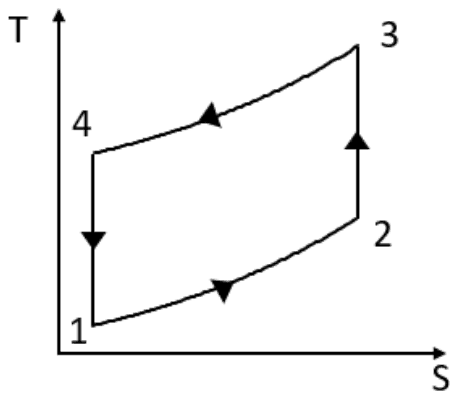
Consider the Otto cycle for an ideal gas engine consisting of two quasistatic adiabatic and two quasistatic isochoric processes. The correct temperature-entropy (T-S) phase diagram for the cycle is

Exam Year(s)

GATE Physics - 2026,

Answer: A

The correct T-S diagram is (A).

The Otto cycle is 1 to 2 adiabatic compression, 2 to 3 heat addition at constant volume, 3 to 4 adiabatic expansion and 4 to 1 heat rejection at constant volume. A quasistatic adiabatic process is isentropic, so 1 to 2 and 3 to 4 are vertical lines. At constant volume \(dS = C_{V}\,dT/T\), so T rises exponentially with S along 2 to 3 and falls along 4 to 1: curved lines rising to the right. An engine runs clockwise on a T-S diagram, taking in heat at the higher temperature.

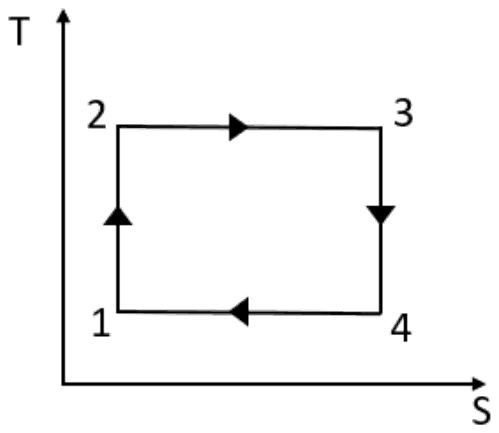
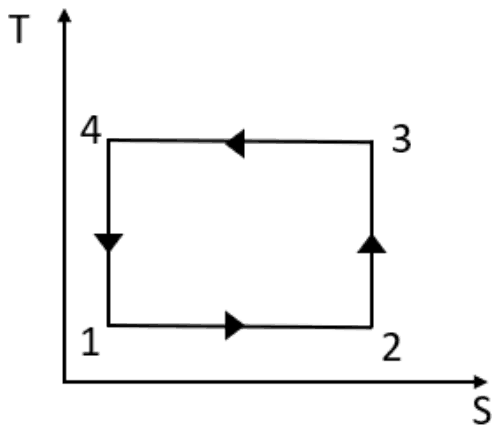
Diagram (A) has exactly this shape and direction. (B) has the same shape traversed anticlockwise, which is a refrigerator, not an engine. (C) and (D) are rectangles, with horizontal isothermal sides, which describe the Carnot cycle, not the Otto cycle.

Please log in or register to report this question.
4.

An air standard Diesel cycle consists of four processes: 1-2 (isentropic compression), 2-3 (constant pressure heat addition), 3-4 (isentropic expansion) and 4-1 (constant volume heat rejection). \(T_{4}\) is the temperature (in K) attained at the end of isentropic expansion (3-4) before constant volume heat rejection. The constant volume heat rejection process (4-1) is replaced by a constant pressure heat rejection process (4a-1) such that \(T_{4a}\) is the temperature (in K) reached at the end of isentropic expansion (3-4a), and the state point 1 remains the same. Then

Exam Year(s)

GATE XE - 2022,

Answer: A

The result is \(T_{4a} \lt T_{4}\).

With constant-volume heat rejection, expansion 3-4 stops at the volume \(v_{1}\). For constant-pressure rejection to return to state 1, expansion 3-4a must continue down to the pressure \(p_{1}\), which is below \(p_{4}\) (\(p_{4} \gt p_{1}\) because state 4 is hotter than state 1 at the same volume). Further isentropic expansion lowers the temperature, since along 3-4a

\[ \begin{aligned} \frac{T_{4a}}{T_{4}} &= (p_{1}/p_{4})^{(\gamma - 1)/\gamma} \\ &\lt 1 \end{aligned} \]

So \(T_{4a}\) is lower than \(T_{4}\), not equal to it, higher, or double.

Please log in or register to report this question.
5.

An ideal Brayton cycle operates between maximum and minimum temperatures of \(T_{3}\) and \(T_{1}\), respectively. For constant values of \(T_{3}\) and \(T_{1}\), the pressure ratio (\(r_{p}\)) for maximum work output is

(\(\gamma\) is the specific heat ratio of air)

Exam Year(s)

GATE XE - 2022,

Answer: C

The optimum pressure ratio is \(\left(\frac{T_{3}}{T_{1}}\right)^{\frac{\gamma}{2(\gamma-1)}}\).

Write \(x = r_{p}^{(\gamma-1)/\gamma}\). Then \(T_{2} = T_{1}x\) and \(T_{4} = T_{3}/x\), and the net work per unit mass is

\[ \begin{aligned} w &= c_{p}\left(T_{3} - \frac{T_{3}}{x} - T_{1}x + T_{1}\right) \\ \frac{dw}{dx} &= c_{p}\left(\frac{T_{3}}{x^{2}} - T_{1}\right) = 0 \Rightarrow x = \sqrt{\frac{T_{3}}{T_{1}}} \end{aligned} \]

So \(r_{p} = (T_{3}/T_{1})^{\gamma/(2(\gamma-1))}\); at this ratio \(T_{2} = T_{4} = \sqrt{T_{1}T_{3}}\). The exponent \(\gamma/(\gamma-1)\) is the largest ratio the cycle can have, where the net work falls to zero, and the other two exponents are not stationary points.

Please log in or register to report this question.

6.

If an ideal air-standard Otto cycle and an ideal air-standard Diesel cycle operate on the same compression ratio, then the relation between the thermal efficiencies (\(\eta_{th}\)) of the cycles is

Exam Year(s)

GATE XE - 2023,

Answer: B

For the same compression ratio, \(\eta_{th,Otto} \gt \eta_{th,Diesel}\).

\[ \begin{aligned} \eta_{Otto} &= 1 - \frac{1}{r^{\gamma - 1}} \\ \eta_{Diesel} &= 1 - \frac{1}{r^{\gamma - 1}}\left[\frac{r_{c}^{\gamma} - 1}{\gamma(r_{c} - 1)}\right] \end{aligned} \]

For any cut-off ratio \(r_{c} \gt 1\), the bracketed factor exceeds 1, so the Diesel cycle loses more. Physically, the Otto cycle adds all its heat at the highest temperature, at constant volume, while the Diesel adds part of its heat at constant pressure as the piston moves away, at a lower effective temperature.

The two would be equal only in the limit \(r_{c} \to 1\), and no heat engine reaches an efficiency of 1. In practice Diesel engines are more efficient because they run at much higher compression ratios, which this comparison excludes.

Please log in or register to report this question.

7.

An ideal Diesel cycle has a compression ratio of 20 and cut-off ratio of 1.5. At the beginning of the compression stroke, air is at 100 kPa, 300 K. Use the cold-air-standard assumptions with property value \(c_{p}\) = 1.005 kJ/kg-K. Assume \(c_{p}/c_{v}\) = 1.4. For this cycle, the net work output per unit mass is

Exam Year(s)

GATE XE - 2023,

Answer: A

The net work output is about 335 kJ/kg.

With \(c_{v} = 1.005/1.4 = 0.7179\) kJ/kg-K, follow the cycle:

\[ \begin{aligned} T_{2} &= 300 \times 20^{0.4} = 994.3\ \text{K} \\ T_{3} &= 1.5\,T_{2} = 1491.5\ \text{K} \\ T_{4} &= T_{3}\left(\tfrac{1.5}{20}\right)^{0.4} = 529.2\ \text{K} \end{aligned} \]

Heat is added at constant pressure and rejected at constant volume:

\[ \begin{aligned} q_{in} &= 1.005(1491.5 - 994.3) = 499.7 \\ q_{out} &= 0.7179(529.2 - 300) = 164.6 \\ w_{net} &= 499.7 - 164.6 \approx 335\ \text{kJ/kg} \end{aligned} \]

The distractors are the intermediate quantities: 500 kJ/kg is the heat added and 165 kJ/kg the heat rejected. The thermal efficiency, \(335/500 = 0.67\), is a check.

Please log in or register to report this question.

Answer: C

The efficiency is \(1 - 1/(\text{Compression ratio})^{(\gamma - 1)}\).

In the air-standard Otto cycle heat is added and rejected at constant volume, and the two other processes are isentropic between the same two volumes. With compression ratio \(r = V_{1}/V_{2}\):

\[ \begin{aligned} \eta &= 1 - \frac{T_{4} - T_{1}}{T_{3} - T_{2}} = 1 - \frac{T_{1}}{T_{2}} \\ \frac{T_{2}}{T_{1}} &= r^{\gamma - 1} \Rightarrow \eta = 1 - \frac{1}{r^{\gamma - 1}} \end{aligned} \]

The exponent is \(\gamma - 1\), not \(\gamma\), because the isentropic temperature-volume relation is \(TV^{\gamma - 1}\) = constant. The forms in terms of a pressure ratio raised to \((\gamma - 1)/\gamma\) describe the Brayton (gas turbine) cycle, where heat is added at constant pressure; the pressure ratio with exponent \(\gamma - 1\) matches neither cycle.

Please log in or register to report this question.

9.

For an ideal gas turbine cycle, \(T_{1}\) and \(T_{3}\) are the compressor inlet temperature and turbine inlet temperature respectively. The ratio \(\frac{T_{3}}{T_{1}}\) is denoted by \(t\) and the ratio of specific heats is denoted by \(\gamma\). For any given \(t\), the optimum pressure ratio for the maximum specific work output is

Exam Year(s)

GATE XE - 2025,

Answer: B

The optimum pressure ratio is \(t^{\gamma/[2(\gamma - 1)]}\).

In the ideal Brayton cycle, let \(x = r_{p}^{(\gamma - 1)/\gamma}\). Then \(T_{2} = xT_{1}\) and \(T_{4} = T_{3}/x\), and the specific net work is:

\[ \begin{aligned} w &= c_{p}\left[(T_{3} - T_{4}) - (T_{2} - T_{1})\right] \\ &= c_{p}T_{1}\left[t - \frac{t}{x} - x + 1\right] \end{aligned} \]

Setting \(dw/dx = 0\) gives \(t/x^{2} = 1\), so \(x = \sqrt{t}\):

\[ \begin{aligned} r_{p}^{(\gamma - 1)/\gamma} &= t^{1/2} \\ \Rightarrow r_{p} &= t^{\frac{\gamma}{2(\gamma - 1)}} \end{aligned} \]

At this ratio the compressor exit and turbine exit temperatures are equal, \(T_{2} = T_{4} = \sqrt{T_{1}T_{3}}\). \(t^{\gamma/(\gamma - 1)}\) is the pressure ratio at which the net work falls to zero (the maximum possible ratio), and the other two exponents do not come from the work expression.

Please log in or register to report this question.

10.

Which one of the figures correctly represents the T-S diagram of a Carnot engine?

Exam Year(s)

IIT JAM - 2018,

Answer: B

The correct diagram is (B).

A Carnot cycle has two isothermal and two adiabatic (isentropic) steps, so on a T-S diagram it is a rectangle with horizontal and vertical sides; this rules out the slanted shapes in (C) and (D).

For an engine the heat \(\oint T\,dS\) must be positive, so heat is absorbed at the high temperature while entropy increases. The top side is traversed left to right and the cycle runs clockwise, as in (B). Diagram (A) runs anticlockwise, which is a Carnot refrigerator.

Please log in or register to report this question.

Loading…

Other Subjects

Tags: Gas Power Cycles Questions and Answers || Gas Power Cycles MCQ Questions and Answers || Gas Power Cycles GK Questions and Answers || Gas Power Cycles GK MCQ Questions || Gas Power Cycles Multiple Choice Questions and Answers || Gas Power Cycles GK || GK on Gas Power Cycles || Thermodynamics Questions and Answers || Thermodynamics MCQ Questions and Answers || Thermodynamics GK Questions and Answers || GK on Thermodynamics