
Machine-translated by Google. Questions are authored in English.
Top

Reciprocal Lattice and Diffraction Questions and Answers

1.

Graphene is a two dimensional material, in which carbon atoms are arranged in a honeycomb lattice with lattice constant \(a\). As shown in the figure, \(\vec{a}_{1}\) and \(\vec{a}_{2}\) are two lattice vectors. Which one of the following is the area of the first Brillouin zone for this lattice?
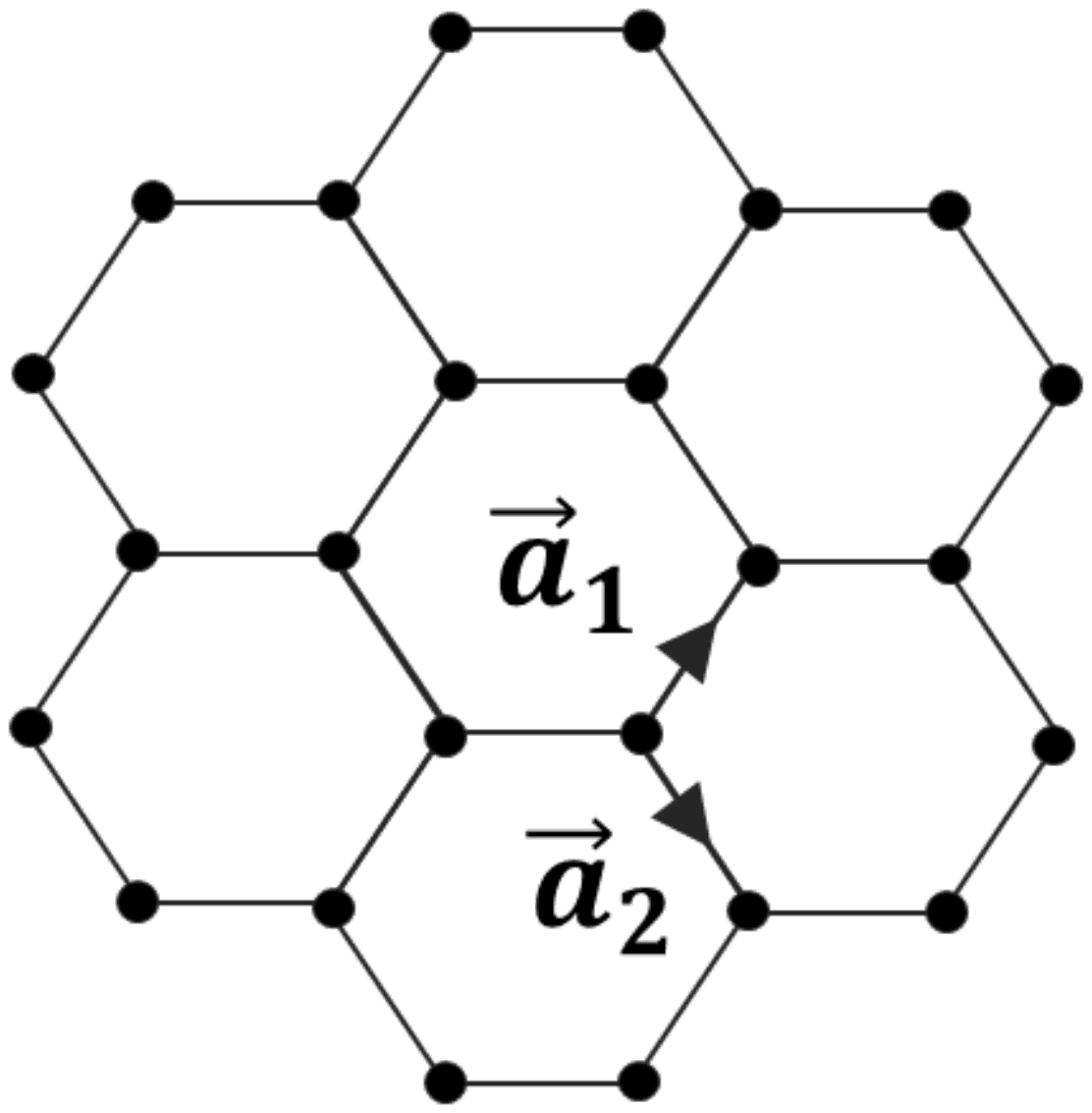
A honeycomb of carbon atoms with two arrows a1 and a2 drawn from one atom to its upper right and lower right neighbouring atoms

Exam Year(s)

GATE Physics - 2023,

Answer: A

The area is \(\frac{8\pi^{2}}{3\sqrt{3}a^{2}}\), with \(a\) read, as in the figure, as the carbon-carbon spacing.

The arrows \(\vec{a}_{1}\) and \(\vec{a}_{2}\) in the figure each join one carbon atom to a neighbouring atom, so the length \(a\) here is the C-C distance. The honeycomb's true Bravais lattice is triangular, with primitive vectors of length \(\sqrt{3}a\) at 60° to each other, so the real-space unit cell has area

\[ \begin{aligned} A_{cell} &= (\sqrt{3}a)^{2}\sin 60^{\circ} \\ &= \frac{3\sqrt{3}}{2}a^{2} \end{aligned} \]

The first Brillouin zone has area \((2\pi)^{2}/A_{cell}\):

\[ \begin{aligned} A_{BZ} &= \frac{4\pi^{2} \times 2}{3\sqrt{3}a^{2}} \\ &= \frac{8\pi^{2}}{3\sqrt{3}a^{2}} \end{aligned} \]

If \(a\) were instead the length of the primitive vectors, the same steps would give \(8\pi^{2}/\sqrt{3}a^{2}\); the key follows the figure's labelling. The options with \(4\pi^{2}\) drop the factor 2 that comes from \(\sin 60^{\circ} = \sqrt{3}/2\).

Please log in or register to report this question.

2.

A neutron beam with a wave vector \(\vec{k}\) and an energy 20.4 meV diffracts from a crystal with an outgoing wave vector \(\vec{k}'\). One of the diffraction peaks is observed for the reciprocal lattice vector \(G\) of magnitude 3.14 Å-1. What is the diffraction angle in degrees (rounded off to the nearest integer) that \(\vec{k}\) makes with the plane? (Use mass of neutron = 1.67 × 10⁻²⁷ Kg)

Exam Year(s)

GATE Physics - 2023,

Answer: B

The angle is 30°.

Find the neutron's wave number from its energy:

\[ \begin{aligned} E &= 20.4\ \text{meV} = 3.27 \times 10^{-21}\ \text{J} \\ p &= \sqrt{2mE} = 3.30 \times 10^{-24}\ \text{kg m/s} \\ k &= p/\hbar \approx 3.13\ \mathring{\mathrm{A}}^{-1} \end{aligned} \]

Elastic diffraction requires \(\vec{k}' - \vec{k} = \vec{G}\), which with \(|\vec{k}'| = |\vec{k}|\) is Bragg's law in the form \(G = 2k\sin\theta\), where \(\theta\) is the angle between \(\vec{k}\) and the reflecting planes:

\[ \begin{aligned} \sin\theta &= \frac{3.14}{2 \times 3.13} \approx 0.50 \\ \theta &= 30^{\circ} \end{aligned} \]

60° is the total scattering angle \(2\theta\), not the angle with the planes; 15° and 45° do not satisfy the Bragg condition.

Please log in or register to report this question.

3.

The X-ray diffraction pattern of a monatomic cubic crystal with rigid spherical atoms of radius 1.56 Å shows several Bragg reflections of which the reflection appearing at the lowest \(2\theta\) value is from (111) plane. If the wavelength of X-ray used is 0.78 Å, the Bragg angle (in \(2\theta\), rounded off to one decimal place) corresponding to this reflection and the crystal structure, respectively, are

Exam Year(s)

GATE Physics - 2024,

Answer: B

The reflection is at 2θ = 17.6°, and the crystal is face centered cubic.

In a cubic crystal the first reflection is (110) for body centered cubic and (111) for face centered cubic, so a lowest reflection from (111) means fcc. In fcc the atoms touch along the face diagonal, so 4r = a√2:

\[ \begin{aligned} a &= 2\sqrt{2}\,r = 2\sqrt{2} \times 1.56 = 4.41\ \text{\AA} \\ d_{111} &= a/\sqrt{3} = 2.55\ \text{\AA} \\ \sin\theta &= \frac{\lambda}{2d} = \frac{0.78}{5.10} = 0.153 \end{aligned} \]

So θ = 8.8° and 2θ = 17.6°. The option '8.8 and face centered cubic' gives θ, not 2θ. Both bcc options are ruled out because (111) is absent in bcc (h + k + l must be even).

Please log in or register to report this question.

4.

An X-ray diffraction pattern of cubic crystal of lattice parameter a = 3·16 Å is obtained using a monochromatic X-ray beam of wavelength 1·54 Å. The first line is obtained at θ = 20·3. The Miller indices (hkl value) of the corresponding diffracting plane is :

(Note : sin 20·3 = 0·34, sin 40·6 = 0·64)

Exam Year(s)

MH SET - 2018, SET Exam - 2018,

Answer: A

The plane is (110).

From Bragg's law in first order, the spacing of the diffracting planes is

\[ \begin{aligned} d &= \frac{\lambda}{2\sin\theta} = \frac{1.54}{2 \times 0.34} \\ &= 2.265\ \text{\AA} \end{aligned} \]

For a cubic crystal \( d = a/\sqrt{h^{2} + k^{2} + l^{2}} \), so

\[ \begin{aligned} \sqrt{h^{2} + k^{2} + l^{2}} &= \frac{3.16}{2.265} \\ &= 1.395 \approx \sqrt{2} \end{aligned} \]

The only integers with \( h^{2} + k^{2} + l^{2} = 2 \) are 1, 1, 0. The other planes give different spacings: (100) gives 3.16 Å, (200) gives 1.58 Å and (220) gives 1.12 Å. A first line from (110) is what a body-centred cubic lattice produces.

Please log in or register to report this question.

5.

The instrumental broadening of an X-ray diffractometer arising from non-monochromatic beam can be written as :

Exam Year(s)

MH SET - 2018, SET Exam - 2018,

Answer: B

The broadening is proportional to \( \frac{1}{d\cos\theta} \); the paper's α stands for 'is proportional to'.

A beam that is not strictly monochromatic contains a spread of wavelengths \( \Delta\lambda \). Differentiating Bragg's law \( \lambda = 2d\sin\theta \) at fixed \( d \):

\[ \begin{aligned} \Delta\lambda &= 2d\cos\theta\, \Delta\theta \\ \Delta\theta &= \frac{\Delta\lambda}{2d\cos\theta} \end{aligned} \]

so the angular spread of a line grows as \( 1/(d\cos\theta) \), that is as \( \tan\theta \) for a given line, and is worst at high angles. \( d\sin\theta \) and \( 1/(d\sin\theta) \) misplace the derivative, and \( 2\theta \) is simply the diffraction angle.

Please log in or register to report this question.

6.

The primitive translational vectors of the body centered lattice are given by

\[ \vec{a} = \frac{a}{2}(\hat{i} + \hat{j} - \hat{k}), \]

\[ \vec{b} = \frac{a}{2}(-\hat{i} + \hat{j} + \hat{k}), \]

\[ \vec{c} = \frac{a}{2}(\hat{i} - \hat{j} + \hat{k}), \]

where a is the side of the conventional unit cube and \(\hat{i}, \hat{j}, \hat{k}\) are orthogonal unit vectors parallel to the cube edges. The volume of the reciprocal lattice of bcc cell is :

Exam Year(s)

MH SET - 2019, SET Exam - 2019,

Answer: B

The volume is \(2(2\pi/a)^{3}\).

The volume of the primitive cell is the scalar triple product of the given vectors. For the bcc lattice it is half the conventional cube:

\[ \begin{aligned} V_{c} &= \vec{a}\cdot(\vec{b} \times \vec{c}) \\ &= \frac{a^{3}}{2} \end{aligned} \]

The reciprocal lattice cell has volume \((2\pi)^{3}/V_{c}\):

\[ \begin{aligned} V^{*} &= \frac{(2\pi)^{3}}{a^{3}/2} \\ &= 2\left(\frac{2\pi}{a}\right)^{3} \end{aligned} \]

The option \(\frac{1}{2}a^{3}\) is the direct-lattice primitive cell, not its reciprocal. The reciprocal of bcc is an fcc lattice, and the other options do not give its cell volume.

Please log in or register to report this question.

7.

In X-ray diffraction pattern the positions of the peaks depend on :

Exam Year(s)

MH SET - 2020, SET Exam - 2020,

Answer: D

Peak positions depend on the lattice constants of the planes of the crystal.

The angle of each diffraction peak is fixed by Bragg's law, \(2d\sin\theta = n\lambda\), where d is the spacing of the lattice planes. In a cubic crystal \(d = a/\sqrt{h^{2} + k^{2} + l^{2}}\), so the positions are set by the lattice constant and the crystal structure.

The size of the crystallites affects the width of the peaks (the Scherrer formula), not their positions. The shape of the crystal and its texture (preferred orientation of grains) change the relative intensities of the peaks, again leaving their positions unchanged.

Please log in or register to report this question.

8.

The first reflection from FCC crystal is observed at Bragg angle θ = 21.5°, the θ corresponding to the second reflection is :

Exam Year(s)

MH SET - 2023, SET Exam - 2023,

Answer: C

The second reflection is at about 25.0°.

In an FCC lattice reflections appear only when h, k, l are all odd or all even, so the first two are (111) and (200). With \(d = a/\sqrt{h^{2} + k^{2} + l^{2}}\), Bragg's law gives \(\sin\theta \propto \sqrt{h^{2} + k^{2} + l^{2}}\):

\[ \begin{aligned} \sin\theta_{2} &= \sin 21.5^{\circ}\sqrt{\tfrac{4}{3}} \\ &= 0.3665 \times 1.1547 = 0.4232 \\ \theta_{2} &= 25.0^{\circ} \end{aligned} \]

The second reflection must come at a larger angle than the first, which rules out 13.5° and 18.5°. 36.8° would be the angle for (220), which is the third FCC reflection, not the second.

Please log in or register to report this question.

9.

A lattice is characterized by the following primitive vectors \(\vec{a} = 2(\hat{i} + \hat{j})\), \(\vec{b} = 2(\hat{j} + \hat{k})\), \(\vec{c} = 2(\hat{k} + \hat{i})\). The reciprocal lattice corresponding to the above is :

Exam Year(s)

MH SET - 2023, SET Exam - 2023,

Answer: B

The reciprocal lattice is bcc with cube edge π.

The vectors \(2(\hat{i} + \hat{j})\), \(2(\hat{j} + \hat{k})\), \(2(\hat{k} + \hat{i})\) are the primitive vectors of an fcc lattice of cube edge a = 4, since fcc primitive vectors are \(\frac{a}{2}(\hat{i} + \hat{j})\) and so on. The reciprocal of an fcc lattice of edge a is a bcc lattice of cube edge \(4\pi/a\):

\[ \frac{4\pi}{a} = \frac{4\pi}{4} = \pi \]

Direct calculation agrees: \(\vec{b}_{1} = 2\pi(\vec{b}\times\vec{c})/V\) with V = 16 gives \(\frac{\pi}{2}(1, 1, -1)\), a bcc primitive vector of cube edge \(\pi\). The fcc options mistake the reciprocal for the direct lattice type, and an edge of \(2\pi\) comes from taking a = 2.

Please log in or register to report this question.

10.

The first Brillouin zone of FCC lattice is :

Exam Year(s)

MH SET - 2024, SET Exam - 2024,

Answer: B

The first Brillouin zone of the FCC lattice is a Truncated octahedron.

The reciprocal lattice of FCC is BCC. The first Brillouin zone is the Wigner-Seitz cell of that BCC reciprocal lattice, bounded by planes bisecting the 8 nearest and 6 next-nearest reciprocal lattice vectors. This gives a truncated octahedron with 8 hexagonal and 6 square faces.

The rhombic dodecahedron is the first Brillouin zone of the BCC lattice (whose reciprocal is FCC). A cube is the zone of the simple cubic lattice.

Please log in or register to report this question.

Loading…

Other Subjects

Tags: Reciprocal Lattice and Diffraction Questions and Answers || Reciprocal Lattice and Diffraction MCQ Questions and Answers || Reciprocal Lattice and Diffraction GK Questions and Answers || Reciprocal Lattice and Diffraction GK MCQ Questions || Reciprocal Lattice and Diffraction Multiple Choice Questions and Answers || Reciprocal Lattice and Diffraction GK || GK on Reciprocal Lattice and Diffraction || Solid State Physics Questions and Answers || Solid State Physics MCQ Questions and Answers || Solid State Physics GK Questions and Answers || GK on Solid State Physics