Machine-translated by Google. Questions are authored in English.
Top

Completion of Incomplete Pattern Questions and Answers

11.

Which one of the patterns labelled P, Q, R, and S is used to generate the following figure?
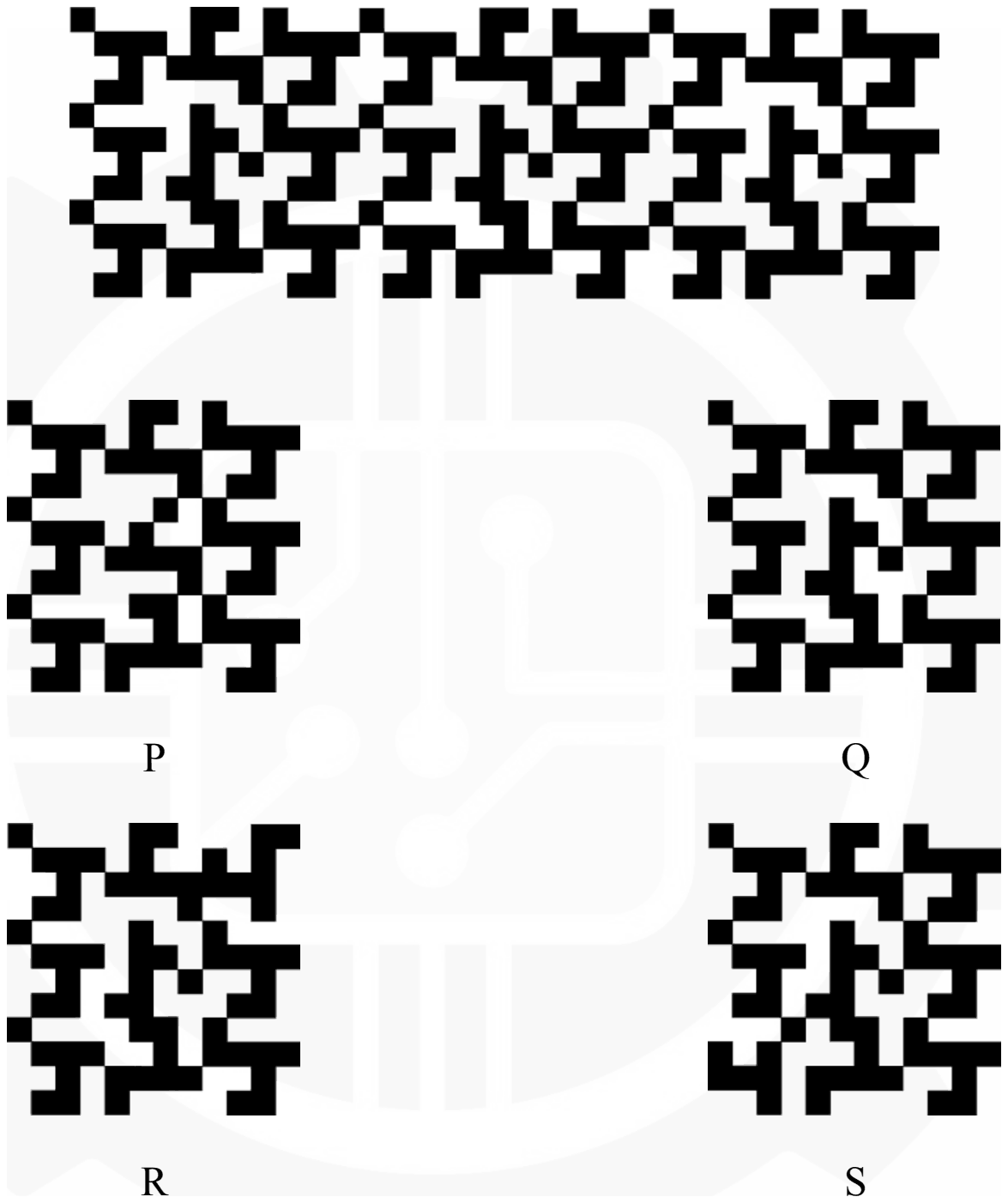
A wide black and white tiled figure above four square candidate patterns labelled P, Q, R and S

Exam Year(s)

GATE ME - 2026,

Answer: B

The figure is generated by pattern Q.

The wide figure is three copies of one square tile placed side by side. Comparing that tile with the four candidates cell by cell, Q matches it everywhere.

Each of the others differs from the tile in one region: P has a different arrangement in its centre, R in its top right corner, and S in its bottom left corner, where it shows a block shape that never appears in the figure. Checking the corners and the centre first is the quick way to separate near-identical patterns like these.

Please log in or register to report this question.
12.

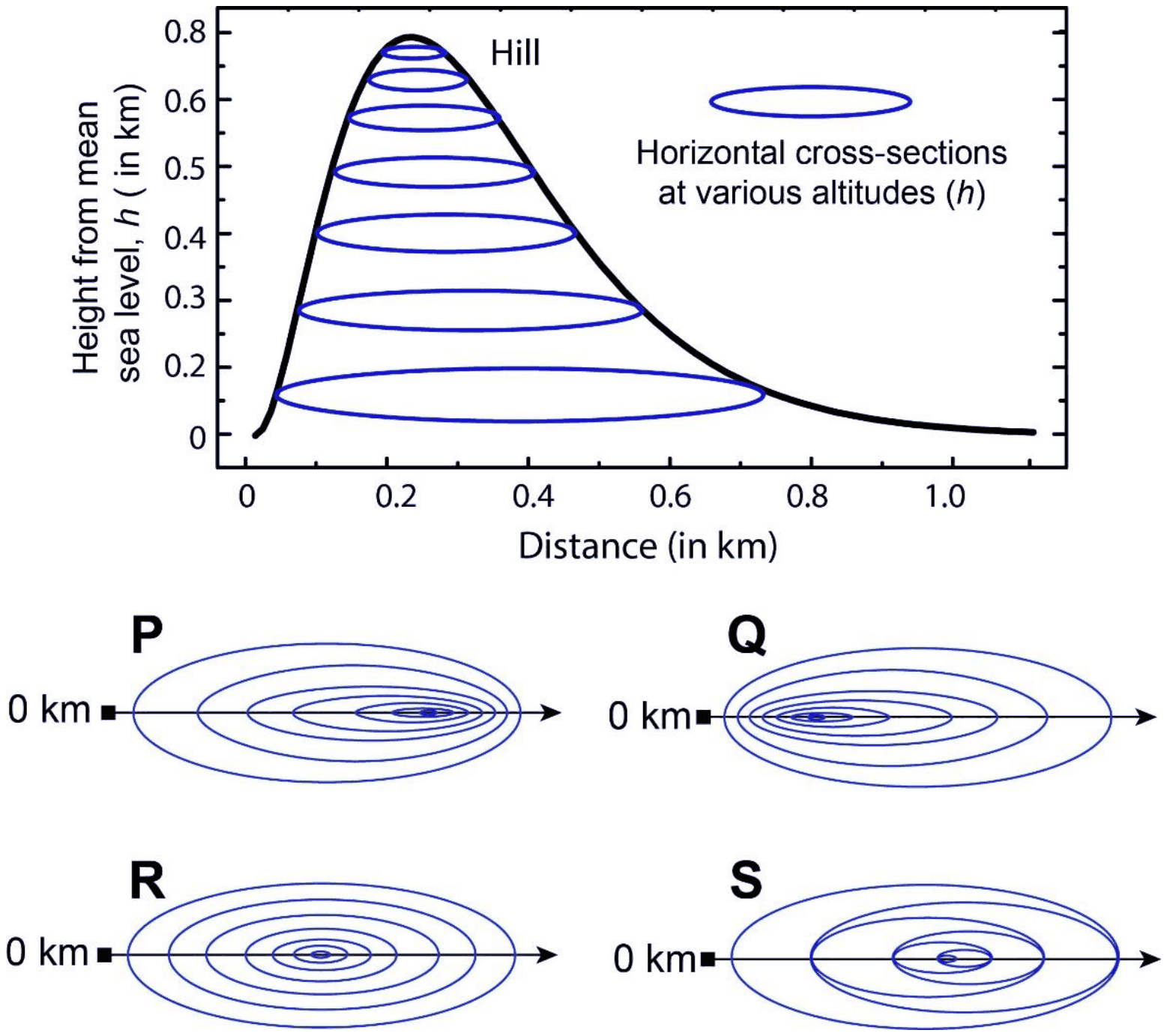
In the given diagram, ovals are marked at different heights (h) of a hill. Which one of the following options P, Q, R, and S depicts the top view of the hill?

Side profile of a hill peaking at 0.8 km about 0.22 km from the origin, steep on the left and sloping gently to the right, with horizontal cross-sections at several heights; below it four top views P, Q, R and S of nested ovals

Exam Year(s)

GATE XE - 2023,

Answer: B

The top view is Q.

The profile shows the hill rising steeply on the near side (summit at about 0.22 km from the origin) and sloping gently away beyond it. Seen from above, each horizontal cross-section becomes an oval. Near the summit they are small and sit close to the origin end. Lower down they grow, but their near edges stay close together, because the near slope is steep, while their far edges spread out, because the far slope is gentle.

Q shows exactly this: the smallest ovals near the origin end and the outlines crowded on the left and spread out on the right. P puts the summit on the far side, R draws concentric ovals for a symmetric hill, and S does not crowd the outlines towards the origin side.

Please log in or register to report this question.
13.

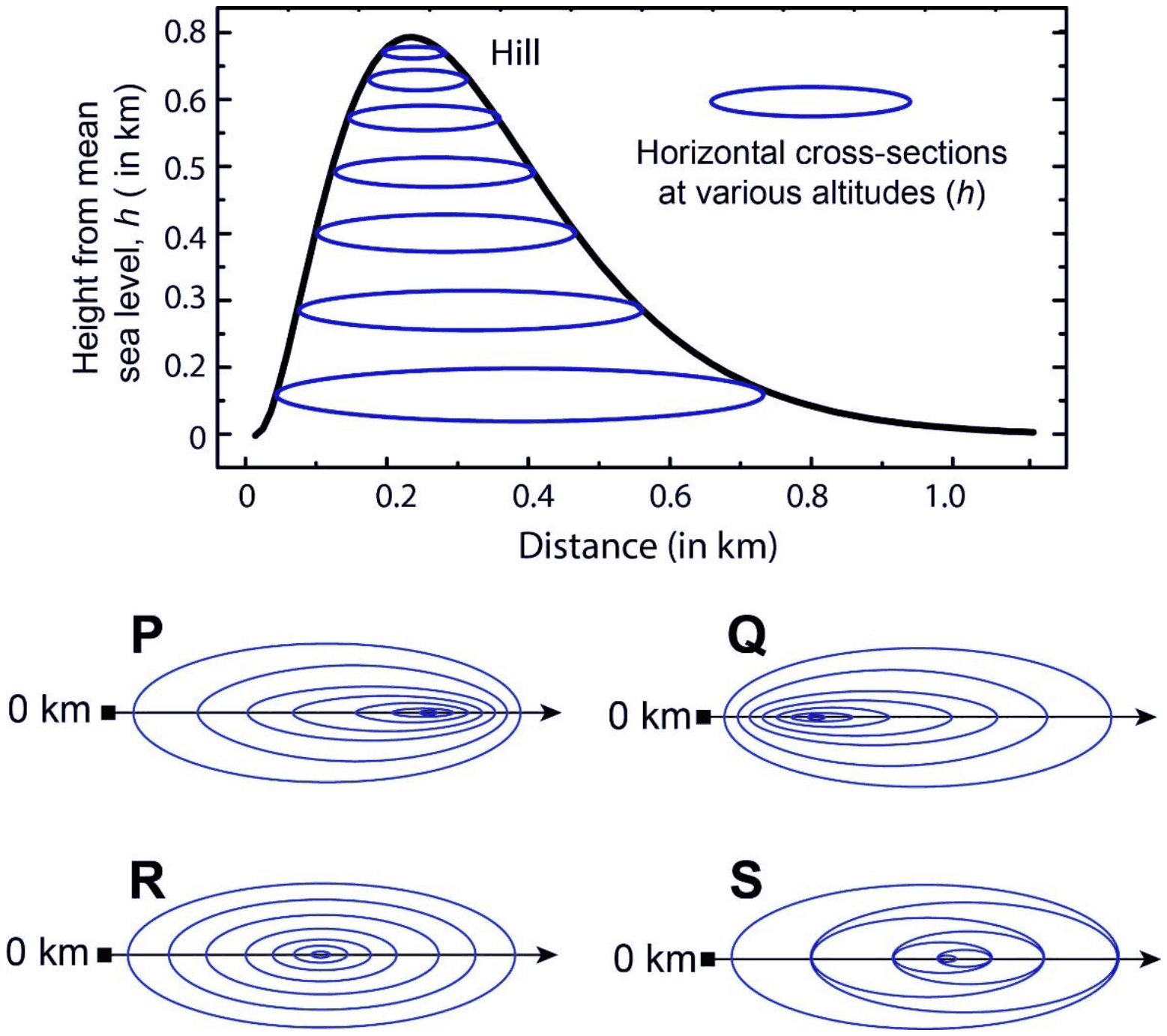
In the given diagram, ovals are marked at different heights (\(h\)) of a hill. Which one of the following options P, Q, R, and S depicts the top view of the hill?

Side profile of a hill rising steeply to a peak of 0.8 km at about 0.22 km and falling gently to 1.1 km, with horizontal cross-section ovals at several heights, and four top views P, Q, R, S of nested ovals drawn from a 0 km mark

Exam Year(s)

GATE Life Sciences - 2023,

Answer: B

The top view is Q.

The hill rises steeply on the side near 0 km and falls gently on the far side, with its summit at about 0.22 km. The cross-sections higher up the hill are smaller ovals, and they are centred close to the summit, near the 0 km end. Seen from above, the nested ovals therefore crowd together close to the 0 km mark, where the slope is steep, and spread out on the far side, where the slope is gentle.

Q shows exactly this: the smallest ovals sit near the left, close to 0 km. P puts the summit at the far end, as if the gentle slope faced 0 km. R has evenly spaced, concentric ovals, which would describe a symmetric hill. S does not shift the ovals steadily in one direction.

Please log in or register to report this question.

14.

What comes in place of question mark?

A row of five squares, each divided by diagonals into four triangles carrying the symbols S, C, P and arrows; the middle square is a question mark

Exam Year(s)

ISRO Assistant - 2023,

Answer: B

The missing square is number 2: double arrow at the top, PP on the left, C on the right and S at the bottom.

Count each symbol in the squares. Figure 1 has S, C, P and one arrow, each once. Figure 2 has P doubled (PP). Figure 4 has the arrow doubled and C doubled. Figure 5 has S doubled. Each step adds one repeat to one symbol, in the order P, arrow, C, S, so figure 3 has PP and a double arrow, with a single C and S.

Positions turn 90 degrees clockwise at every step: in figure 1 the order from the top is S, P, arrow, C, and in figure 2 it is C, S, PP, arrow. Rotating figure 2 once more puts the double arrow at the top, then C on the right, S at the bottom and PP on the left. Check: turning this once more gives figure 4, which has PP at the top and the arrows on the right, as printed.

Option 1 has the symbols in the wrong places; option 3 has CC; option 4 has C and S swapped.

Please log in or register to report this question.

15.

Consider the following matrix :

↑↓↑↑↓↑
↓→↓←↑←
←↓→↑

Which one of the following figures fits into the blank part of the above matrix ?

Exam Year(s)

Kerala PSC KAS - 2020,

Answer: A

The blank is filled by ←↑.

Read each row as three figures of two arrows. Within every row, the first arrows follow the pattern same, same, reversed: up, up, down in row 1 and down, down, up in row 2. So row 3, with left in the first figure and right in the third, needs left in the middle.

The second arrows follow the pattern given, reversed, same: down, up, up in row 1 and right, left, left in row 2. So row 3, with down first and up third, needs up in the middle.

That gives left then up. The other figures get one arrow wrong: left-down repeats the first figure, and right-up and right-down break the first-arrow pattern.

Please log in or register to report this question.

16.

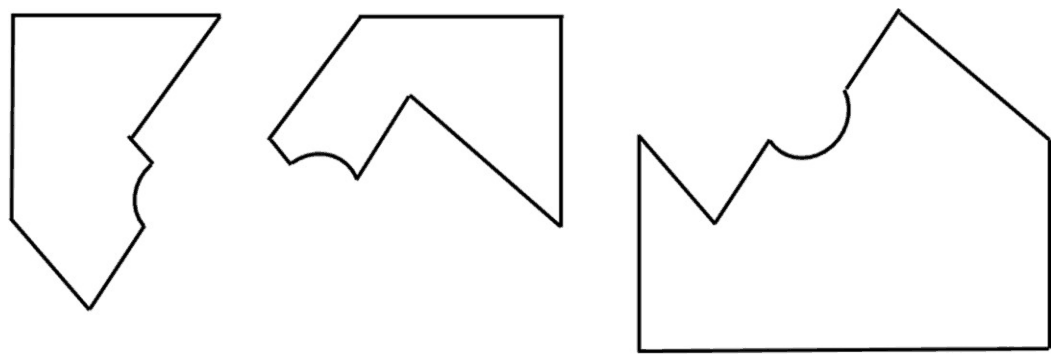
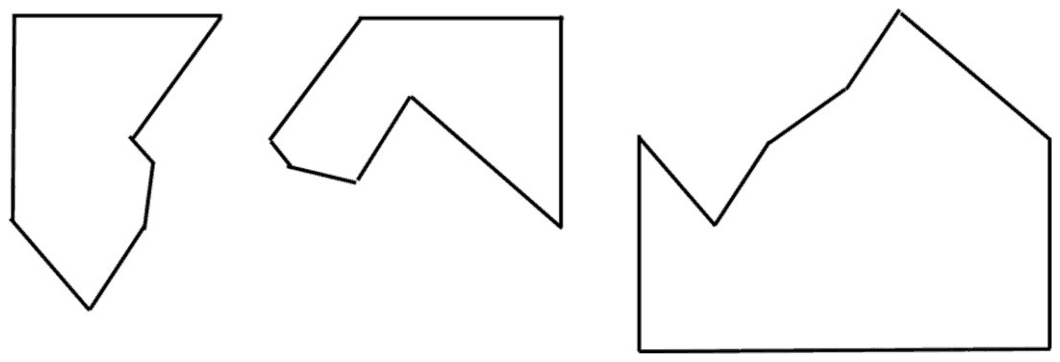
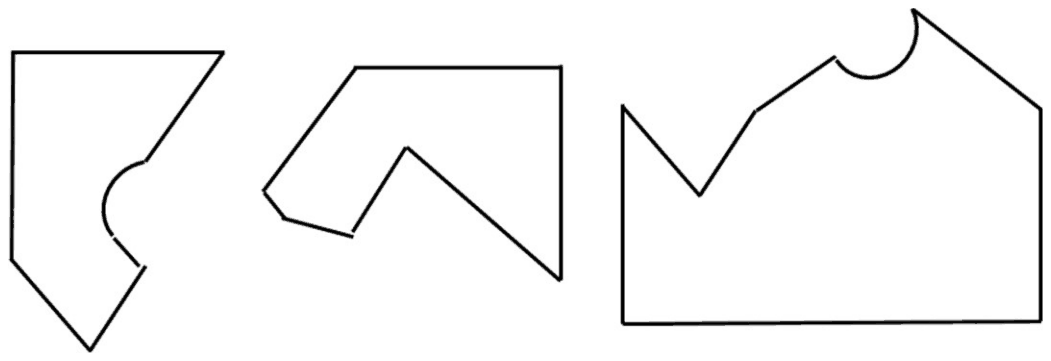
Which one of the following sets of pieces can be assembled to form a square with a single round hole near the center? Pieces cannot overlap.

Exam Year(s)

GATE Chemistry - 2022,

Answer: C

The set that works is (C).

In each set, two pieces carry square corners at the top (the left piece the top-left corner, the middle piece the top-right corner) and the large piece has a flat bottom and two square lower corners, so together they can make a square. The pointed lower end of the left piece fits the V-shaped notch in the top edge of the large piece, and the peak of the large piece fits under the inverted V of the middle piece.

The hole comes from curved notches. In (C) each of the three pieces has a curved notch on an inner edge, and when the pieces are fitted together the three notches meet near the centre to close one round hole.

(D) has no curved notch on any piece, so it cannot leave a round hole. In (A) the middle piece has no notch, and the notch on the large piece is cut beside its peak rather than at the inner corner, so the curved edges do not come together as one circle. In (B) the third piece is a four-sided piece with no inverted V, so it cannot fit over the peak of the large piece and the pieces do not form a square.

Please log in or register to report this question.

17.

Find out the correct figure from the multiple choices for the question mark shown below to make the series in order :

Series of four boxes: a triangle inside a pentagon, a square inside a triangle, a question mark, a pentagon inside a circle

Exam Year(s)

MPPSC State Service - 2018,

Answer: B

The missing figure is (B), a circle inside a square.

In each box the inner shape becomes the outer shape of the next box. The first box has a triangle inside a pentagon; the second has that triangle as its outer shape, with a square inside. So the third box must have the square as its outer shape. The fourth box is a pentagon inside a circle, so the circle must be the inner shape of the third box: a circle inside a square.

Option (A) has a circle outside, (C) a pentagon outside and (D) a triangle outside, so none of them continues the chain from the square.

Please log in or register to report this question.

18.

Which is the missing square in the following options?

Three by three grid of triangles, some inverted, some with a small circle, some with a vertical stem; the centre square is empty

Exam Year(s)

MPPSC State Service - 2018,

Answer: B

The missing square is (B), a plain inverted triangle.

Every row and every column holds one triangle with a circle inside, one triangle with stems at top and bottom, and one plain triangle, and each row has exactly one inverted triangle.

The middle row already has a stemmed upright triangle and an upright triangle with a circle, so it needs a plain triangle, and since the row has no inverted triangle yet, it must be inverted. The middle column confirms it: it has a stemmed triangle and a circled triangle, so it also needs the plain one.

(A) adds a second stemmed triangle and (C) a second circled one to the row, while (D) is plain but upright, leaving the row without an inverted triangle.

Please log in or register to report this question.
Loading…