Machine-translated by Google. Questions are authored in English.
Top

Series Completion Questions and Answers

Important Instructions
91.

To continue the sequence of tiles shown, the tile indicated by the question mark should be

Seven square tiles in a row: blank, one dot, one dot, two dots, three dots, five dots, then a dashed tile with a question mark

Exam Year(s)

GATE AG - 2026,

Answer: C

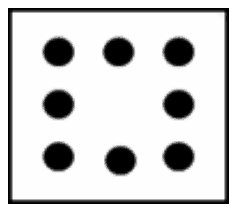
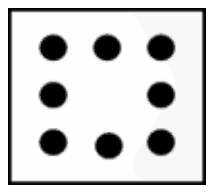
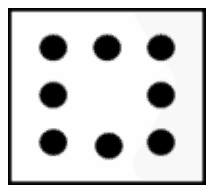
The missing tile is (C), the tile with eight dots.

Count the dots in the tiles from left to right: 0, 1, 1, 2, 3, 5. Each count from the third onward is the sum of the two before it (0 + 1 = 1, 1 + 1 = 2, 1 + 2 = 3, 2 + 3 = 5), which is the Fibonacci sequence. The next term is 3 + 5 = 8, so the seventh tile must carry eight dots.

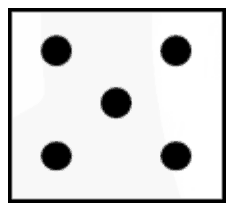
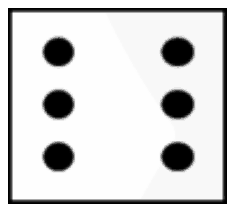
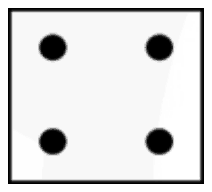
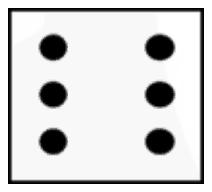
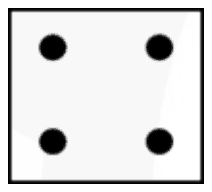
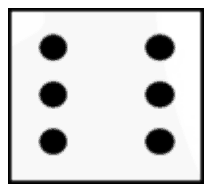
Tile (A) has 4 dots, tile (B) has 6 and tile (D) has 9; none of these continues the sequence. Tile (C) has eight dots arranged round the edge of the tile, which is the only eight-dot choice.

Please log in or register to report this question.

92.

In the sequence of tiles shown below, the missing tile indicated by the question mark should be

Five square tiles in a row holding 2 dots, 3 dots, a dashed tile with a question mark, 7 dots and 11 dots

Exam Year(s)

GATE Chemistry - 2026,

Answer: B

The missing tile is (B), the tile with 5 dots.

Count the dots in the given tiles: 2, 3, ?, 7, 11. These are consecutive prime numbers, and the prime between 3 and 7 is 5. Tile (B) is the only option with five dots.

Tile (A) has 4 dots and tile (C) has 6, neither of which is prime. Tile (D) has 8 dots, which is neither prime nor the term between 3 and 7. A difference pattern does not work either: the gaps 1, ?, ?, 4 are only explained by the primes, so 5 is the term that keeps the sequence consistent.

Please log in or register to report this question.

93.

To continue the sequence of tiles shown, the tile indicated by the question mark should be
(The figure shows a row of square tiles holding, in order, 0, 1, 1, 2, 3 and 5 dots, followed by a dashed tile marked ?.)

Exam Year(s)

GATE Mathematics - 2026,

Answer: C

The missing tile is the tile with 8 dots.

The tiles hold 0, 1, 1, 2, 3 and 5 dots. From the third tile on, each count is the sum of the two before it, which is the Fibonacci sequence:

\[ \begin{aligned} 0 + 1 &= 1, \quad 1 + 1 = 2, \quad 1 + 2 = 3 \\ 2 + 3 &= 5, \quad 3 + 5 = 8 \end{aligned} \]

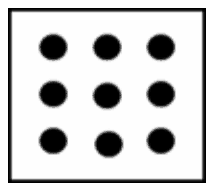
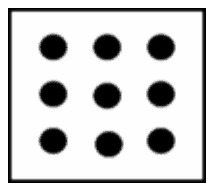
So the next tile must carry 8 dots. The tiles with 4 and 6 dots fall short, and the 3 by 3 tile with 9 dots is one too many; a simple 'add one more dot' or 'square number' rule does not fit the counts already shown.

Please log in or register to report this question.

94.

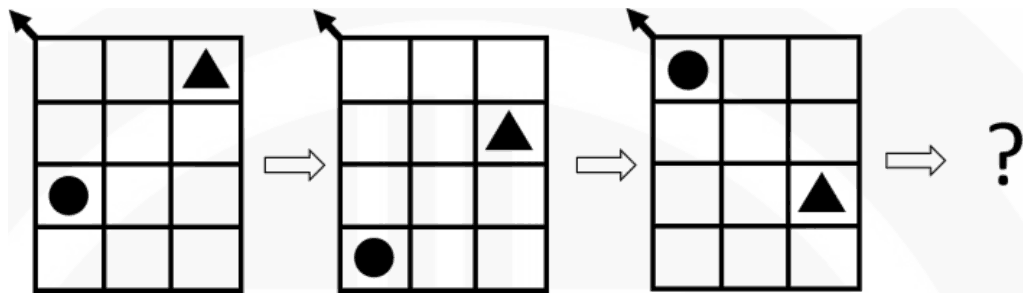
The next figure (indicated by '?') in the sequence is

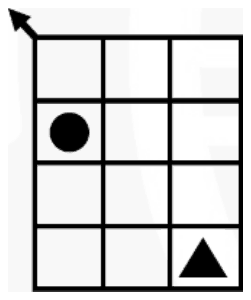
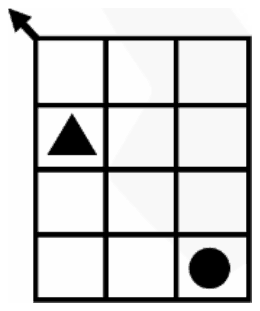
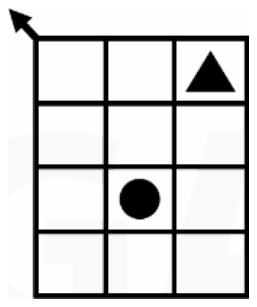
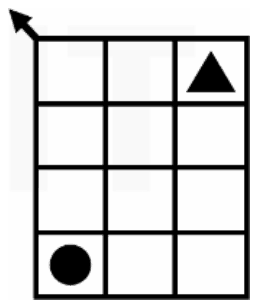
Three 3 by 4 grids in sequence, each with a black circle in the first column and a black triangle in the third column, followed by a question mark

Exam Year(s)

GATE ME - 2026,

Answer: A

The next figure is option (A), with the circle in row 2 of the first column and the triangle in the bottom row of the third column.

Track each shape separately. The triangle stays in the third column and moves down one row each step: row 1, row 2, row 3, so next it is in row 4. The circle stays in the first column and also moves down one row each step, wrapping round from the bottom to the top: row 3, row 4, row 1, so next it is in row 2.

Option (B) swaps the shapes' columns, option (C) moves the circle into the middle column and puts the triangle back in row 1, and option (D) leaves the circle in row 4 and the triangle in row 1. Only (A) continues both movements.

Please log in or register to report this question.

95.

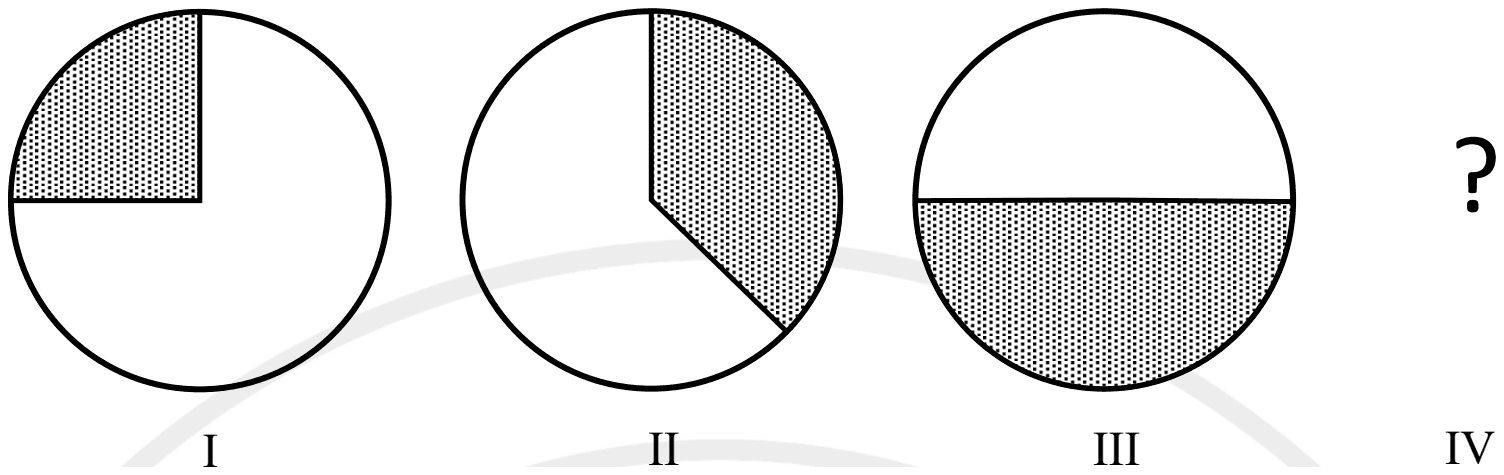
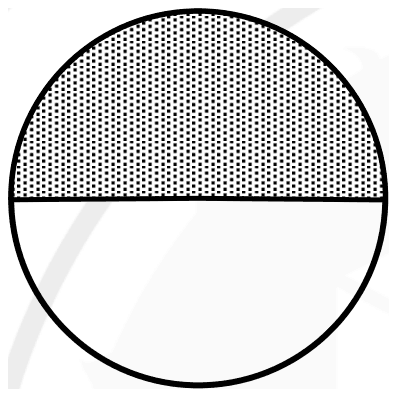
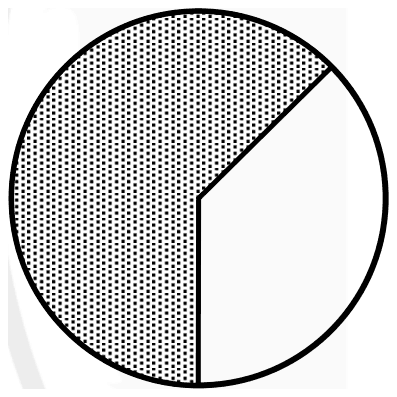
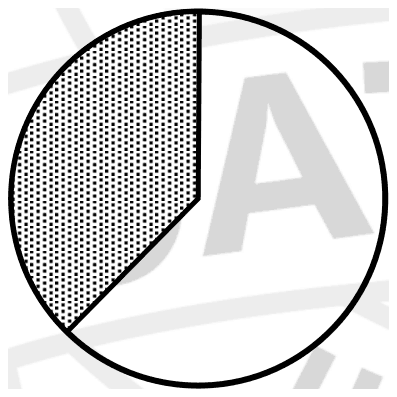
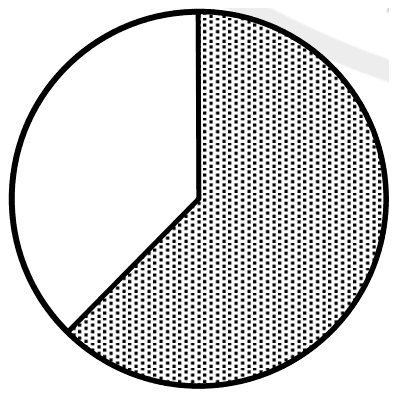
The figures I, II and III are parts of a sequence. Which one of the following options comes next in the sequence at IV?

Three circles with a dotted shaded sector: I a quarter at upper left, II a wedge from 12 o'clock to about half past 4, III the lower half; IV is a question mark

Exam Year(s)

GATE Physics - 2025,

Answer: B

The next figure is (B).

Two things change from figure to figure. The shaded sector grows by 45° each time: 90° in I, 135° in II and 180° in III, so IV must shade 225°. And the sector's starting edge turns 90° clockwise each time: I starts at 9 o'clock, II at 12 o'clock and III at 3 o'clock, so IV must start at 6 o'clock.

A 225° sector running clockwise from 6 o'clock covers the left side and the top and ends at about half past one, leaving 135° unshaded on the right. That is option (B).

(A) shades only a half, like III. (C) shades a sector of about 135°, and (D) shades the right side, the mirror image of the required figure.

Please log in or register to report this question.

96.

In the context of the given figure, which one of the following options correctly represents the entries in the blocks labelled (i), (ii), (iii), and (iv), respectively?

NUF(i)
211496
HL(ii)O
12(iv)15(iii)

[In the figure, thick lines divide this 4 by 4 grid into four 2 by 2 blocks: each block holds two letters in its top row and two numbers in its bottom row.]

Exam Year(s)

GATE XE - 2025,

Answer: C

The entries are I, J, 10, and 8.

In each 2 by 2 block the numbers are the alphabet positions of the two letters above, written in the opposite order. N is 14 and U is 21, and the block shows 21, 14.

  • Top right: F is 6 and the bottom row reads 9, 6, so (i) is the 9th letter, I.
  • Bottom left: H is 8 and L is 12; the bottom row reads 12, (iv), so (iv) = 8.
  • Bottom right: the bottom row reads 15, (iii); 15 is the value of O, the second letter, so (iii) is the value of the first letter (ii). J and 10 fit.

Only option C gives (ii) = J and (iii) = 10, consistent with J being the 10th letter, together with (i) = I and (iv) = 8. The other options break the rule: K and L are not the 9th letter, and Q with 12 do not match.

Please log in or register to report this question.

97.

To continue the sequence of tiles shown, the tile indicated by the question mark should be
Seven square tiles in a row: the first is blank, the next two have one dot each, then tiles with 2, 3 and 5 dots, and a dashed tile with a question mark

Exam Year(s)

GATE XE - 2026,

Answer: C

The missing tile is (C), the tile with 8 dots.

Count the dots in the tiles in order: 0, 1, 1, 2, 3, 5. From the third tile on, each count is the sum of the two before it (1 = 0 + 1, 2 = 1 + 1, 3 = 1 + 2, 5 = 2 + 3), which is the Fibonacci sequence.

The next count is therefore 3 + 5 = 8. Tile (C) has 8 dots, while (A) has 4, (B) 6 and (D) 9, none of which continues the sequence.

Please log in or register to report this question.

98.

In the context of the given figure, which one of the following options correctly represents the entries in the blocks labelled (i), (ii), (iii), and (iv), respectively?

NUF(i)
211496
HL(ii)O
12(iv)15(iii)

(The figure draws heavy borders dividing this grid into four 2 × 2 blocks.)

Exam Year(s)

GATE Life Sciences - 2025,

Answer: C

The entries are I, J, 10, and 8.

Read each 2 × 2 block as two letters above two numbers, with letters standing for their alphabet positions (A = 1, ..., Z = 26). In every block the left number is the left letter's position plus a fixed step, and the right number is the right letter's position minus the same step:

  • Top left: N = 14 and 14 + 7 = 21; U = 21 and 21 - 7 = 14.
  • Top right: F = 6 and 6 + 3 = 9; so (i) must be the letter whose position minus 3 is 6, which is 9 = I.
  • Bottom left: H = 8 and 8 + 4 = 12; L = 12, so (iv) = 12 - 4 = 8.
  • Bottom right: (ii) + 5 = 15 gives 10 = J; O = 15, so (iii) = 15 - 5 = 10.

Only I (9) satisfies the top-right block, since 9 - 3 = 6; Q (17), K (11) and L (12) all fail it, which rules out the other three options at the first entry.

Please log in or register to report this question.

99.

To continue the sequence of tiles shown, the tile indicated by the question mark should be
Six square tiles holding 0, 1, 1, 2, 3 and 5 dots, followed by a dashed tile marked with a question mark

Exam Year(s)

GATE Life Sciences - 2026,

Answer: C

The missing tile holds 8 dots, which is the tile in option (C).

Count the dots in the six tiles: 0, 1, 1, 2, 3, 5. From the third tile on, each count is the sum of the two before it (1 = 0 + 1, 2 = 1 + 1, 3 = 1 + 2, 5 = 2 + 3), the Fibonacci rule. The next count is therefore 3 + 5 = 8.

Option (C) shows 8 dots (three in the top row, one at each side of the middle row, three in the bottom row). Option (A) has 4, option (B) has 6 and option (D) has 9, none of which continues the sequence; 9 is the trap for anyone who simply fills the grid.

Please log in or register to report this question.

100.

In the sequence of tiles shown below, the missing tile indicated by the question mark should be

Five tiles: 2 dots, 3 dots, a tile with a question mark, 7 dots, 11 dots

Exam Year(s)

GATE Physics - 2026,

Answer: B

The missing tile is the one with 5 dots, tile (B).

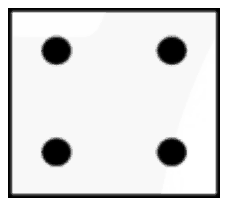
The tiles hold 2, 3, ?, 7 and 11 dots. These are consecutive prime numbers, and the prime between 3 and 7 is 5, so the missing tile must carry 5 dots. Tile (B) has four dots at the corners and one in the centre, five in all.

Tile (A) has 4 dots, (C) has 6 and (D) has 8, and none of these is prime. The prime sequence also accounts for the uneven growth of the tiles: the gaps 1, 2, 2, 4 between 2, 3, 5, 7 and 11 are exactly the gaps between consecutive primes, which no simple arithmetic rule would give.

Please log in or register to report this question.
Loading…
Tags: Series Completion Questions and Answers || Series Completion MCQ Questions and Answers || Series Completion GK Questions and Answers || Series Completion GK MCQ Questions || Series Completion Multiple Choice Questions and Answers || Series Completion GK || GK on Series Completion || Reasoning Questions and Answers || Reasoning MCQ Questions and Answers || Reasoning GK Questions and Answers || GK on Reasoning