Machine-translated by Google. Questions are authored in English.
Top

Miscellaneous Logical Puzzles Questions and Answers

Important Instructions
1.

The opposite sides of a solid cube of 8 ×8×8 cm is coloured with Red, Green and Yellow. After that cube is cut into 2 cm small and equal size cubes. Number of small cubes which have two sides coloured with Red and Yellow is :

Exam Year(s)

CBSE Assistant Secretary - 2024,

Answer: D

The number of such cubes is 8.

Cutting an 8 cm cube into 2 cm cubes gives \(4 \times 4 \times 4 = 64\) small cubes, 4 along each edge. Each pair of opposite faces has one colour: two red faces, two green and two yellow.

A small cube with exactly two coloured faces lies on an edge of the big cube but not at a corner. The edges where a red face meets a yellow face number \(2 \times 2 = 4\), and each such edge has \(4 - 2 = 2\) non-corner cubes. So there are \(4 \times 2 = 8\) cubes coloured red and yellow.

16 counts all four cubes along each red-yellow edge, including the corner cubes, which have three coloured faces; 4 counts only one cube per edge, and 32 counts far more edges than meet red to yellow.

Please log in or register to report this question.

2.

Find the number of triangles in the following figure :

Two squares side by side, each with both diagonals drawn and sharing a middle side, with a small triangle on top of and below each square and a plain rectangle attached at each outer side.

Exam Year(s)

CBSE Assistant Secretary - 2024,

Answer: B

There are 22 triangles.

The two outer rectangles carry no diagonals and give none. The central block is two squares side by side, each with both diagonals drawn.

Each square gives 8: the 4 small triangles that meet at its centre, and the 4 half-square triangles cut off by its diagonals (two diagonals, two halves each). Two squares give 16. The two squares together give 2 more large triangles, one with its base along the whole top edge of the block and its apex at the middle of the bottom edge, and one the other way up. The small triangles standing on the top and bottom edges of the squares add 4 more, two above and two below.

The total is \(16 + 2 + 4 = 22\). Counting only 16 plus the 4 outer triangles gives 20, and 18 and 24 come from missing or double counting the large triangles.

Please log in or register to report this question.
3.

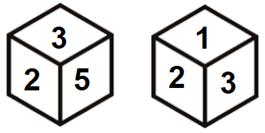
Two different positions of the same dice are shown. Select the number that will be on the face opposite to the one having 1.

Two views of one dice. First view: 3 on top, 2 on the left face, 5 on the right face. Second view: 1 on top, 2 on the left face, 3 on the right face.

Exam Year(s)

DSSSB - 2023,

Answer: C

Faces 2 and 3 appear in both views, so they are the clue. In the first view the 2 is on the left, the 3 is on top and the 5 is on the right; in the second view the 2 is still on the left, the 3 has moved to the right and the 1 is on top. So the cube has been turned about the axis through the face 2: the face that was on top (3) has gone to the right, the face that was on the right (5) has gone to the bottom, and the face that was at the back has come to the top, which is the 1. The face at the back was the one opposite to 5, so 1 is opposite to 5. The answer is 5, option (C).

Please log in or register to report this question.
4.

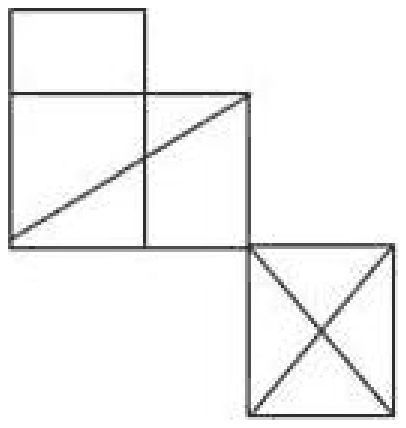
How many triangles are there in the given figure?

Figure made of a square, a rectangle with one diagonal and a square with both diagonals, joined corner to corner

Exam Year(s)

DSSSB - 2023,

Answer: B

The figure has 12 triangles.

The square with both diagonals has 4 small triangles and 4 larger triangles made of two neighbouring ones, which is 8 triangles in all. The block with one diagonal has 4 more triangles formed between the diagonal, the sides of the block and the inner line: the large one at the bottom, the small one at the bottom left, the one against the top line, and the small one against the inner line. That is 8 + 4 = 12.

9, 10 and 8 miss some of the triangles formed by combining parts.

Count in groups to avoid missing any. The crossed square has its four small triangles and four larger ones made of two small ones. The diagonal block has two triangles on each side of the inner line and the big ones that use the whole diagonal. Adding the groups gives 12.

Please log in or register to report this question.

5.

Three different positions of the same dice are shown. Which pattern will be on the face opposite to the one having 'O'?

Three views of one dice showing a sun-like pattern, a zigzag arrow pattern and a circle

Exam Year(s)

DSSSB TGT - 2023,

Answer: B

The face opposite the 'O' carries the zigzag arrow pattern, option (B). In views 1 and 3 the sun-like pattern and the zigzag arrow stay on the same two faces, but the top face changes: it is a Z-like pattern in view 1 and the circle 'O' in view 3. The two faces that touch both the sun and the arrow faces must be opposite each other, so the circle is opposite the Z-like zigzag pattern. The ring and the star are different patterns and the sun-like face already shares an edge with the circle in view 3, so neither can be opposite it.

Please log in or register to report this question.

6.

A line of symmetry is defined as a line that divides a figure into two parts in a way such that each part is a mirror image of the other part about that line.

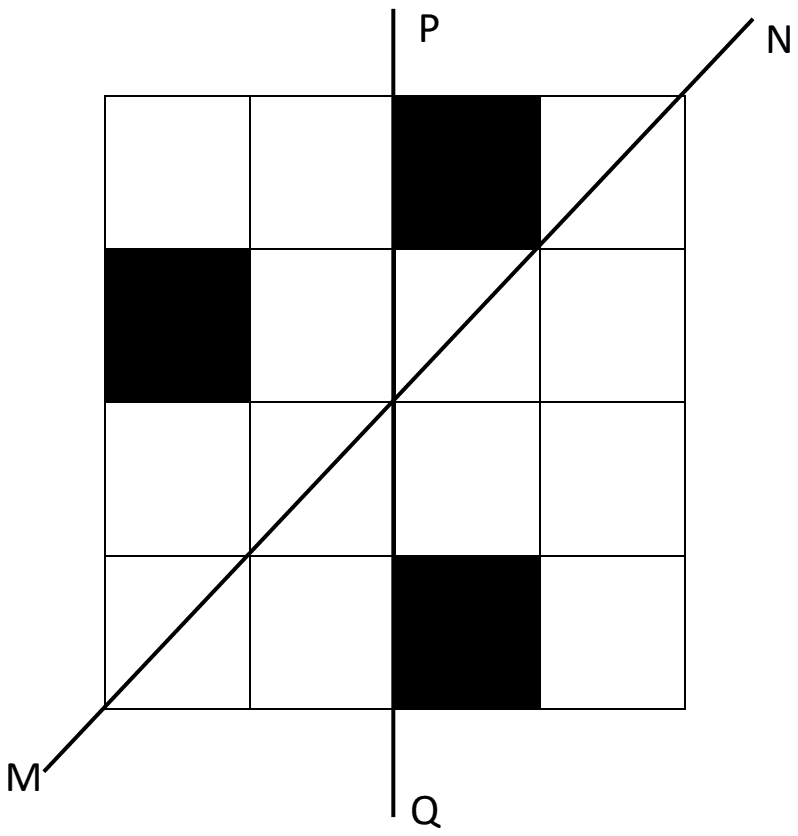
The given figure consists of 16 unit squares arranged as shown. In addition to the three black squares, what is the minimum number of squares that must be coloured black, such that both PQ and MN form lines of symmetry? (The figure is representative)

A 4 by 4 grid of unit squares with the vertical line PQ through its centre and the diagonal MN from the bottom-left to the top-right corner; black squares at row 1 column 3, row 2 column 1 and row 4 column 3, counting from the top left

Exam Year(s)

GATE AE - 2023, GATE AG - 2023,

Answer: C

The minimum number of extra black squares is 5.

Number columns 1 to 4 from the left and rows 1 to 4 from the top. PQ is the vertical centre line, so it maps column c to column 5 − c. MN is the diagonal from the bottom-left corner to the top-right corner, so it swaps a square’s column with its height above the bottom edge. For both lines to be lines of symmetry, the black set must be unchanged by both reflections, and therefore by every symmetry of the square they generate.

The given black squares are (row 1, column 3), (row 2, column 1) and (row 4, column 3). Applying the two reflections repeatedly to any one of them gives the same family of eight squares: the two middle squares of the top row, the two middle squares of the bottom row, and the two middle squares of the left and right columns. All three given squares lie in this family, so the black set must be all eight of them, and 8 − 3 = 5 more squares are needed.

Three or four squares make PQ a symmetry line but leave some square without its mirror image in MN; six is more than necessary.

Please log in or register to report this question.

7.

Which one of the following shapes can be used to tile (completely cover by repeating) a flat plane, extending to infinity in all directions, without leaving any empty spaces in between them? The copies of the shape used to tile are identical and are not allowed to overlap.

Exam Year(s)

GATE Physics - 2023, GATE AE - 2023, GATE AG - 2023,

Answer: D

A rhombus tiles the plane.

Copies of any parallelogram, a rhombus included, can be laid in rows by translation: each row fits edge to edge, and the next row sits on top of it, so the plane is covered with no gaps or overlaps. At each vertex the angles meet as two acute and two obtuse angles, which sum to 360°.

Circles always leave curved gaps between them. A regular polygon tiles the plane on its own only if its interior angle divides 360° exactly: the regular pentagon’s 108° and the regular octagon’s 135° do not, so both leave gaps (octagons need extra squares to fill the space between them). Only the equilateral triangle, the square and the regular hexagon tile among regular polygons.

Please log in or register to report this question.

8.

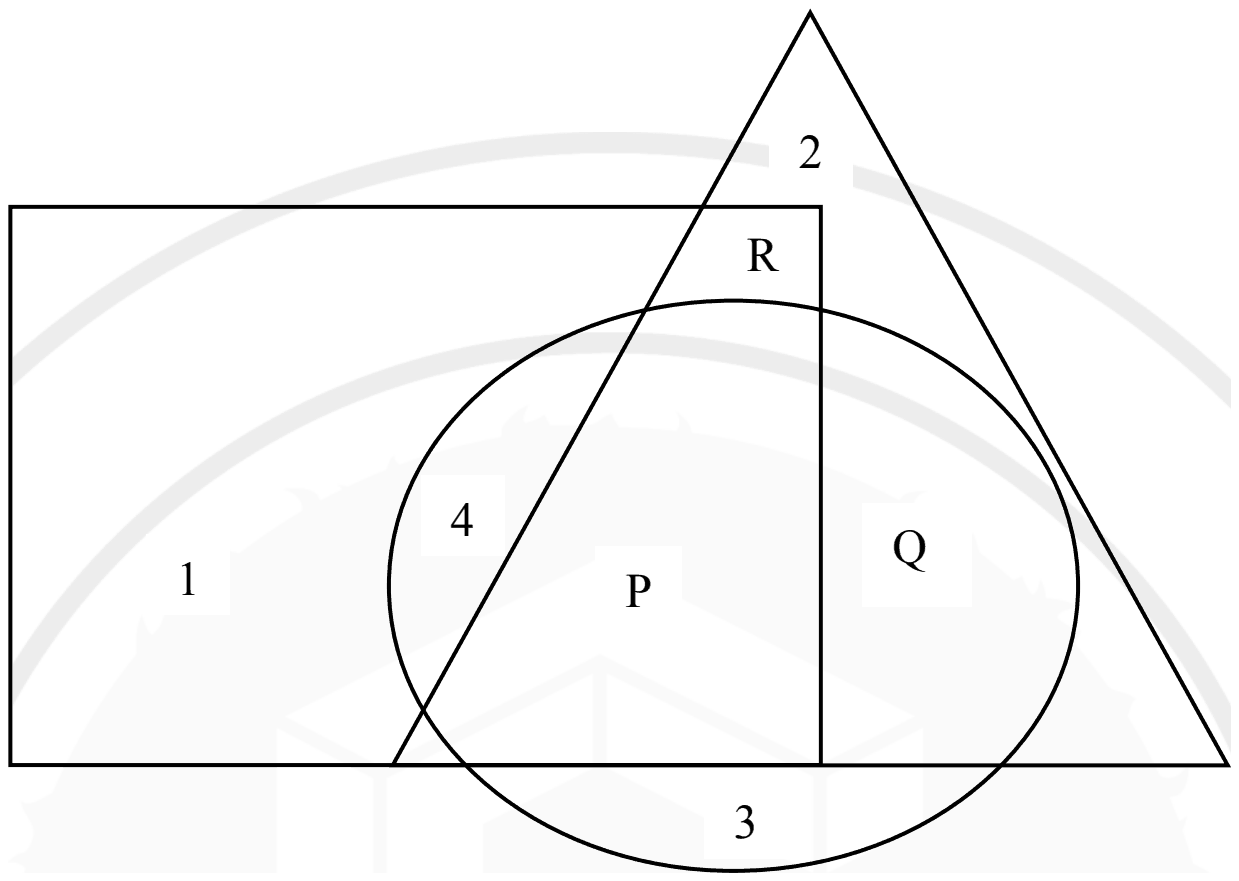
In the given figure, the numbers associated with the rectangle, triangle, and ellipse are 1, 2, and 3, respectively. Which one among the given options is the most appropriate combination of P, Q, and R ?

A rectangle, a triangle and an ellipse overlapping; region 4 is inside the rectangle and ellipse only, P inside all three, Q inside the triangle and ellipse only, R inside the rectangle and triangle only

Exam Year(s)

GATE AE - 2025,

Answer: A

The combination is P = 6; Q = 5; R = 3.

The labelled region 4 shows the rule: it lies inside the rectangle (1) and the ellipse (3) but outside the triangle, and 1 + 3 = 4. So each region carries the sum of the numbers of the shapes that contain it.

P lies inside all three shapes, so P = 1 + 2 + 3 = 6. Q lies inside the triangle and the ellipse but outside the rectangle, so Q = 2 + 3 = 5. R lies inside the rectangle and the triangle but outside the ellipse, so R = 1 + 2 = 3.

The other options swap P and Q, or assign 6 to regions that lie in only two shapes, which breaks the rule fixed by region 4.

Please log in or register to report this question.

9.

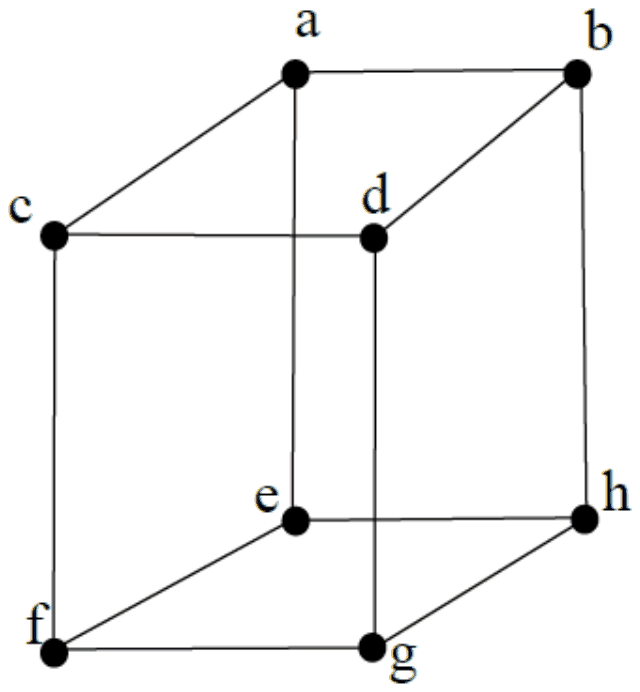
Consider the cube shown below with its 8 corners labelled a, b, c, d, e, f, g, and h. The figure is representative. All corners are to be colored such that any two corners that are connected by an edge must be of different colors. The minimum number of colors required to achieve this is ________

A cube with top corners a, b, c, d and bottom corners e, h, f, g; a above e, b above h, c above f and d above g

Exam Year(s)

GATE AE - 2026,

Answer: D

The minimum is 2 colours.

A cube's corners can be split into two sets of four so that every edge joins one set to the other. Colour a, d, f and h with one colour and b, c, e and g with the other. Checking every edge: a-b, a-c, a-e, d-b, d-c, d-g, f-c, f-e, f-g, h-b, h-e and h-g all join corners of different colours.

One colour is clearly not enough, because the two ends of any edge would match. So 2 is the minimum, and 3, 4 and 8 are all more colours than needed. In graph terms, the cube is bipartite (it has no cycle of odd length), so its chromatic number is 2.

Please log in or register to report this question.
10.

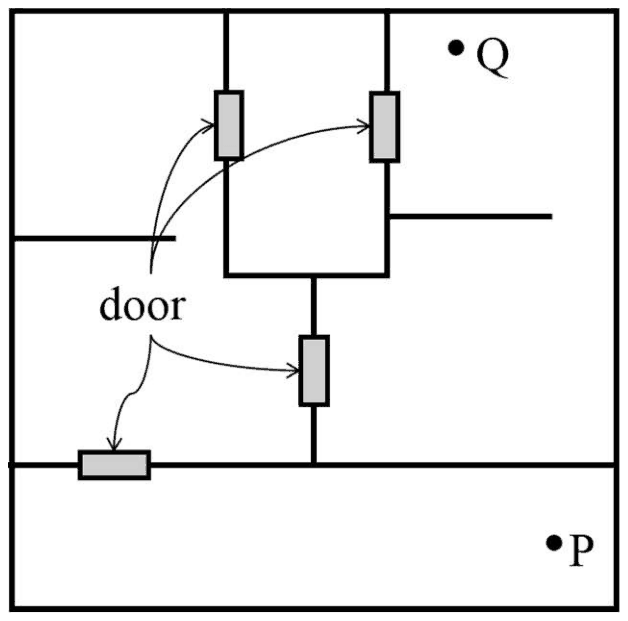
A building has several rooms and doors as shown in the top view of the building given below. The doors are closed initially.

What is the minimum number of doors that need to be opened in order to go from the point P to the point Q?

Top view of a building divided into rooms by walls, with four doors marked; P is in the long room along the bottom and Q is in the upper right room

Exam Year(s)

GATE Chemistry - 2022, GATE AG - 2022,

Answer: C

The minimum number of doors to open is 2.

P is in the long room along the bottom of the building. The wall above it has only one door, at its left end, so the first door opened is that one, leading into the room on the left above it. That room has a door in its right-hand wall, leading into the large room on the right, and that room is open to Q’s room through the gap at the right end of the short wall between them. So the route P, bottom-left door, middle door, then through the gap to Q opens two doors.

One door is not enough, because no single door connects P’s room to a room open to Q. The two upper doors lead into and out of the small central room and are not needed; a route through them would open three or four doors, the distractors.

Please log in or register to report this question.
Loading…
Tags: Miscellaneous Logical Puzzles Questions and Answers || Miscellaneous Logical Puzzles MCQ Questions and Answers || Miscellaneous Logical Puzzles GK Questions and Answers || Miscellaneous Logical Puzzles GK MCQ Questions || Miscellaneous Logical Puzzles Multiple Choice Questions and Answers || Miscellaneous Logical Puzzles GK || GK on Miscellaneous Logical Puzzles || Reasoning Questions and Answers || Reasoning MCQ Questions and Answers || Reasoning GK Questions and Answers || GK on Reasoning