Machine-translated by Google. Questions are authored in English.
Top

Kinematic Pairs and Chains Questions and Answers

1.

The Ball and socket joint is an example of

Exam Year(s)

DSSSB - 2023,

Answer: C

A ball and socket joint is an example of a spherical pair, since one element in the form of a sphere turns inside another that is a spherical socket, and it allows rotation about all three axes. A sliding pair has linear motion, a rolling pair has pure rolling and a turning pair allows rotation about one axis only.

Please log in or register to report this question.

2.

Which inversion of the slider-crank mechanism is commonly used in reciprocating internal combustion engines?

Exam Year(s)

DSSSB - 2023,

Answer: A

The first inversion of the slider-crank mechanism, in which the crank is fixed, is the one used in reciprocating engines and compressors. In it the cylinder is fixed and the piston slides, so the connecting rod and crank convert reciprocating motion to rotation. The second inversion is used in the Whitworth quick return mechanism and the Gnome engine type, the third in the oscillating cylinder engine, and the fourth in the hand pump, so the first is the one for internal combustion engines.

Please log in or register to report this question.

3.

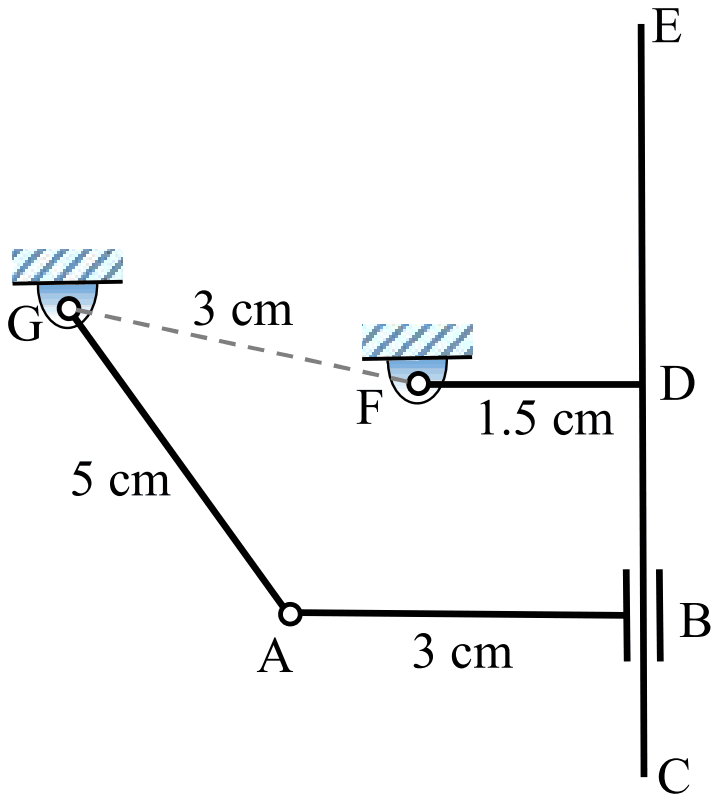
A planar four-bar linkage mechanism with 3 revolute kinematic pairs and 1 prismatic kinematic pair is shown in the figure, where AB ⊥ CE and FD ⊥ CE. The T-shaped link CDEF is constructed such that the slider B can cross the point D, and CE is sufficiently long. For the given lengths as shown, the mechanism is

Ground pivots G and F 3 cm apart; link GA 5 cm; link AB 3 cm ending in a slider B on the bar CE; the T-shaped link has FD 1.5 cm perpendicular to CE

Exam Year(s)

GATE ME - 2022,

Answer: A

The mechanism is a Grashof chain with links AG, AB and CDEF completely rotatable about the ground link FG.

Because AB and FD are both perpendicular to CE, the bar CE is always a line lying 3 cm from A and 1.5 cm from F, on the same side of both (as drawn). Such a line is a common tangent to a circle of radius 3 cm about A and a circle of radius 1.5 cm about F, and a common tangent of that kind exists whenever the distance FA is at least the difference of the radii, 1.5 cm.

As AG turns about G, A moves on a circle of radius 5 cm. F lies 3 cm from G, inside that circle, so FA always lies between \(5 - 3 = 2\) cm and \(5 + 3 = 8\) cm, never below 1.5 cm. The assembly is therefore possible in every position: AG turns through a full revolution, and because F is inside A's path the direction FA, and with it the direction of CE, also turns through 360°. So the T-shaped link CDEF and the link AB (fixed at right angles to CE) rotate fully too.

That rules out a non-Grashof chain, a chain in which AG and CDEF only oscillate, and a change-point (border) case, which would need FA to reach exactly 1.5 cm.

Please log in or register to report this question.

4.

Which of the following is an inversion of single slider crank chain ?

Exam Year(s)

RSMSSB JE - 2025, RSMSSB - 2025,

Answer: C

The inversion is the hand pump.

A single slider crank chain has four links: the frame, the crank, the connecting rod and the slider. Fixing different links gives its inversions, and one of them is the pendulum pump or hand pump, obtained by fixing the slider. The others include the oscillating cylinder engine, the rotary engine and the quick return mechanisms.

Oldham's coupling, the elliptical trammel and the Scotch yoke all belong to the double slider crank chain, which has two sliding pairs, so they are not inversions of the single slider crank chain.

Please log in or register to report this question.

5.

The link which does not undergo any deformation while transmitting the motion is known as :

Exam Year(s)

RSMSSB JE - 2025, RSMSSB - 2025,

Answer: B

It is a rigid link.

A rigid link is one in which the distance between any two points does not change while it transmits motion. In practice every link deforms slightly, but in kinematics links such as cranks, connecting rods and frames are treated as rigid because the deformation is negligible.

A flexible link, such as a belt, rope or chain, deforms but can transmit tension. A fluid link transmits motion through a fluid under pressure, as in a hydraulic press. 'Non-rigid link' simply means one that does deform.

Please log in or register to report this question.

6.

The Gruebler's criterion for determining the degrees of Freedom (F) of a mechanism having 'n' links and 'p' pairs is given by:

Exam Year(s)

RSMSSB JE - 2025, RSMSSB - 2025,

Answer: D

Gruebler's criterion is F = 3(n - 1) - 2p.

Each of the n links of a planar mechanism has 3 degrees of freedom, but one link is fixed as the frame, leaving \(3(n - 1)\). Each lower pair removes 2 of them.

\[ \begin{aligned} F &= 3(n - 1) - 2p \end{aligned} \]

The '+2p' versions add freedom for each joint, which is backwards, and '(n + 1)' counts the fixed link as moving. For a four-bar chain, \(3(4 - 1) - 2 \times 4 = 1\), as expected.

Please log in or register to report this question.

7.

The pair is known as higher pair, when the relative motion between the elements of a pair is:

Exam Year(s)

RSMSSB JE - 2025, RSMSSB - 2025,

Answer: D

In a higher pair the relative motion is partly turning and partly sliding.

A higher pair has point or line contact between its elements, as in a cam and follower, gear teeth or a ball bearing. In the standard textbook definition, the relative motion of such elements is partly turning and partly sliding.

Pure turning (a revolute pair) and pure sliding (a prismatic pair) take place with surface contact and so describe lower pairs. 'Rolling only' covers just one special case of a higher pair, not the general one.

Please log in or register to report this question.

Loading…
Tags: Kinematic Pairs and Chains Questions and Answers || Kinematic Pairs and Chains MCQ Questions and Answers || Kinematic Pairs and Chains GK Questions and Answers || Kinematic Pairs and Chains GK MCQ Questions || Kinematic Pairs and Chains Multiple Choice Questions and Answers || Kinematic Pairs and Chains GK || GK on Kinematic Pairs and Chains || Theory of Machines Questions and Answers || Theory of Machines MCQ Questions and Answers || Theory of Machines GK Questions and Answers || GK on Theory of Machines