
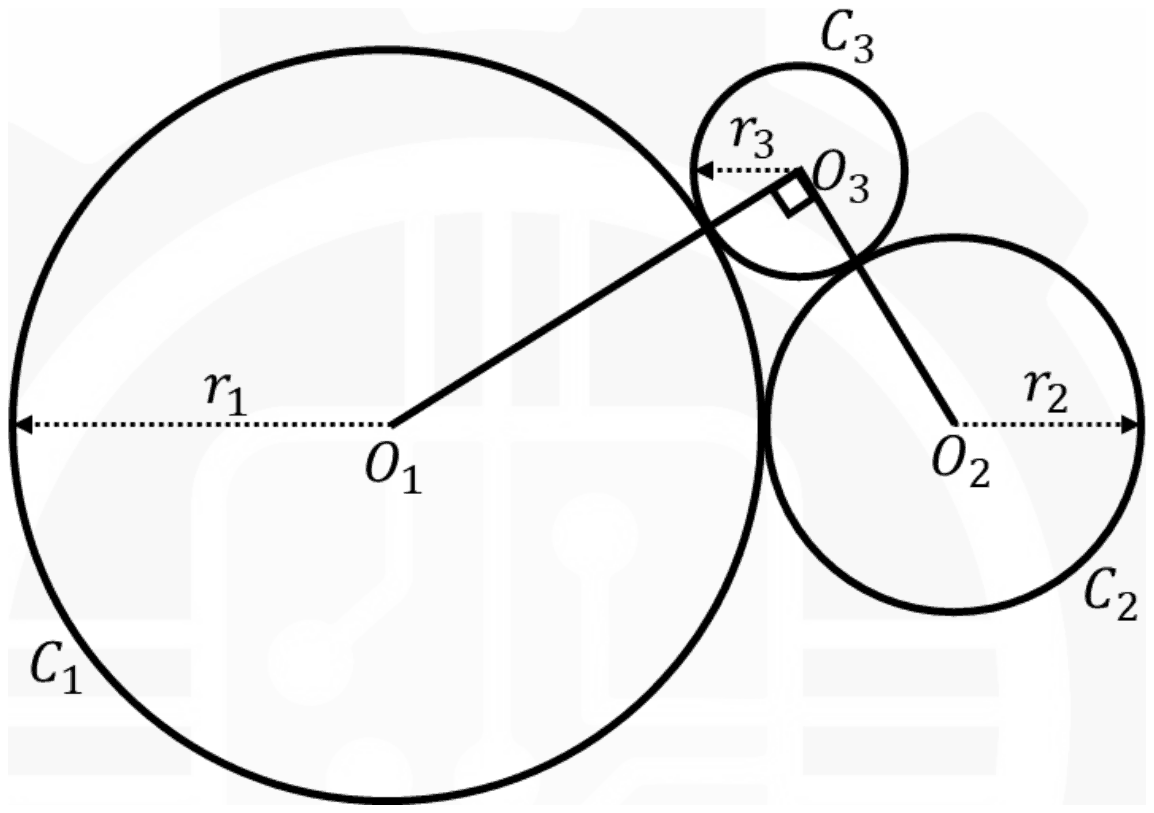
Circles \(C_{1}\), \(C_{2}\), and \(C_{3}\), with centers \(O_{1}\), \(O_{2}\), and \(O_{3}\), and radii \(r_{1}\), \(r_{2}\), and \(r_{3}\), respectively, touch each other as shown in the following figure. Given \(r_{1} = 2\) cm, \(r_{2} = 1\) cm and the angle \(\angle O_{1}O_{3}O_{2}\) is 90°, \(r_{3}\) = _____ cm.
GATE Life Sciences - 2026,
Answer: A
The radius is \(r_{3} = \frac{1}{2}(-3 + \sqrt{17})\) cm.
The circles touch externally, so each distance between centres is the sum of the two radii: \(O_{1}O_{3} = 2 + r_{3}\), \(O_{2}O_{3} = 1 + r_{3}\) and \(O_{1}O_{2} = 2 + 1 = 3\). The angle at \(O_{3}\) is a right angle, so Pythagoras applies with \(O_{1}O_{2}\) as the hypotenuse:
\[ \begin{aligned} (2 + r)^{2} + (1 + r)^{2} &= 9 \\ 2r^{2} + 6r + 5 &= 9 \\ r^{2} + 3r - 2 &= 0 \end{aligned} \]
\[ \begin{aligned} r &= \frac{-3 + \sqrt{9 + 8}}{2} \\ &= \frac{-3 + \sqrt{17}}{2} \approx 0.56 \end{aligned} \]
The other root is negative and is rejected. \(\frac{1}{2}(3 + \sqrt{17})\) has the sign of the 3 reversed and would be about 3.56 cm, larger than both given circles; the remaining two options come from slips in the constant or the discriminant.
Please log in or register to report this question.