
Machine-translated by Google. Questions are authored in English.
Top

Boundary Layer and Drag Questions and Answers

101.

Consider steady, two-dimensional, incompressible flow over a non-porous flat plate as shown in the figure. For the control volume PQRS, the speed, \(u_{\infty}\), at section PQ is uniform and the speed at section RS is given by \(u(y) = A_{0}\left(\frac{y}{h}\right)^{n}\), where \(n\) is a positive integer. The value of \(A_{0}\) for which the flow through section PS will vanish is:
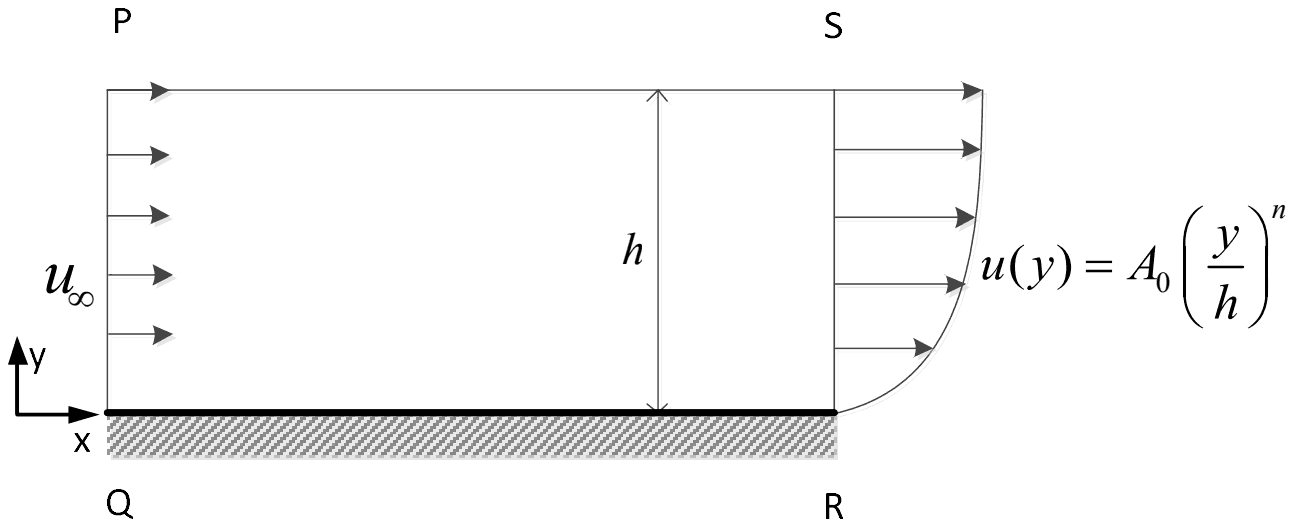
Control volume PQRS of height h on a flat plate QR: uniform speed u-infinity enters through PQ, the profile u(y) = A0 (y/h)^n leaves through RS, and PS is the top face

Exam Year(s)

GATE AE - 2022,

Answer: B

The flow through PS vanishes when \(A_{0} = u_{\infty}(n + 1)\).

The plate is non-porous, so no fluid crosses QR. If nothing crosses PS either, the mass entering through PQ must all leave through RS. Per unit depth:

\[ \begin{aligned} u_{\infty} h &= \int_{0}^{h} A_{0}\left(\frac{y}{h}\right)^{n} dy \\ &= \frac{A_{0} h}{n + 1} \\ A_{0} &= u_{\infty}(n + 1) \end{aligned} \]

\(u_{\infty}/(n + 1)\) is the average speed of a profile with \(A_{0} = u_{\infty}\), the result inverted. The options with n - 1 come from a slip in the power of y when integrating the profile.

Please log in or register to report this question.
102.

For a laminar incompressible flow past a flat plate at zero angle of attack, the variation of skin friction drag coefficient \((C_{f})\) with Reynolds number based on the chord length \((Re_{c})\) can be expressed as

Exam Year(s)

GATE AE - 2016,

Answer: C

The skin friction coefficient varies as \(C_{f} \propto 1/\sqrt{Re_{c}}\).

For a laminar boundary layer on a flat plate the Blasius solution gives the average skin friction coefficient over a plate of length \(c\) as

\[ C_{f} = \frac{1.328}{\sqrt{Re_{c}}} \]

so it falls as the inverse square root of the Reynolds number. A coefficient growing with \(\sqrt{Re_{c}}\) or with \(Re_{c}\) has the trend backwards. \(1/Re_{c}\) falls too fast; that is the behaviour of a creeping, Stokes-type flow, not a boundary layer. (A turbulent boundary layer falls more slowly, roughly as \(Re_{c}^{-1/5}\).)

Please log in or register to report this question.

Answer: A

With Pr = 0.7, the thermal boundary layer is thicker than the velocity boundary layer.

The Prandtl number compares momentum diffusivity with thermal diffusivity. When Pr is below 1, heat diffuses faster than momentum, so the temperature disturbance spreads further from the wall than the velocity disturbance. For laminar flow over a flat plate the ratio is about \(\delta/\delta_{t} \approx Pr^{1/3}\), so \(\delta_{t}/\delta \approx 0.7^{-1/3} \approx 1.13\).

A thinner thermal layer would need Pr above 1, as in oils and water, and equal thicknesses need Pr = 1. The two thicknesses are linked through Pr, so 'no relationship' is wrong.

Please log in or register to report this question.

104.

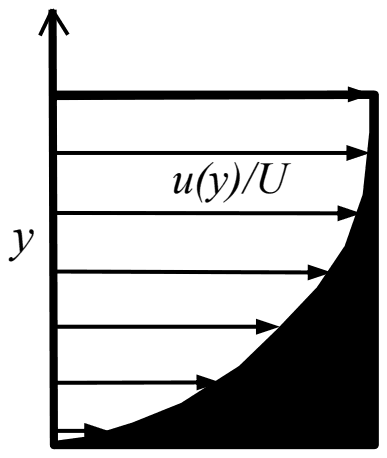
The velocity profile in an incompressible, laminar boundary layer is shown in the figure below. U is the free-stream velocity, u(y) is the stream-wise velocity component. The area of the black shaded region in the figure below represents the

Boundary layer velocity profile u(y)/U against y, with the region between the profile and the free-stream velocity line shaded black

Exam Year(s)

GATE AE - 2018,

Answer: C

The shaded area represents the displacement thickness.

The plot is drawn in the non-dimensional velocity \(u/U\) against y. The black region lies between the profile and the line \(u/U = 1\), so its area is

\[ \delta^{*} = \int_{0}^{\infty} (1 - u/U)\,dy \]

which is the definition of displacement thickness: the distance by which the wall would have to be moved out, in an inviscid flow, to carry the same mass-flow deficit that the boundary layer causes.

Boundary layer thickness is a height (where u reaches about 0.99U), not an area. Momentum thickness is \(\int \frac{u}{U}(1 - \frac{u}{U})dy\), which carries an extra factor \(u/U\) and is not the shaded region. The shape factor is the ratio of displacement to momentum thickness, a pure number.

Please log in or register to report this question.

105.

A thermocouple, mounted flush in an insulated flat surface in a supersonic laminar flow of air measures the

Exam Year(s)

GATE AE - 2018,

Answer: B

It measures a temperature greater than static but less than total temperature.

An insulated surface reaches the adiabatic wall (recovery) temperature, where the frictional heating in the boundary layer balances the heat conducted away. It is written with a recovery factor r:

\[ T_{aw} = T + r\frac{V^{2}}{2c_{p}} \]

For a laminar boundary layer in air, \(r \approx \sqrt{Pr} \approx 0.85\). Since r is less than 1, the wall recovers most but not all of the kinetic energy, so \(T \lt T_{aw} \lt T_{0}\).

The static temperature would be read only with no recovery at all (r = 0), the total temperature only with full recovery (r = 1), and a temperature above total would need r greater than 1, which laminar flow of air does not give.

Please log in or register to report this question.

106.

Consider the Blasius solution for the incompressible laminar flat plate boundary layer. Among the following options, select the correct relation for the development of the momentum thickness \(\theta\) with distance \(x\) from the leading edge along the length of the plate.

Exam Year(s)

GATE AE - 2023,

Answer: B

The momentum thickness grows as \(\theta \propto x^{1/2}\).

The Blasius solution for the laminar boundary layer on a flat plate gives

\[ \begin{aligned} \theta &= \frac{0.664\,x}{\sqrt{Re_{x}}} \\ Re_{x} &= \frac{U_{\infty}x}{\nu} \end{aligned} \]

so \(\theta = 0.664\sqrt{\nu x / U_{\infty}}\), which is proportional to \(\sqrt{x}\). The displacement thickness and the boundary-layer thickness grow in the same way, as all laminar thicknesses do.

The other exponents do not belong to this solution. \(x^{1/7}\) recalls the one-seventh power velocity profile of a turbulent boundary layer, whose thickness grows roughly as \(x^{4/5}\). A negative exponent would make the layer thin downstream, the opposite of what happens, and \(x^{2/3}\) has no basis here.

Please log in or register to report this question.

107.

Consider a flat plate, with a sharp leading edge, placed in a uniform flow of speed U. The direction of the free-stream flow is aligned with the plate. Assume that the flow is steady, incompressible and laminar. The thickness of the boundary layer at a fixed stream-wise location L from the leading edge of the plate is δ. Which one of the following correctly describes the variation of δ with U?

Exam Year(s)

GATE AE - 2024,

Answer: D

The boundary-layer thickness varies as δ \(\propto U^{-1/2}\).

For a laminar boundary layer on a flat plate, the Blasius solution gives

\[ \begin{aligned} \delta &\approx \frac{5.0\,x}{\sqrt{Re_{x}}} \\ &= 5.0\sqrt{\frac{\nu x}{U}} \end{aligned} \]

At a fixed location \(x = L\) and fixed viscosity, \(\delta\) is proportional to \(1/\sqrt{U}\): a faster stream gives a thinner boundary layer, because the momentum carried downstream outpaces the diffusion of viscous effects away from the wall.

The options with positive powers of \(U\) would make the layer thicken as the flow speeds up, the opposite of what happens. \(U^{1/2}\) is the right power with the wrong sign.

Please log in or register to report this question.

108.

For a two-dimensional incompressible flow over a flat plate, the laminar boundary layer thickness at a distance \(x\) from the leading edge is \(\delta\). If \(Re_{x}\) is the Reynolds number defined based on length scale x, \(\left(\dfrac{\delta}{x}\right)\) is proportional to ______.

Exam Year(s)

GATE AE - 2025,

Answer: A

\(\delta/x\) is proportional to \(Re_{x}^{-1/2}\).

For a laminar boundary layer on a flat plate, the Blasius solution gives

\[ \frac{\delta}{x} \approx \frac{5.0}{\sqrt{Re_{x}}} \]

The scaling follows from balancing inertia, \(U^{2}/x\), with viscous diffusion, \(\nu U/\delta^{2}\), which gives \(\delta \sim \sqrt{\nu x/U}\). So the boundary layer grows as \(\sqrt{x}\) and \(\delta/x\) falls as \(Re_{x}^{-1/2}\). The exponent −1/5 belongs to the turbulent boundary layer; −1, −3/2 and −2 do not arise for either.

Please log in or register to report this question.

Answer: C

d'Alembert's paradox is the prediction of zero drag by potential flow theory.

In 1752 d'Alembert showed that steady, inviscid, incompressible, irrotational flow past a body gives a pressure distribution symmetric front to back, so the net drag is zero, contrary to every experiment. The paradox is resolved by viscosity: the boundary layer and flow separation create skin friction and pressure drag, which an inviscid theory leaves out.

Departures of drag from \(D \propto v^{2}\) at low speeds (Stokes flow) or high subsonic speeds (drag divergence) are real effects with other names, and shocks in transonic flow are a compressibility effect, not a paradox of potential flow.

Please log in or register to report this question.

Loading…
Tags: Boundary Layer and Drag Questions and Answers || Boundary Layer and Drag MCQ Questions and Answers || Boundary Layer and Drag GK Questions and Answers || Boundary Layer and Drag GK MCQ Questions || Boundary Layer and Drag Multiple Choice Questions and Answers || Boundary Layer and Drag GK || GK on Boundary Layer and Drag || Aerodynamics Questions and Answers || Aerodynamics MCQ Questions and Answers || Aerodynamics GK Questions and Answers || GK on Aerodynamics