
Machine-translated by Google. Questions are authored in English.
Top

Incompressible Flow over Airfoils Questions and Answers

101.

Which of the following airfoil will have location of the maximum camber at half chord length from the leading edge?

Exam Year(s)

GATE AE - 2016,

Answer: D

The airfoil is NACA 2512.

In the NACA four-digit series, the first digit is the maximum camber as a percentage of chord, the second digit is the position of maximum camber in tenths of chord from the leading edge, and the last two digits are the thickness as a percentage of chord.

NACA 2512 has its maximum camber of 2% at 5/10 = 0.5 of the chord, which is half chord, and is 12% thick. NACA 5212, 1225 and 2215 all have 2 as their second digit, so their maximum camber is at 0.2 of the chord, not at half chord.

Please log in or register to report this question.
102.

In a low-speed wind tunnel, the angular location(s) from the front stagnation point on a circular cylinder where the static pressure equals the free-stream static pressure, is

Exam Year(s)

GATE AE - 2018,

Answer: B

The angular locations are ±30° from the front stagnation point.

Inviscid flow over a circular cylinder gives a surface speed \(2U\sin\theta\), measured from the front stagnation point, and so a pressure coefficient

\[ C_{p} = 1 - 4\sin^{2}\theta \]

The static pressure equals the free-stream pressure where \(C_{p} = 0\): \(\sin\theta = 1/2\), so \(\theta = \pm 30^{\circ}\) on the front of the cylinder (and \(\pm 150^{\circ}\) at the rear, which the options do not offer).

At 0° the pressure is the stagnation value, \(C_{p} = 1\). At ±60°, \(C_{p} = 1 - 4(0.75) = -2\), well below free-stream pressure. ±38° does not satisfy the inviscid result that the key follows.

Please log in or register to report this question.

103.

A thin airfoil is mounted in a low-speed, subsonic wind tunnel, in which the Mach number is 0.1. At a point on the airfoil, the pressure coefficient is measured to be -1.2. If the flow velocity is increased such that the free-stream Mach number is 0.6, the pressure coefficient at the same point on the airfoil will approximately be:

Exam Year(s)

GATE AE - 2018,

Answer: C

The pressure coefficient will be about -1.5.

The Prandtl-Glauert rule scales a thin airfoil's pressure coefficient with Mach number: \(C_{p} = C_{p,0}/\sqrt{1 - M^{2}}\), where \(C_{p,0}\) is the incompressible value. First recover \(C_{p,0}\) from the reading at M = 0.1, then scale it to M = 0.6:

\[ \begin{aligned} C_{p,0} &= -1.2\sqrt{1 - 0.01} \approx -1.194 \\ C_{p} &= \frac{-1.194}{\sqrt{1 - 0.36}} \\ &= \frac{-1.194}{0.8} \\ &\approx -1.49 \end{aligned} \]

At M = 0.1 the correction is negligible, so the answer is essentially -1.2 divided by 0.8. -0.75 multiplies by a factor less than 1 instead, as if compressibility weakened the suction; it strengthens it. -2.9 and -3.5 are far larger than any compressibility correction gives at M = 0.6 (even the Karman-Tsien rule gives only about -1.75).

Please log in or register to report this question.

104.

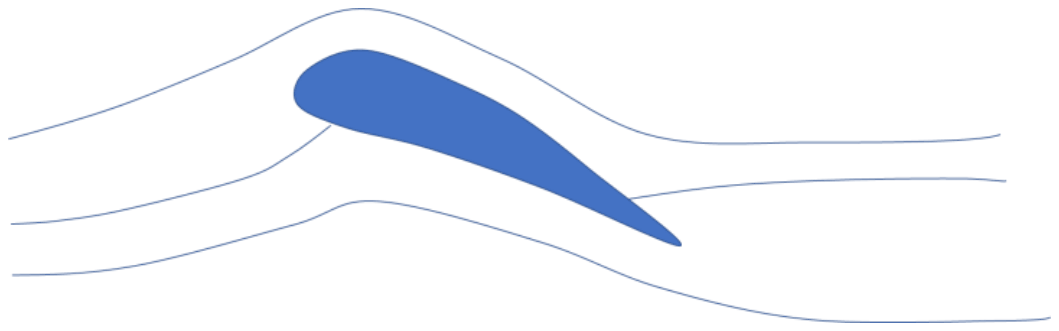
A two-dimensional potential flow solution for flow past an airfoil has a streamline pattern as shown in the figure. Which of the following conditions is additionally required to satisfy the Kutta condition?

Streamlines flowing from left to right past an airfoil; the dividing streamline leaves the airfoil from its upper surface ahead of the trailing edge, so the flow wraps around the trailing edge from below

Exam Year(s)

GATE AE - 2023,

Answer: D

A clockwise circulation, \(\Gamma \lt 0\), must be added.

In the sketch, the flow from below the airfoil wraps around the sharp trailing edge and the rear stagnation point sits on the upper surface ahead of it. This is the zero-circulation potential flow, which predicts no lift and infinite velocity at the trailing edge. The Kutta condition requires the flow to leave the sharp trailing edge smoothly, with the rear stagnation point at the trailing edge itself.

With the free stream from left to right, a clockwise vortex speeds up the flow over the upper surface and slows it underneath, moving the rear stagnation point back along the upper surface until it reaches the trailing edge. That clockwise circulation is what produces positive lift by the Kutta-Joukowski theorem.

A counter-clockwise circulation would move the stagnation point the wrong way and give negative lift. A source or sink adds or removes mass, changing the thickness of the body the flow sees, but it cannot fix the flow at the trailing edge or create lift.

Please log in or register to report this question.

105.

Consider steady, incompressible, inviscid flow past two airfoils shown in the figure. The coefficient of pressure at the trailing edge of the airfoil with finite angle, shown in figure (I), is \(C_{P_{I}}\) while that at the trailing edge of the airfoil with cusp, shown in figure (II), is \(C_{P_{II}}\). Which one of the following options is TRUE?

(The figure shows a uniform stream U approaching two airfoils: (I) Trailing edge with finite angle, where the upper and lower surfaces meet at an angle; (II) Trailing edge with cusp, where they meet tangentially.)

Exam Year(s)

GATE AE - 2024,

Answer: C

The correct option is \(C_{P_{I}} = 1,\ C_{P_{II}} \lt 1\).

The Kutta condition requires the flow to leave the trailing edge smoothly. With a finite trailing-edge angle the upper and lower surfaces point in different directions there, so the only way both streams can leave with one velocity is for that velocity to be zero: the trailing edge is a stagnation point and

\[ C_{P} = 1 - \left(\frac{V}{U}\right)^{2} = 1 \]

At a cusped trailing edge the two surfaces are tangent, so the flow can leave with a common, finite, non-zero velocity, and \(C_{P} \lt 1\).

So the airfoils differ: the options giving both the same value, or reversing them, are wrong.

Please log in or register to report this question.

106.

For a NACA 4415 airfoil, the location of maximum camber, as a fraction of the chord length from the leading edge, is ______.

Exam Year(s)

GATE AE - 2025,

Answer: B

The maximum camber is at 0.40 of the chord.

In the NACA four-digit series the digits are read as M P XX: the first digit is the maximum camber in per cent of chord, the second is its position in tenths of chord from the leading edge, and the last two are the maximum thickness in per cent of chord. For NACA 4415: maximum camber 4% (0.04c) located at 0.4c, with 15% thickness.

0.04 is the camber itself, not its location, and 0.15 is the thickness ratio. 0.44 simply runs the first two digits together and has no meaning in the designation.

Please log in or register to report this question.

Loading…
Tags: Incompressible Flow over Airfoils Questions and Answers || Incompressible Flow over Airfoils MCQ Questions and Answers || Incompressible Flow over Airfoils GK Questions and Answers || Incompressible Flow over Airfoils GK MCQ Questions || Incompressible Flow over Airfoils Multiple Choice Questions and Answers || Incompressible Flow over Airfoils GK || GK on Incompressible Flow over Airfoils || Aerodynamics Questions and Answers || Aerodynamics MCQ Questions and Answers || Aerodynamics GK Questions and Answers || GK on Aerodynamics