Machine-translated by Google. Questions are authored in English.
Top

ER Model and Business Rules Questions and Answers

1.

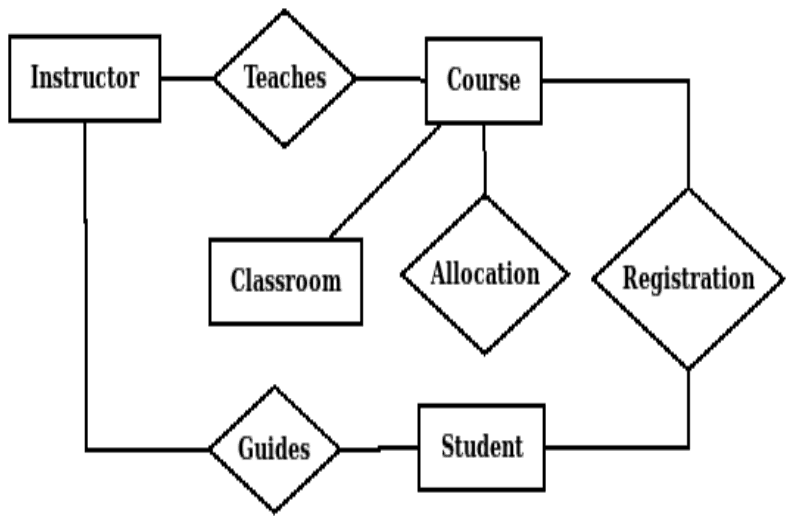
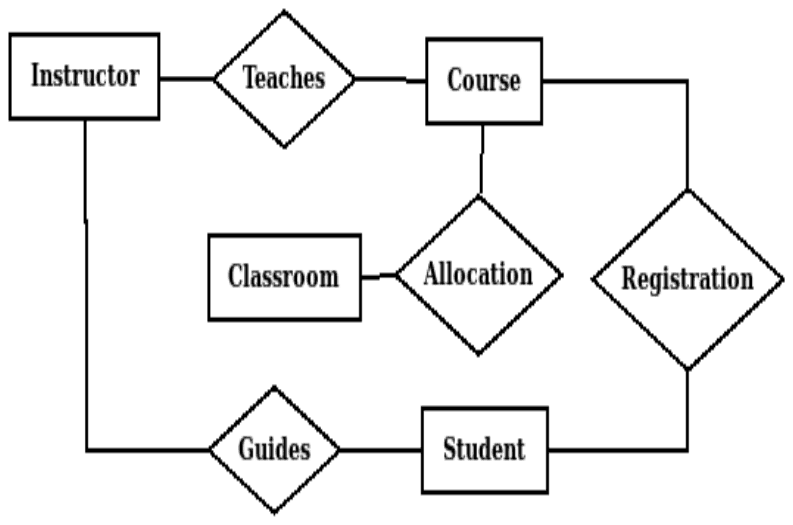
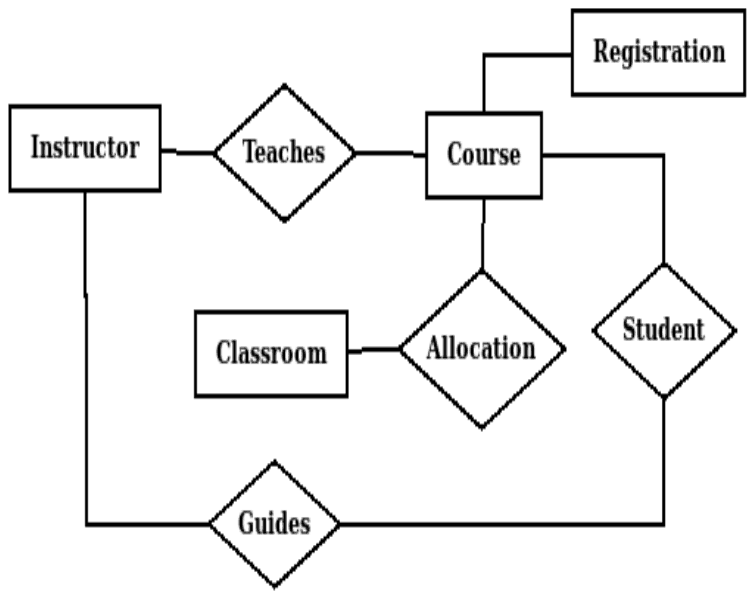
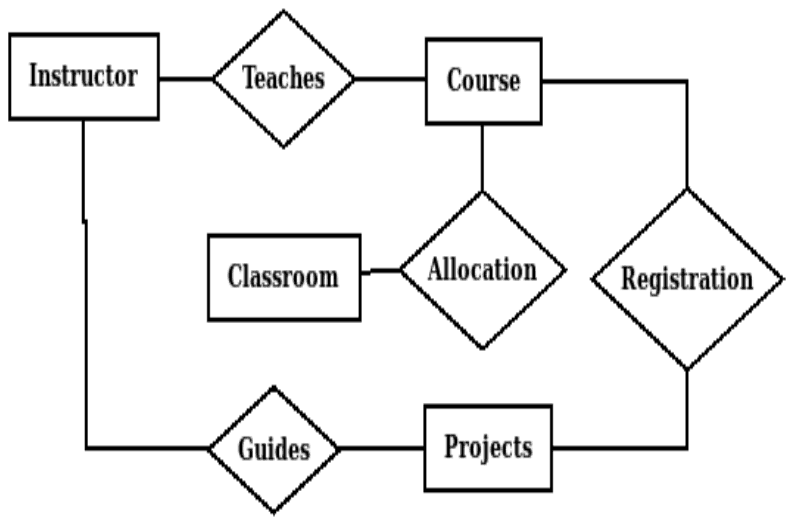
Let S be the specification: "Instructors teach courses. Students register for courses. Courses are allocated classrooms. Instructors guide students." Which one of the following ER diagrams CORRECTLY represents S?
Exam Year(s)

GATE CS - 2024,

Answer: D

The correct ER diagram is (iv).

The specification has four entity sets, Instructor, Course, Classroom and Student, and four relationships: Teaches (Instructor, Course), Registration (Student, Course), Allocation (Course, Classroom) and Guides (Instructor, Student). Diagram (iv) draws exactly these, with entities as rectangles and relationships as diamonds joining the right pairs.

Diagram (i) makes Registration an entity and Student a relationship. Diagram (ii) has no Student entity and has Guides linking Instructor to Projects. Diagram (iii) leaves Allocation unconnected to Classroom and joins Classroom directly to Course.

Please log in or register to report this question.

Answer: A

The true statement is The weak entity set MUST have total participation in the identifying relationship.

A weak entity has no key of its own; it is identified only through its owner, by combining the owner's key with its partial key. So every weak entity must be linked to an owner through the identifying relationship, which is total participation.

The owner need not participate totally: an employee may have no dependents, for example, so not every owner entity has a related weak entity. That rules out the options requiring total participation of the owner, and 'neither' is wrong because the weak side's participation is required.

Please log in or register to report this question.

3.

In an Entity-Relationship (ER) model, suppose \(R\) is a many-to-one relationship from entity set E1 to entity set E2. Assume that E1 and E2 participate totally in \(R\) and that the cardinality of E1 is greater than the cardinality of E2.

Which one of the following is true about \(R\)?

Exam Year(s)

GATE CS - 2018,

Answer: A

The true statement is Every entity in E1 is associated with exactly one entity in E2.

Many-to-one from E1 to E2 means each E1 entity is related to at most one E2 entity. Total participation of E1 means each E1 entity is related to at least one. Together, each E1 entity has exactly one partner in E2.

Some entity in E1 with more than one E2 partner would break the many-to-one rule. On the E2 side, E1 has more entities than E2 and every E1 entity is mapped to some E2 entity, so by the pigeonhole principle some E2 entity is related to two or more E1 entities. That rules out 'exactly one' and 'at most one' for E2.

Please log in or register to report this question.

4.

A rectangle represents which of the following in an EER?

Answer: C

Correct answer: Entity

The rectangle is the entity symbol in an entity-relationship diagram, as the oval is the attribute symbol and the diamond the relationship symbol. Optional participation is shown by cardinality notation on the relationship line rather than by any shape of its own.

Please log in or register to report this question.

5.

An oval represents which of the following in an EER?

Answer: A

Correct answer: Attribute

The oval is the attribute symbol, attached by a line to the entity or relationship it describes. The three basic shapes are quickly learnt: rectangle for entity, oval for attribute, diamond for relationship - and the variants such as the double oval for a multivalued attribute build on them.

Please log in or register to report this question.

6.

An ERD that has had the entities clustered will display more entities.

Answer: B

Correct answer: False

Clustering groups related entities into a single higher-level object, so the diagram shows fewer symbols. The point is to make a large model readable at a summary level, with the detail visible on decomposing a cluster rather than all at once.

Please log in or register to report this question.

7.

Action assertions have traditionally been implemented within an application program

Answer: A

Correct answer: True

Historically the rules were coded into each application that touched the data, which is why the same rule was often implemented several times and inconsistently. Moving them into the database as constraints and triggers, or into a rules engine, is what gives one authoritative statement of each rule.

Please log in or register to report this question.

8.

An entity cluster is a set of one or more entity types and associated relationships.

Answer: A

Correct answer: True

An entity cluster is a set of entity types and their relationships treated as one object on a summary diagram. Because a cluster can itself contain clusters, a large model can be presented at several levels of detail, each readable on its own.

Please log in or register to report this question.

Answer: B

Correct answer: Attributes are assigned at the highest logical level.

An attribute shared by every subtype belongs at the supertype, where it is held once and inherited by all. Pushing it down to the subtypes duplicates it and invites inconsistency. The rule is a matter of placing each attribute as high as it is true, and no higher.

Please log in or register to report this question.

10.

It is appropriate to use a supertype/subtype relationship when there are attributes that apply to some of the instances of an entity type.

Answer: A

Correct answer: True

This is one of the two conditions justifying the construct. If an attribute applies to only some instances, holding it on the single entity type means most rows carry a null, and the null has no meaning - it is not unknown but inapplicable. A subtype gives it a proper home.

Please log in or register to report this question.

Loading…
Tags: ER Model and Business Rules Questions and Answers || ER Model and Business Rules MCQ Questions and Answers || ER Model and Business Rules GK Questions and Answers || ER Model and Business Rules GK MCQ Questions || ER Model and Business Rules Multiple Choice Questions and Answers || ER Model and Business Rules GK || GK on ER Model and Business Rules || Database Questions and Answers || Database MCQ Questions and Answers || Database GK Questions and Answers || GK on Database