
Machine-translated by Google. Questions are authored in English.
Top

Geomorphology Questions and Answers

1.

The process that continually adds new crust is

Exam Year(s)

BPSC Exam - 2023, BPSC CDPO - 2023,

Answer: C

New crust is continually added by seafloor spreading.

At mid-ocean ridges, such as the Mid-Atlantic Ridge, tectonic plates move apart and magma rises from the mantle, cools and forms new oceanic crust. The ocean floor spreads outward from the ridge, so the youngest rocks lie at the ridge and the oldest farther away, as Harry Hess proposed in the 1960s.

Subduction does the opposite, destroying crust as one plate sinks beneath another. Earthquakes are the result of plate movement, not a process that adds crust, and convection in the mantle drives plate motion but does not itself create crust.

Please log in or register to report this question.
2.

The theory that states "pieces of the Earth's crust are in constant, slow motion driven by movement in the mantle" is called

Exam Year(s)

BPSC Exam - 2023, BPSC CDPO - 2023,

Answer: C

This is the theory of plate tectonics.

Plate tectonics, developed in the 1960s, holds that the Earth's lithosphere is broken into large plates that move slowly over the softer asthenosphere, driven by movements in the mantle such as convection currents. It explains earthquakes, volcanoes, mountain building and seafloor spreading.

Alfred Wegener's continental drift (1912) said the continents had moved but could not explain how. Pangaea is the name of the former supercontinent, not a theory, and plate boundaries are features described within plate tectonics.

Please log in or register to report this question.

3.

Assertion (A) : Rich placer deposits of gold are found on the Ghana coast and gold-bearing veins are found in Brazil.
Reason (R) : At some points of time, these continents were joined together along the Atlantic coast.

Select the correct answer.

Exam Year(s)

BPSC Exam - 2023, BPSC CDPO - 2023,

Answer: A

Both A and R are true and R is the correct explanation of A.

Ghana, once called the Gold Coast, has rich placer gold deposits, and Brazil has gold-bearing veins (A). These matching deposits on opposite sides of the Atlantic are classic evidence for continental drift: South America and Africa were once joined as part of Gondwana, along the line of today's Atlantic coasts (R).

Because the gold-bearing rocks formed when the two continents were one landmass and were later separated as the Atlantic opened, R explains A.

Please log in or register to report this question.

4.

Sea caves are formed in coastal areas. Select the suitable reason for formation of sea caves :

Exam Year(s)

CTET - 2023,

Answer: A

Sea caves are formed by erosion and deposition by waves.

Sea waves continuously strike the rocks along the coast. They exploit cracks and weak joints in the rock, which grow larger and wider over time until hollow, cave-like openings are formed in the cliff face. Wave action, which both erodes and deposits along coasts, is the agent.

Wind erosion shapes landforms in deserts, such as mushroom rocks, not sea caves. Sea caves are natural features, not man-made, and falling rocks are a result of erosion rather than the process that hollows out a cave.

Please log in or register to report this question.

Answer: B

The correct sequence is Sedimentary Rock, Metamorphic Rock, Magma.

In the rock cycle as the school textbook describes it, molten magma cools to form igneous rock; igneous rock is broken into particles that are transported and deposited to form sedimentary rock; igneous and sedimentary rocks under great heat and pressure change into metamorphic rock; and metamorphic rock under still greater heat and pressure melts to form magma again. The sequence sedimentary, metamorphic, magma follows the last two of these steps in order.

Magma never turns directly into metamorphic rock: it first cools into igneous rock. That rules out 'Igneous Rock, Magma, Metamorphic Rock' and 'Magma, Metamorphic Rock, Sedimentary Rock'. In 'Igneous Rock, Metamorphic Rock, Sedimentary Rock', the textbook cycle sends metamorphic rock on to magma, not to sedimentary rock, so the paper does not accept it.

Please log in or register to report this question.

6.

Match List-I with List-II :

List-IList-II
(a) P waves(i) Transverse waves
(b) L waves(ii) Longitudinal waves
(c) S waves(iii) Surface waves

Choose the correct option.

Exam Year(s)

CTET - 2024,

Answer: C

The correct matching is (a)-(ii), (b)-(iii), (c)-(i).

  • P waves (primary waves) are longitudinal waves: they push and pull the rock in the direction the wave travels, are the fastest, and pass through solids, liquids and gases.
  • L waves are surface waves. They travel along the earth's surface, arrive last and cause most of the damage in an earthquake.
  • S waves (secondary waves) are transverse waves: they move the rock at right angles to their direction of travel, and cannot pass through liquids.

Every other option swaps two of these, for example calling the P wave transverse.

Please log in or register to report this question.

Answer: D

The correct statement is It provides us forests, grasslands for grazing, land for agriculture and human settlements.

The lithosphere is the solid outer shell of the earth, and it is the domain that supplies forests, grazing land, farmland and the land on which people live. It is also a source of minerals.

Each of the other statements has one word wrong. The lithosphere is the solid crust or hard top layer, not a soft one. It is made of rocks and minerals covered by a thin layer of soil, not a thick one. And it is an irregular surface, with mountains, plateaus, plains and valleys, not a regular one.

Please log in or register to report this question.

8.

Identify the various layers of the earth in order from interior to the outermost layer :

Exam Year(s)

CTET - 2018,

Answer: D

From the interior outward the order is inner core, outer core, mantle, crust.

The earth's centre is the solid inner core, mainly of iron and nickel (sometimes called nife). Around it is the liquid outer core. Next comes the thick mantle, and the thin outermost layer is the crust, on which we live.

The first two options start from the surface, which is the reverse of the order asked for, and the third places the crust inside the mantle, which is wrong: the mantle lies between the core and the crust.

Please log in or register to report this question.

9.

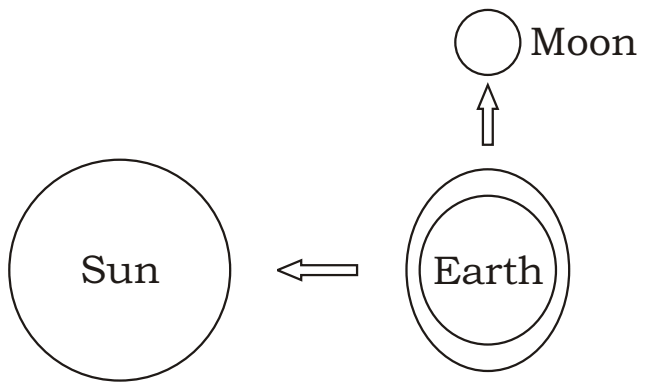
Observe carefully the location of the sun, earth and moon in the given diagram and tell what it depicts :

Diagram: the Sun on the left with an arrow from the Earth pointing to it, and the Moon above the Earth with an arrow from the Earth pointing up to it, so the Sun and Moon are at right angles as seen from the Earth

Exam Year(s)

CTET - 2018,

Answer: D

The diagram depicts a neap tide.

In the figure the sun lies in one direction from the earth and the moon at right angles to it. When the sun and moon pull at right angles, which happens at the first and last quarter of the moon, their tidal forces partly counteract each other, so high tides are lower and low tides higher than usual: these are neap tides.

Spring tides occur when the sun, earth and moon are in a straight line (full moon and new moon). Eclipses also need the three bodies in a line: a solar eclipse when the moon is between the sun and earth, a lunar eclipse when the earth is between them.

Please log in or register to report this question.

10.

When the river enters the plain, it bends and flows forming large bends known as-

Exam Year(s)

CTET - 2018,

Answer: C

The large bends are called meanders.

On reaching the plains the river's slope falls and it flows slowly, swinging from side to side in wide loops. These loops are meanders, named after the winding Menderes river in Turkey.

An oxbow lake forms later, when a meander loop is cut off from the main channel. A floodplain is the flat land built up by deposits when the river overflows, and levees are the raised banks formed by those deposits along the channel.

Please log in or register to report this question.

Loading…
Tags: Geomorphology Questions and Answers