
TS SET 2014: Paper II, Management
Text of page 1
CCCCCCCCCCCCCCCCCCCCCCCCCCCCCCCCCCCCCCCCCCCCCCCCCCCCCCCCCCCCCCCCCCCCCCCCCCC
CCCCCCCCCCCCCCCCCCCCCCCCCCCCCCCCCCCCCCCCCCCCCCCCCCCCCCCCCCCCCCCCCCCCCCCCCCCCCCCCCCCCCCCCCCCCCCCCCCCC CCCCCCCCCCCCCCCCCCCCCCCCCCCCCCCCCCCCCCCCCCCCCCCCCCCCCCCCCCCCCCCCCCCCCCCCCCCCCCCCCCCCCCCCCCCCCCCCCCCC
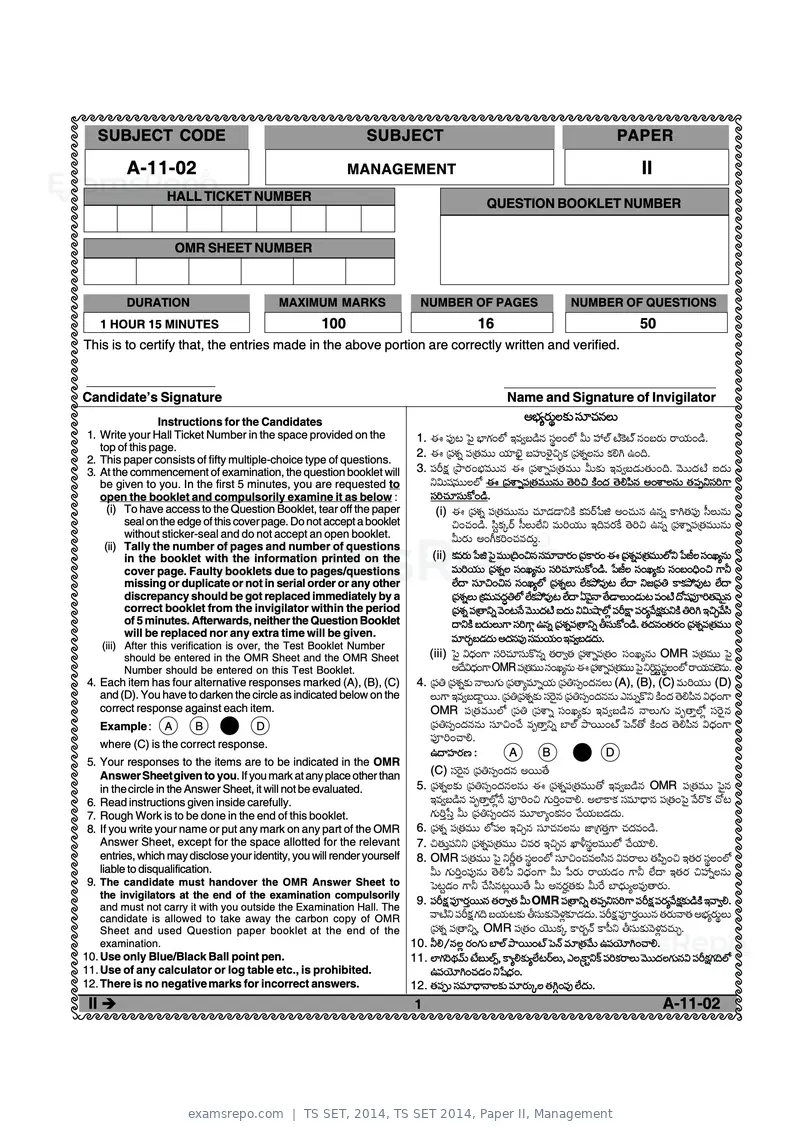
SUBJECT CODE SUBJECT PAPER
A-11-02 MANAGEMENT II
HALL TICKET NUMBER
QUESTION BOOKLET NUMBER
OMR SHEET NUMBER
DURATION MAXIMUM MARKS NUMBER OF PAGES NUMBER OF QUESTIONS
1 HOUR 15 MINUTES 100 16 50
This is to certify that, the entries made in the above portion are correctly written and verified.
Candidate’s Signature Name and Signature of Invigilator
Instructions for the Candidates A¿æýÅÆæÿ$¦ËMæü$ çÜ*^èþ¯èþË$
1. Write your Hall Ticket Number in the space provided on the 1. D ç³#r ò³O ¿êVæü ÌZ CÐèþÓºyìþ¯èþ çÜ¦Ë ÌZ Ò$ çàÌý sìýMðüsý ¯èþ ºÆæÿ$ Æ>Äæý$ yìþ.
top of this page.
2. D {ç³Ôèý² ç³{èþÐèþ$$ Äæý*¿ñýO ºçßý$âñýO_eMæü {ç³Ôèý²Ë¯èþ$ MæüÍW E ¨.
2. This paper consists of fifty multiple-choice type of questions.
3. At the commencement of examination, the question booklet will 3. ç³Èæü {´ëÆæÿ ¿æýÐèþ$$¯èþ D {ç³Ôé²ç³{èþÐèþ$$ Ò$Mæü$ CÐèþÓºyæþ$èþ$ ¨. Ððþ$$§æþsìý I§æþ$
be given to you. In the first 5 minutes, you are requested to °Ñ$çÙÐèþ$$ËÌZ D {ç³Ôé²ç³{èþÐèþ$$¯èþ$ ðþÇ_ Mìü §æþ ðþÍí³¯èþ A Ôé˯èþ$ èþç³µ°çÜÇV>
open the booklet and compulsorily examine it as below : çÜÇ^èþ*çÜ$Mø yìþ.
(i) To have access to the Question Booklet, tear off the paper (i) D {ç³Ôèý² ç³{èþÐèþ$$¯èþ$ ^èþ*yæþyé°Mìü MæüÐèþÆÿõ³h A ^èþ$¯èþ E¯èþ² M>Wèþç³# ïÜË$¯èþ$
seal on the edge of this cover page. Do not accept a booklet _ ^èþ yìþ. íÜtMæüPÆÿ ïÜË$Ìôý° Ðèþ$ÇÄæý$$ C¨ÐèþÆæÿMóü ðþÇ_ E¯èþ² {ç³Ôé²ç³{èþÐèþ$$¯èþ$
without sticker-seal and do not accept an open booklet. Ò$Ææÿ$ A XMæüÇ ^èþÐèþ§æþ$ª.
(ii) Tally the number of pages and number of questions
in the booklet with the information printed on the (ii) MæüÐèþÆæÿ$ õ³h ò³O Ðèþ$${¨ _¯èþ çÜÐèþ*^éÆæÿ {ç³M>Ææÿ D {ç³Ôèý²ç³{èþÐèþ$$ÌZ° õ³iË çÜ Qůèþ$
cover page. Faulty booklets due to pages/questions Ðèþ$ÇÄæý$$ {ç³Ôèý²Ë çÜ Qůèþ$ çÜÇ^èþ*çÜ$Mø yìþ. õ³iË çÜ QÅMæü$ çÜ º «¨ _ V>±
missing or duplicate or not in serial order or any other Ìôý§é çÜ*_ _¯èþ çÜ QÅÌZ {ç³Ôèý²Ë$ ÌôýMæü´ùÐèþ#r Ìôý§é °f{ç³ M>Mæü´ùÐèþ#r Ìôý§é
discrepancy should be got replaced immediately by a {ç³Ôèý²Ë$ {MæüÐèþ$糧æþ®ÌZ ÌôýMæü´ùÐèþ#r Ìôý§é HÐðþO¯é óþyéË$ yæþ$r Ðèþ sìý §øçÙç³NÇèþÐðþ$O¯èþ
correct booklet from the invigilator within the period {ç³Ôèý² ç³{é°² Ððþ r¯óþ Ððþ$$§æþsìý I§æþ$ °Ñ$ÚëÌZÏ ç³È> ç³ÆæÿÅÐóþæüMæü$°Mìü ÇW C_aÐóþíÜ
of 5 minutes. Afterwards, neither the Question Booklet §é°Mìü º§æþ$Ë$V> çÜÇV>Y E¯èþ² {ç³Ôèý²ç³{é°² ¡çÜ$Mø yìþ. èþ§æþ¯èþ èþÆæÿ {ç³Ôèý²ç³{èþÐèþ$$
will be replaced nor any extra time will be given. Ðèþ*Ææÿaºyæþ§æþ$ A§æþ¯èþç³# çÜÐèþ$Äæý$ CÐèþÓºyæþ§æþ$.
(iii) After this verification is over, the Test Booklet Number
should be entered in the OMR Sheet and the OMR Sheet (iii) ò³O Ñ«§æþ V> çÜÇ^èþ*çÜ$Mö¯èþ² èþÆ>Óèþ {ç³Ôé²ç³{èþ çÜ Qůèþ$ OMR ç³{èþÐèþ$$ ò³O
Number should be entered on this Test Booklet. A§óþÑ«§æþ V> OMR ç³{èþÐèþ$$ çÜ Qůèþ$ D {ç³Ôé²ç³{èþÐèþ$$ ò³O °ÇªçÙtt çÜ¦Ë ÌZ Æ>Äæý$ÐèþÌñý¯èþ$.
4. Each item has four alternative responses marked (A), (B), (C) 4. {ç³ {ç³Ôèý²Mæü$ ¯éË$Væü$ {ç³éÅÐèþ*²Äæý$ {ç³çܵ §æþ¯èþË$ (A), (B), (C) Ðèþ$ÇÄæý$$ (D)
and (D). You have to darken the circle as indicated below on the Ë$V> CÐèþÓºyézÆÿ$$. {ç³{ç³Ôèý²Mæü$ çÜÆðÿO¯èþ {ç³çܵ §æþ¯èþ¯èþ$ G¯èþ$²Mö° Mìü §æþ ðþÍí³¯èþ Ñ«§æþ V>
correct response against each item. OMR ç³{èþÐèþ$$ÌZ {ç³ {ç³Ôé² çÜ QÅMæü$ CÐèþÓºyìþ¯èþ ¯éË$Væü$ Ðèþé¢ÌZÏ çÜÆðÿO¯èþ
Example : A B C D {ç³çܵ §æþ¯èþ¯èþ$ çÜ*_ ^óþ Ðèþ颰² »êÌý ´ëÆÿ$$ sý ò³¯þø Mìü §æþ ðþÍí³¯èþ Ñ«§æþ V>
where (C) is the correct response.
ç³NÇ ^éÍ.
E§éçßýÆæÿ×ý : A B C D
5. Your responses to the items are to be indicated in the OMR
Answer Sheet given to you. If you mark at any place other than (C) çÜÆðÿO¯èþ {ç³çܵ §æþ¯èþ AÆÿ$$óþ
in the circle in the Answer Sheet, it will not be evaluated. 5. {ç³Ôèý²ËMæü$ {ç³çܵ §æþ¯èþ˯èþ$ D {ç³Ôèý²ç³{èþÐèþ$$ø CÐèþÓºyìþ¯èþ OMR ç³{èþÐèþ$$ ò³O¯èþ
6. Read instructions given inside carefully. CÐèþÓºyìþ¯èþ Ðèþé¢ÌZϯóþ ç³NÇ _ Væü$Ç¢ ^éÍ. AÌêM>Mæü çÜÐèþ*«§é¯èþ ç³{èþ ò³O ÐóþÆöMæü ^ør
7. Rough Work is to be done in the end of this booklet. Væü$Ç¢õÜ¢ Ò$ {ç³çܵ §æþ¯èþ Ðèþ$*ÌêÅ Mæü¯èþ ^óþÄæý$ºyæþ§æþ$.
8. If you write your name or put any mark on any part of the OMR 6. {ç³Ôèý² ç³{èþÐèþ$$ ÌZç³Ë C_a¯èþ çÜ*^èþ¯èþ˯èþ$ gê{Væüèþ¢V> ^èþ§æþÐèþ yìþ.
Answer Sheet, except for the space allotted for the relevant 7. _èþ$¢ç³°° {ç³Ôèý²ç³{èþÐèþ$$ _ÐèþÆæÿ C_a¯èþ RêäçܦËÐèþ$$ÌZ ^óþÄæý*Í.
entries, which may disclose your identity, you will render yourself 8. OMR ç³{èþÐèþ$$ ò³O °È~èþ çÜ¦Ë ÌZ çÜ*_ ^èþÐèþËíܯèþ ÑÐèþÆ>Ë$ èþí³µ _ CèþÆæÿ çÜ¦Ë ÌZ
liable to disqualification. Ò$ Væü$Ç¢ ç³#¯èþ$ ðþÍõ³ Ñ«§æþ V> Ò$ õ³Ææÿ$ Æ>Äæý$yæþ V>± Ìôý§é CèþÆæÿ _à²Ë¯èþ$
9. The candidate must handover the OMR Answer Sheet to ò³rtyæþ V>± ^óþíܯèþrÏÆÿ$$óþ Ò$ A¯èþÆæÿáèþMæü$ Ò$Æóÿ »ê«§æþ$ÅËÐèþ#éÆæÿ$.
the invigilators at the end of the examination compulsorily
9. ç³Èæü ç³NÆæÿ¢Æÿ$$¯èþ èþÆ>Óèþ Ò$ OMR ç³{é°² èþç³µ°çÜÇV> ç³Èæü ç³ÆæÿÅÐóþæüMæü$yìþMìü CÐéÓÍ.
and must not carry it with you outside the Examination Hall. The
candidate is allowed to take away the carbon copy of OMR Ðésìý° ç³Èæü Væü¨ ºÄæý$rMæü$ ¡çÜ$Mæü$ÐðþâæýÏMæü*yæþ§æþ$. ç³Èæü ç³NÆæÿ¢Æÿ$$¯èþ èþÆæÿ$Ðéèþ A¿æýÅÆæÿ$¦Ë$
Sheet and used Question paper booklet at the end of the {ç³Ôèý² ç³{é°², OMR ç³{èþ Äñý$$MæüP M>Ææÿ¾¯þ M>ï³° ¡çÜ$Mæü$ÐðþâæýÏÐèþ^èþ$a.
examination. 10. ±Í/¯èþËÏ Ææÿ Væü$ »êÌý ´ëÆÿ$$ sý ò³¯þ Ðèþ*{èþÐóþ$ Eç³Äñý*W ^éÍ.
10. Use only Blue/Black Ball point pen. 11. ÌêVæüÇ£æþÐþ$ sôýº$ÌýÞ, M>ÅÍMæü$ÅÌôýrÆÿË$, GË[M>t°Mü ç³ÇMæüÆ>Ë$ Ððþ$$§æþËVæü$¯èþÑ ç³ÈæüVæü¨ÌZ
11. Use of any calculator or log table etc., is prohibited. Eç³Äñý*W ^èþyæþ °õÙ«§æþ .
12. There is no negative marks for incorrect answers. 12. èþç³ çÜÐèþ*«§é¯éËMæü$ Ðèþ*Ææÿ$PË èþWY ç³# Ìôý§æþ$.
II Î 1 A-11-02
CCCCCCCCCCCCCCCCCCCCCCCCCCCCCCCCCCCCCCCCCCCCCCCCCCCCCCCCCCCCCCCCCCCCCCCCCCC
Text of page 2
*A1102*


                  HE
                    RE

            WR
              ITE

        NO
          T
       DO


II Î          2            A-11-02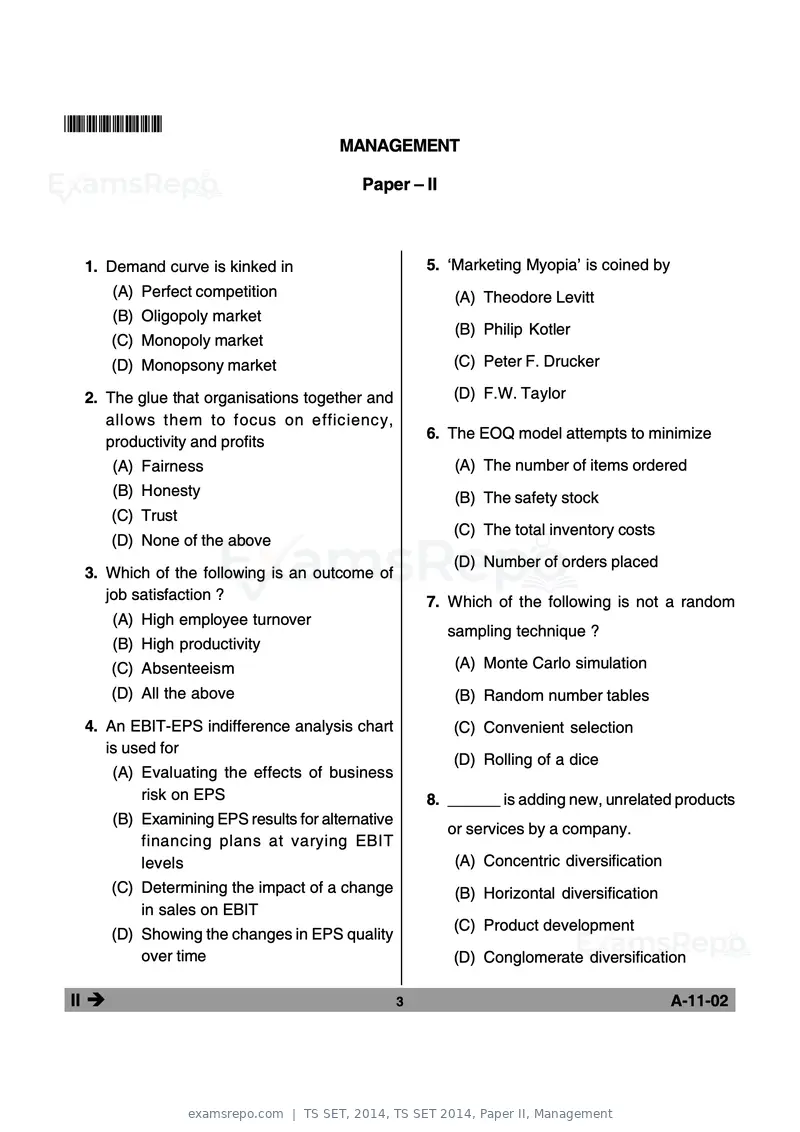
Text of page 3
*A1102*
                                        MANAGEMENT

                                           Paper – II


 1. Demand curve is kinked in                          5. ‘Marketing Myopia’ is coined by
       (A) Perfect competition                            (A) Theodore Levitt
       (B) Oligopoly market
                                                          (B) Philip Kotler
       (C) Monopoly market
       (D) Monopsony market                               (C) Peter F. Drucker

 2. The glue that organisations together and              (D) F.W. Taylor
    allows them to focus on efficiency,
                                                       6. The EOQ model attempts to minimize
    productivity and profits
       (A) Fairness                                       (A) The number of items ordered
       (B) Honesty                                        (B) The safety stock
       (C) Trust
                                                          (C) The total inventory costs
       (D) None of the above
                                                          (D) Number of orders placed
 3. Which of the following is an outcome of
    job satisfaction ?                                 7. Which of the following is not a random
       (A) High employee turnover
                                                         sampling technique ?
       (B) High productivity
       (C) Absenteeism                                    (A) Monte Carlo simulation
       (D) All the above                                  (B) Random number tables
 4. An EBIT-EPS indifference analysis chart               (C) Convenient selection
    is used for
                                                          (D) Rolling of a dice
       (A) Evaluating the effects of business
           risk on EPS                                 8. ______ is adding new, unrelated products
       (B) Examining EPS results for alternative
                                                         or services by a company.
           financing plans at varying EBIT
           levels                                         (A) Concentric diversification
       (C) Determining the impact of a change             (B) Horizontal diversification
           in sales on EBIT
                                                          (C) Product development
       (D) Showing the changes in EPS quality
           over time                                      (D) Conglomerate diversification

II Î                                               3                                        A-11-02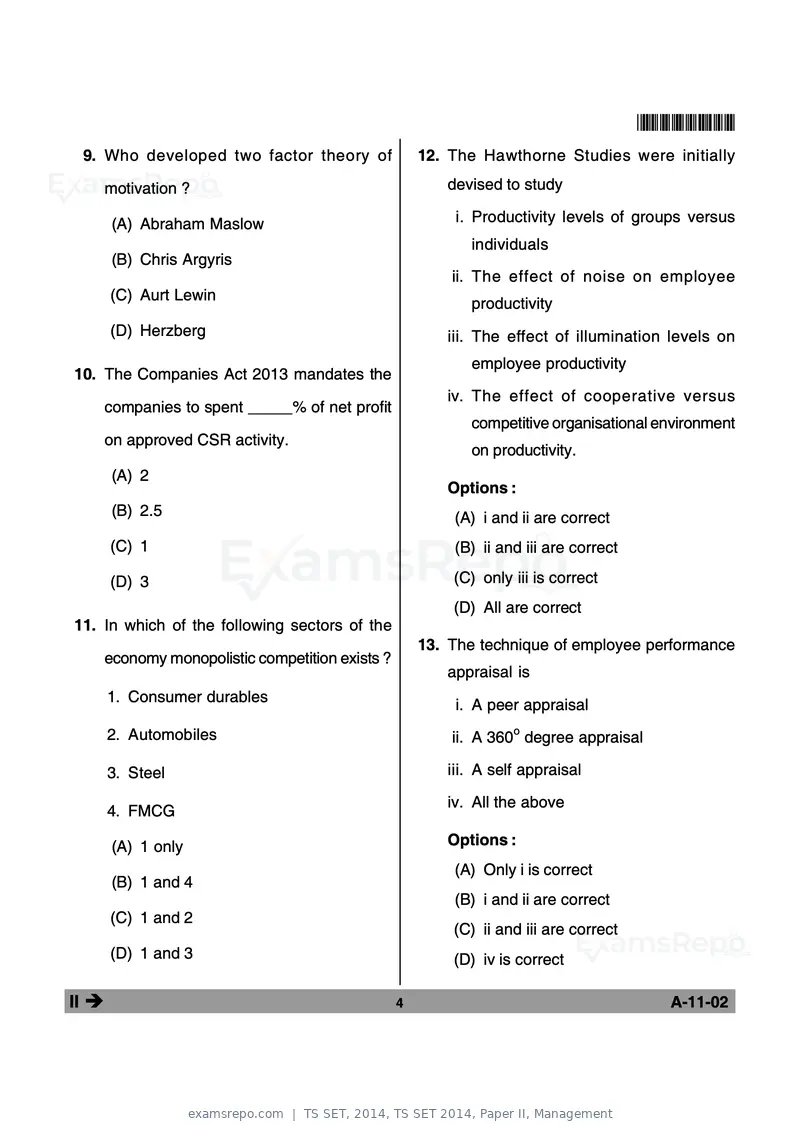
Text of page 4
*A1102*
 9. Who developed two factor theory of              12. The Hawthorne Studies were initially

    motivation ?                                       devised to study

       (A) Abraham Maslow                               i. Productivity levels of groups versus
                                                          individuals
       (B) Chris Argyris
                                                        ii. The effect of noise on employee
       (C) Aurt Lewin
                                                          productivity
       (D) Herzberg                                    iii. The effect of illumination levels on
                                                          employee productivity
10. The Companies Act 2013 mandates the
                                                       iv. The effect of cooperative versus
    companies to spent _____% of net profit
                                                          competitive organisational environment
    on approved CSR activity.
                                                          on productivity.
       (A) 2
                                                       Options :
       (B) 2.5                                          (A) i and ii are correct
       (C) 1                                            (B) ii and iii are correct

       (D) 3                                            (C) only iii is correct
                                                        (D) All are correct
11. In which of the following sectors of the
                                                    13. The technique of employee performance
    economy monopolistic competition exists ?
                                                       appraisal is
       1. Consumer durables
                                                        i. A peer appraisal
       2. Automobiles                                            o
                                                        ii. A 360 degree appraisal

       3. Steel                                        iii. A self appraisal

                                                       iv. All the above
       4. FMCG

       (A) 1 only                                      Options :
                                                        (A) Only i is correct
       (B) 1 and 4
                                                        (B) i and ii are correct
       (C) 1 and 2
                                                        (C) ii and iii are correct
       (D) 1 and 3                                      (D) iv is correct

II Î                                            4                                      A-11-02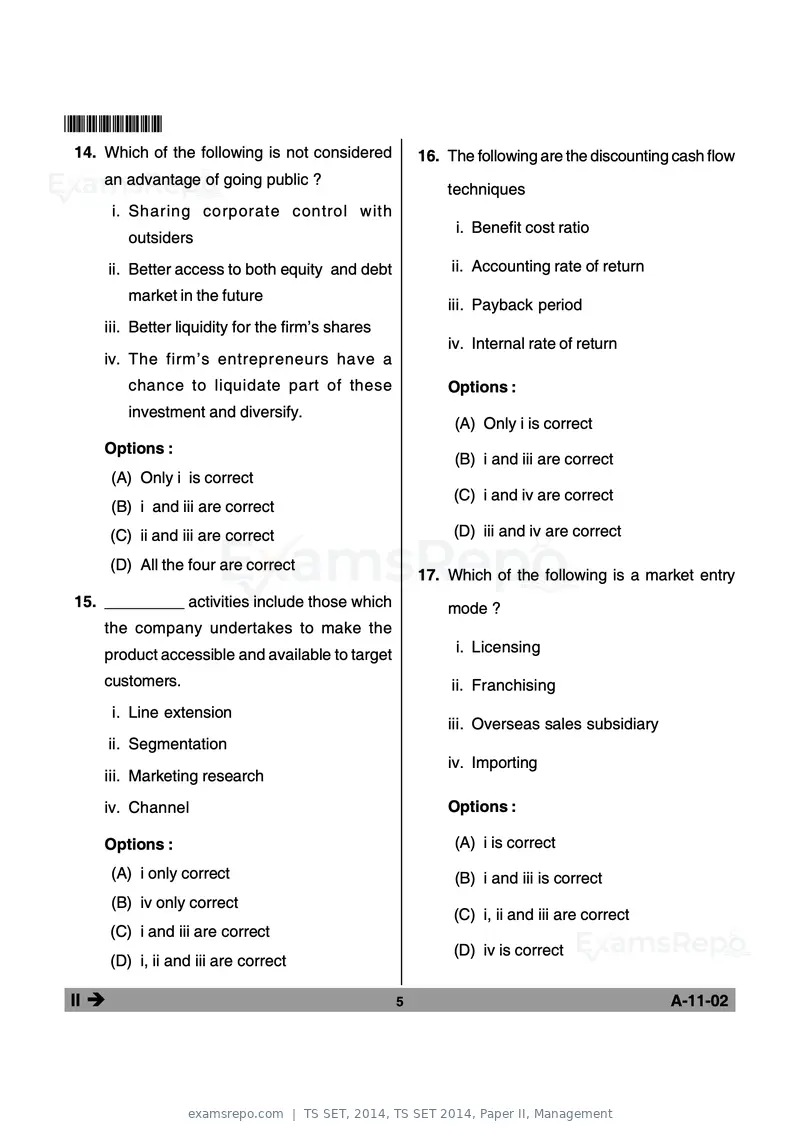
Text of page 5
*A1102*
14. Which of the following is not considered           16. The following are the discounting cash flow
    an advantage of going public ?
                                                           techniques
       i. Sharing corporate control with
                                                            i. Benefit cost ratio
         outsiders
       ii. Better access to both equity and debt            ii. Accounting rate of return
         market in the future
                                                           iii. Payback period
    iii. Better liquidity for the firm’s shares
                                                           iv. Internal rate of return
    iv. The firm’s entrepreneurs have a
         chance to liquidate part of these                 Options :
         investment and diversify.
                                                            (A) Only i is correct
    Options :
                                                            (B) i and iii are correct
       (A) Only i is correct
                                                            (C) i and iv are correct
       (B) i and iii are correct
       (C) ii and iii are correct                           (D) iii and iv are correct

       (D) All the four are correct
                                                       17. Which of the following is a market entry
15. _________ activities include those which               mode ?
    the company undertakes to make the
    product accessible and available to target              i. Licensing

    customers.                                              ii. Franchising
       i. Line extension
                                                           iii. Overseas sales subsidiary
       ii. Segmentation
                                                           iv. Importing
    iii. Marketing research
    iv. Channel                                            Options :

    Options :                                               (A) i is correct
       (A) i only correct                                   (B) i and iii is correct
       (B) iv only correct
                                                            (C) i, ii and iii are correct
       (C) i and iii are correct
                                                            (D) iv is correct
       (D) i, ii and iii are correct

II Î                                               5                                        A-11-02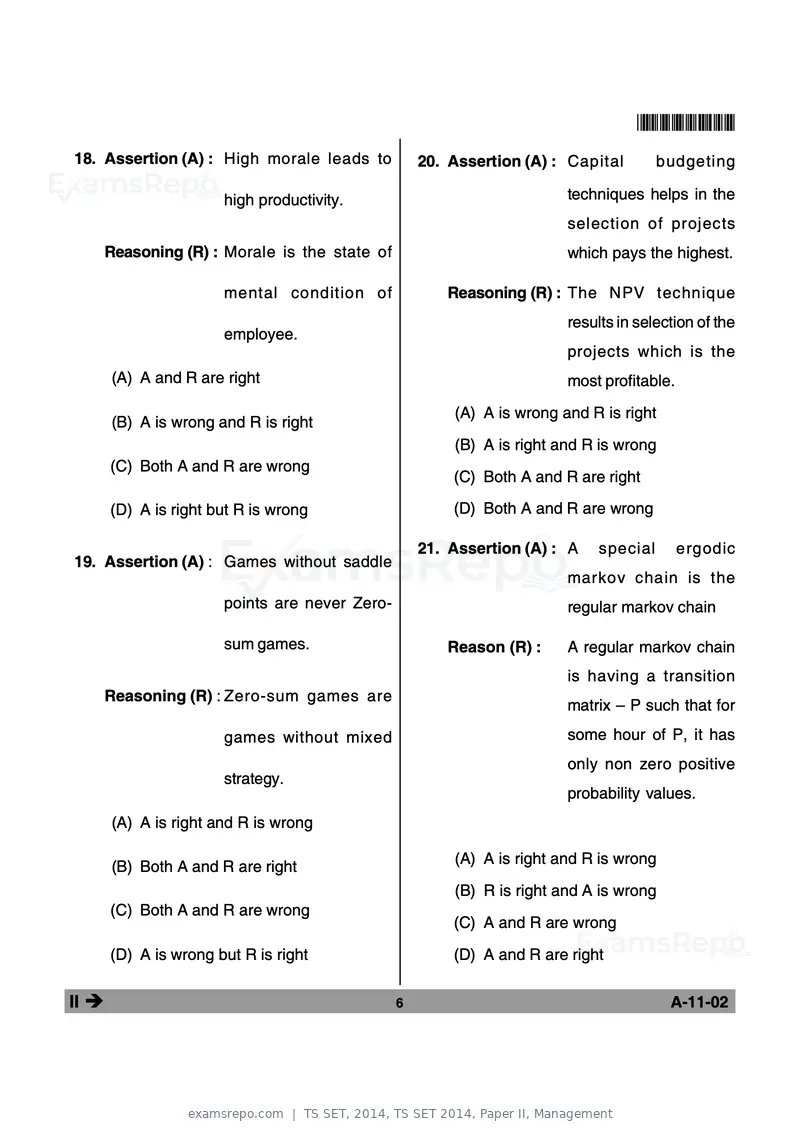
Text of page 6
*A1102*
18. Assertion (A) : High morale leads to            20. Assertion (A) : Capital        budgeting

                       high productivity.                               techniques helps in the
                                                                        selection of projects
   Reasoning (R) : Morale is the state of                               which pays the highest.

                       mental condition of             Reasoning (R) : The NPV technique
                                                                        results in selection of the
                       employee.
                                                                        projects which is the
       (A) A and R are right                                            most profitable.
                                                        (A) A is wrong and R is right
       (B) A is wrong and R is right
                                                        (B) A is right and R is wrong
       (C) Both A and R are wrong
                                                        (C) Both A and R are right

       (D) A is right but R is wrong                    (D) Both A and R are wrong

                                                    21. Assertion (A) : A    special       ergodic
19. Assertion (A) : Games without saddle
                                                                        markov chain is the
                       points are never Zero-                           regular markov chain

                       sum games.                      Reason (R) :     A regular markov chain
                                                                        is having a transition
   Reasoning (R) : Zero-sum games are
                                                                        matrix – P such that for
                       games without mixed                              some hour of P, it has
                                                                        only non zero positive
                       strategy.
                                                                        probability values.
       (A) A is right and R is wrong

       (B) Both A and R are right                       (A) A is right and R is wrong
                                                        (B) R is right and A is wrong
       (C) Both A and R are wrong
                                                        (C) A and R are wrong
       (D) A is wrong but R is right                    (D) A and R are right

II Î                                            6                                       A-11-02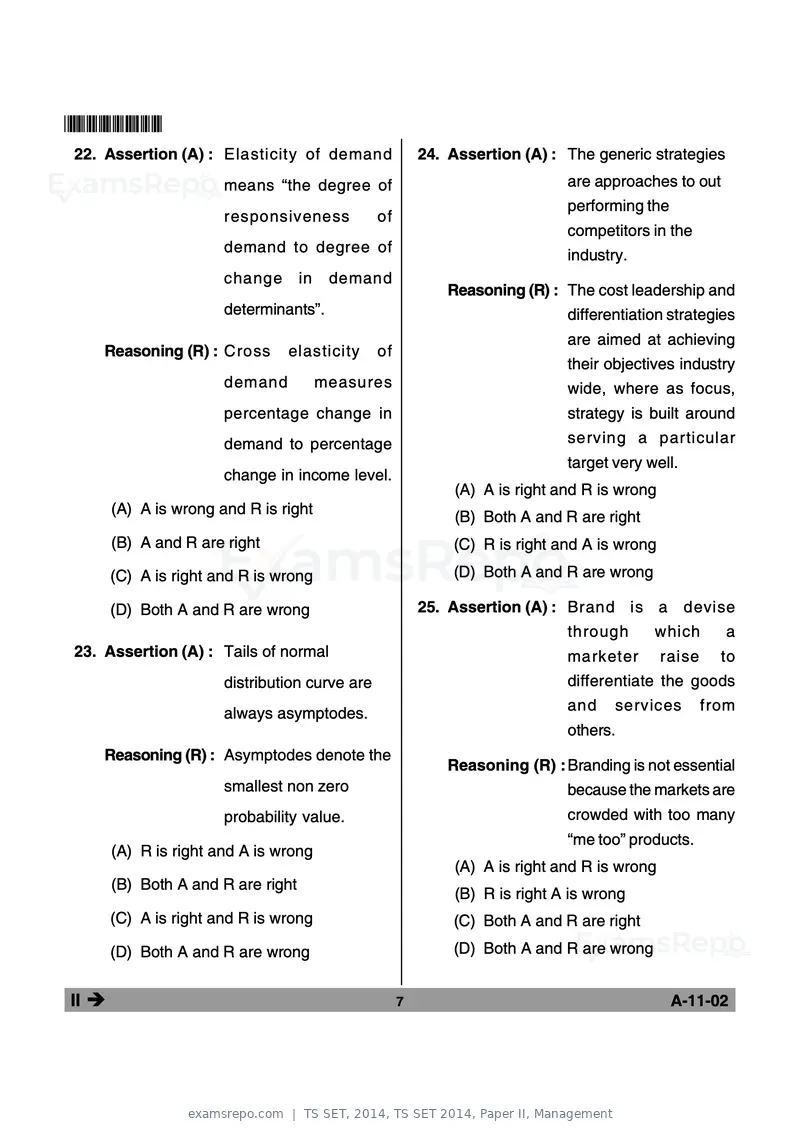
Text of page 7
*A1102*
22. Assertion (A) : Elasticity of demand                 24. Assertion (A) : The generic strategies
                       means “the degree of                                   are approaches to out
                                                                              performing the
                       responsiveness           of
                                                                              competitors in the
                       demand to degree of                                    industry.
                       change       in    demand
                                                             Reasoning (R) : The cost leadership and
                       determinants”.                                         differentiation strategies
                                                                              are aimed at achieving
    Reasoning (R) : Cross       elasticity      of
                                                                              their objectives industry
                       demand            measures                             wide, where as focus,
                       percentage change in                                   strategy is built around
                       demand to percentage                                   serving a particular
                                                                              target very well.
                       change in income level.
                                                              (A) A is right and R is wrong
       (A) A is wrong and R is right
                                                              (B) Both A and R are right
       (B) A and R are right                                 (C) R is right and A is wrong
       (C) A is right and R is wrong                         (D) Both A and R are wrong

       (D) Both A and R are wrong                        25. Assertion (A) : Brand is a devise
                                                                              through      which        a
23. Assertion (A) : Tails of normal                                           marketer        raise     to
                       distribution curve are                                 differentiate the goods
                                                                              and    services         from
                       always asymptodes.
                                                                              others.
    Reasoning (R) : Asymptodes denote the
                                                             Reasoning (R) : Branding is not essential
                       smallest non zero                                      because the markets are
                       probability value.                                     crowded with too many
                                                                              “me too” products.
       (A) R is right and A is wrong
                                                              (A) A is right and R is wrong
       (B) Both A and R are right
                                                              (B) R is right A is wrong
       (C) A is right and R is wrong                         (C) Both A and R are right
       (D) Both A and R are wrong                            (D) Both A and R are wrong


II Î                                                 7                                         A-11-02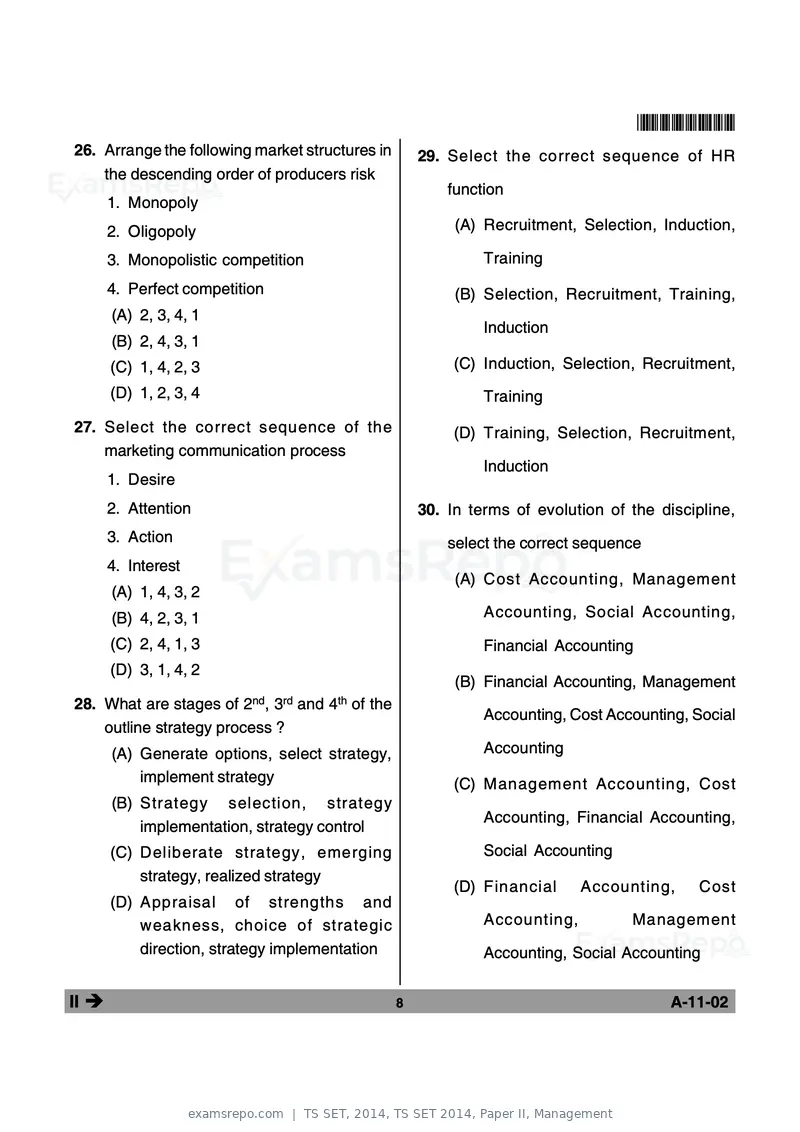
Text of page 8
*A1102*
26. Arrange the following market structures in         29. Select the correct sequence of HR
    the descending order of producers risk
                                                           function
       1. Monopoly
       2. Oligopoly                                         (A) Recruitment, Selection, Induction,

       3. Monopolistic competition                              Training
       4. Perfect competition                               (B) Selection, Recruitment, Training,
       (A) 2, 3, 4, 1
                                                                Induction
       (B) 2, 4, 3, 1
       (C) 1, 4, 2, 3                                       (C) Induction, Selection, Recruitment,
       (D) 1, 2, 3, 4                                           Training
27. Select the correct sequence of the                      (D) Training, Selection, Recruitment,
    marketing communication process
                                                                Induction
       1. Desire
       2. Attention                                    30. In terms of evolution of the discipline,
       3. Action                                           select the correct sequence
       4. Interest
                                                            (A) Cost Accounting, Management
       (A) 1, 4, 3, 2
       (B) 4, 2, 3, 1                                           Accounting, Social Accounting,

       (C) 2, 4, 1, 3                                           Financial Accounting
       (D) 3, 1, 4, 2
                                                            (B) Financial Accounting, Management
28.   What are stages of 2nd, 3rd and 4th of the
                                                                Accounting, Cost Accounting, Social
      outline strategy process ?
       (A) Generate options, select strategy,                   Accounting
           implement strategy                               (C) Management Accounting, Cost
       (B) Strategy selection, strategy
                                                                Accounting, Financial Accounting,
           implementation, strategy control
       (C) Deliberate strategy, emerging                        Social Accounting
           strategy, realized strategy
                                                            (D) Financial     Accounting,     Cost
       (D) Appraisal of strengths and
           weakness, choice of strategic                        Accounting,         Management
           direction, strategy implementation                   Accounting, Social Accounting


II Î                                               8                                      A-11-02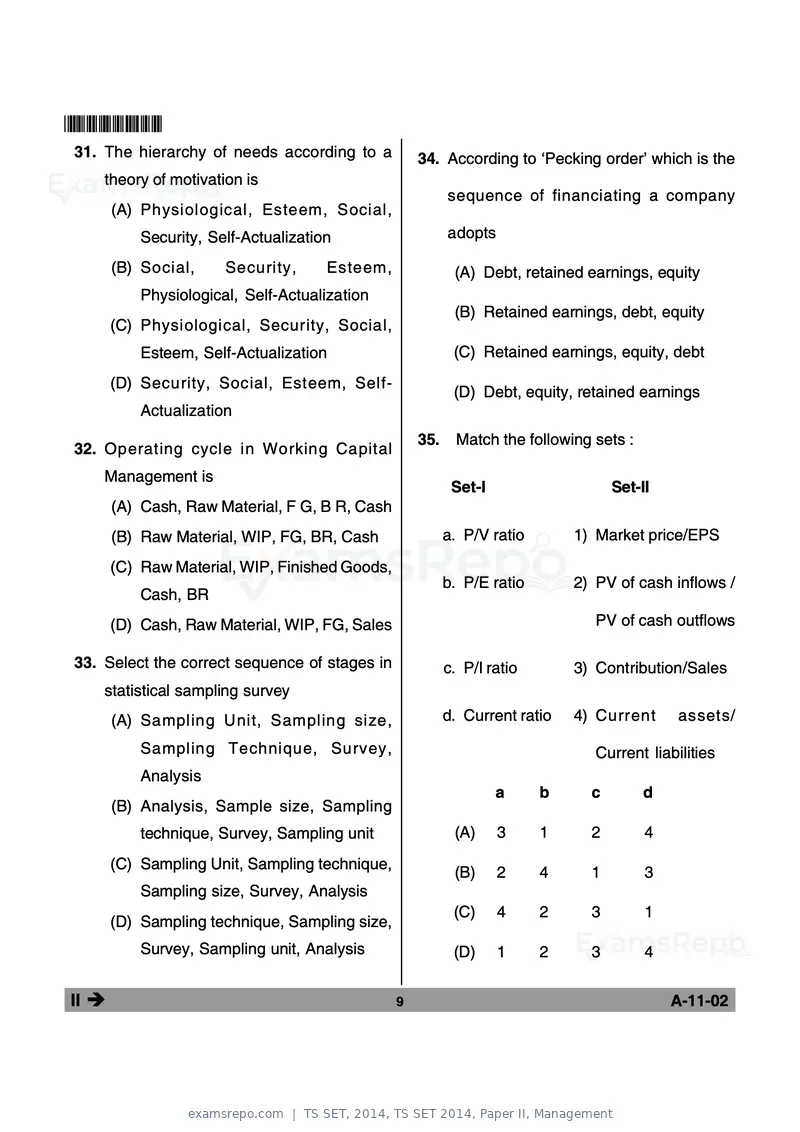
Text of page 9
*A1102*
31. The hierarchy of needs according to a           34. According to ‘Pecking order’ which is the
    theory of motivation is
                                                          sequence of financiating a company
       (A) Physiological, Esteem, Social,
           Security, Self-Actualization                   adopts

       (B) Social,     Security,      Esteem,              (A) Debt, retained earnings, equity
           Physiological, Self-Actualization
                                                           (B) Retained earnings, debt, equity
       (C) Physiological, Security, Social,
           Esteem, Self-Actualization                      (C) Retained earnings, equity, debt
       (D) Security, Social, Esteem, Self-
                                                           (D) Debt, equity, retained earnings
           Actualization
                                                    35.    Match the following sets :
32. Operating cycle in Working Capital
    Management is
                                                           Set-I                   Set-II
       (A) Cash, Raw Material, F G, B R, Cash
       (B) Raw Material, WIP, FG, BR, Cash                a. P/V ratio       1) Market price/EPS
       (C) Raw Material, WIP, Finished Goods,
                                                          b. P/E ratio       2) PV of cash inflows /
           Cash, BR
       (D) Cash, Raw Material, WIP, FG, Sales                                   PV of cash outflows

33. Select the correct sequence of stages in              c. P/I ratio       3) Contribution/Sales
    statistical sampling survey
       (A) Sampling Unit, Sampling size,                  d. Current ratio   4) Current      assets/

           Sampling Technique, Survey,                                          Current liabilities
           Analysis
                                                                   a     b     c        d
       (B) Analysis, Sample size, Sampling
           technique, Survey, Sampling unit                (A)     3     1     2        4
       (C) Sampling Unit, Sampling technique,
                                                           (B)     2     4     1        3
           Sampling size, Survey, Analysis
                                                           (C)     4     2     3        1
       (D) Sampling technique, Sampling size,
           Survey, Sampling unit, Analysis                 (D)     1     2     3        4


II Î                                            9                                           A-11-02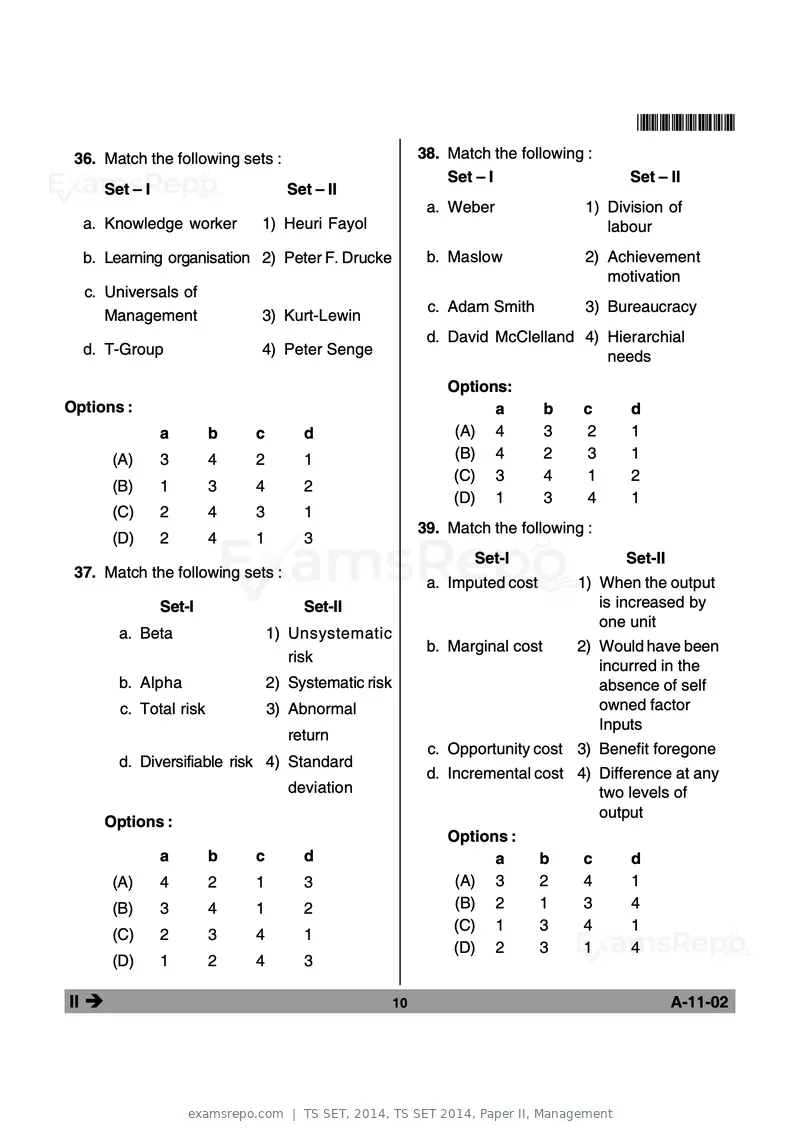
Text of page 10
*A1102*
 36. Match the following sets :                           38. Match the following :
                                                              Set – I                    Set – II
     Set – I                       Set – II
                                                           a. Weber                1) Division of
  a. Knowledge worker       1) Heuri Fayol                                            labour
  b. Learning organisation 2) Peter F. Drucke              b. Maslow               2) Achievement
                                                                                      motivation
  c. Universals of
                                                           c. Adam Smith           3) Bureaucracy
     Management             3) Kurt-Lewin
                                                           d. David McClelland 4) Hierarchial
  d. T-Group                4) Peter Senge                                        needs
                                                              Options:
Options :                                                           a         b   c      d
               a        b   c        d                         (A) 4          3   2      1
       (A)     3        4   2        1                         (B) 4          2   3      1
                                                              (C) 3           4   1      2
       (B)     1        3   4        2
                                                              (D) 1           3   4      1
       (C)     2        4   3        1
                                                          39. Match the following :
       (D)     2        4   1        3
                                                                  Set-I                 Set-II
 37. Match the following sets :
                                                           a. Imputed cost        1) When the output
               Set-I                 Set-II                                          is increased by
                                                                                     one unit
       a. Beta                  1) Unsystematic
                                                           b. Marginal cost       2) Would have been
                                   risk
                                                                                     incurred in the
       b. Alpha                 2) Systematic risk                                   absence of self
        c. Total risk           3) Abnormal                                          owned factor
                                                                                     Inputs
                                   return
                                                           c. Opportunity cost 3) Benefit foregone
       d. Diversifiable risk 4) Standard
                                                           d. Incremental cost 4) Difference at any
                                   deviation                                      two levels of
                                                                                  output
     Options :
                                                              Options :
               a        b   c        d                              a        b    c      d
       (A)     4        2   1        3                         (A) 3         2    4      1
       (B)     3        4   1        2                         (B) 2         1    3      4
                                                              (C) 1          3    4      1
       (C)     2        3   4        1
                                                              (D) 2          3    1      4
       (D)     1        2   4        3

II Î                                                 10                                          A-11-02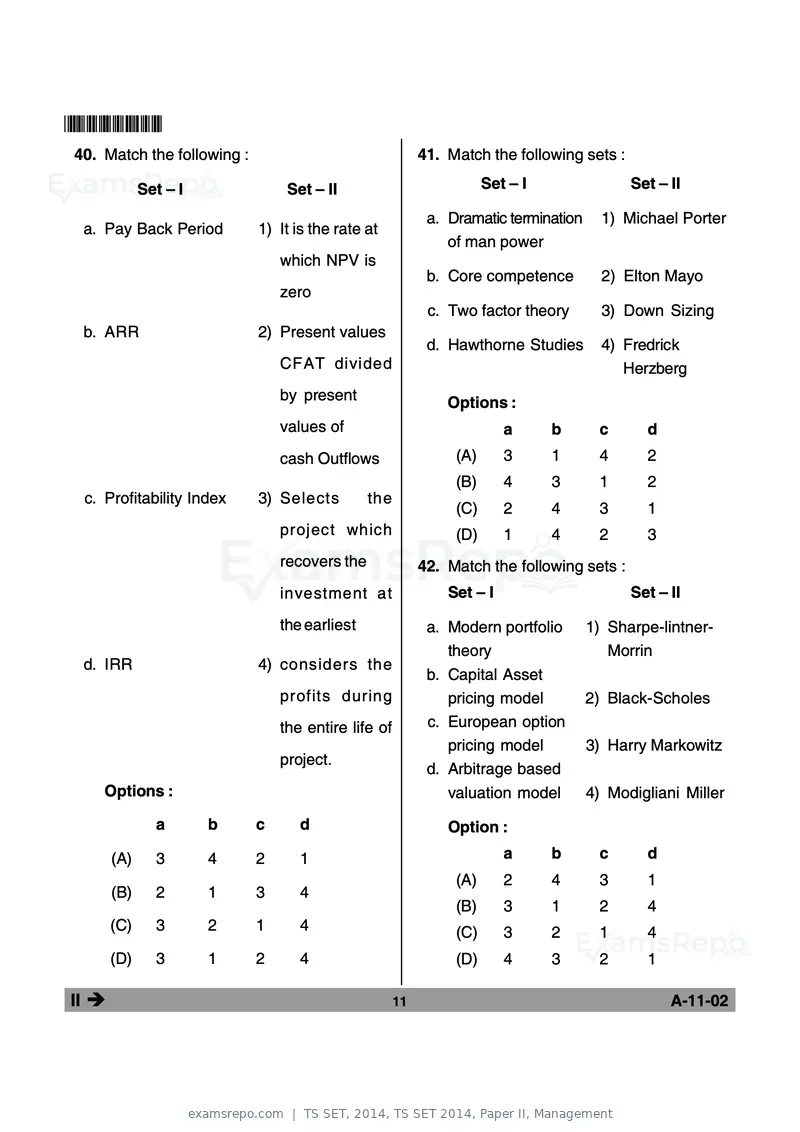
Text of page 11
*A1102*
40. Match the following :                                 41. Match the following sets :

             Set – I             Set – II                            Set – I               Set – II

                                                           a. Dramatic termination     1) Michael Porter
 a. Pay Back Period         1) It is the rate at
                                                              of man power
                                which NPV is
                                                           b. Core competence          2) Elton Mayo
                                zero
                                                           c. Two factor theory        3) Down Sizing
 b. ARR                     2) Present values
                                                           d. Hawthorne Studies        4) Fredrick
                                CFAT divided                                              Herzberg
                                by present                    Options :
                                values of                               a      b      c      d
                                cash Outflows                  (A)      3      1      4      2
                                                               (B)      4      3      1      2
 c. Profitability Index     3) Selects         the
                                                               (C)      2      4      3      1
                                project which                  (D)      1      4      2      3
                                recovers the              42. Match the following sets :
                                investment at                 Set – I                      Set – II

                                the earliest               a. Modern portfolio       1) Sharpe-lintner-
                                                              theory                    Morrin
 d. IRR                     4) considers the
                                                           b. Capital Asset
                                profits during                pricing model          2) Black-Scholes
                                the entire life of         c. European option
                                                              pricing model          3) Harry Markowitz
                                project.
                                                           d. Arbitrage based
    Options :                                                 valuation model        4) Modigliani Miller
               a       b    c      d                          Option :
       (A)     3       4    2      1                                    a      b      c      d
                                                               (A)      2      4      3      1
       (B)     2       1    3      4
                                                               (B)      3      1      2      4
       (C)     3       2    1      4                           (C)      3      2      1      4
       (D)     3       1    2      4                           (D)      4      3      2      1

II Î                                                 11                                          A-11-02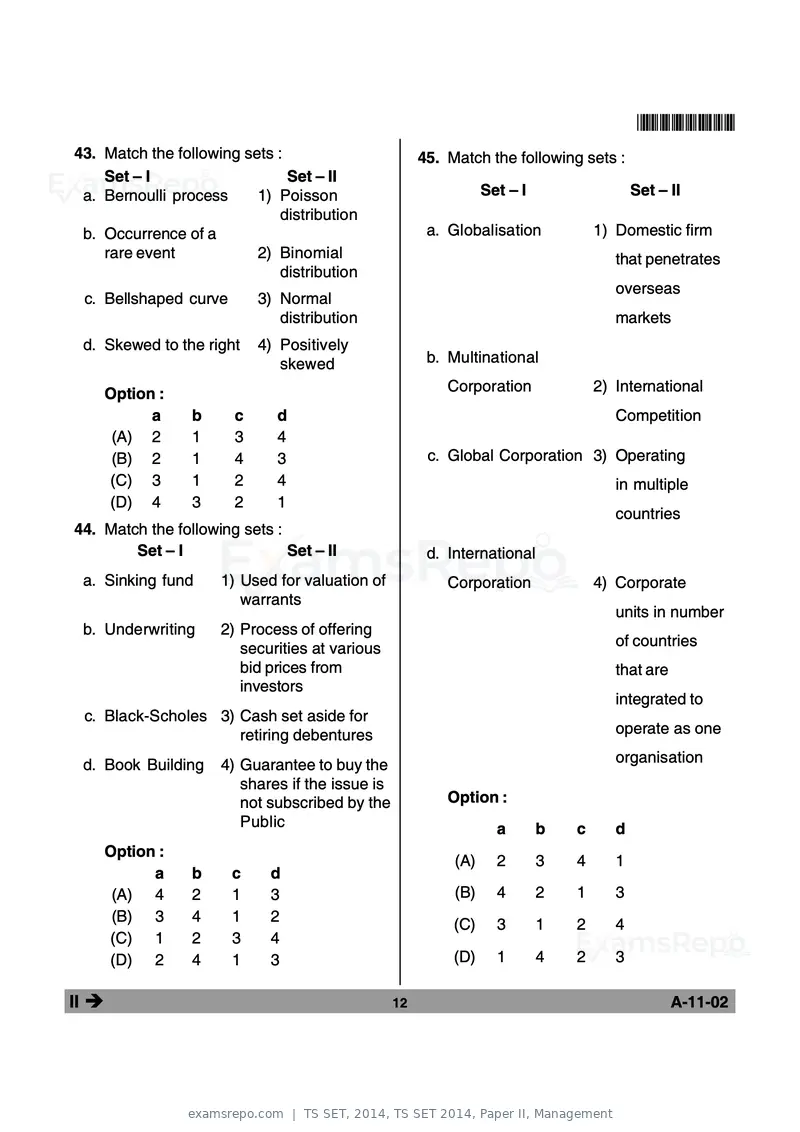
Text of page 12
*A1102*
43. Match the following sets :                        45. Match the following sets :
    Set – I                    Set – II
 a. Bernoulli process     1) Poisson                             Set – I                  Set – II
                             distribution
 b. Occurrence of a                                    a. Globalisation            1) Domestic firm
    rare event            2) Binomial                                                 that penetrates
                             distribution
                                                                                      overseas
 c. Bellshaped curve       3) Normal
                              distribution                                            markets
 d. Skewed to the right    4) Positively
                              skewed                   b. Multinational

    Option :                                              Corporation              2) International
          a      b     c      d                                                       Competition
     (A) 2       1     3      4
     (B) 2       1     4      3                        c. Global Corporation 3) Operating
    (C) 3        1     2      4                                                       in multiple
    (D) 4        3     2      1
                                                                                      countries
44. Match the following sets :
        Set – I                Set – II                d. International
 a. Sinking fund     1) Used for valuation of             Corporation              4) Corporate
                        warrants
                                                                                      units in number
 b. Underwriting     2) Process of offering
                        securities at various                                         of countries
                        bid prices from                                               that are
                        investors
                                                                                      integrated to
 c. Black-Scholes 3) Cash set aside for
                     retiring debentures                                              operate as one

 d. Book Building    4) Guarantee to buy the                                          organisation
                        shares if the issue is
                        not subscribed by the             Option :
                        Public                                     a       b   c      d
    Option :
                                                           (A)     2       3   4      1
          a      b     c     d
     (A) 4       2     1     3                             (B)     4       2   1      3
     (B) 3       4     1     2
                                                           (C)     3       1   2      4
    (C) 1        2     3     4
    (D) 2        4     1     3                             (D)     1       4   2      3

II Î                                             12                                              A-11-02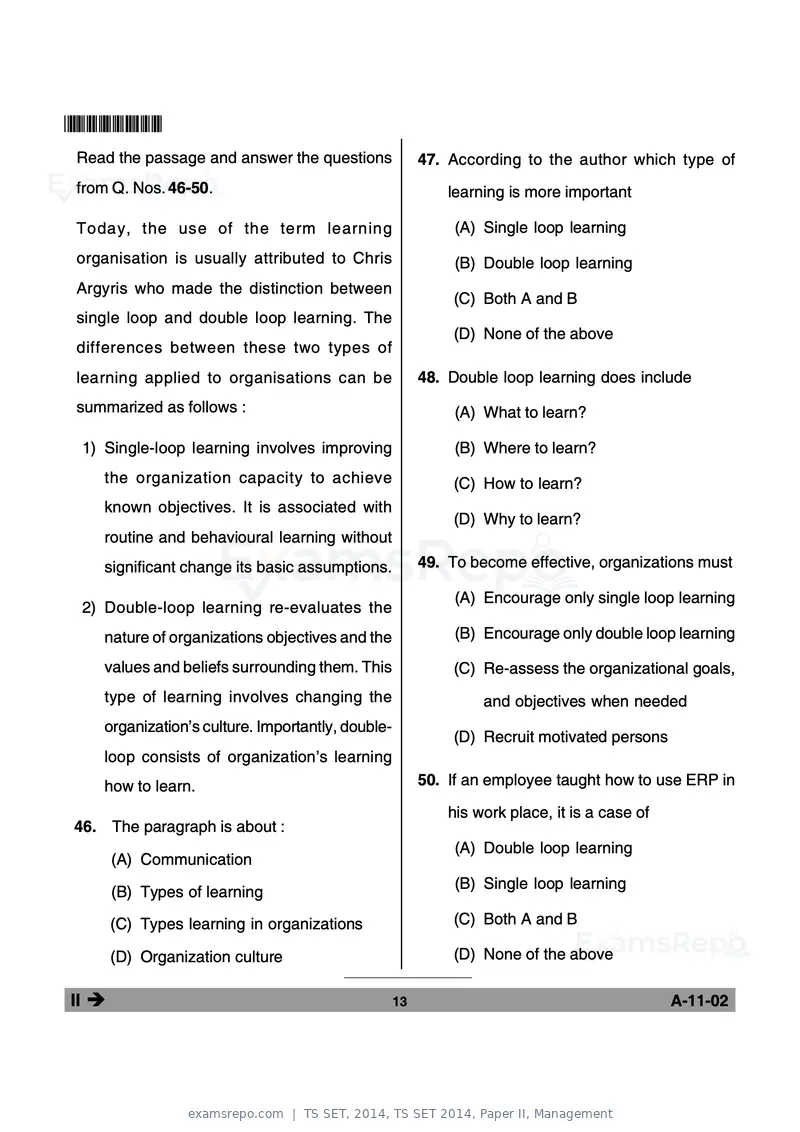
Text of page 13
*A1102*
Read the passage and answer the questions               47. According to the author which type of
from Q. Nos. 46-50.                                         learning is more important

Today, the use of the term learning                          (A) Single loop learning
organisation is usually attributed to Chris                  (B) Double loop learning
Argyris who made the distinction between
                                                            (C) Both A and B
single loop and double loop learning. The
                                                            (D) None of the above
differences between these two types of
learning applied to organisations can be                48. Double loop learning does include
summarized as follows :                                      (A) What to learn?

 1) Single-loop learning involves improving                  (B) Where to learn?
    the organization capacity to achieve                    (C) How to learn?
    known objectives. It is associated with
                                                            (D) Why to learn?
    routine and behavioural learning without
    significant change its basic assumptions.           49. To become effective, organizations must

                                                             (A) Encourage only single loop learning
 2) Double-loop learning re-evaluates the
    nature of organizations objectives and the               (B) Encourage only double loop learning

    values and beliefs surrounding them. This               (C) Re-assess the organizational goals,
    type of learning involves changing the                       and objectives when needed
    organization’s culture. Importantly, double-
                                                            (D) Recruit motivated persons
    loop consists of organization’s learning
    how to learn.                                       50. If an employee taught how to use ERP in

                                                            his work place, it is a case of
46. The paragraph is about :
                                                             (A) Double loop learning
       (A) Communication
                                                             (B) Single loop learning
       (B) Types of learning

       (C) Types learning in organizations                  (C) Both A and B

       (D) Organization culture                             (D) None of the above

II Î                                               13                                         A-11-02
Text of page 14
*A1102*
       Space for Rough Work


II Î            14              A-11-02
Text of page 15
*A1102*
          Space for Rough Work


II Î               15            A-11-02
Text of page 16
*A1102*
       Space for Rough Work


II Î            16              A-11-02
Official key not published for this paper.
Page 1 of 16
Source: Telangana State Eligibility Test. Question paper published by Telangana State Eligibility Test.