
TS SET 2014: Paper II, Mathematical Sciences
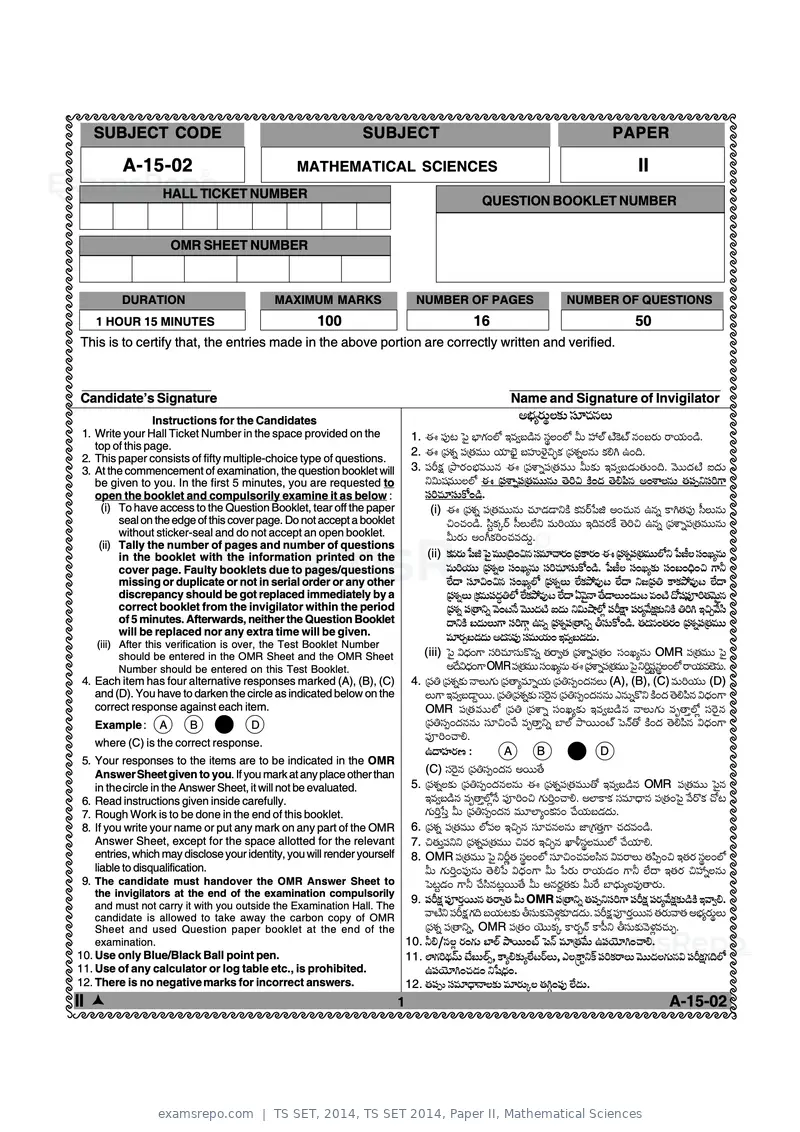
Text of page 1
CCCCCCCCCCCCCCCCCCCCCCCCCCCCCCCCCCCCCCCCCCCCCCCCCCCCCCCCCCCCCCCCCCCCCCCCCCC
CCCCCCCCCCCCCCCCCCCCCCCCCCCCCCCCCCCCCCCCCCCCCCCCCCCCCCCCCCCCCCCCCCCCCCCCCCCCCCCCCCCCCCCCCCCCCCCCCCCC CCCCCCCCCCCCCCCCCCCCCCCCCCCCCCCCCCCCCCCCCCCCCCCCCCCCCCCCCCCCCCCCCCCCCCCCCCCCCCCCCCCCCCCCCCCCCCCCCCCC
SUBJECT CODE SUBJECT PAPER
A-15-02 MATHEMATICAL SCIENCES II
HALL TICKET NUMBER
QUESTION BOOKLET NUMBER
OMR SHEET NUMBER
DURATION MAXIMUM MARKS NUMBER OF PAGES NUMBER OF QUESTIONS
1 HOUR 15 MINUTES 100 16 50
This is to certify that, the entries made in the above portion are correctly written and verified.
Candidate’s Signature Name and Signature of Invigilator
Instructions for the Candidates A¿æýÅÆæÿ$¦ËMæü$ çÜ*^èþ¯èþË$
1. Write your Hall Ticket Number in the space provided on the 1. D ç³#r ò³O ¿êVæü ÌZ CÐèþÓºyìþ¯èþ çÜ¦Ë ÌZ Ò$ çàÌý sìýMðüsý ¯èþ ºÆæÿ$ Æ>Äæý$ yìþ.
top of this page.
2. D {ç³Ôèý² ç³{èþÐèþ$$ Äæý*¿ñýO ºçßý$âñýO_eMæü {ç³Ôèý²Ë¯èþ$ MæüÍW E ¨.
2. This paper consists of fifty multiple-choice type of questions.
3. At the commencement of examination, the question booklet will 3. ç³Èæü {´ëÆæÿ ¿æýÐèþ$$¯èþ D {ç³Ôé²ç³{èþÐèþ$$ Ò$Mæü$ CÐèþÓºyæþ$èþ$ ¨. Ððþ$$§æþsìý I§æþ$
be given to you. In the first 5 minutes, you are requested to °Ñ$çÙÐèþ$$ËÌZ D {ç³Ôé²ç³{èþÐèþ$$¯èþ$ ðþÇ_ Mìü §æþ ðþÍí³¯èþ A Ôé˯èþ$ èþç³µ°çÜÇV>
open the booklet and compulsorily examine it as below : çÜÇ^èþ*çÜ$Mø yìþ.
(i) To have access to the Question Booklet, tear off the paper (i) D {ç³Ôèý² ç³{èþÐèþ$$¯èþ$ ^èþ*yæþyé°Mìü MæüÐèþÆÿõ³h A ^èþ$¯èþ E¯èþ² M>Wèþç³# ïÜË$¯èþ$
seal on the edge of this cover page. Do not accept a booklet _ ^èþ yìþ. íÜtMæüPÆÿ ïÜË$Ìôý° Ðèþ$ÇÄæý$$ C¨ÐèþÆæÿMóü ðþÇ_ E¯èþ² {ç³Ôé²ç³{èþÐèþ$$¯èþ$
without sticker-seal and do not accept an open booklet. Ò$Ææÿ$ A XMæüÇ ^èþÐèþ§æþ$ª.
(ii) Tally the number of pages and number of questions
in the booklet with the information printed on the (ii) MæüÐèþÆæÿ$ õ³h ò³O Ðèþ$${¨ _¯èþ çÜÐèþ*^éÆæÿ {ç³M>Ææÿ D {ç³Ôèý²ç³{èþÐèþ$$ÌZ° õ³iË çÜ Qůèþ$
cover page. Faulty booklets due to pages/questions Ðèþ$ÇÄæý$$ {ç³Ôèý²Ë çÜ Qůèþ$ çÜÇ^èþ*çÜ$Mø yìþ. õ³iË çÜ QÅMæü$ çÜ º «¨ _ V>±
missing or duplicate or not in serial order or any other Ìôý§é çÜ*_ _¯èþ çÜ QÅÌZ {ç³Ôèý²Ë$ ÌôýMæü´ùÐèþ#r Ìôý§é °f{ç³ M>Mæü´ùÐèþ#r Ìôý§é
discrepancy should be got replaced immediately by a {ç³Ôèý²Ë$ {MæüÐèþ$糧æþ®ÌZ ÌôýMæü´ùÐèþ#r Ìôý§é HÐðþO¯é óþyéË$ yæþ$r Ðèþ sìý §øçÙç³NÇèþÐðþ$O¯èþ
correct booklet from the invigilator within the period {ç³Ôèý² ç³{é°² Ððþ r¯óþ Ððþ$$§æþsìý I§æþ$ °Ñ$ÚëÌZÏ ç³È> ç³ÆæÿÅÐóþæüMæü$°Mìü ÇW C_aÐóþíÜ
of 5 minutes. Afterwards, neither the Question Booklet §é°Mìü º§æþ$Ë$V> çÜÇV>Y E¯èþ² {ç³Ôèý²ç³{é°² ¡çÜ$Mø yìþ. èþ§æþ¯èþ èþÆæÿ {ç³Ôèý²ç³{èþÐèþ$$
will be replaced nor any extra time will be given. Ðèþ*Ææÿaºyæþ§æþ$ A§æþ¯èþç³# çÜÐèþ$Äæý$ CÐèþÓºyæþ§æþ$.
(iii) After this verification is over, the Test Booklet Number
should be entered in the OMR Sheet and the OMR Sheet (iii) ò³O Ñ«§æþ V> çÜÇ^èþ*çÜ$Mö¯èþ² èþÆ>Óèþ {ç³Ôé²ç³{èþ çÜ Qůèþ$ OMR ç³{èþÐèþ$$ ò³O
Number should be entered on this Test Booklet. A§óþÑ«§æþ V> OMR ç³{èþÐèþ$$ çÜ Qůèþ$ D {ç³Ôé²ç³{èþÐèþ$$ ò³O °ÇªçÙtt çÜ¦Ë ÌZ Æ>Äæý$ÐèþÌñý¯èþ$.
4. Each item has four alternative responses marked (A), (B), (C) 4. {ç³ {ç³Ôèý²Mæü$ ¯éË$Væü$ {ç³éÅÐèþ*²Äæý$ {ç³çܵ §æþ¯èþË$ (A), (B), (C) Ðèþ$ÇÄæý$$ (D)
and (D). You have to darken the circle as indicated below on the Ë$V> CÐèþÓºyézÆÿ$$. {ç³{ç³Ôèý²Mæü$ çÜÆðÿO¯èþ {ç³çܵ §æþ¯èþ¯èþ$ G¯èþ$²Mö° Mìü §æþ ðþÍí³¯èþ Ñ«§æþ V>
correct response against each item. OMR ç³{èþÐèþ$$ÌZ {ç³ {ç³Ôé² çÜ QÅMæü$ CÐèþÓºyìþ¯èþ ¯éË$Væü$ Ðèþé¢ÌZÏ çÜÆðÿO¯èþ
Example : A B C D {ç³çܵ §æþ¯èþ¯èþ$ çÜ*_ ^óþ Ðèþ颰² »êÌý ´ëÆÿ$$ sý ò³¯þø Mìü §æþ ðþÍí³¯èþ Ñ«§æþ V>
where (C) is the correct response.
ç³NÇ ^éÍ.
E§éçßýÆæÿ×ý : A B C D
5. Your responses to the items are to be indicated in the OMR
Answer Sheet given to you. If you mark at any place other than (C) çÜÆðÿO¯èþ {ç³çܵ §æþ¯èþ AÆÿ$$óþ
in the circle in the Answer Sheet, it will not be evaluated. 5. {ç³Ôèý²ËMæü$ {ç³çܵ §æþ¯èþ˯èþ$ D {ç³Ôèý²ç³{èþÐèþ$$ø CÐèþÓºyìþ¯èþ OMR ç³{èþÐèþ$$ ò³O¯èþ
6. Read instructions given inside carefully. CÐèþÓºyìþ¯èþ Ðèþé¢ÌZϯóþ ç³NÇ _ Væü$Ç¢ ^éÍ. AÌêM>Mæü çÜÐèþ*«§é¯èþ ç³{èþ ò³O ÐóþÆöMæü ^ør
7. Rough Work is to be done in the end of this booklet. Væü$Ç¢õÜ¢ Ò$ {ç³çܵ §æþ¯èþ Ðèþ$*ÌêÅ Mæü¯èþ ^óþÄæý$ºyæþ§æþ$.
8. If you write your name or put any mark on any part of the OMR 6. {ç³Ôèý² ç³{èþÐèþ$$ ÌZç³Ë C_a¯èþ çÜ*^èþ¯èþ˯èþ$ gê{Væüèþ¢V> ^èþ§æþÐèþ yìþ.
Answer Sheet, except for the space allotted for the relevant 7. _èþ$¢ç³°° {ç³Ôèý²ç³{èþÐèþ$$ _ÐèþÆæÿ C_a¯èþ RêäçܦËÐèþ$$ÌZ ^óþÄæý*Í.
entries, which may disclose your identity, you will render yourself 8. OMR ç³{èþÐèþ$$ ò³O °È~èþ çÜ¦Ë ÌZ çÜ*_ ^èþÐèþËíܯèþ ÑÐèþÆ>Ë$ èþí³µ _ CèþÆæÿ çÜ¦Ë ÌZ
liable to disqualification. Ò$ Væü$Ç¢ ç³#¯èþ$ ðþÍõ³ Ñ«§æþ V> Ò$ õ³Ææÿ$ Æ>Äæý$yæþ V>± Ìôý§é CèþÆæÿ _à²Ë¯èþ$
9. The candidate must handover the OMR Answer Sheet to ò³rtyæþ V>± ^óþíܯèþrÏÆÿ$$óþ Ò$ A¯èþÆæÿáèþMæü$ Ò$Æóÿ »ê«§æþ$ÅËÐèþ#éÆæÿ$.
the invigilators at the end of the examination compulsorily
9. ç³Èæü ç³NÆæÿ¢Æÿ$$¯èþ èþÆ>Óèþ Ò$ OMR ç³{é°² èþç³µ°çÜÇV> ç³Èæü ç³ÆæÿÅÐóþæüMæü$yìþMìü CÐéÓÍ.
and must not carry it with you outside the Examination Hall. The
candidate is allowed to take away the carbon copy of OMR Ðésìý° ç³Èæü Væü¨ ºÄæý$rMæü$ ¡çÜ$Mæü$ÐðþâæýÏMæü*yæþ§æþ$. ç³Èæü ç³NÆæÿ¢Æÿ$$¯èþ èþÆæÿ$Ðéèþ A¿æýÅÆæÿ$¦Ë$
Sheet and used Question paper booklet at the end of the {ç³Ôèý² ç³{é°², OMR ç³{èþ Äñý$$MæüP M>Ææÿ¾¯þ M>ï³° ¡çÜ$Mæü$ÐðþâæýÏÐèþ^èþ$a.
examination. 10. ±Í/¯èþËÏ Ææÿ Væü$ »êÌý ´ëÆÿ$$ sý ò³¯þ Ðèþ*{èþÐóþ$ Eç³Äñý*W ^éÍ.
10. Use only Blue/Black Ball point pen. 11. ÌêVæüÇ£æþÐþ$ sôýº$ÌýÞ, M>ÅÍMæü$ÅÌôýrÆÿË$, GË[M>t°Mü ç³ÇMæüÆ>Ë$ Ððþ$$§æþËVæü$¯èþÑ ç³ÈæüVæü¨ÌZ
11. Use of any calculator or log table etc., is prohibited. Eç³Äñý*W ^èþyæþ °õÙ«§æþ .
12. There is no negative marks for incorrect answers. 12. èþç³ çÜÐèþ*«§é¯éËMæü$ Ðèþ*Ææÿ$PË èþWY ç³# Ìôý§æþ$.
II æ 1 A-15-02
CCCCCCCCCCCCCCCCCCCCCCCCCCCCCCCCCCCCCCCCCCCCCCCCCCCCCCCCCCCCCCCCCCCCCCCCCCC
Text of page 2
*A1502*


                   HE
                     RE

            WR
              ITE

        NO
          T
       DO


II æ           2            A-15-02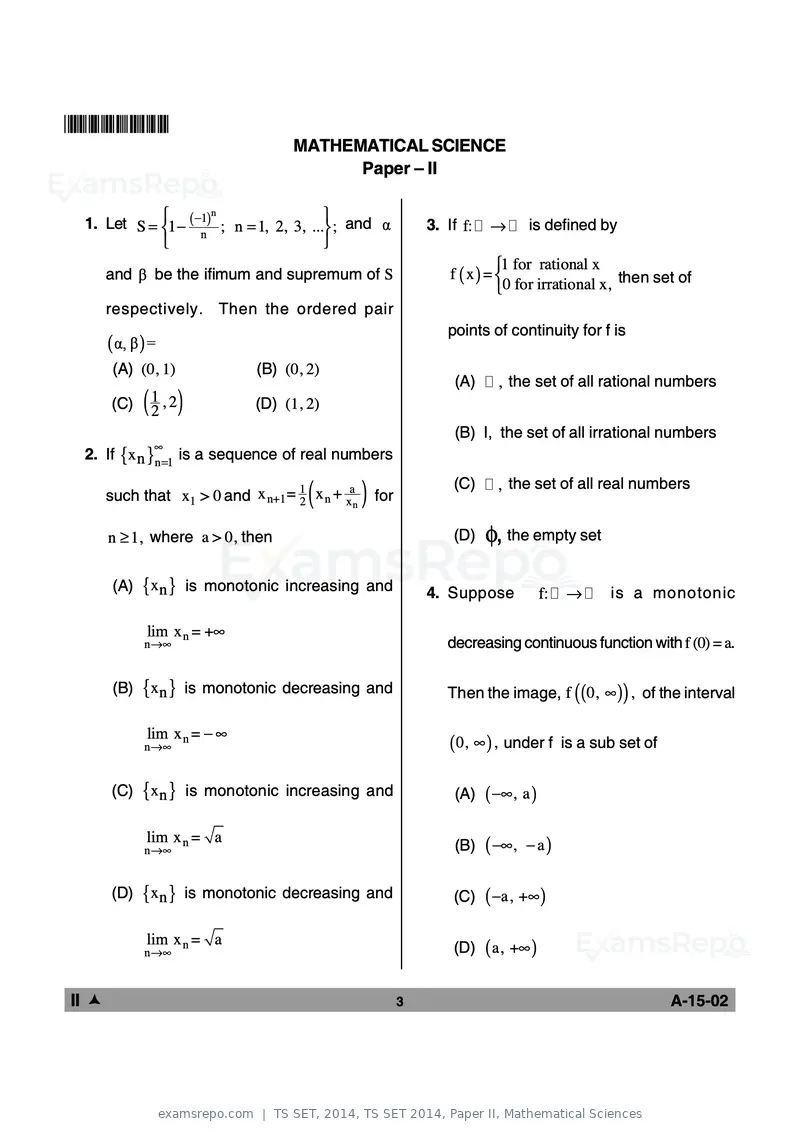
Text of page 3
*A1502*
                                     MATHEMATICAL SCIENCE
                                           Paper – II


 1. Let S = ⎧⎨1 − ( −1) ; n = 1, 2, 3, ...⎫⎬ ; and
                       n
                                                               3. If f:  →  is defined by
                     n
             ⎩                             ⎭
                                                                           ⎧1 for rational x
       and  be the ifimum and supremum of S                      f ( x) = ⎨                    then set of
                                                                           ⎩0 for irrational x,
       respectively. Then the ordered pair
                                                                  points of continuity for f is
       ( ,  ) =
        (A) (0, 1)             (B) (0, 2)
                                                                   (A)  , the set of all rational numbers
       (C)    ( )
                1,2
                2              (D) (1, 2)
                                                                   (B) I, the set of all irrational numbers
                ∞
 2. If {x n }   n =1
                     is a sequence of real numbers

                                       (
       such that x1 > 0 and x n+1 = 12 x n + xan   ) for          (C)  , the set of all real numbers


       n ≥ 1, where a > 0, then                                   (D) φ, the empty set


        (A) {x n } is monotonic increasing and                 4. Suppose          f:  →    is a monotonic

               lim x n = +∞
              n →∞                                                decreasing continuous function with f (0) = a.

        (B) {x n } is monotonic decreasing and                    Then the image, f ( ( 0, ∞ ) ) , of the interval

               lim x n = − ∞
              n →∞                                                ( 0, ∞ ) , under f is a sub set of

       (C) {x n } is monotonic increasing and                      (A) ( −∞, a )


                                                                   (B) ( −∞, − a )
               lim x n = a
              n →∞


       (D) {x n } is monotonic decreasing and                     (C) ( −a, +∞ )


                                                                  (D) ( a, +∞ )
               lim x n = a
              n →∞


II æ                                                       3                                           A-15-02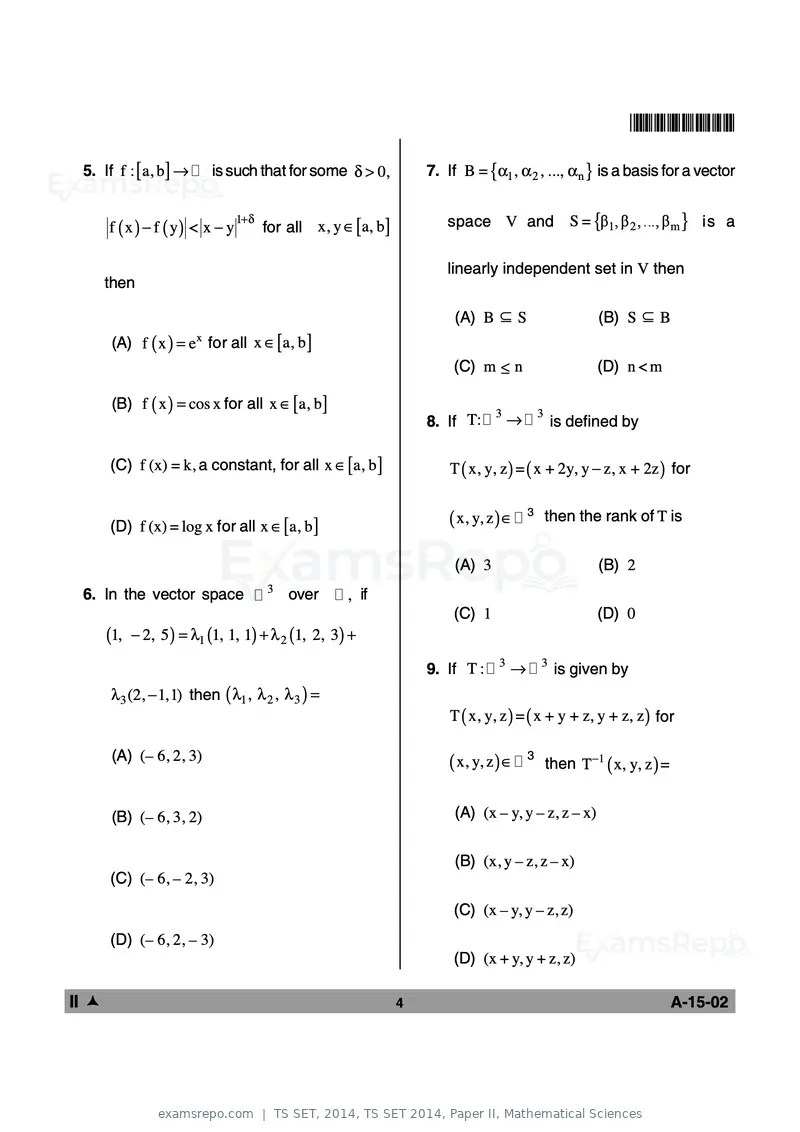
Text of page 4
*A1502*

 5. If f : [ a, b ] →  is such that for some δ > 0,                7. If B = {α1, α2 , ..., αn } is a basis for a vector


       f ( x ) − f ( y) < x − y
                                  1+δ
                                        for all x, y ∈ [a, b]          space V and            S = {1,  2 , ...,  m } is a

                                                                       linearly independent set in V then
       then

                                                                        (A) B ⊆ S                   (B) S ⊆ B
       (A) f ( x ) = ex for all x ∈ [a, b ]
                                                                        (C) m ≤ n                   (D) n < m

       (B) f ( x ) = cos x for all x ∈ [a, b ]
                                                                              3   3
                                                                    8. If T:  →  is defined by

       (C) f (x) = k, a constant, for all x ∈ [a, b ]                  T ( x, y, z ) = ( x + 2y, y − z, x + 2z ) for


       (D) f (x) = log x for all x ∈ [a, b ]                           ( x, y, z ) ∈  3 then the rank of T is

                                                                        (A) 3                       (B) 2
 6. In the vector space  3 over                     , if
                                                                        (C) 1                       (D) 0
       (1, − 2, 5 ) = λ1 (1, 1, 1) + λ 2 (1, 2, 3) +
                                                                    9. If T :  3 →  3 is given by
       λ3 (2, − 1, 1) then ( λ1 , λ 2 , λ 3 ) =
                                                                       T ( x, y, z ) = ( x + y + z, y + z, z ) for

       (A) (– 6, 2, 3)                                                 ( x, y, z ) ∈  3 then T−1 ( x, y, z ) =

       (B) (– 6, 3, 2)                                                  (A) (x – y, y – z, z – x)


                                                                        (B) (x, y – z, z – x)
       (C) (– 6, – 2, 3)
                                                                        (C) (x – y, y – z, z)
       (D) (– 6, 2, – 3)
                                                                        (D) (x + y, y + z, z)

II æ                                                            4                                                 A-15-02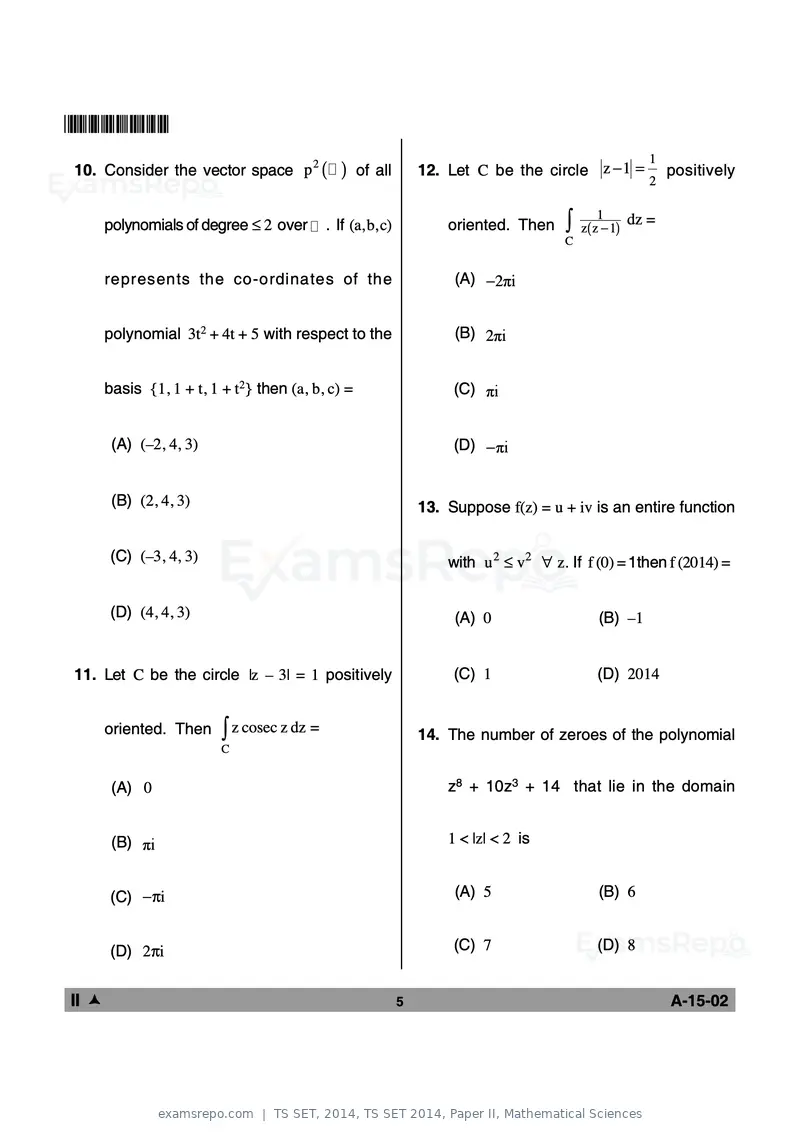
Text of page 5
*A1502*
                                                                                                  1
10. Consider the vector space p (  ) of all                 12. Let C be the circle z − 1 =
                                         2
                                                                                                      positively
                                                                                                  2


                                                                 oriented. Then ∫ z( z − 1) dz =
                                                                                         1
       polynomials of degree ≤ 2 over  . If (a, b, c)
                                                                                    C


       represents the co-ordinates of the                         (A) −2i


       polynomial 3t2 + 4t + 5 with respect to the                (B) 2i


       basis {1, 1 + t, 1 + t2} then (a, b, c) =                  (C) i


        (A) (–2, 4, 3)                                            (D) − i


        (B) (2, 4, 3)                                        13. Suppose f(z) = u + iv is an entire function


       (C) (–3, 4, 3)                                            with u 2 ≤ v2 ∀ z. If f (0) = 1then f (2014) =


       (D) (4, 4, 3)                                              (A) 0                  (B) –1


11. Let C be the circle |z – 3| = 1 positively                    (C) 1                  (D) 2014


       oriented. Then ∫ z cosec z dz =                       14. The number of zeroes of the polynomial
                          C


        (A) 0                                                    z8 + 10z3 + 14 that lie in the domain


        (B) i                                                   1 < |z| < 2 is


       (C) −πi                                                    (A) 5                  (B) 6


       (D) 2πi                                                    (C) 7                  (D) 8


II æ                                                     5                                            A-15-02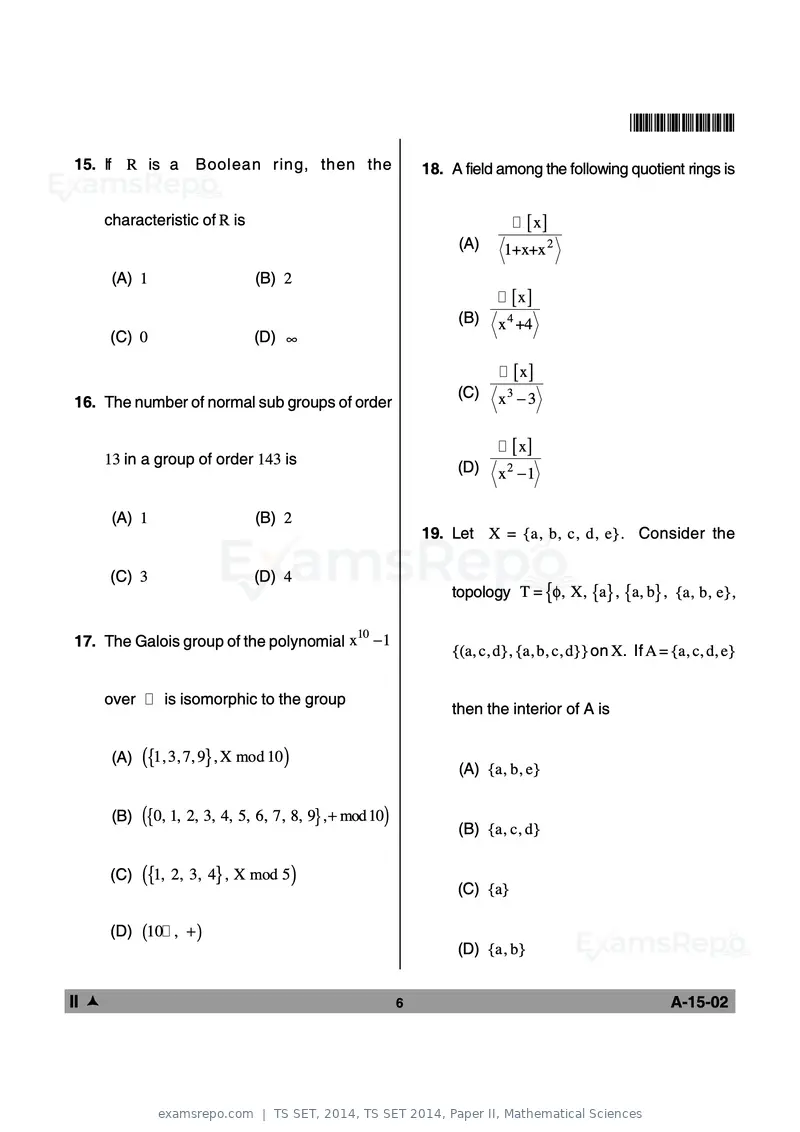
Text of page 6
*A1502*
15. If R is a         Boolean ring, then the                 18. A field among the following quotient rings is


       characteristic of R is                                                [x]
                                                                  (A)     1+x+x 2
        (A) 1                   (B) 2
                                                                          [x]
                                                                  (B)    x 4 +4
       (C) 0                    (D) ∞

                                                                          [x]
                                                                  (C)    x3 − 3
16. The number of normal sub groups of order

                                                                          [ x]
       13 in a group of order 143 is                              (D)    x2 −1

        (A) 1                   (B) 2
                                                             19. Let X = {a, b, c, d, e}. Consider the

       (C) 3                    (D) 4
                                                                 topology T = {φ, X, {a} , {a, b} , {a, b, e},

                                        10
17. The Galois group of the polynomial x − 1
                                                                 {(a, c, d}, {a, b, c, d}} on X. If A = {a, c, d, e}


       over  is isomorphic to the group
                                                                 then the interior of A is


        (A) ({1, 3, 7, 9} , X mod 10 )
                                                                  (A) {a, b, e}

        (B) ({0, 1, 2, 3, 4, 5, 6, 7, 8, 9} , + mod10)
                                                                  (B) {a, c, d}

       (C) ({1, 2, 3, 4} , X mod 5 )
                                                                  (C) {a}

       (D) (10 , + )
                                                                  (D) {a, b}


II æ                                                     6                                              A-15-02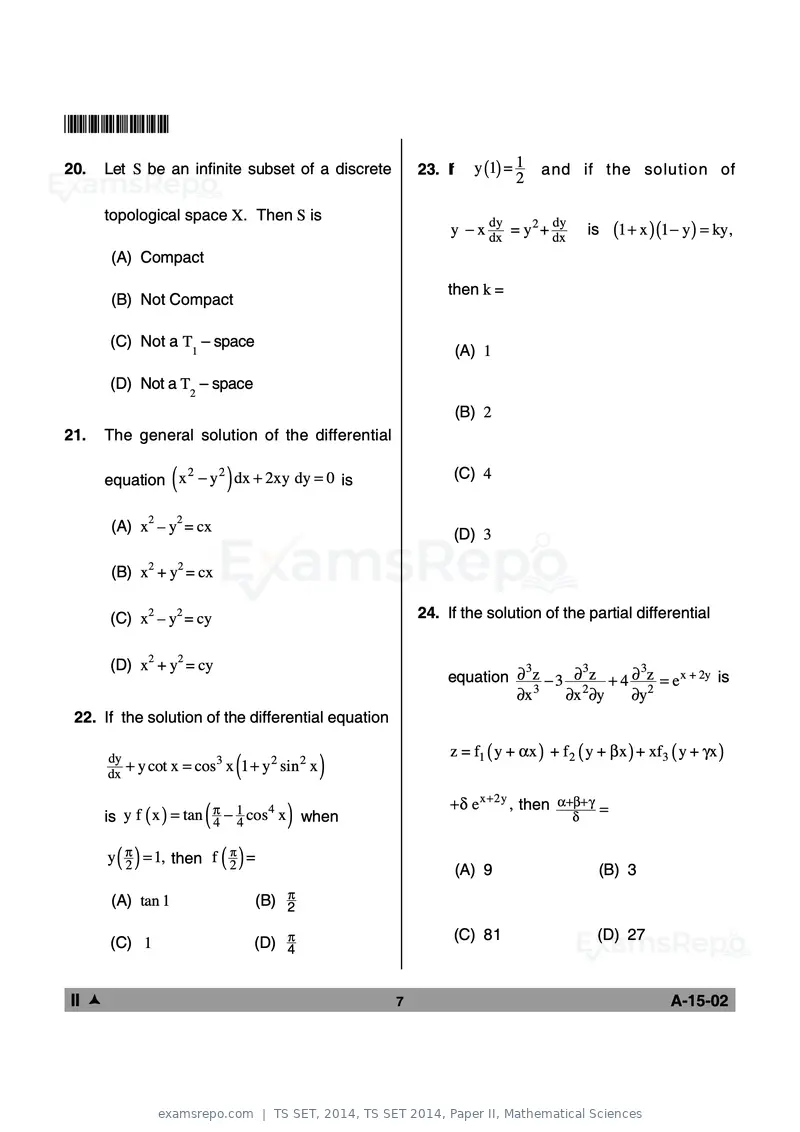
Text of page 7
*A1502*

20.    Let S be an infinite subset of a discrete              23. If     y (1) = 1   and if the solution of
                                                                                 2

       topological space X. Then S is                                      dy
                                                                   y − x dx = y 2 + dx
                                                                                      dy
                                                                                               is   (1 + x )(1 − y ) = ky,
        (A) Compact
                                                                  then k =
        (B) Not Compact

       (C) Not a T – space
                            1                                          (A) 1

       (D) Not a T2 – space
                                                                       (B) 2
21.    The general solution of the differential

                 2
                    (2
                                    )
       equation x − y dx + 2xy dy = 0 is                           (C) 4

              2     2
        (A) x – y = cx
                                                                   (D) 3

        (B) x2 + y2 = cx

       (C) x2 – y2 = cy                                       24. If the solution of the partial differential

              2         2
       (D) x + y = cy                                                       3        3      3
                                                                  equation ∂ z − 3 ∂ z + 4 ∂ z = e x + 2y is
                                                                           ∂x 3   ∂x 2∂y   ∂y2
 22. If the solution of the differential equation

                                                                   z = f1 ( y + αx ) + f 2 ( y + β x ) + xf3 ( y + γx )
       dy
       dx                               (
          + y cot x = cos3 x 1 + y 2 sin 2 x          )
                                                                   +δ e x + 2y , then α+β+γ =
                                (
       is y f ( x ) = tan π4 − 14 cos x when
                                              4
                                                  )                                        δ


        ( )
       y π2 = 1, then f 2 =        ( )                                (A) 9                    (B) 3
        (A) tan 1                           (B) 2π

       (C) 1                                (D) 4π                 (C) 81                       (D) 27


II æ                                                      7                                                   A-15-02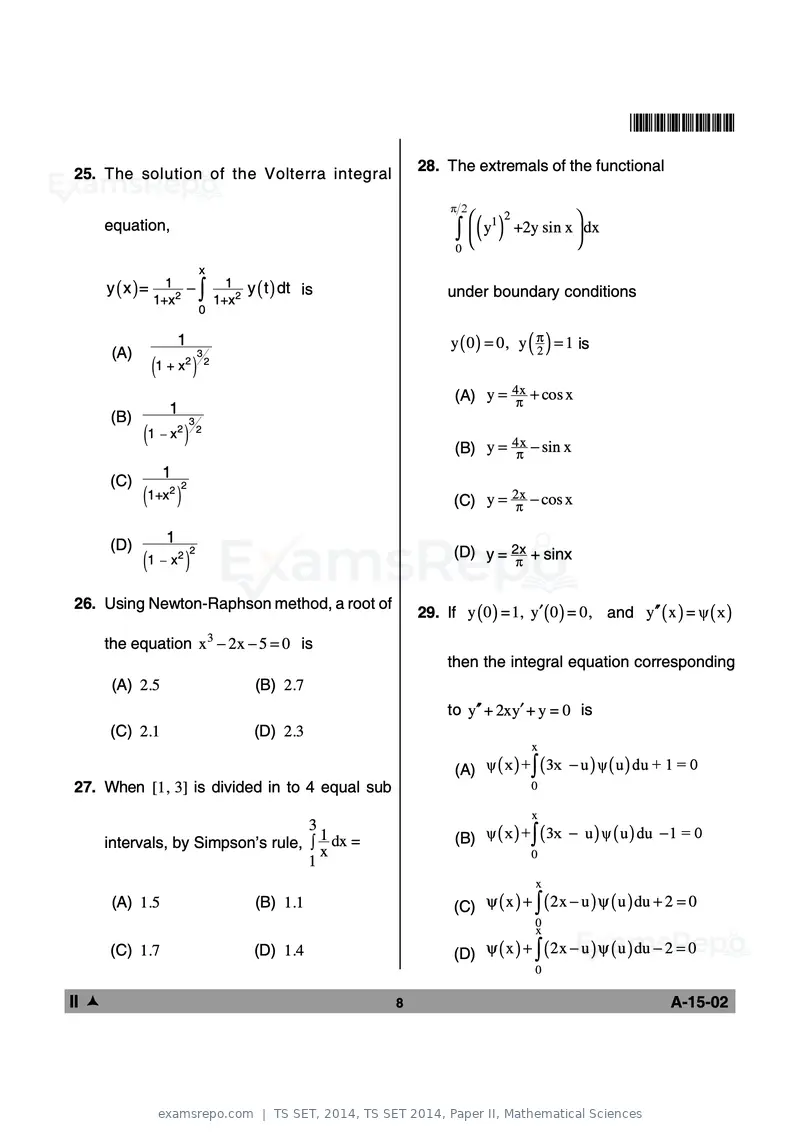
Text of page 8
*A1502*

                                                               28. The extremals of the functional
25. The solution of the Volterra integral


                                                                            ( )
                                                                           ⎛ 1 2          ⎞


       equation,                                                        ∫ ⎜⎝ y +2y sin x ⎟⎠ dx
                                                                        0
                                  x
        ( )
       y x = 12 −
            1+x                   ∫ 1+x1 2 y ( t ) dt is            under boundary conditions
                                  0


        (A)
                          1
                                  3
                                                                                       ( )
                                                                        y ( 0 ) = 0, y π2 = 1 is
                  (
                  1 + x2      )       2


                                                                        (A) y = 4x
                                                                                 π
                                                                                   + cos x
                      1
        (B)                   3
              (
              1 − x2      )2                                            (B) y = 4x − sin x
                                                                                 π
                      1
       (C)
              (1+x2 )
                          2
                                                                        (C) y = 2x
                                                                                 π
                                                                                   − cos x

       (D)            1
                                                                        (D) y = 2x + sinx
              (1 − x2 )
                              2
                                                                                   π


26. Using Newton-Raphson method, a root of
                                                               29. If y ( 0 ) = 1, y′ ( 0 ) = 0, and y′′ ( x ) =  ( x )
       the equation x 3 − 2x − 5 = 0 is
                                                                    then the integral equation corresponding
        (A) 2.5                             (B) 2.7
                                                                    to y′′ + 2xy′ + y = 0 is
       (C) 2.1                              (D) 2.3
                                                                                       x

                                                                        (A)  ( x ) + ∫ ( 3x − u )  ( u ) du + 1 = 0
27. When [1, 3] is divided in to 4 equal sub                                           0

                                                                                       x
                                     3
       intervals, by Simpson’s rule, ∫ 1 dx =                           (B)  ( x ) + ∫ ( 3x − u )  ( u ) du − 1 = 0
                                       x                                               0
                                     1
                                                                                       x
        (A) 1.5                             (B) 1.1                     (C) ψ ( x ) + ∫ ( 2x − u ) ψ ( u ) du + 2 = 0
                                                                                       0
                                                                                       x
       (C) 1.7                              (D) 1.4                     (D) ψ ( x ) + ∫ ( 2x − u ) ψ ( u ) du − 2 = 0
                                                                                       0

II æ                                                       8                                                    A-15-02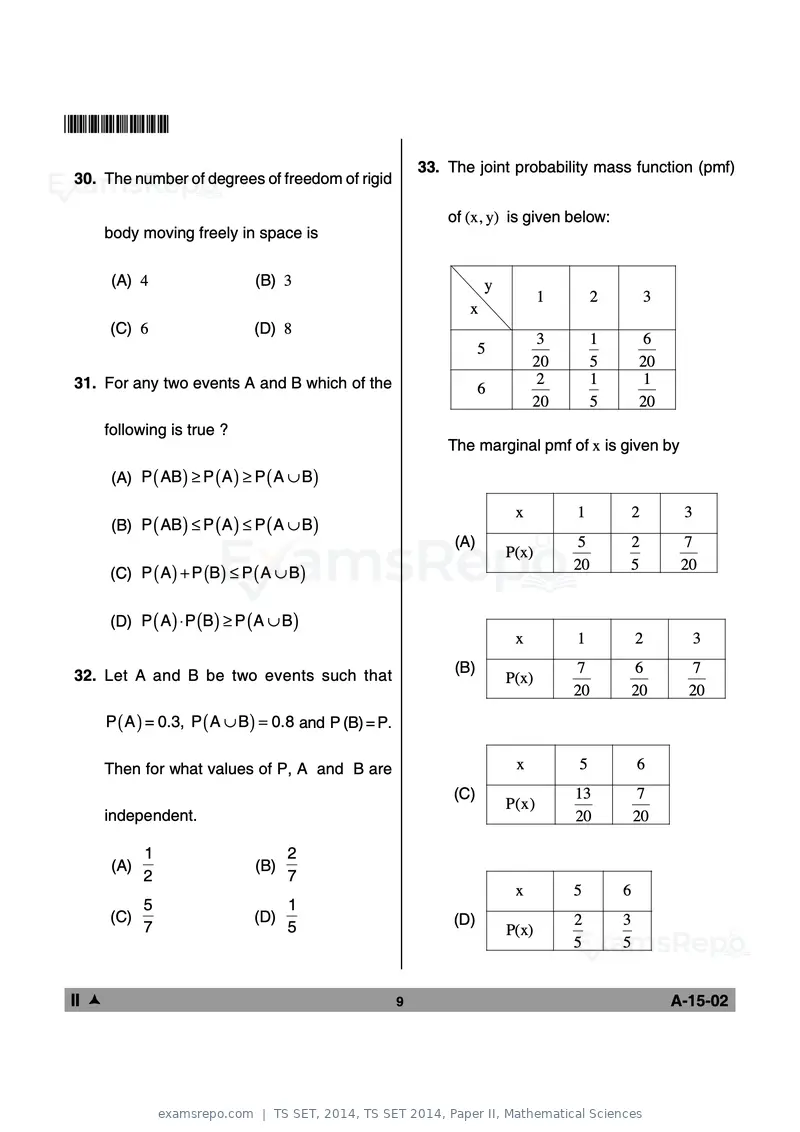
Text of page 9
*A1502*

                                                             33. The joint probability mass function (pmf)
30. The number of degrees of freedom of rigid

                                                                 of (x, y) is given below:
       body moving freely in space is

        (A) 4                    (B) 3                                  y
                                                                                   1       2        3
                                                                    x
       (C) 6                    (D) 8
                                                                                 3         1       6
                                                                        5
                                                                                 20        5       20
31. For any two events A and B which of the                                      2         1       1
                                                                        6
                                                                                 20        5       20
       following is true ?
                                                                 The marginal pmf of x is given by

        (A) P ( AB ) ≥ P ( A ) ≥ P ( A ∪ B )

                                                                             x         1        2        3
        (B) P ( AB ) ≤ P ( A ) ≤ P ( A ∪ B )
                                                                  (A)                   5      2         7
                                                                            P(x)
                                                                                       20      5         20
       (C) P ( A ) + P (B ) ≤ P ( A ∪ B )

       (D) P ( A ) ⋅ P (B ) ≥ P ( A ∪ B )
                                                                             x         1           2      3
                                                                  (B)                  7        6         7
32. Let A and B be two events such that                                     P(x)
                                                                                       20       20        20
       P ( A ) = 0.3, P ( A ∪ B ) = 0.8 and P (B) = P.

       Then for what values of P, A and B are                                x         5           6
                                                                  (C)                  13          7
                                                                            P(x)
       independent.                                                                    20          20

              1                        2
        (A)                      (B)
              2                        7
                                                                             x         5       6
           5                        1
       (C)                      (D)                               (D)                  2       3
           7                        5                                       P(x)
                                                                                       5       5


II æ                                                     9                                              A-15-02
Text of page 10
*A1502*
34. The characteristic function of standard        36. If X and Y are two i.i.d. random variables
       normal distribution is given by
              sint                                     such that X+Y and X–Y are independently
        (A)
                t
        (B) e− t                                       distributed, then the distribution of X is

                1
       (C)
              1 + t2                                    (A) Exponential

       (D)     − 1 t2
              e 2
                                                        (B) Normal
35. Which of the following matrix is not a

       transition probability matrix ?                  (C) Cauchy


            ⎡ 1 0 0⎤
            ⎢        ⎥                                  (D) Laplace
        (A) ⎢ 21 1 1⎥
            ⎢    3 6⎥
            ⎢⎣ 0 0 1⎥⎦
                                                   37. State which of the following is correct ?

            ⎡ 1        1 1⎤
            ⎢2         4 4⎥                             (A) Unbiased estimator is always the
            ⎢          2 1⎥
        (B) ⎢ 0
                       3 3⎥
            ⎢              ⎥                                best estimator
            ⎢3         0 1 ⎥
            ⎣4           4 ⎦

           ⎡                ⎤                           (B) Unbiased estimator is also a
           ⎢0          2 − 1⎥
           ⎢ 1         1 0⎥
           ⎢                ⎥                               consistent estimator
       (C) ⎢ 2         2
                            ⎥
           ⎢ 1         1 0⎥
           ⎣3          3    ⎦
                                                        (C) Unbiased estimator is unique
           ⎡ 1 0 1⎤
           ⎢2    2⎥
                                                        (D) Unbiased estimator need not be
       (D) ⎢ 1 0 2 ⎥
           ⎢3    3⎥
           ⎢       ⎥
           ⎢3 1 0⎥                                          consistent
           ⎣4 4    ⎦


II æ                                          10                                         A-15-02
Text of page 11
*A1502*
38. Consider the following statements on the               41. T h e        Gauss    Markov    theorem

       maximum likelihood estimator (MLE) of θ
                                                               establishes that the OLS estimator of
       involved in the uniform        U ( θ, θ + 1)
                                                                  ∧
                                                                       ( ) X1Y is
                                                                              −1
       distribution:                                           ,  = X1X

       P : MLE of θ is unique; Q : MLE of θ is
                                                                (A) BLUE
       always unbiased
                                                                (B) Error free estimator
        (A) Both P and Q are true

        (B) P is true but not Q
                                                                (C) uve only
       (C) Both P and Q are not true
                                                                (D) Not a BLUE
       (D) Q is true but not P

39. For a fixed confidence coefficient (1 − α) ,           42. A quadratic form in            p-variables

       the most preferred confidence interval for              x1, x 2 , ..., x p is a homogeneous function
       the parameter θ is the one with
                                                               consisting of all possible second order
        (A) Shortest length

        (B) Largest length
                                                               terms namely
       (C) Average length
                                                                       p
       (D) None of these                                        (A) ∑ a ij x i x j
                                                                       ij
40. The nonparametric alternative to the two
                                                                       p
       sample t – test is                                       (B) ∑ a ij x i
                                                                       ij
        (A) Sign test
                                                                       p
        (B) Mann-Whitney U test                                 (C) ∑ a ij x j
                                                                       ij
       (C) Wilcoxon signed rank test                                   p

       (D) Runs test for randomness                             (D) ∑ a ji x ij
                                                                       ij


II æ                                                  11                                         A-15-02
Text of page 12
*A1502*

43. The standard procedure for maximising a                 45. Let r12.3 be the partial correlation coefficient

                                                                between X1 and X2 after linear effect of X3
       function of several variables, subject to one
                                                                has been eliminated, then the relationship

       or more constraints, is the method of                    between total correlation, partial

                                                                correlation and multiple correlation can be
        (A) Lagrange Multipliers
                                                                expressed as

        (B) First Principal Component                                  2
                                                                  (A) R1.23 = (1 − r12 )(1 − r13.2 )


       (C) Principal of Least Squares                                  2
                                                                                (  2
                                                                                        )( 2
                                                                  (B) R1.23 = 1 − r12 1 − r13.2    )
       (D) Data Reduction Method                                         2
                                                                                    (    2
                                                                                             (
                                                                 (C) R1.23 = 1 − 1 − r12 1 − r13.2     ))
44. In Cluster Analysis the dissimilarity
                                                                      2
                                                                                    ( 2
                                                                                             )(
                                                                                              2
                                                                 (D) R1.23 = 1 − 1 − r12 1 − r13.2      )
       measure equation d AB = Min dij
                                      i∈A
                                          ( ) is                                 ⎧2, 0 < x < y; 0 < y < 1
                                                            46. Let f ( x, y ) = ⎨
                                      j∈B                                        ⎩0, Otherwise

       known as                                                 be the joint probability density function of

                                                                 x and y , then x and y
        (A) Dendrogram
                                                                  (A) are uncorrelated
                                                                  (B) are correlated with coefficient of
        (B) Complete linkage clustering                                correlation equal to 1
                                                                 (C) are correlated with coefficient of
       (C) Single linkage clustering
                                                                       correlation equal to 0.5

                                                                 (D) are correlated with coefficient of
       (D) Both (B) and (C)
                                                                       correlation equal to 0.2
                                                  __

II æ                                                   12                                                   A-15-02
Text of page 13
*A1502*
47. The estimator of reliability function for           49. Any solution to a general linear

       exponential failure distribution with
                                                            programming problem which also satisfies
       parameter '' is given by
                                                            the non negative restrictions is called a
       (A) 1− exp ( −λt )
                                                             (A) Optimum solution
       (B) λ
                                                             (B) Non basic solution
       (C) exp ( −λt )

       (D) 1λ                                               (C) Feasible solution


48. The structure function φ ( x ) of K out of n            (D) Basic solution


       system is                                        50. Single item inventory models occur when

             n                                              an item is ordered only once to satisfy the
       (A) ∑ x i ≥ K
            i =1
                                                             (A) Supply for the period
             n
       (B) ∑ x i ≤ K
            i =1                                            (B) Demand for the period
             n
       (C) ∑ x i = K                                        (C) EOQ problem with shortages
            i =1

             n
       (D) ∑ x i ≠ K                                        (D) Supply and Demand for the period
            i =1


II æ                                               13                                        A-15-02
Text of page 14
*A1502*
       Space for Rough Work


II æ            14              A-15-02
Text of page 15
*A1502*
          Space for Rough Work


II æ             15              A-15-02
Text of page 16
*A1502*
       Space for Rough Work


II æ            16              A-15-02
Official key not published for this paper.
Page 1 of 16
Source: Telangana State Eligibility Test. Question paper published by Telangana State Eligibility Test.