
TS SET 2014: Paper III, Mathematical Sciences
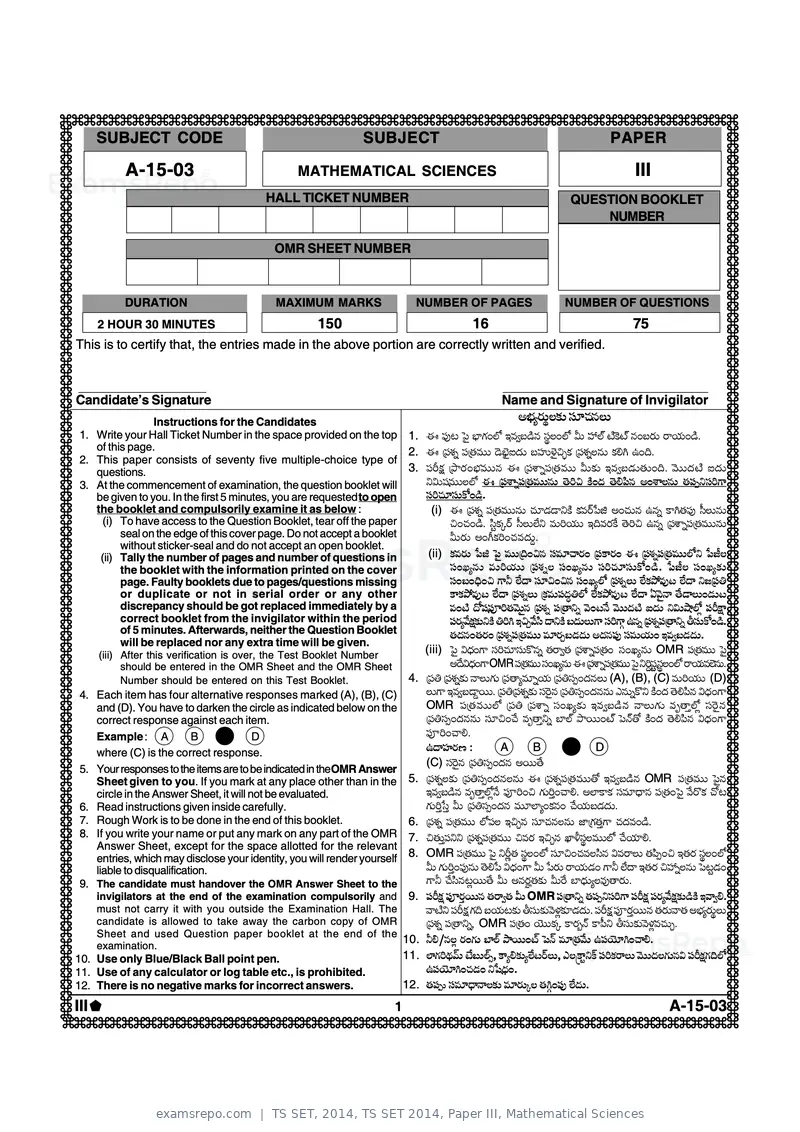
Text of page 1
aaaaaaaaaaaaaaaaaaaaaaaaaaaaaaaaaaaaaaaaaaaaaaaaaaaaaaaa
aaaaaaaaaaaaaaaaaaaaaaaaaaaaaaaaaaaaaaaaaaaaaaaaaaaaaaaaaaaaaaaaaaaaaaaaaaaaa aaaaaaaaaaaaaaaaaaaaaaaaaaaaaaaaaaaaaaaaaaaaaaaaaaaaaaaaaaaaaaaaaaaaaaaaaaaaaaa
SUBJECT CODE SUBJECT PAPER
A-15-03 MATHEMATICAL SCIENCES III
HALL TICKET NUMBER QUESTION BOOKLET
NUMBER
OMR SHEET NUMBER
DURATION MAXIMUM MARKS NUMBER OF PAGES NUMBER OF QUESTIONS
2 HOUR 30 MINUTES 150 16 75
This is to certify that, the entries made in the above portion are correctly written and verified.
Candidate’s Signature Name and Signature of Invigilator
Instructions for the Candidates A¿æýÅÆæÿ$¦ËMæü$ çÜ*^èþ¯èþË$
1. Write your Hall Ticket Number in the space provided on the top 1. D ç³#r ò³O ¿êVæü ÌZ CÐèþÓºyìþ¯èþ çÜ¦Ë ÌZ Ò$ çàÌý sìýMðüsý ¯èþ ºÆæÿ$ Æ>Äæý$ yìþ.
of this page. 2. D {ç³Ôèý² ç³{èþÐèþ$$ yðþ¿ñýOI§æþ$ ºçßý$âñýO_eMæü {ç³Ôèý²Ë¯èþ$ MæüÍW E ¨.
2. This paper consists of seventy five multiple-choice type of
questions. 3. ç³Èæü {´ëÆæÿ ¿æýÐèþ$$¯èþ D {ç³Ôé²ç³{èþÐèþ$$ Ò$Mæü$ CÐèþÓºyæþ$èþ$ ¨. Ððþ$$§æþsìý I§æþ$
3. At the commencement of examination, the question booklet will °Ñ$çÙÐèþ$$ËÌZ D {ç³Ôé²ç³{èþÐèþ$$¯èþ$ ðþÇ_ Mìü §æþ ðþÍí³¯èþ A Ôé˯èþ$ èþç³µ°çÜÇV>
be given to you. In the first 5 minutes, you are requested to open çÜÇ^èþ*çÜ$Mø yìþ.
the booklet and compulsorily examine it as below : (i) D {ç³Ôèý² ç³{èþÐèþ$$¯èþ$ ^èþ*yæþyé°Mìü MæüÐèþÆÿõ³h A ^èþ$¯èþ E¯èþ² M>Wèþç³# ïÜË$¯èþ$
(i) To have access to the Question Booklet, tear off the paper _ ^èþ yìþ. íÜtMæüPÆÿ ïÜË$Ìôý° Ðèþ$ÇÄæý$$ C¨ÐèþÆæÿMóü ðþÇ_ E¯èþ² {ç³Ôé²ç³{èþÐèþ$$¯èþ$
seal on the edge of this cover page. Do not accept a booklet Ò$Ææÿ$ A XMæüÇ ^èþÐèþ§æþ$ª.
without sticker-seal and do not accept an open booklet.
(ii) Tally the number of pages and number of questions in (ii) MæüÐèþÆæÿ$ õ³h ò³O Ðèþ$${¨ _¯èþ çÜÐèþ*^éÆæÿ {ç³M>Ææÿ D {ç³Ôèý²ç³{èþÐèþ$$ÌZ° õ³iË
the booklet with the information printed on the cover çÜ Qůèþ$ Ðèþ$ÇÄæý$$ {ç³Ôèý²Ë çÜ Qůèþ$ çÜÇ^èþ*çÜ$Mø yìþ. õ³iË çÜ QÅMæü$
page. Faulty booklets due to pages/questions missing çÜ º «¨ _ V>± Ìôý§é çÜ*_ _¯èþ çÜ QÅÌZ {ç³Ôèý²Ë$ ÌôýMæü´ùÐèþ#r Ìôý§é °f{ç³
or duplicate or not in serial order or any other M>Mæü´ùÐèþ#r Ìôý§é {ç³Ôèý²Ë$ {MæüÐèþ$糧æþ®ÌZ ÌôýMæü´ùÐèþ#r Ìôý§é HÐðþO¯é óþyéË$ yæþ$r
discrepancy should be got replaced immediately by a Ðèþ sìý §øçÙç³NÇèþÐðþ$O¯èþ {ç³Ôèý² ç³{é°² Ððþ r¯óþ Ððþ$$§æþsìý I§æþ$ °Ñ$ÚëÌZÏ ç³È>
correct booklet from the invigilator within the period ç³ÆæÿÅÐóþæüMæü$°Mìü ÇW C_aÐóþíÜ §é°Mìü º§æþ$Ë$V> çÜÇV>Y E¯èþ² {ç³Ôèý²ç³{é°² ¡çÜ$Mø yìþ.
of 5 minutes. Afterwards, neither the Question Booklet èþ§æþ¯èþ èþÆæÿ {ç³Ôèý²ç³{èþÐèþ$$ Ðèþ*Ææÿaºyæþ§æþ$ A§æþ¯èþç³# çÜÐèþ$Äæý$ CÐèþÓºyæþ§æþ$.
will be replaced nor any extra time will be given.
(iii) After this verification is over, the Test Booklet Number (iii) ò³O Ñ«§æþ V> çÜÇ^èþ*çÜ$Mö¯èþ² èþÆ>Óèþ {ç³Ôé²ç³{èþ çÜ Qůèþ$ OMR ç³{èþÐèþ$$ ò³O
should be entered in the OMR Sheet and the OMR Sheet A§óþÑ«§æþ V> OMR ç³{èþÐèþ$$ çÜ Qůèþ$ D {ç³Ôé²ç³{èþÐèþ$$ ò³O °ÇªçÙtt çÜ¦Ë ÌZ Æ>Äæý$ÐèþÌñý¯èþ$.
Number should be entered on this Test Booklet. 4. {ç ³ {ç ³ Ôèý²Mæü$ ¯éË$Væü$ {ç³éÅÐèþ*²Äæý$ {ç³çܵ §æþ¯èþË$ (A), (B), (C) Ðèþ$ÇÄæý$$ (D)
4. Each item has four alternative responses marked (A), (B), (C) Ë$V> CÐèþÓºyézÆÿ$$. {ç³{ç³Ôèý²Mæü$ çÜÆðÿO¯èþ {ç³çܵ §æþ¯èþ¯èþ$ G¯èþ$²Mö° Mìü §æþ ðþÍí³¯èþ Ñ«§æþ V>
and (D). You have to darken the circle as indicated below on the OMR ç³{èþÐèþ$$ÌZ {ç³ {ç³Ôé² çÜ QÅMæü$ CÐèþÓºyìþ¯èþ ¯éË$Væü$ Ðèþé¢ÌZÏ çÜÆðÿO¯èþ
correct response against each item. {ç³çܵ §æþ¯èþ¯èþ$ çÜ*_ ^óþ Ðèþ颰² »êÌý ´ëÆÿ$$ sý ò³¯þø Mìü §æþ ðþÍí³¯èþ Ñ«§æþ V>
Example : A B C D ç³NÇ ^éÍ.
where (C) is the correct response. E§éçßýÆæÿ×ý : A B C D
(C) çÜÆðÿO¯èþ {ç³çܵ §æþ¯èþ AÆÿ$$óþ
5. Your responses to the items are to be indicated in theOMR Answer
Sheet given to you. If you mark at any place other than in the5. {ç³Ôèý²ËMæü$ {ç³çܵ §æþ¯èþ˯èþ$ D {ç³Ôèý²ç³{èþÐèþ$$ø CÐèþÓºyìþ¯èþ OMR ç³{èþÐèþ$$ ò³O¯èþ
circle in the Answer Sheet, it will not be evaluated. CÐèþÓºyìþ¯èþ Ðèþé¢ÌZϯóþ ç³NÇ _ Væü$Ç¢ ^éÍ. AÌêM>Mæü çÜÐèþ*«§é¯èþ ç³{èþ ò³O ÐóþÆöMæü ^ør
6. Read instructions given inside carefully. Væü$Ç¢õÜ¢ Ò$ {ç³çܵ §æþ¯èþ Ðèþ$*ÌêÅ Mæü¯èþ ^óþÄæý$ºyæþ§æþ$.
7. Rough Work is to be done in the end of this booklet. 6. {ç³Ôèý² ç³{èþÐèþ$$ ÌZç³Ë C_a¯èþ çÜ*^èþ¯èþ˯èþ$ gê{Væüèþ¢V> ^èþ§æþÐèþ yìþ.
8. If you write your name or put any mark on any part of the OMR 7. _èþ$¢ç³°° {ç³Ôèý²ç³{èþÐèþ$$ _ÐèþÆæÿ C_a¯èþ RêäçܦËÐèþ$$ÌZ ^óþÄæý*Í.
Answer Sheet, except for the space allotted for the relevant
8. OMR ç³{èþÐèþ$$ ò³O °È~èþ çÜ¦Ë ÌZ çÜ*_ ^èþÐèþËíܯèþ ÑÐèþÆ>Ë$ èþí³µ _ CèþÆæÿ çÜ¦Ë ÌZ
entries, which may disclose your identity, you will render yourself
liable to disqualification. Ò$ Væü$Ç¢ ç³#¯èþ$ ðþÍõ³ Ñ«§æþ V> Ò$ õ³Ææÿ$ Æ>Äæý$yæþ V>± Ìôý§é CèþÆæÿ _à²Ë¯èþ$ ò³rtyæþ
9. The candidate must handover the OMR Answer Sheet to the V>± ^óþíܯèþrÏÆÿ$$óþ Ò$ A¯èþÆæÿáèþMæü$ Ò$Æóÿ »ê«§æþ$ÅËÐèþ#éÆæÿ$.
invigilators at the end of the examination compulsorily and 9. ç ³Èæü ç³NÆæÿ¢Æÿ$$¯èþ èþÆ>Óèþ Ò$ OMR ç³{é°² èþç³µ°çÜÇV> ç³Èæü ç³ÆæÿÅÐóþæüMæü$yìþMìü CÐéÓÍ.
must not carry it with you outside the Examination Hall. The Ðésìý° ç³Èæü Væü¨ ºÄæý$rMæü$ ¡çÜ$Mæü$ÐðþâæýÏMæü*yæþ§æþ$. ç³Èæü ç³NÆæÿ¢Æÿ$$¯èþ èþÆæÿ$Ðéèþ A¿æýÅÆæÿ$¦Ë$
candidate is allowed to take away the carbon copy of OMR {ç³Ôèý² ç³{é°², OMR ç³{èþ Äñý$$MæüP M>Ææÿ¾¯þ M>ï³° ¡çÜ$Mæü$ÐðþâæýÏÐèþ^èþ$a.
Sheet and used Question paper booklet at the end of the
10. ±Í/¯èþËÏ Ææÿ Væü$ »êÌý ´ëÆÿ$$ sý ò³¯þ Ðèþ*{èþÐóþ$ Eç³Äñý*W ^éÍ.
examination.
10. Use only Blue/Black Ball point pen. 11. ÌêVæüÇ£æþÐþ$ sôýº$ÌýÞ, M>ÅÍMæü$ÅÌôýrÆÿË$, GË[M>t°Mü ç³ÇMæüÆ>Ë$ Ððþ$$§æþËVæü$¯èþÑ ç³ÈæüVæü¨ÌZ
11. Use of any calculator or log table etc., is prohibited. Eç³Äñý*W ^èþyæþ °õÙ«§æþ .
12. There is no negative marks for incorrect answers. 12. èþç³ çÜÐèþ*«§é¯éËMæü$ Ðèþ*Ææÿ$PË èþWY ç³# Ìôý§æþ$.
IIIÀ 1 A-15-03
aaaaaaaaaaaaaaaaaaaaaaaaaaaaaaaaaaaaaaaaaaaaaaaaaaaaaaaaa
Text of page 2
*A1503*


                   HE
                     RE

            WR
              ITE

        NO
          T
       DO


IIIÀ           2             A-15-03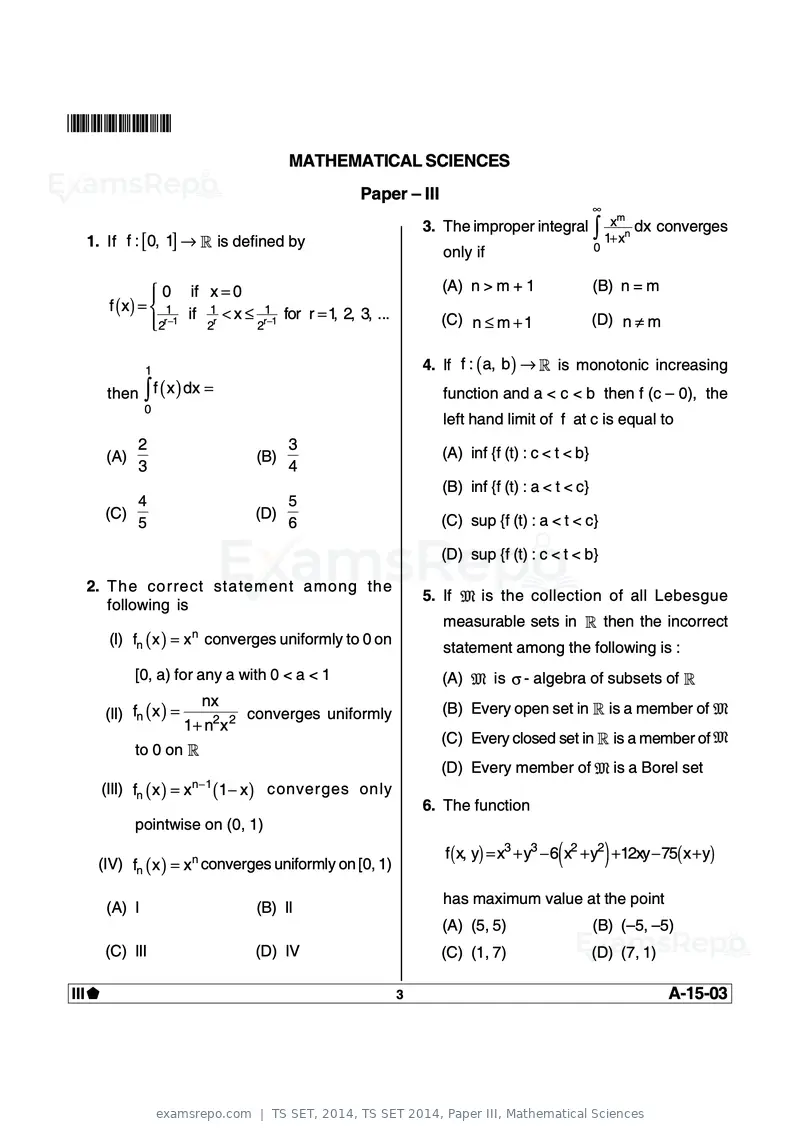
Text of page 3
*A1503*
                                           MATHEMATICAL SCIENCES
                                                  Paper – III
                                                                                              ∞
                                                                                                      m
                                                             3. The improper integral ∫ x n dx converges
 1. If f : [ 0, 1] →            is defined by                                                 0
                                                                                                  1+ x
                                                                only if

                ⎧⎪ 0 if x = 0                                   (A) n > m + 1                 (B) n = m
       f ( x) = ⎨ 1 if 1 < x ≤ 1 for r = 1, 2, 3, ...
                 ⎪⎩2r −1 2r   2r−1                              (C) n ≤ m + 1                 (D) n ≠ m


               1                                             4. If f : ( a, b ) →    is monotonic increasing
       then ∫ f ( x ) dx =                                      function and a < c < b then f (c – 0), the
               0
                                                                left hand limit of f at c is equal to
             2                             3
       (A)                           (B)                        (A) inf {f (t) : c < t < b}
             3                             4
                                                                (B) inf {f (t) : a < t < c}
           4                             5
       (C)                           (D)                        (C) sup {f (t) : a < t < c}
           5                             6

                                                                (D) sup {f (t) : c < t < b}

 2. The correct statement among the
                                                             5. If     is the collection of all Lebesgue
    following is
                                                                measurable sets in                then the incorrect
       (I) fn ( x ) = xn converges uniformly to 0 on
                                                                statement among the following is :
             [0, a) for any a with 0 < a < 1                    (A)       is σ - algebra of subsets of
                           nx
       (II) fn ( x ) =             converges uniformly          (B) Every open set in             is a member of
                         1+ n2 x 2
                                                                (C) Every closed set in               is a member of
             to 0 on
                                                                (D) Every member of                   is a Borel set
   (III) fn ( x ) = x     n−1
                                (1− x ) converges only
                                                             6. The function
             pointwise on (0, 1)

   (IV) fn ( x ) = xn converges uniformly on [0, 1)                                  (            )
                                                                f ( x, y) = x3 + y3 − 6 x2 + y2 +12xy − 75( x + y)

                                                                has maximum value at the point
       (A) I                         (B) II
                                                                (A) (5, 5)                    (B) (–5, –5)
       (C) III                       (D) IV                     (C) (1, 7)                    (D) (7, 1)

IIIÀ                                                     3                                                    A-15-03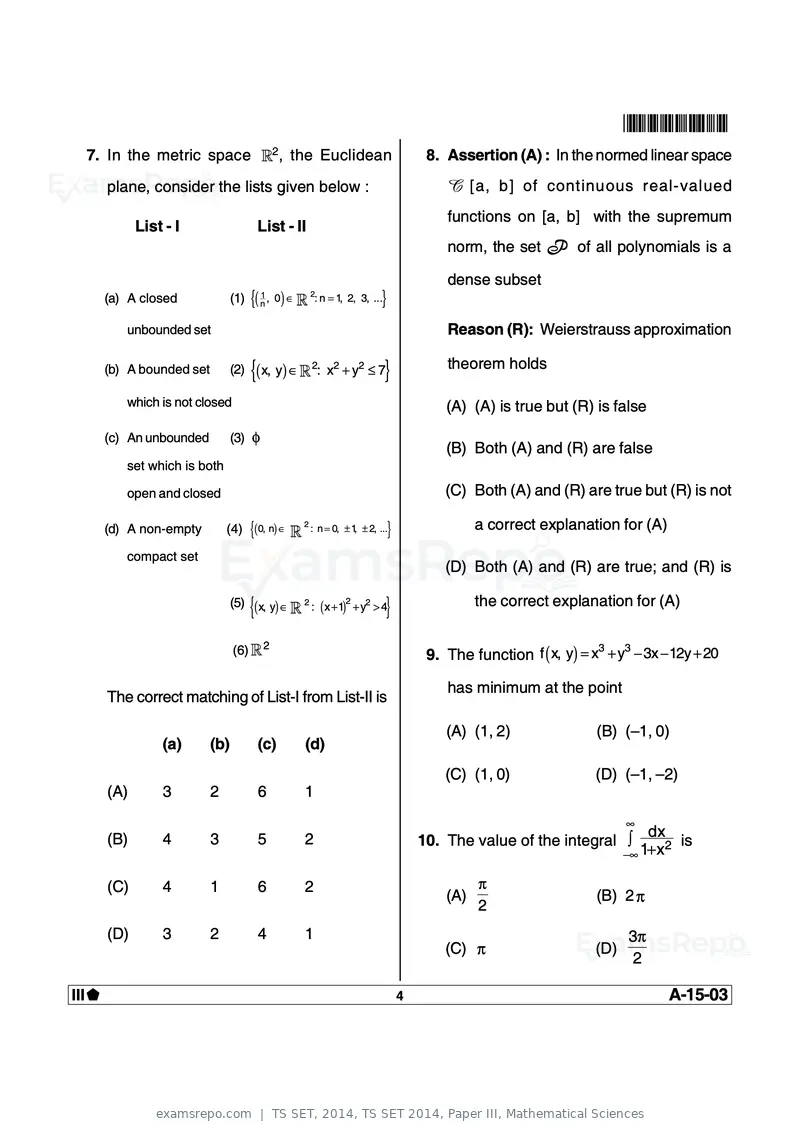
Text of page 4
*A1503*
 7. In the metric space                       2, the Euclidean                           8. Assertion (A) : In the normed linear space
       plane, consider the lists given below :                                              C [a, b] of continuous real-valued
                                                                                            functions on [a, b] with the supremum
             List - I                   List - II
                                                                                            norm, the set P of all polynomials is a

                                                                                            dense subset
       (a) A closed            (1) {(    1, 0 ∈
                                         n     )        2
                                                         : n = 1, 2, 3, ... }
          unbounded set                                                                     Reason (R): Weierstrauss approximation

       (b) A bounded set       (2)     {( x, y) ∈       2
                                                            : x2 + y2 ≤ 7     }             theorem holds

          which is not closed                                                               (A) (A) is true but (R) is false
       (c) An unbounded        (3) φ
                                                                                            (B) Both (A) and (R) are false
          set which is both

          open and closed                                                                   (C) Both (A) and (R) are true but (R) is not

       (d) A non-empty         (4) {( 0, n) ∈       2
                                                        : n = 0, ± 1, ± 2, ...  }                 a correct explanation for (A)
          compact set
                                                                                            (D) Both (A) and (R) are true; and (R) is

                               (5)     {(x, y) ∈    2             2
                                                        : ( x + 1) + y2 > 4   }                   the correct explanation for (A)

                                          2
                                                                                         9. The function f ( x, y) = x + y − 3x − 12y + 20
                                 (6)                                                                                 3     3


                                                                                            has minimum at the point
       The correct matching of List-I from List-II is

                                                                                            (A) (1, 2)               (B) (–1, 0)
                  (a)      (b)          (c)         (d)
                                                                                            (C) (1, 0)               (D) (–1, –2)
       (A)        3        2            6           1
                                                                                                                           ∞
                                                                                                                               dx
       (B)        4        3            5           2                                   10. The value of the integral ∫             is
                                                                                                                           −∞ 1+ x2

       (C)        4        1            6           2                                             π
                                                                                            (A)                      (B) 2 π
                                                                                                  2
       (D)        3        2            4           1                                                                      3π
                                                                                            (C) π                    (D)
                                                                                                                            2

IIIÀ                                                                                4                                             A-15-03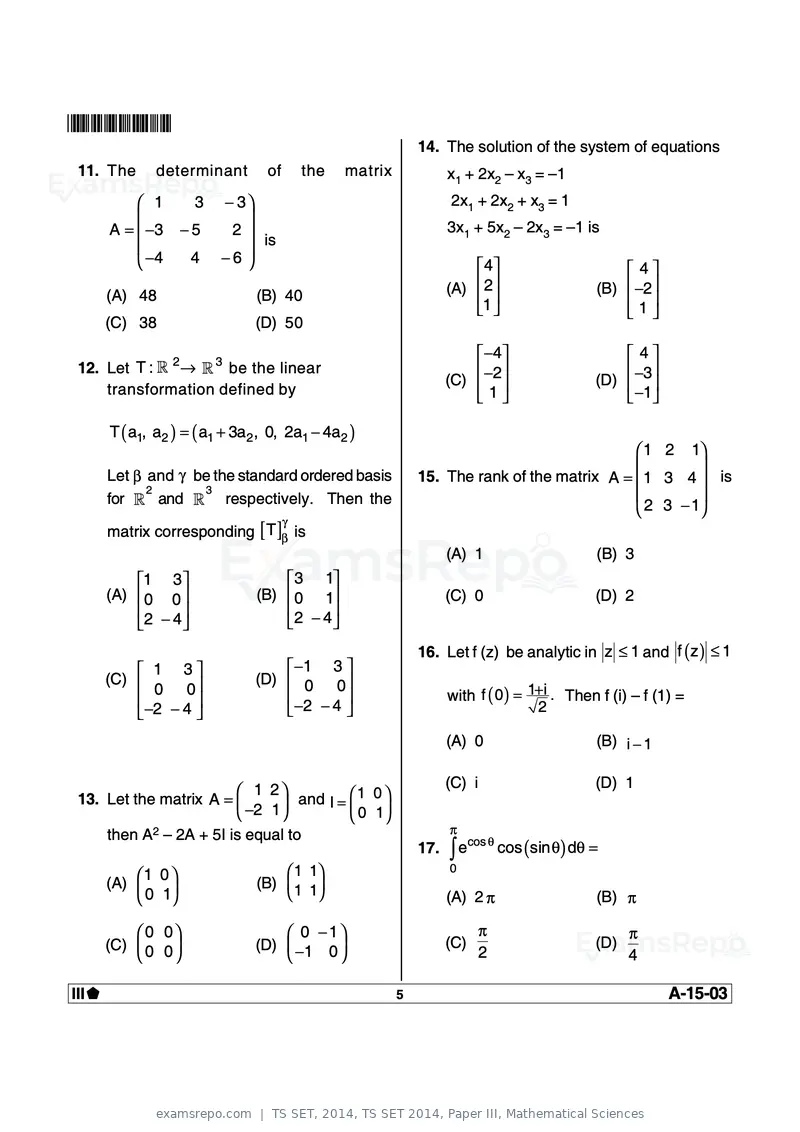
Text of page 5
*A1503*
                                                             14. The solution of the system of equations
11. The       determinant        of       the   matrix            x1 + 2x2 – x3 = –1
           ⎛ 1        3   − 3⎞                                    2x1 + 2x2 + x3 = 1
           ⎜                 ⎟
       A = ⎜ −3      −5    2⎟                                     3x1 + 5x2 – 2x3 = –1 is
                               is
           ⎜                 ⎟
           ⎝ −4       4   −6 ⎠
                                                                     ⎡4 ⎤                       ⎡ 4⎤
       (A) 48                   (B) 40                           (A) ⎢2 ⎥                   (B) ⎢ −2⎥
                                                                     ⎢1 ⎥                       ⎢1⎥
                                                                     ⎣ ⎦                        ⎣ ⎦
       (C) 38                  (D) 50
                                                                     ⎡ −4⎤                      ⎡ 4⎤
12. Let T : 2→ 3 be the linear                                       ⎢ ⎥                        ⎢ ⎥
                                                                 (C) ⎢ −2⎥                  (D) ⎢ −3⎥
    transformation defined by                                        ⎣1⎦                        ⎣ −1⎦

       T ( a1, a2 ) = ( a1 + 3a2 , 0, 2a1 − 4a2 )
                                                                                            ⎛ 1 2 1⎞
                                                                                            ⎜        ⎟
       Let β and γ be the standard ordered basis             15. The rank of the matrix A = ⎜ 1 3 4 ⎟ is
             2      3
       for     and      respectively. Then the                                              ⎜        ⎟
                                                                                            ⎝ 2 3 − 1⎠
                                      γ
       matrix corresponding [ T]β is
                                                                 (A) 1                      (B) 3
           ⎡1 3 ⎤                   ⎡3 1⎤
       (A) ⎢0 0 ⎥               (B) ⎢0 1⎥                        (C) 0                      (D) 2
           ⎢2 − 4 ⎥                 ⎢2 − 4 ⎥
           ⎣      ⎦                 ⎣      ⎦
                                                             16. Let f (z) be analytic in z ≤ 1 and f ( z ) ≤ 1
           ⎡ 1 3⎤                  ⎡ −1 3 ⎤
       (C) ⎢                   (D) ⎢ 0 0 ⎥
              0 0⎥                                                with f ( 0 ) = 1+ i . Then f (i) – f (1) =
           ⎢ −2 − 4 ⎥              ⎢        ⎥
           ⎣        ⎦              ⎣ −2 − 4 ⎦                                     2

                                                                 (A) 0                      (B) i − 1

                                                                 (C) i                      (D) 1
                       ⎛ 1 2 ⎞ and    ⎛1 0 ⎞
13. Let the matrix A = ⎜      ⎟    I= ⎜    ⎟
                       ⎝ −2 1 ⎠       ⎝ 0 1⎠
    then A2 – 2A + 5I is equal to                                 π
                                                             17. ∫ ecos θ cos ( sin θ ) dθ =
                                    ⎛ 1 1⎞                        0
              1 0⎞
       (A) ⎛⎜    ⎟              (B) ⎜ 1 1⎟
            ⎝ 0 1⎠                  ⎝    ⎠                       (A) 2 π                    (B) π

           ⎛ 0 0⎞                  ⎛ 0 −1⎞                             π                          π
       (C) ⎜ 0 0 ⎟             (D) ⎜ −1 0 ⎟                      (C)                        (D)
           ⎝     ⎠                 ⎝      ⎠                            2                          4

IIIÀ                                                     5                                               A-15-03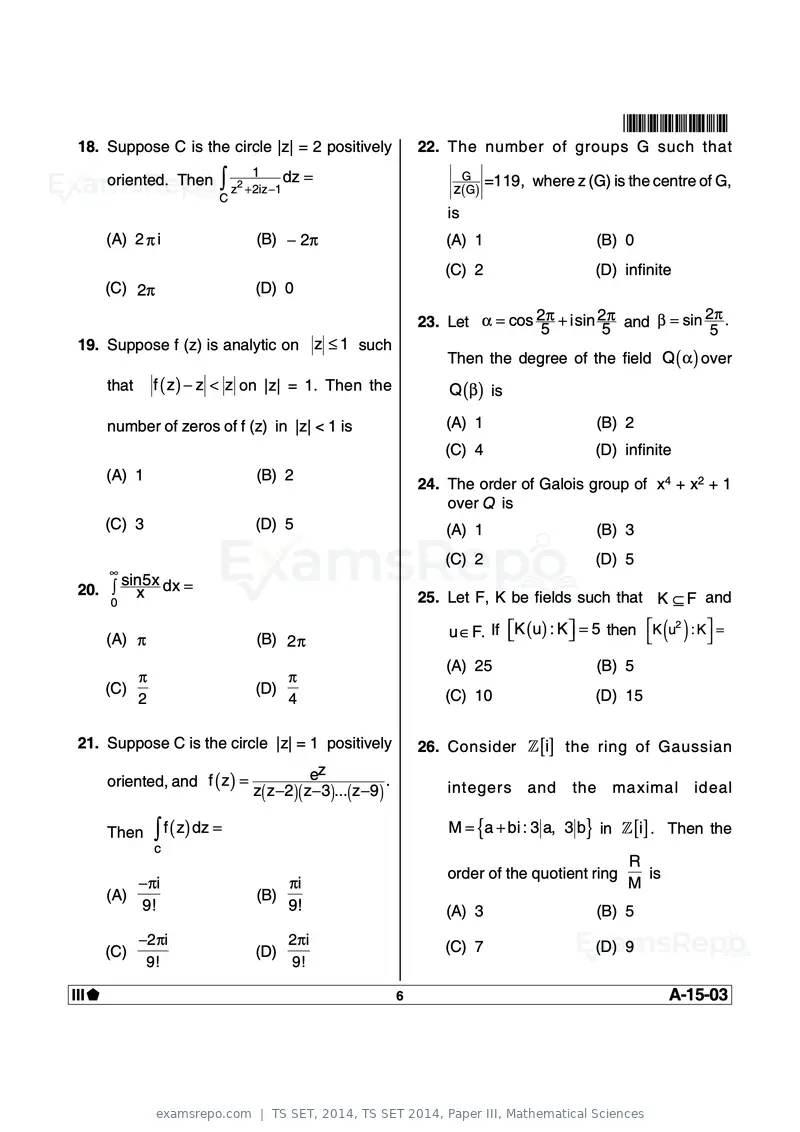
Text of page 6
*A1503*
18. Suppose C is the circle |z| = 2 positively                        22. The number of groups G such that
                                 1
       oriented. Then ∫ z2 + 2iz −1 dz =                                       G   =119, where z (G) is the centre of G,
                                                                           z( G)
                         C
                                                                          is
       (A) 2 π i                 (B) − 2π                                 (A) 1                       (B) 0
                                                                         (C) 2                      (D) infinite
       (C) 2π                    (D) 0
                                                                                                                2π
                                                                      23. Let α = cos 25π + isin 25π and β = sin .
                                                                                                                 5
19. Suppose f (z) is analytic on z ≤ 1 such
                                                                          Then the degree of the field Q ( α ) over
       that     f ( z ) − z < z on |z| = 1. Then the                      Q (β ) is

       number of zeros of f (z) in |z| < 1 is                             (A) 1                       (B) 2
                                                                         (C) 4                      (D) infinite
       (A) 1                     (B) 2
                                                                      24. The order of Galois group of x4 + x2 + 1
                                                                          over Q is
       (C) 3                     (D) 5                                    (A) 1                       (B) 3
                                                                         (C) 2                      (D) 5
       ∞
           sin5x dx =
20. ∫        x                                                        25. Let F, K be fields such that K ⊆ F and
       0


       (A) π                     (B) 2π                                                                          ( )
                                                                          u ∈ F. If ⎡⎣K ( u) : K ⎤⎦ = 5 then ⎡⎣K u : K ⎤⎦ =
                                                                                                                  2


                                                                          (A) 25                      (B) 5
           π                         π
       (C)                       (D)                                     (C) 10                     (D) 15
           2                         4

21. Suppose C is the circle |z| = 1 positively                        26. Consider  [i] the ring of Gaussian

       oriented, and f ( z ) =               ez               .
                                 z( z −2 )( z −3 )...( z −9 )             integers       and    the     maximal        ideal

       Then ∫ f ( z ) dz =                                                M = {a + bi : 3 a, 3 b} in  [i] . Then the
                c
                                                                                                          R
                                                                          order of the quotient ring        is
              −πi                       πi                                                                M
       (A)                       (B)
              9!                        9!                                (A) 3                       (B) 5
              −2πi                      2πi                              (C) 7                      (D) 9
       (C)                       (D)
               9!                       9!

IIIÀ                                                              6                                              A-15-03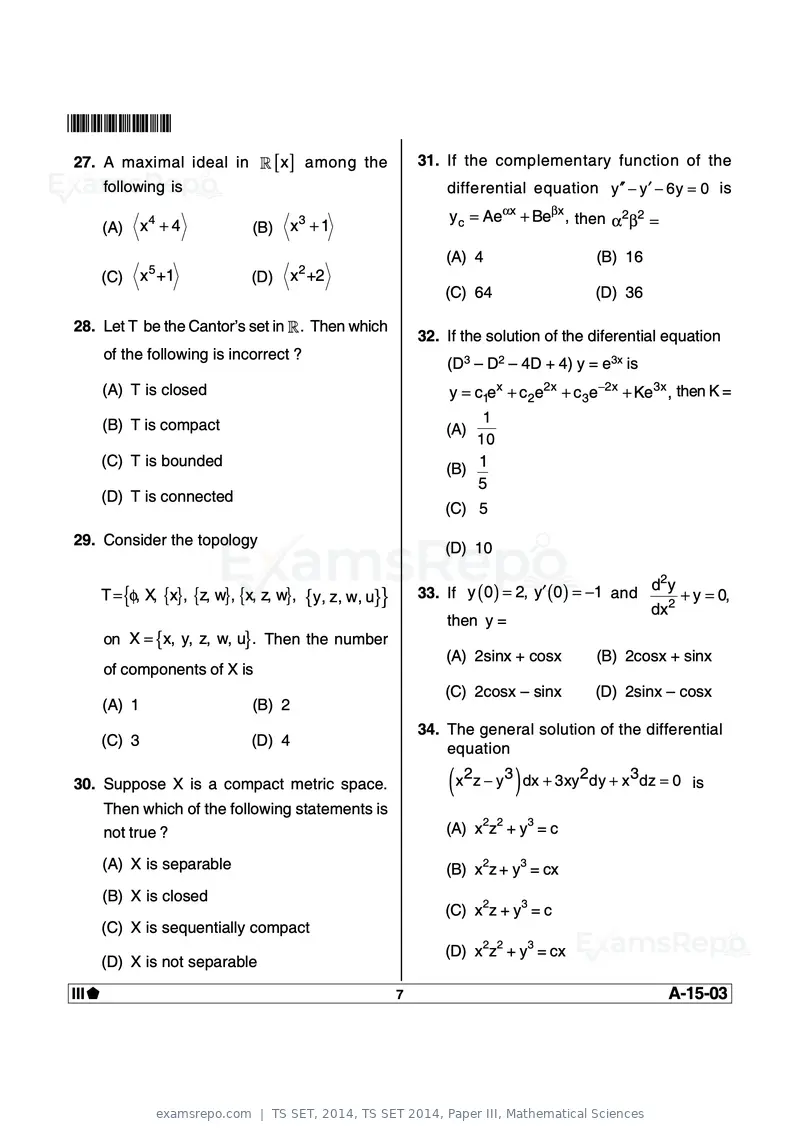
Text of page 7
*A1503*
27. A maximal ideal in              [ x] among the           31. If the complementary function of the
       following is                                              differential equation y ′′ − y ′ − 6y = 0 is
                                                                  y c = Aeαx + Beβx , then α2β2 =
       (A)     x4 + 4         (B)     x3 + 1
                                                                 (A) 4                   (B) 16
                5                      2
   (C)         x +1           (D)     x +2
                                                                 (C) 64                  (D) 36

28. Let T be the Cantor’s set in . Then which
                                                             32. If the solution of the diferential equation
       of the following is incorrect ?
                                                                 (D3 – D2 – 4D + 4) y = e3x is
       (A) T is closed                                            y = c1ex + c 2e2x + c3e−2x + Ke3x , then K =
                                                                      1
       (B) T is compact                                          (A)
                                                                     10
   (C) T is bounded
                                                                 (B) 1
                                                                     5
   (D) T is connected
                                                                 (C) 5
29. Consider the topology
                                                                 (D) 10
                                                                                                    2
   T = {φ, X, {x} , {z, w} , {x, z, w} , {y, z, w, u}}       33. If y ( 0 ) = 2, y′ ( 0 ) = −1 and d y + y = 0,
                                                                                                   dx2
                                                                 then y =
       on X = {x, y, z, w, u}. Then the number
                                                                 (A) 2sinx + cosx        (B) 2cosx + sinx
       of components of X is
                                                                 (C) 2cosx – sinx        (D) 2sinx – cosx
       (A) 1                  (B) 2
                                                             34. The general solution of the differential
   (C) 3                      (D) 4
                                                                 equation

30. Suppose X is a compact metric space.                          ( x2z − y3 ) dx + 3xy2dy + x3dz = 0 is
       Then which of the following statements is
       not true ?                                                (A) x2z2 + y3 = c

       (A) X is separable                                              2     3
                                                                 (B) x z + y = cx
       (B) X is closed
                                                                 (C) x2z + y3 = c
   (C) X is sequentially compact
                                                                       2 2       3
                                                                 (D) x z + y = cx
   (D) X is not separable

IIIÀ                                                     7                                           A-15-03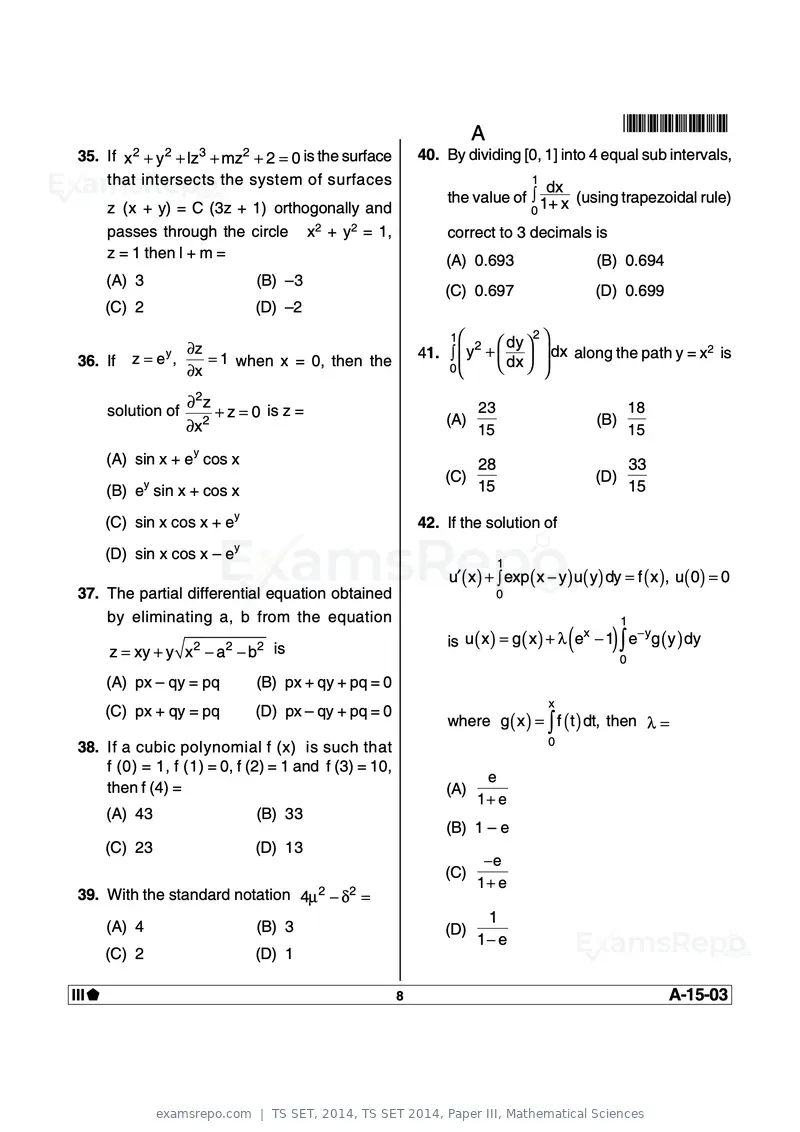
Text of page 8
A                              *A1503*
35. If x 2 + y 2 + lz3 + mz2 + 2 = 0 is the surface         40. By dividing [0, 1] into 4 equal sub intervals,
    that intersects the system of surfaces                                      1
                                                                                dx
                                                                the value of ∫ 1+ x (using trapezoidal rule)
       z (x + y) = C (3z + 1) orthogonally and                                  0
       passes through the circle x2 + y2 = 1,                   correct to 3 decimals is
       z = 1 then l + m =                                       (A) 0.693                    (B) 0.694
       (A) 3                     (B) –3
                                                                (C) 0.697                    (D) 0.699
       (C) 2                     (D) –2
                                                                 1⎛       dy ⎞ ⎞
                                                                              2
                   ∂z                                                 2 ⎛
          z = ey ,    = 1 when x = 0, then the              41. ∫ ⎜ y + ⎜ ⎟ ⎟ dx along the path y = x2 is
36. If                                                          0⎝
                                                                  ⎜     ⎝ dx ⎠ ⎠⎟
                   ∂x

                     ∂2z                                              23                                 18
       solution of       + z = 0 is z =                         (A)                          (B)
                     ∂x2                                              15                                 15
                      y
       (A) sin x + e cos x                                            28                                 33
                                                                (C)                          (D)
            y
       (B) e sin x + cos x                                            15                                 15
                             y
       (C) sin x cos x + e                                  42. If the solution of
                             y
       (D) sin x cos x – e
                                                                           1
                                                                u′ ( x ) + ∫ exp ( x − y ) u( y ) dy = f ( x ), u( 0) = 0
37. The partial differential equation obtained                             0

       by eliminating a, b from the equation                                                         1

       z = xy + y x2 − a2 − b2 is
                                                                                        (        )
                                                                is u ( x ) = g ( x ) + λ e − 1 ∫ e g ( y ) dy
                                                                                          x       −y

                                                                                                     0
       (A) px – qy = pq          (B) px + qy + pq = 0
                                                                                    x
       (C) px + qy = pq          (D) px – qy + pq = 0
                                                                where g ( x ) = ∫ f ( t ) dt, then λ =
                                                                                    0
38. If a cubic polynomial f (x) is such that
    f (0) = 1, f (1) = 0, f (2) = 1 and f (3) = 10,
                                                                       e
    then f (4) =                                                (A)
                                                                      1+ e
       (A) 43                    (B) 33
                                                                (B) 1 – e
       (C) 23                    (D) 13
                                                                       −e
                                                                (C)
                                                                      1+ e
39. With the standard notation 4μ2 − δ2 =
                                                                       1
       (A) 4                     (B) 3                          (D)
                                                                      1− e
       (C) 2                     (D) 1

IIIÀ                                                    8                                                     A-15-03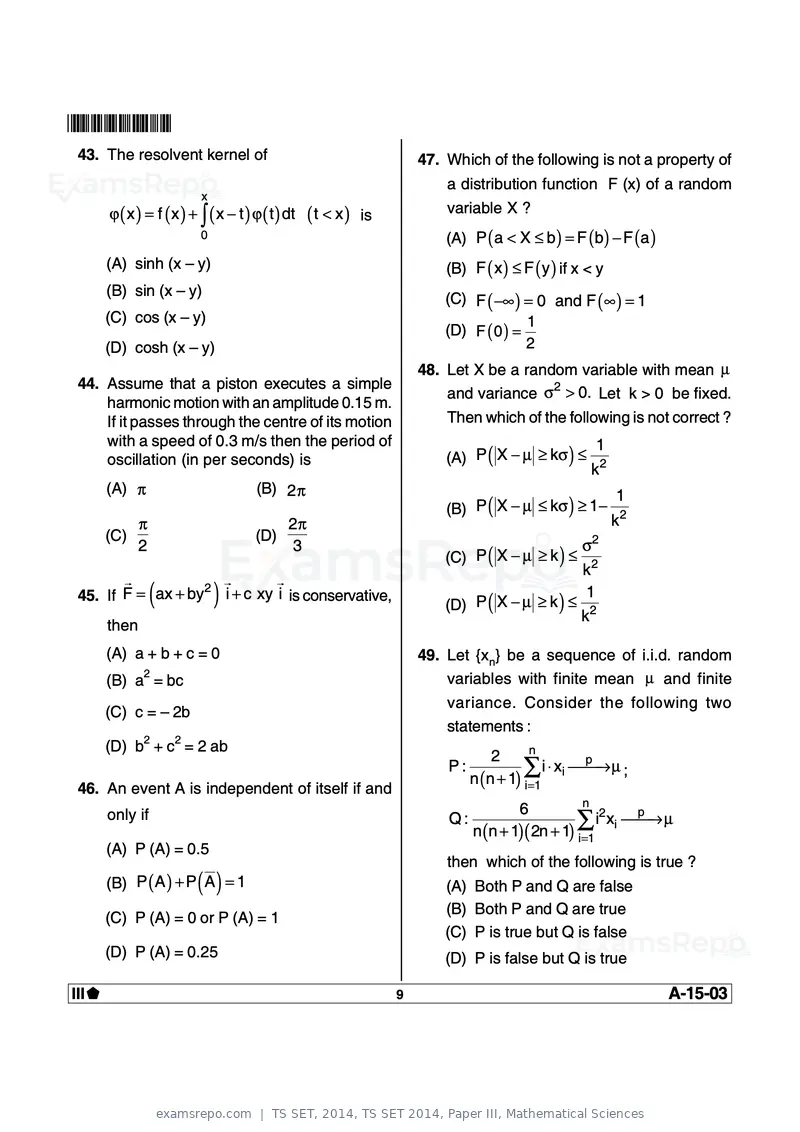
Text of page 9
*A1503*
43. The resolvent kernel of                                            47. Which of the following is not a property of
                                                                           a distribution function F (x) of a random
                           x
       ϕ ( x ) = f ( x ) + ∫ ( x − t ) ϕ ( t ) dt   ( t < x ) is           variable X ?
                           0                                               (A) P ( a < X ≤ b ) = F ( b ) − F ( a )
       (A) sinh (x – y)                                                    (B) F ( x ) ≤ F ( y ) if x < y
       (B) sin (x – y)
                                                                           (C) F ( −∞ ) = 0 and F ( ∞ ) = 1
       (C) cos (x – y)                                                                   1
                                                                           (D) F ( 0 ) =
       (D) cosh (x – y)                                                                  2
                                                                       48. Let X be a random variable with mean μ
44. Assume that a piston executes a simple                                                2
                                                                           and variance σ > 0. Let k > 0 be fixed.
    harmonic motion with an amplitude 0.15 m.
    If it passes through the centre of its motion                          Then which of the following is not correct ?
    with a speed of 0.3 m/s then the period of                                                         1
    oscillation (in per seconds) is                                        (A) P ( X − μ ≥ kσ ) ≤
                                                                                                      k2
       (A) π                            (B) 2π                                                              1
                                                                           (B) P ( X − μ ≤ kσ ) ≥ 1−
           π                                2π                                                              k2
       (C)                              (D)
           2                                3                                                        σ2
                                                                           (C) P ( X − μ ≥ k ) ≤
                                                                                                k2

                 (2
                               )
45. If F = ax + by i + c xy i is conservative,                                                   1
                                                                           (D) P ( X − μ ≥ k ) ≤ 2
                                                                                                k
       then
       (A) a + b + c = 0                                               49. Let {xn} be a sequence of i.i.d. random
              2
       (B) a = bc                                                          variables with finite mean μ and finite
                                                                           variance. Consider the following two
       (C) c = – 2b
                                                                           statements :
              2      2
       (D) b + c = 2 ab                                                                      n
                                                                                     2
                                                                           P:              ∑
                                                                                n ( n + 1) i =1
                                                                                                        p
                                                                                                i ⋅ xi ⎯⎯ →μ ;
46. An event A is independent of itself if and
                                                                                                     n
                                                                                        6                      p
       only if                                                             Q:                      ∑
                                                                                n (n + 1)( 2n + 1) i =1
                                                                                                        i2 xi ⎯⎯ →μ
       (A) P (A) = 0.5
                                                                           then which of the following is true ?
                           ( )
       (B) P ( A ) + P A = 1                                               (A) Both P and Q are false
                                                                           (B) Both P and Q are true
       (C) P (A) = 0 or P (A) = 1
                                                                           (C) P is true but Q is false
       (D) P (A) = 0.25                                                    (D) P is false but Q is true

IIIÀ                                                               9                                                 A-15-03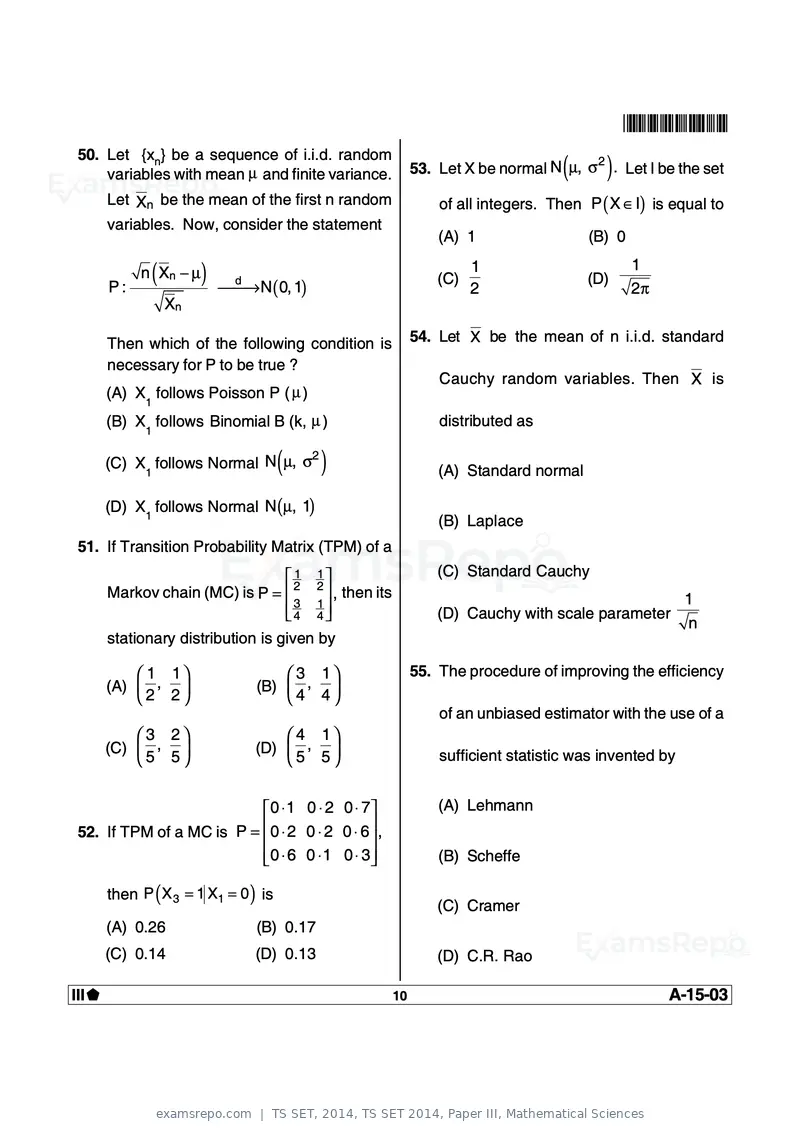
Text of page 10
*A1503*
50. Let {xn} be a sequence of i.i.d. random
    variables with mean μ and finite variance.                                          (  2
                                                                                              )
                                                                 53. Let X be normal N μ, σ . Let I be the set
       Let Xn be the mean of the first n random                      of all integers. Then P ( X ∈ I) is equal to
       variables. Now, consider the statement
                                                                     (A) 1                  (B) 0


       P:
                 (
            n Xn − μ      ) ⎯⎯
                             d
                               → N ( 0, 1)
                                                                    (C)
                                                                          1
                                                                          2
                                                                                            (D)
                                                                                                    1
                                                                                                    2π
                     Xn

       Then which of the following condition is                  54. Let X be the mean of n i.i.d. standard
       necessary for P to be true ?
                                                                     Cauchy random variables. Then X is
       (A) X1 follows Poisson P ( μ )
       (B) X follows Binomial B (k, μ )                              distributed as
             1


       (C) X follows Normal N μ, σ
             1
                                      (      2
                                                 )                   (A) Standard normal

       (D) X1 follows Normal N (μ, 1)
                                                                     (B) Laplace
51. If Transition Probability Matrix (TPM) of a
                                   ⎡ 21 21 ⎤                        (C) Standard Cauchy
       Markov chain (MC) is P = ⎢            ⎥ , then its                                                   1
                                   ⎢⎣ 34 41 ⎥⎦                      (D) Cauchy with scale parameter
                                                                                                            n
       stationary distribution is given by

           ⎛ 1 1⎞                     ⎛ 3 1⎞                     55. The procedure of improving the efficiency
       (A) ⎜ , ⎟                  (B) ⎜ , ⎟
           ⎝2 2⎠                      ⎝4 4⎠
                                                                     of an unbiased estimator with the use of a
           ⎛3 2⎞                      ⎛ 4 1⎞
       (C) ⎜ , ⎟                  (D) ⎜ , ⎟                          sufficient statistic was invented by
           ⎝5 5⎠                      ⎝5 5⎠


                          ⎡ 0 ⋅ 1 0 ⋅ 2 0 ⋅ 7⎤                       (A) Lehmann
                          ⎢                    ⎥
52. If TPM of a MC is P = ⎢ 0 ⋅ 2 0 ⋅ 2 0 ⋅ 6 ⎥ ,
                          ⎢⎣ 0 ⋅ 6 0 ⋅ 1 0 ⋅ 3⎥⎦                     (B) Scheffe

       then P ( X 3 = 1 X1 = 0 ) is
                                                                    (C) Cramer
       (A) 0.26                   (B) 0.17
       (C) 0.14                   (D) 0.13                          (D) C.R. Rao

IIIÀ                                                        10                                           A-15-03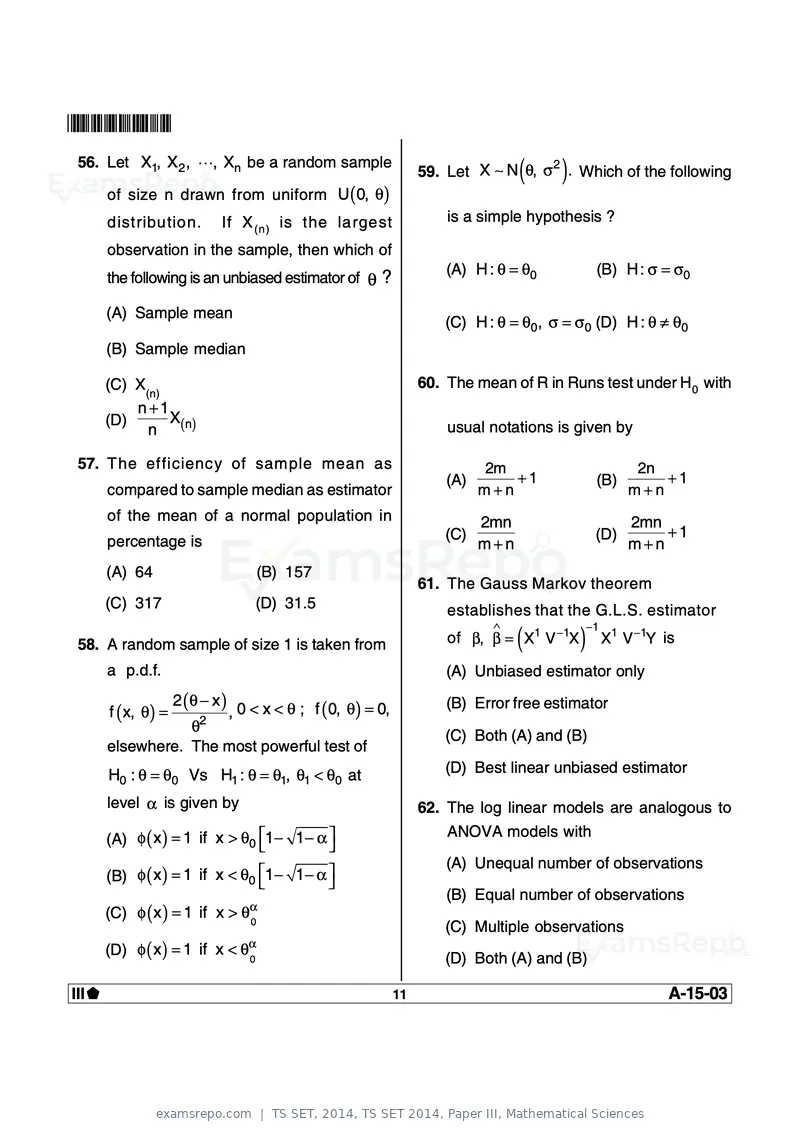
Text of page 11
*A1503*
56. Let X1, X2 , , Xn be a random sample
                                                                                       (  2
                                                                                            )
                                                                        59. Let X  N θ, σ . Which of the following
       of size n drawn from uniform U ( 0, θ )
       distribution.           If X (n) is the largest                      is a simple hypothesis ?

       observation in the sample, then which of
                                                                           (A) H : θ = θ0         (B) H : σ = σ0
       the following is an unbiased estimator of θ ?

       (A) Sample mean
                                                                           (C) H : θ = θ0, σ = σ0 (D) H : θ ≠ θ0
       (B) Sample median

       (C) X(n)                                                         60. The mean of R in Runs test under H0 with
           n+1
       (D)      X
             n ( n)                                                         usual notations is given by

57. The efficiency of sample mean as                                             2m                        2n
                                                                           (A)       +1           (B)         +1
       compared to sample median as estimator                                    m+n                      m+n
       of the mean of a normal population in                                     2mn                      2mn
                                                                           (C)                    (D)         +1
       percentage is                                                             m+n                      m+n
       (A) 64                             (B) 157
                                                                        61. The Gauss Markov theorem
       (C) 317                         (D) 31.5                             establishes that the G.L.S. estimator
                                                                                  ∧
                                                                                       (         ) X V Y is
                                                                                                 −1
58. A random sample of size 1 is taken from                                 of β, β = X1 V −1X        1   −1


       a p.d.f.                                                            (A) Unbiased estimator only
                      2 (θ − x )                                           (B) Error free estimator
       f ( x, θ ) =       2
                                   , 0 < x < θ ; f ( 0, θ ) = 0,
                  θ
                                                                           (C) Both (A) and (B)
       elsewhere. The most powerful test of
       H0 : θ = θ0 Vs H1 : θ = θ1, θ1 < θ0 at                              (D) Best linear unbiased estimator

       level α is given by                                              62. The log linear models are analogous to
       (A) φ ( x ) = 1 if x > θ0 ⎣⎡1− 1− α ⎦⎤                               ANOVA models with
                                                                           (A) Unequal number of observations
       (B) φ ( x ) = 1 if x < θ0 ⎡⎣1− 1− α ⎤⎦
                                                                           (B) Equal number of observations
       (C) φ ( x ) = 1 if x > θα0
                                                                           (C) Multiple observations
       (D) φ ( x ) = 1 if x < θ 0     α
                                                                           (D) Both (A) and (B)

IIIÀ                                                               11                                          A-15-03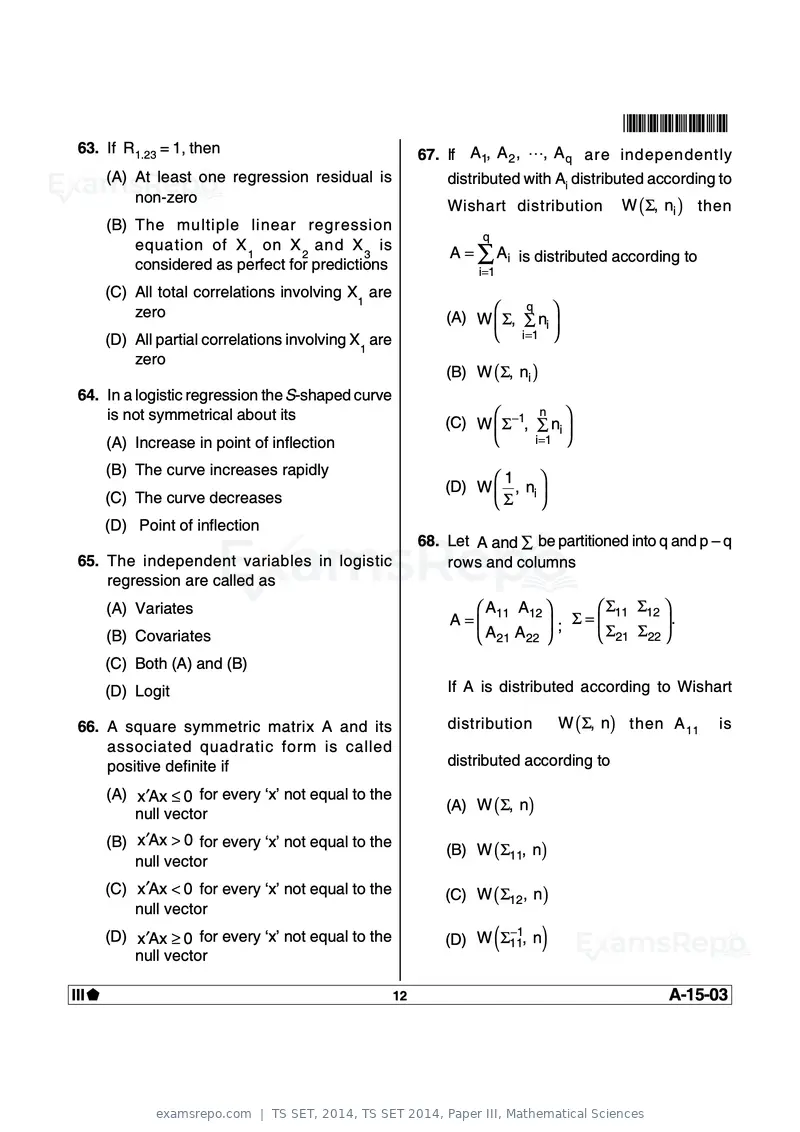
Text of page 12
*A1503*
63. If R1.23 = 1, then                                     67. If A1, A 2 , , A q are independently
       (A) At least one regression residual is                 distributed with Ai distributed according to
           non-zero
                                                               Wishart distribution          W ( Σ, ni ) then
       (B) The multiple linear regression
                                                                    q
           equation of X on X and X is
                          1        2         3                 A = ∑ Ai is distributed according to
           considered as perfect for predictions                    i=1
       (C) All total correlations involving X are
                                             1
           zero                                                      ⎛    q    ⎞
                                                               (A) W ⎜ Σ, ∑ ni ⎟
       (D) All partial correlations involving X are                  ⎝ i =1 ⎠
                                               1
           zero
                                                               (B) W ( Σ, ni )
64. In a logistic regression the S-shaped curve
    is not symmetrical about its                                     ⎛        n  ⎞
                                                               (C) W ⎜ Σ−1, ∑ ni ⎟
       (A) Increase in point of inflection                           ⎝      i =1 ⎠

       (B) The curve increases rapidly
                                                                     ⎛1     ⎞
                                                               (D) W ⎜ , ni ⎟
       (C) The curve decreases                                       ⎝Σ     ⎠
       (D) Point of inflection
                                                           68. Let A and ∑ be partitioned into q and p – q
65. The independent variables in logistic                      rows and columns
    regression are called as
       (A) Variates                                                ⎛A A ⎞          ⎛ Σ11 Σ12 ⎞
                                                               A = ⎜ 11 12 ⎟ ; Σ = ⎜         ⎟.
       (B) Covariates                                               A  A
                                                                   ⎝ 21 22 ⎠         Σ   Σ
                                                                                   ⎝ 21 22 ⎠
       (C) Both (A) and (B)
       (D) Logit                                               If A is distributed according to Wishart

66. A square symmetric matrix A and its                        distribution          W ( Σ, n) then A 11   is
    associated quadratic form is called
    positive definite if                                       distributed according to

       (A) x′Ax ≤ 0 for every ‘x’ not equal to the
                                                               (A) W ( Σ, n)
           null vector
       (B) x′Ax > 0 for every ‘x’ not equal to the
                                                               (B) W ( Σ11, n)
           null vector
       (C) x′Ax < 0 for every ‘x’ not equal to the             (C) W ( Σ12 , n)
           null vector
       (D) x′Ax ≥ 0 for every ‘x’ not equal to the
           null vector
                                                                      −1
                                                                        (
                                                               (D) W Σ11, n      )
IIIÀ                                                  12                                           A-15-03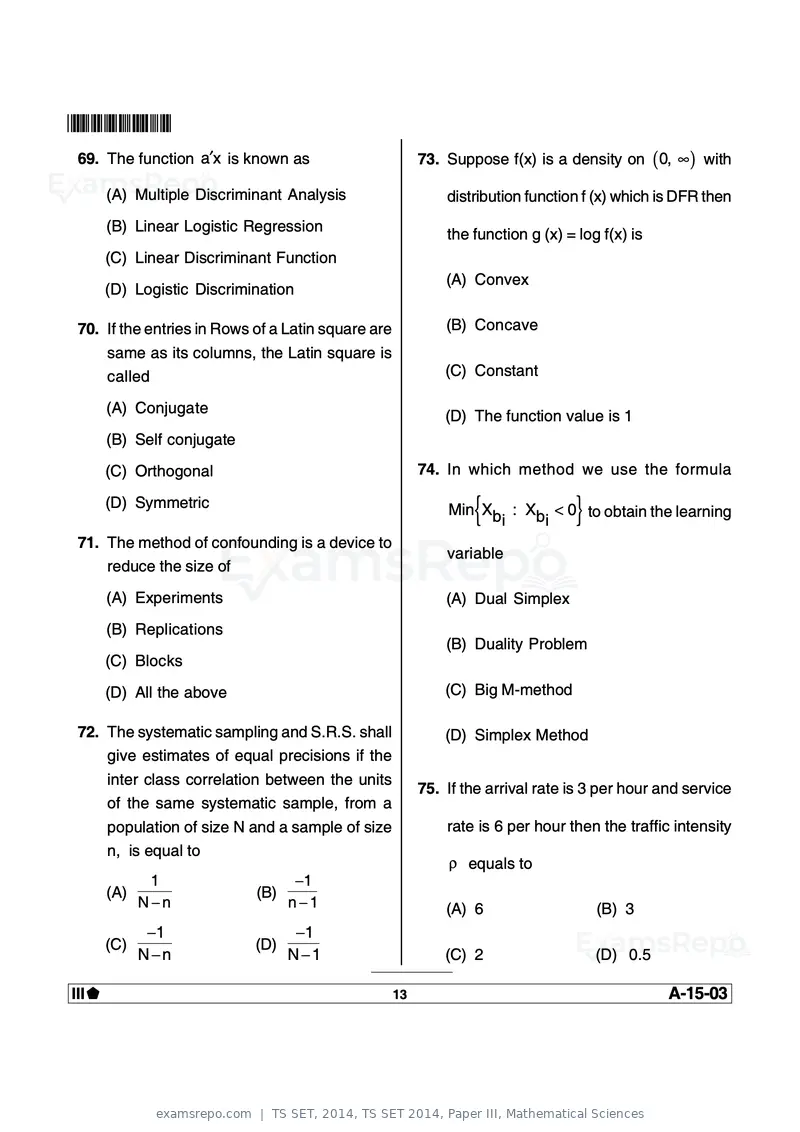
Text of page 13
*A1503*
69. The function a′x is known as                        73. Suppose f(x) is a density on ( 0, ∞ ) with

       (A) Multiple Discriminant Analysis                   distribution function f (x) which is DFR then
       (B) Linear Logistic Regression                       the function g (x) = log f(x) is
       (C) Linear Discriminant Function
                                                            (A) Convex
       (D) Logistic Discrimination

70. If the entries in Rows of a Latin square are            (B) Concave
       same as its columns, the Latin square is
       called                                               (C) Constant

       (A) Conjugate
                                                            (D) The function value is 1
       (B) Self conjugate
       (C) Orthogonal                                   74. In which method we use the formula

       (D) Symmetric
                                                                {                }
                                                            Min Xb : Xb < 0 to obtain the learning
                                                                  i    i
71. The method of confounding is a device to
                                                            variable
    reduce the size of
       (A) Experiments                                      (A) Dual Simplex
       (B) Replications
                                                            (B) Duality Problem
       (C) Blocks
       (D) All the above                                    (C) Big M-method

72. The systematic sampling and S.R.S. shall                (D) Simplex Method
    give estimates of equal precisions if the
       inter class correlation between the units
                                                        75. If the arrival rate is 3 per hour and service
       of the same systematic sample, from a
       population of size N and a sample of size            rate is 6 per hour then the traffic intensity
       n, is equal to
                                                            ρ equals to
            1                    −1
       (A)                  (B)
           N−n                  n−1                         (A) 6                    (B) 3
              −1                   −1
       (C)                  (D)
             N−n                  N−1                       (C) 2                    (D) 0.5

IIIÀ                                               13                                          A-15-03
Text of page 14
*A1503*
       Space for Rough Work


IIIÀ            14               A-15-03
Text of page 15
*A1503*
          Space for Rough Work


IIIÀ               15            A-15-03
Text of page 16
*A1503*
       Space for Rough Work


IIIÀ            16               A-15-03
Official key not published for this paper.
Page 1 of 16
Source: Telangana State Eligibility Test. Question paper published by Telangana State Eligibility Test.