
TS SET 2014: Paper III, Philosophy

Text of page 1
aaaaaaaaaaaaaaaaaaaaaaaaaaaaaaaaaaaaaaaaaaaaaaaaaaaaaaaa
aaaaaaaaaaaaaaaaaaaaaaaaaaaaaaaaaaaaaaaaaaaaaaaaaaaaaaaaaaaaaaaaaaaaaaaaaaaa
aaaaaaaaaaaaaaaaaaaaaaaaaaaaaaaaaaaaaaaaaaaaaaaaaaaaaaaaaaaaaaaaaaaaaaaaaaaaaaa
SUBJECT CODE SUBJECT PAPER
A-18-03 PHILOSOPHY III
HALL TICKET NUMBER QUESTION BOOKLET
NUMBER
OMR SHEET NUMBER
DURATION MAXIMUM MARKS NUMBER OF PAGES NUMBER OF QUESTIONS
2 HOUR 30 MINUTES 150 16 75
This is to certify that, the entries made in the above portion are correctly written and verified.
Candidate’s Signature Name and Signature of Invigilator
Instructions for the Candidates A¿æýÅÆæÿ$¦ËMæü$ çÜ*^èþ¯èþË$
1. Write your Hall Ticket Number in the space provided on the top 1. D ç³#r ò³O ¿êVæü ÌZ CÐèþÓºyìþ¯èþ çÜ¦Ë ÌZ Ò$ çàÌý sìýMðüsý ¯èþ ºÆæÿ$ Æ>Äæý$ yìþ.
of this page.
2. D {ç³Ôèý² ç³{èþÐèþ$$ yðþ¿ñýOI§æþ$ ºçßý$âñýO_eMæü {ç³Ôèý²Ë¯èþ$ MæüÍW E ¨.
2. This paper consists of seventy five multiple-choice type of
questions. 3. ç³Èæü {´ëÆæÿ ¿æýÐèþ$$¯èþ D {ç³Ôé²ç³{èþÐèþ$$ Ò$Mæü$ CÐèþÓºyæþ$èþ$ ¨. Ððþ$$§æþsìý I§æþ$
3. At the commencement of examination, the question booklet will °Ñ$çÙÐèþ$$ËÌZ D {ç³Ôé²ç³{èþÐèþ$$¯èþ$ ðþÇ_ Mìü §æþ ðþÍí³¯èþ A Ôé˯èþ$ èþç³µ°çÜÇV>
be given to you. In the first 5 minutes, you are requested to open çÜÇ^èþ*çÜ$Mø yìþ.
the booklet and compulsorily examine it as below : (i) D {ç³Ôèý² ç³{èþÐèþ$$¯èþ$ ^èþ*yæþyé°Mìü MæüÐèþÆÿõ³h A ^èþ$¯èþ E¯èþ² M>Wèþç³# ïÜË$¯èþ$
(i) To have access to the Question Booklet, tear off the paper _ ^èþ yìþ. íÜtMæüPÆÿ ïÜË$Ìôý° Ðèþ$ÇÄæý$$ C¨ÐèþÆæÿMóü ðþÇ_ E¯èþ² {ç³Ôé²ç³{èþÐèþ$$¯èþ$
seal on the edge of this cover page. Do not accept a booklet Ò$Ææÿ$ A XMæüÇ ^èþÐèþ§æþ$ª.
without sticker-seal and do not accept an open booklet.
(ii) Tally the number of pages and number of questions in (ii) MæüÐèþÆæÿ$ õ³h ò³O Ðèþ$${¨ _¯èþ çÜÐèþ*^éÆæÿ {ç³M>Ææÿ D {ç³Ôèý²ç³{èþÐèþ$$ÌZ° õ³iË
the booklet with the information printed on the cover çÜ Qůèþ$ Ðèþ$ÇÄæý$$ {ç³Ôèý²Ë çÜ Qůèþ$ çÜÇ^èþ*çÜ$Mø yìþ. õ³iË çÜ QÅMæü$
page. Faulty booklets due to pages/questions missing çÜ º «¨ _ V>± Ìôý§é çÜ*_ _¯èþ çÜ QÅÌZ {ç³Ôèý²Ë$ ÌôýMæü´ùÐèþ#r Ìôý§é °f{ç³
or duplicate or not in serial order or any other M>Mæü´ùÐèþ#r Ìôý§é {ç³Ôèý²Ë$ {MæüÐèþ$糧æþ®ÌZ ÌôýMæü´ùÐèþ#r Ìôý§é HÐðþO¯é óþyéË$ yæþ$r
discrepancy should be got replaced immediately by a Ðèþ sìý §øçÙç³NÇèþÐðþ$O¯èþ {ç³Ôèý² ç³{é°² Ððþ r¯óþ Ððþ$$§æþsìý I§æþ$ °Ñ$ÚëÌZÏ ç³È>
correct booklet from the invigilator within the period ç³ÆæÿÅÐóþæüMæü$°Mìü ÇW C_aÐóþíÜ §é°Mìü º§æþ$Ë$V> çÜÇV>Y E¯èþ² {ç³Ôèý²ç³{é°² ¡çÜ$Mø yìþ.
of 5 minutes. Afterwards, neither the Question Booklet
will be replaced nor any extra time will be given.
èþ§æþ¯èþ èþÆæÿ {ç³Ôèý²ç³{èþÐèþ$$ Ðèþ*Ææÿaºyæþ§æþ$ A§æþ¯èþç³# çÜÐèþ$Äæý$ CÐèþÓºyæþ§æþ$.
(iii) After this verification is over, the Test Booklet Number (iii) ò³O Ñ«§æþ V> çÜÇ^èþ*çÜ$Mö¯èþ² èþÆ>Óèþ {ç³Ôé²ç³{èþ çÜ Qůèþ$ OMR ç³{èþÐèþ$$ ò³O
should be entered in the OMR Sheet and the OMR Sheet A§óþÑ«§æþ V> OMR ç³{èþÐèþ$$ çÜ Qůèþ$ D {ç³Ôé²ç³{èþÐèþ$$ ò³O °ÇªçÙtt çÜ¦Ë ÌZ Æ>Äæý$ÐèþÌñý¯èþ$.
Number should be entered on this Test Booklet. 4. {ç³ {ç³Ôèý²Mæü$ ¯éË$Væü$ {ç³éÅÐèþ*²Äæý$ {ç³çܵ §æþ¯èþË$ (A), (B), (C) Ðèþ$ÇÄæý$$ (D)
4. Each item has four alternative responses marked (A), (B), (C) Ë$V> CÐèþÓºyézÆÿ$$. {ç³{ç³Ôèý²Mæü$ çÜÆðÿO¯èþ {ç³çܵ §æþ¯èþ¯èþ$ G¯èþ$²Mö° Mìü §æþ ðþÍí³¯èþ Ñ«§æþ V>
and (D). You have to darken the circle as indicated below on the OMR ç³{èþÐèþ$$ÌZ {ç³ {ç³Ôé² çÜ QÅMæü$ CÐèþÓºyìþ¯èþ ¯éË$Væü$ Ðèþé¢ÌZÏ çÜÆðÿO¯èþ
correct response against each item. {ç³çܵ §æþ¯èþ¯èþ$ çÜ*_ ^óþ Ðèþ颰² »êÌý ´ëÆÿ$$ sý ò³¯þø Mìü §æþ ðþÍí³¯èþ Ñ«§æþ V>
Example : A B C D ç³NÇ ^éÍ.
where (C) is the correct response. E§éçßýÆæÿ×ý : A B C D
5. Your responses to the items are to be indicated in theOMR Answer (C) ç
Ü Æð ÿ O ¯ è þ {ç ³ ç Ü µ §æ þ ¯è þ AÆÿ$$ó þ
Sheet given to you. If you mark at any place other than in the 5. {ç³Ôèý²ËMæü$ {ç³çܵ §æþ¯èþ˯èþ$ D {ç³Ôèý²ç³{èþÐèþ$$ø CÐèþÓºyìþ¯èþ OMR ç³{èþÐèþ$$ ò³O¯èþ
circle in the Answer Sheet, it will not be evaluated. CÐèþÓºyìþ¯èþ Ðèþé¢ÌZϯóþ ç³NÇ _ Væü$Ç¢ ^éÍ. AÌêM>Mæü çÜÐèþ*«§é¯èþ ç³{èþ ò³O ÐóþÆöMæü ^ør
6. Read instructions given inside carefully. Væü$Ç¢õÜ¢ Ò$ {ç³çܵ §æþ¯èþ Ðèþ$*ÌêÅ Mæü¯èþ ^óþÄæý$ºyæþ§æþ$.
7. Rough Work is to be done in the end of this booklet. 6. {ç³Ôèý² ç³{èþÐèþ$$ ÌZç³Ë C_a¯èþ çÜ*^èþ¯èþ˯èþ$ gê{Væüèþ¢V> ^èþ§æþÐèþ yìþ.
8. If you write your name or put any mark on any part of the OMR
Answer Sheet, except for the space allotted for the relevant 7. _èþ$¢ç³°° {ç³Ôèý²ç³{èþÐèþ$$ _ÐèþÆæÿ C_a¯èþ RêäçܦËÐèþ$$ÌZ ^óþÄæý*Í.
entries, which may disclose your identity, you will render yourself 8. OMR ç³{èþÐèþ$$ ò³O °È~èþ çÜ¦Ë ÌZ çÜ*_ ^èþÐèþËíܯèþ ÑÐèþÆ>Ë$ èþí³µ _ CèþÆæÿ çÜ¦Ë ÌZ
liable to disqualification. Ò$ Væü$Ç¢ ç³#¯èþ$ ðþÍõ³ Ñ«§æþ V> Ò$ õ³Ææÿ$ Æ>Äæý$yæþ V>± Ìôý§é CèþÆæÿ _à²Ë¯èþ$ ò³rtyæþ
9. The candidate must handover the OMR Answer Sheet to the V>± ^óþíܯèþrÏÆÿ$$óþ Ò$ A¯èþÆæÿáèþMæü$ Ò$Æóÿ »ê«§æþ$ÅËÐèþ#éÆæÿ$.
invigilators at the end of the examination compulsorily and 9. ç³Èæü ç³NÆæÿ¢Æÿ$$¯èþ èþÆ>Óèþ Ò$ OMR ç³{é°² èþç³µ°çÜÇV> ç³Èæü ç³ÆæÿÅÐóþæüMæü$yìþMìü CÐéÓÍ.
must not carry it with you outside the Examination Hall. The Ðésìý° ç³Èæü Væü¨ ºÄæý$rMæü$ ¡çÜ$Mæü$ÐðþâæýÏMæü*yæþ§æþ$. ç³Èæü ç³NÆæÿ¢Æÿ$$¯èþ èþÆæÿ$Ðéèþ A¿æýÅÆæÿ$¦Ë$
candidate is allowed to take away the carbon copy of OMR
{ç³Ôèý² ç³{é°², OMR ç³{èþ Äñý$$MæüP M>Ææÿ¾¯þ M>ï³° ¡çÜ$Mæü$ÐðþâæýÏÐèþ^èþ$a.
Sheet and used Question paper booklet at the end of the
examination. 10. ±Í/¯èþËÏ Ææÿ Væü$ »êÌý ´ëÆÿ$$ sý ò³¯þ Ðèþ*{èþÐóþ$ Eç³Äñý*W ^éÍ.
10. Use only Blue/Black Ball point pen. 11. ÌêVæüÇ£æþÐþ$ sôýº$ÌýÞ, M>ÅÍMæü$ÅÌôýrÆÿË$, GË[M>t°Mü ç³ÇMæüÆ>Ë$ Ððþ$$§æþËVæü$¯èþÑ ç³ÈæüVæü¨ÌZ
11. Use of any calculator or log table etc., is prohibited. Eç³Äñý*W ^èþyæþ °õÙ«§æþ .
12. There is no negative marks for incorrect answers. 12. èþç³ çÜÐèþ*«§é¯éËMæü$ Ðèþ*Ææÿ$PË èþWY ç³# Ìôý§æþ$.
III Ë 1 A-18-03
aaaaaaaaaaaaaaaaaaaaaaaaaaaaaaaaaaaaaaaaaaaaaaaaaaaaaaaaa
Text of page 2
*A1803*


                   HE
                     RE

            WR
              ITE

        NO
          T
       DO


IIIË           2             A-18-03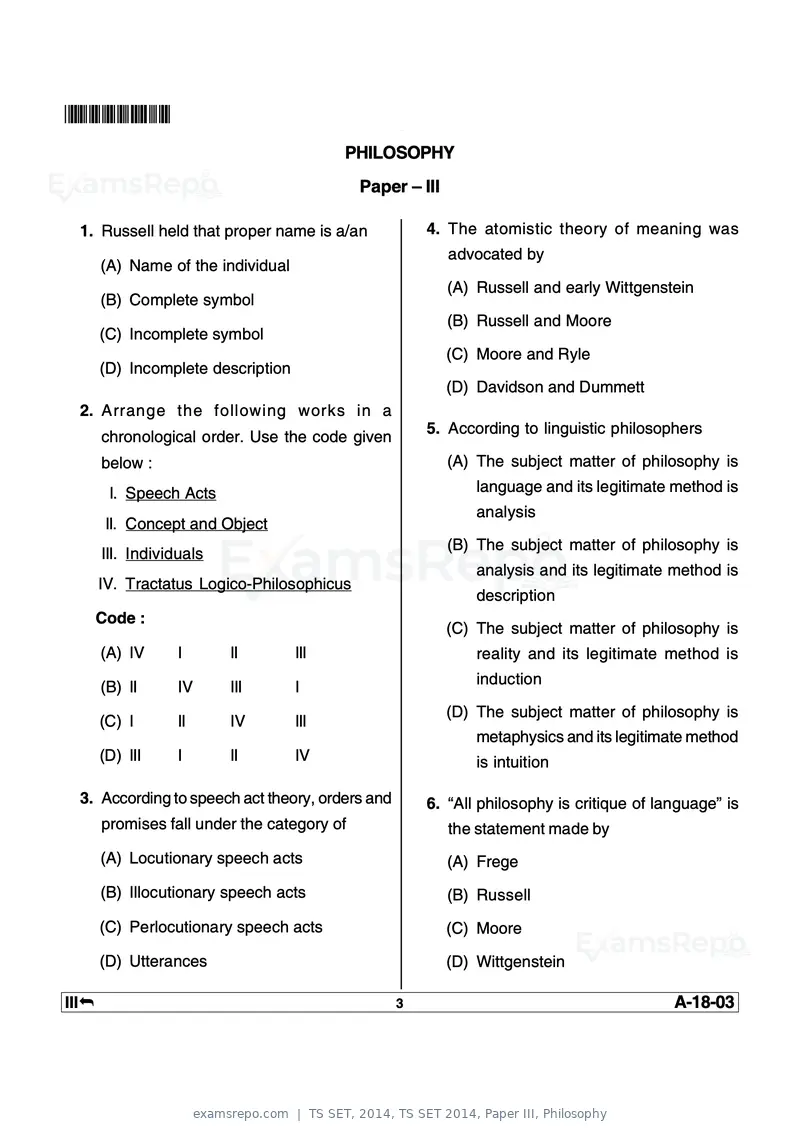
Text of page 3
*A1803*
                                          PHILOSOPHY
                                             Paper – III

  1. Russell held that proper name is a/an            4. The atomistic theory of meaning was
                                                           advocated by
       (A) Name of the individual
                                                           (A) Russell and early Wittgenstein
       (B) Complete symbol
                                                           (B) Russell and Moore
       (C) Incomplete symbol
                                                           (C) Moore and Ryle
       (D) Incomplete description
                                                           (D) Davidson and Dummett
  2. Arrange the following works in a
                                                      5. According to linguistic philosophers
       chronological order. Use the code given
       below :                                             (A) The subject matter of philosophy is
        I. Speech Acts                                         language and its legitimate method is
                                                               analysis
        II. Concept and Object
                                                           (B) The subject matter of philosophy is
       III. Individuals
                                                               analysis and its legitimate method is
       IV. Tractatus Logico-Philosophicus
                                                               description
       Code :
                                                           (C) The subject matter of philosophy is
       (A) IV      I      II        III                        reality and its legitimate method is
                                                               induction
       (B) II      IV     III       I
                                                           (D) The subject matter of philosophy is
       (C) I       II     IV        III
                                                               metaphysics and its legitimate method
       (D) III     I      II        IV                         is intuition

  3. According to speech act theory, orders and       6. “All philosophy is critique of language” is
       promises fall under the category of                 the statement made by
       (A) Locutionary speech acts                         (A) Frege
       (B) Illocutionary speech acts                       (B) Russell
       (C) Perlocutionary speech acts                      (C) Moore

       (D) Utterances                                      (D) Wittgenstein

IIIË                                              3                                       A-18-03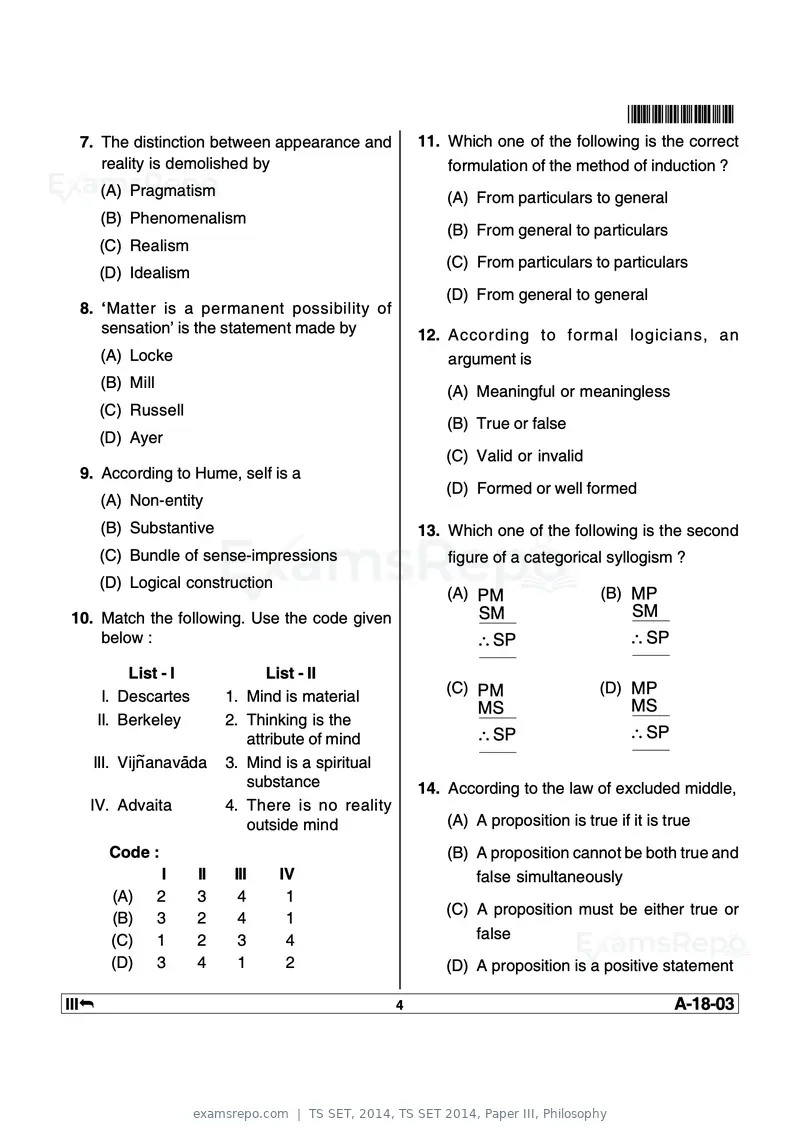
Text of page 4
*A1803*
 7. The distinction between appearance and               11. Which one of the following is the correct
    reality is demolished by                                 formulation of the method of induction ?
       (A) Pragmatism                                        (A) From particulars to general
       (B) Phenomenalism
                                                             (B) From general to particulars
       (C) Realism
                                                            (C) From particulars to particulars
       (D) Idealism
                                                            (D) From general to general
 8. ‘Matter is a permanent possibility of
    sensation’ is the statement made by                  12. According to formal logicians, an
       (A) Locke                                             argument is
       (B) Mill
                                                             (A) Meaningful or meaningless
       (C) Russell
                                                             (B) True or false
       (D) Ayer
                                                            (C) Valid or invalid
 9. According to Hume, self is a
                                                            (D) Formed or well formed
       (A) Non-entity
       (B) Substantive                                   13. Which one of the following is the second
       (C) Bundle of sense-impressions                       figure of a categorical syllogism ?
       (D) Logical construction
                                                             (A) PM                  (B) MP
10. Match the following. Use the code given                       SM                      SM
    below :                                                      ∴ SP                     ∴ SP

            List - I              List - II
                                                            (C) PM                   (D) MP
        I. Descartes        1. Mind is material
                                                                 MS                       MS
       II. Berkeley         2. Thinking is the
                               attribute of mind                 ∴ SP                     ∴ SP
           ~anava-da
   III. Vijn                3. Mind is a spiritual
                               substance                 14. According to the law of excluded middle,
   IV. Advaita              4. There is no reality
                               outside mind                  (A) A proposition is true if it is true
        Code :                                               (B) A proposition cannot be both true and
                   I   II    III   IV                            false simultaneously
        (A)       2    3      4     1
                                                            (C) A proposition must be either true or
        (B)       3    2      4     1
        (C)       1    2      3     4                           false
        (D)       3    4      1     2                       (D) A proposition is a positive statement

IIIË                                                 4                                           A-18-03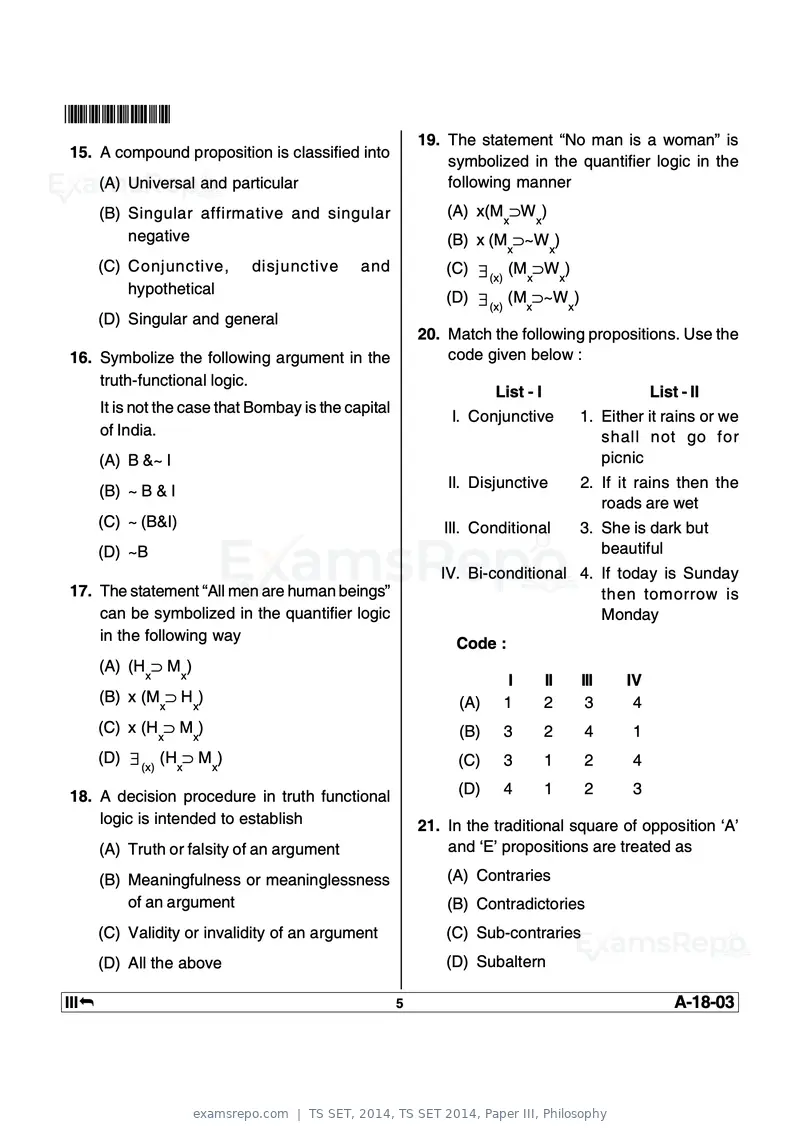
Text of page 5
*A1803*
                                                           19. The statement “No man is a woman” is
15. A compound proposition is classified into
                                                               symbolized in the quantifier logic in the
       (A) Universal and particular                            following manner
       (B) Singular affirmative and singular                   (A) x(M ⊃W )
                                                                        x    x
           negative                                            (B) x (Mx⊃~Wx)
       (C) Conjunctive,       disjunctive      and             (C) ∃ (x) (Mx⊃Wx)
           hypothetical
                                                               (D) ∃ (x) (Mx⊃~Wx)
       (D) Singular and general
                                                           20. Match the following propositions. Use the
16. Symbolize the following argument in the                    code given below :
    truth-functional logic.
                                                                       List - I                    List - II
       It is not the case that Bombay is the capital
                                                                I. Conjunctive         1. Either it rains or we
       of India.                                                                          shall not go for
       (A) B &~ I                                                                         picnic
                                                               II. Disjunctive         2. If it rains then the
       (B) ~ B & I
                                                                                          roads are wet
       (C) ~ (B&I)                                            III. Conditional         3. She is dark but
       (D) ~B                                                                             beautiful
                                                              IV. Bi-conditional 4. If today is Sunday
17. The statement “All men are human beings”                                        then tomorrow is
    can be symbolized in the quantifier logic                                       Monday
    in the following way                                        Code :
       (A) (H ⊃ M )
              x      x
                                                                         I        II   III    IV
       (B) x (Mx⊃ Hx)                                            (A)    1         2     3      4
       (C) x (Hx⊃ Mx)                                            (B)    3         2    4      1
       (D) ∃ (x) (Hx⊃ Mx)                                       (C)     3         1    2      4

18. A decision procedure in truth functional                    (D)     4         1    2      3
    logic is intended to establish                         21. In the traditional square of opposition ‘A’
       (A) Truth or falsity of an argument                     and ‘E’ propositions are treated as

       (B) Meaningfulness or meaninglessness                   (A) Contraries
           of an argument                                      (B) Contradictories
       (C) Validity or invalidity of an argument               (C) Sub-contraries
       (D) All the above                                       (D) Subaltern

IIIË                                                   5                                               A-18-03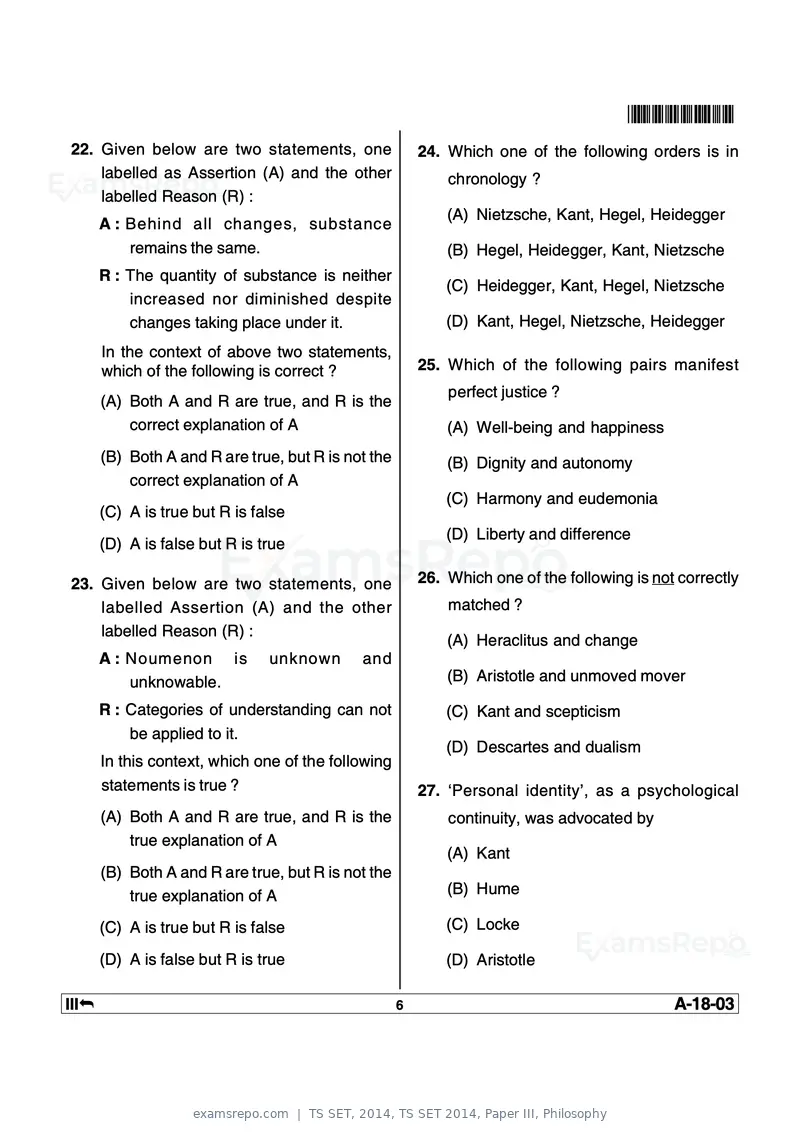
Text of page 6
*A1803*
22. Given below are two statements, one                  24. Which one of the following orders is in
    labelled as Assertion (A) and the other                  chronology ?
    labelled Reason (R) :
                                                             (A) Nietzsche, Kant, Hegel, Heidegger
       A : Behind all changes, substance
           remains the same.                                 (B) Hegel, Heidegger, Kant, Nietzsche
       R : The quantity of substance is neither
                                                             (C) Heidegger, Kant, Hegel, Nietzsche
           increased nor diminished despite
           changes taking place under it.                    (D) Kant, Hegel, Nietzsche, Heidegger
       In the context of above two statements,
       which of the following is correct ?               25. Which of the following pairs manifest
                                                             perfect justice ?
       (A) Both A and R are true, and R is the
           correct explanation of A                          (A) Well-being and happiness
       (B) Both A and R are true, but R is not the           (B) Dignity and autonomy
           correct explanation of A
                                                             (C) Harmony and eudemonia
       (C) A is true but R is false
                                                             (D) Liberty and difference
       (D) A is false but R is true

23. Given below are two statements, one                  26. Which one of the following is not correctly
    labelled Assertion (A) and the other                     matched ?
    labelled Reason (R) :
                                                             (A) Heraclitus and change
       A : Noumenon is          unknown      and
           unknowable.                                       (B) Aristotle and unmoved mover

       R : Categories of understanding can not               (C) Kant and scepticism
           be applied to it.
                                                             (D) Descartes and dualism
       In this context, which one of the following
       statements is true ?                              27. ‘Personal identity’, as a psychological
       (A) Both A and R are true, and R is the               continuity, was advocated by
           true explanation of A
                                                             (A) Kant
       (B) Both A and R are true, but R is not the
           true explanation of A                             (B) Hume

       (C) A is true but R is false                          (C) Locke

       (D) A is false but R is true                          (D) Aristotle

IIIË                                                 6                                        A-18-03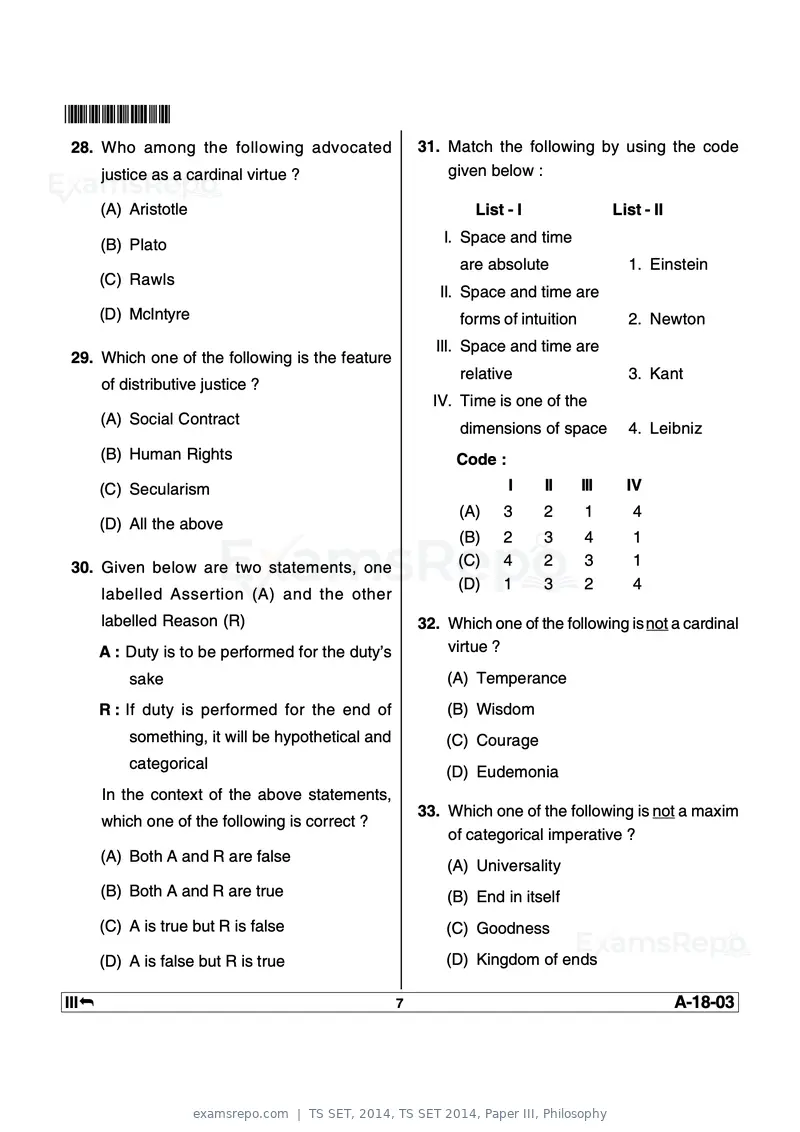
Text of page 7
*A1803*
28. Who among the following advocated                   31. Match the following by using the code
       justice as a cardinal virtue ?                       given below :

       (A) Aristotle                                            List - I                 List - II

       (B) Plato                                           I. Space and time
                                                              are absolute                 1. Einstein
       (C) Rawls
                                                           II. Space and time are
       (D) McIntyre                                           forms of intuition           2. Newton
                                                          III. Space and time are
29. Which one of the following is the feature
                                                              relative                     3. Kant
       of distributive justice ?
                                                          IV. Time is one of the
       (A) Social Contract
                                                              dimensions of space          4. Leibniz
       (B) Human Rights                                      Code :
       (C) Secularism                                                 I    II      III     IV
                                                              (A)   3      2       1        4
       (D) All the above
                                                              (B)   2      3       4        1
30. Given below are two statements, one                       (C)   4      2       3        1
                                                              (D)   1      3       2        4
       labelled Assertion (A) and the other
       labelled Reason (R)                              32. Which one of the following is not a cardinal
       A : Duty is to be performed for the duty’s           virtue ?
           sake                                             (A) Temperance
       R : If duty is performed for the end of              (B) Wisdom
           something, it will be hypothetical and           (C) Courage
           categorical
                                                            (D) Eudemonia
       In the context of the above statements,
                                                        33. Which one of the following is not a maxim
       which one of the following is correct ?
                                                            of categorical imperative ?
       (A) Both A and R are false
                                                            (A) Universality
       (B) Both A and R are true                            (B) End in itself
       (C) A is true but R is false                         (C) Goodness

       (D) A is false but R is true                         (D) Kingdom of ends

IIIË                                                7                                                A-18-03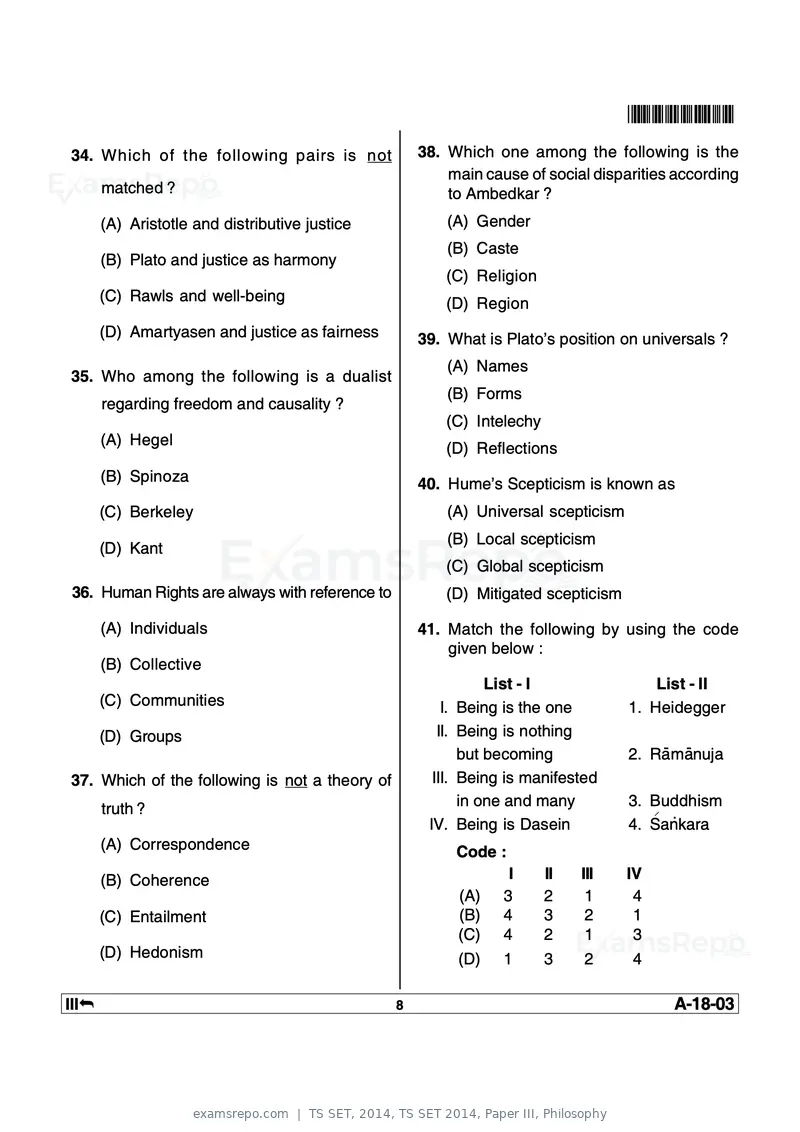
Text of page 8
*A1803*
34. Which of the following pairs is not             38. Which one among the following is the
                                                        main cause of social disparities according
       matched ?                                        to Ambedkar ?
       (A) Aristotle and distributive justice           (A) Gender
                                                        (B) Caste
       (B) Plato and justice as harmony
                                                        (C) Religion
       (C) Rawls and well-being                         (D) Region
       (D) Amartyasen and justice as fairness       39. What is Plato’s position on universals ?
                                                        (A) Names
35. Who among the following is a dualist
                                                        (B) Forms
       regarding freedom and causality ?
                                                        (C) Intelechy
       (A) Hegel
                                                        (D) Reflections
       (B) Spinoza                                  40. Hume’s Scepticism is known as
       (C) Berkeley                                     (A) Universal scepticism
                                                        (B) Local scepticism
       (D) Kant
                                                        (C) Global scepticism
36. Human Rights are always with reference to           (D) Mitigated scepticism

       (A) Individuals                              41. Match the following by using the code
                                                        given below :
       (B) Collective
                                                               List - I                List - II
       (C) Communities                                  I. Being is the one        1. Heidegger
       (D) Groups                                      II. Being is nothing
                                                           but becoming            2. Ra-ma-nuja
37. Which of the following is not a theory of         III. Being is manifested
       truth ?                                             in one and many         3. Buddhism
                                                                                        .
                                                     IV. Being is Dasein           4. Sankara
       (A) Correspondence                                Code :
       (B) Coherence                                             I      II   III   IV
                                                         (A)    3       2     1     4
       (C) Entailment                                    (B)    4       3     2     1
                                                         (C)    4       2     1     3
       (D) Hedonism                                      (D)    1       3    2     4

IIIË                                            8                                        A-18-03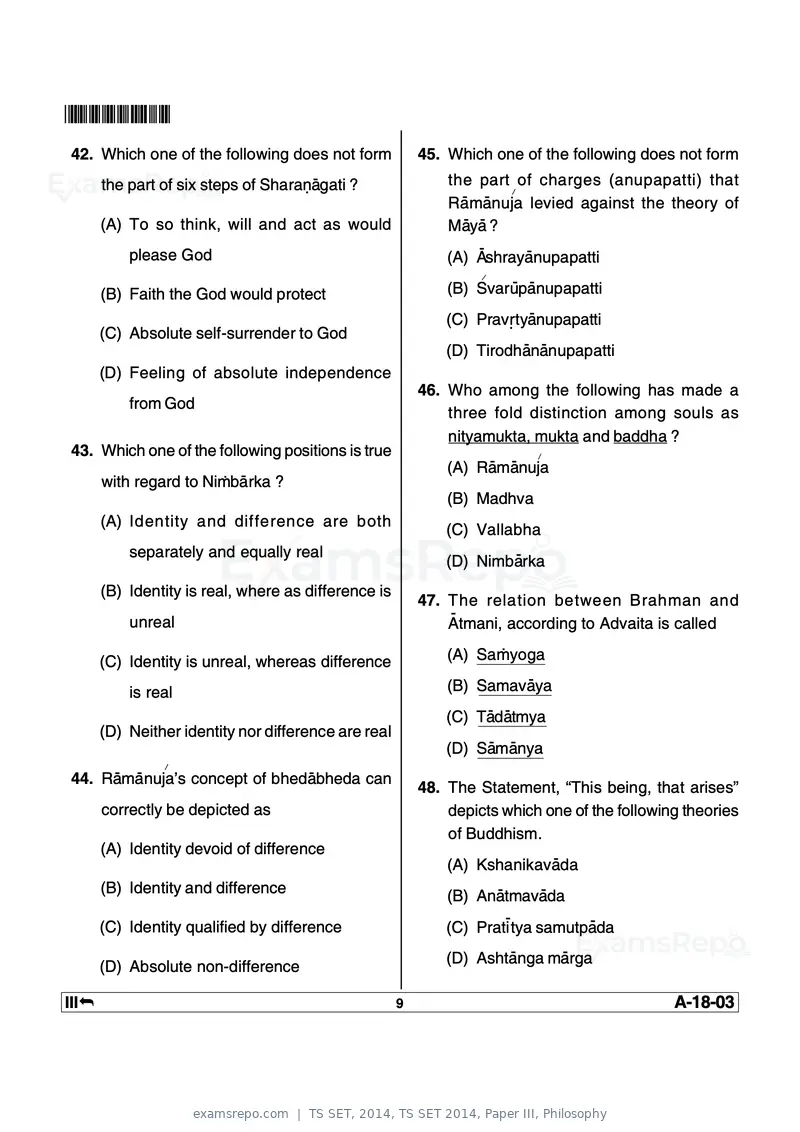
Text of page 9
*A1803*
42. Which one of the following does not form              45. Which one of the following does not form
       the part of six steps of Sharan.a-gati ?               the part of charges (anupapatti) that
                                                              Ra-ma-nuja levied against the theory of
       (A) To so think, will and act as would                 Ma-ya- ?
                                                                   -
           please God                                         (A) Ashraya-nupapatti

       (B) Faith the God would protect                        (B) Svaru-pa-nupapatti
                                                              (C) Pravr. tya-nupapatti
       (C) Absolute self-surrender to God
                                                              (D) Tirodha-na-nupapatti
       (D) Feeling of absolute independence
                                                          46. Who among the following has made a
           from God
                                                              three fold distinction among souls as
                                                              nityamukta, mukta and baddha ?
43. Which one of the following positions is true
                      .                                       (A) Ra-ma-nuja
    with regard to Nimba-rka ?
                                                              (B) Madhva
       (A) Identity and difference are both
                                                              (C) Vallabha
           separately and equally real
                                                              (D) Nimba-rka
       (B) Identity is real, where as difference is
                                                          47. The relation between Brahman and
                                                               -
           unreal                                             Atmani, according to Advaita is called
                                                                     .
       (C) Identity is unreal, whereas difference             (A) Samyoga

           is real                                            (B) Samava-ya
                                                              (C) Ta-da-tmya
       (D) Neither identity nor difference are real
                                                              (D) Sa-ma-nya
44. Ra-ma-nuja’s concept of bheda-bheda can
                                                          48. The Statement, “This being, that arises”
       correctly be depicted as                               depicts which one of the following theories
                                                              of Buddhism.
       (A) Identity devoid of difference
                                                              (A) Kshanikava-da
       (B) Identity and difference                            (B) Ana-tmava-da
                                                                      -
       (C) Identity qualified by difference                   (C) Prati tya samutpa-da
                                                              (D) Ashta-nga ma-rga
       (D) Absolute non-difference

IIIË                                                  9                                        A-18-03
Text of page 10
*A1803*
49. The essence of religions consists in their            52. Which one of the following religions is not
       (A) Bare externals such as rituals,                    a monotheistic religion ?
           methods of prayer, ceremonies etc.                 (A) Judaism
       (B) Inner beliefs and convictions which                (B) Zoroastrianism
           they carry along them and which give               (C) Jainism
           their followers a distinctive character
                                                              (D) Sikhism
       (C) Understanding and criticizing the other
           religions                                      53. Match the following. Use the code given
                                                              below :
       (D) Both (A) and (B) above
                                                               List - I                  List - II
50. Sa-dha-ran.a dharmas in Hinduism refers to
                                                           I. Nya-ya            1. Nirvikalpaka is only
       (A) Specific duties to be performed by all                                  type     of     valid
           people                                                                  perception
                                                                  -     - - . -
       (B) General duties to be performed by                II. Bhatta Mi mamsa 2. Nirvikalpaka is a real
                                                                                   but not a perceived
           every one irrespective of his varn.a or
                                                                                   fact
           a-shrama
                                                           III. Buddhist        3. Nirvikalpaka is the
       (C) Specific duties ascribed to varn.as                                     knowledge of the
       (D) General duties to be performed by all                                   pure being
                                      -                   IV. Advaita Veda-nta 4. Nirvikalpaka and
           the people of a particular Ashrama
                                                                                   savikalpaka       are
51. Match the following. Use the code given                                        equally valid in
    below:                                                                         perception
                                                              Code :
         List - I                 List - II
                                                                           I   II   III   IV
       I. Jainism         1. Sa-dharan.a Dharma-s              (A)        1    2     3     4
   II. Buddhism           2. Pancha Maha-vratas                (B)        2    4     1     3
                                                               (C)        3    4     2     1
   III. Hinduism          3. Pancha Maka-ra Pu-ja
                                     -                         (D)        4    1     3     2
  IV. Sakteyism           4. Pancha Si la
                                                          54. In the process of producing objectively
       Code :
                                                              valid knowledge (prama), which factor is
                 I   II     III     IV                        the operative cause (Ka-ran.a).
         (A)    2    3       1       4
                                                              (A) Prameya
         (B)    4    3      1        2
                                                              (B) Prama-ta
        (C)     2    4      3        1                        (C) Prama-n.a
        (D)     2    4      1        3                        (D) Hetu

IIIË                                                 10                                        A-18-03
Text of page 11
*A1803*
55. State the pair of schools of Indian                    58. Arrange the sequence in which words are
    Philosophy which advocate the theory that                  put together for understanding the
    all knowledge has self-evident validity,                   meaning of all words in a sentence.
    while falsehood is due to certain extrinsic
                                                               (A) a-ka-nks.a, Sannidhi, ta-tparya, yogyata
    conditions.
                      -. .
    (A) Sa-n.kya and Mi ma-m sa-                               (B) Sannidhi, ta-tparya, yogyata, a-ka-nks. a
          -. .
    (B) Mi ma-msa- and Veda-nta                                (C) Yogata, a-ka-nksa, sannidhi, tatpariya

       (C) Veda-nta and Buddhism                               (D) a-ka-nks. a, sannidhi, yogyata, ta-tparya
                         .
       (D) Nya-ya and Sa-nkhya                             59. Define Pratyaksha in the given list. Use
                                                               the code given below :
56. Match the following. Use the code given
    below :                                                     List - I                    List - II
         List - I                   List - II                I. Old School of
                   - .  .            -                          Nya-ya
  I. Pra-bha-kara Mi ma-msa- 1. Vipari takhya-ti                                     1. Sense-organ
                  -. .                                                                  constitute the
   II. Kuma-rila Mi ma-msa-     2. Satkhya-ti
         .                                                                              unique cause of
  III. Sankara                  3. Akhya-ti                                             perceptual
 IV. Nya-ya-Vaises.ika          4. Anyatha--Khya-ti                                     cognition
       Code :                                               II. Buddhism             2. Immediate
                I    II   III     IV                                                    knowledge
        (A)     1   2     3        4                       III. Modern School
        (B)     4   3     2        1                            of Nya-ya            3. Sense-object
        (C)     3   1     2        4                                                    contact
        (D)     2   4     1        3                       IV. Advaita               4. Unerring
                                                                                        cognition of a
57. Which doctrine/theory defines the relation                                          given sensum in
    between meaning of a sentence and those                                             complete isolation
    of its constituent words is a synthesis
                                                                                        from all ideata
    (anvaya) of the meanings of the separate
    words composing it ?                                        Code :

    (A) Anvita-bhidha-na-va-da                                             I    II   III   IV
                                                                 (A)       1   2      3     4
       (B) Abhinita-nvaya-va-da
                                                                 (B)       2   1      4     3
       (C) Satka-rya-va-da                                       (C)       4   3      1     2
       (D) Asatka-rya-va-da                                      (D)       3   4      2     1

IIIË                                                  11                                           A-18-03
Text of page 12
*A1803*
60. State the type of fallacy in the argument             63. State the type of fallacy in the given
    given below :                                             argument.
       That the world ceases from manifestation
                                                              Fire is cold because it is a substance
       because it is not eternal
       That even then it exists because it cannot            (A) Sa-dha-rana
       be destroyed                                          (B) Asa-dha-rana
       (A) Prakaran.a sama
                                                             (C) Ba-dhita
       (B) Viruddha
                                                             (D) Viruddha
       (C) Asiddha
                  -
       (D) Ka-la-ti ta                                    64. Match the following. Use the code given
                                                              below :
61. State the type of vyapti in the given
    inference                                                     List - I                     List - II
       All cases of smoke are cases of fire
       The hill is a case of smoke                         I. Paks.adharmata 1. It must be
                                                                                non-compatible with
       Therefore the hill is a case of fire.
                                                                                the minor term
       (A) Anvaya-Vyatireki
       (B) Kevala-nvayi                                    II. Sapaks.asattva 2. It must be present in
       (C) Kevala-nvayi – vyatireki                                              the minor term

       (D) Anvaya                                         III. Vipaks.a-sattva    3. It must be absent in
62. Match the following, use the code given                                          all negative instances
    below :                                                                          in which the major
                                                                                     term is absent.
           List - I                      List - II
       I. Vya-vaharika satta        1. Dream              IV. Aba-dhita           4. It must be present in
                                                                                     all positive instances
       II. Prathibha-sika satta     2. Imaginary
                                                                                     in which the major
    III. Tuccha satta               3. Absolute
                                                                                     term is present
   IV. Parama-rthika satta          4. Empirical
                                                              Code :
       Code :
                                                                       I     II    III    IV
                 I       II   III   IV
         (A)    1        2     3     4                         (A)     1     2      3      4
         (B)    2        3     4     1                         (B)     4     3      2      1
         (C)    3        4     1     2                         (C)     3     1      4      2
         (D)    4        1     2     3                         (D)     2     4      3      1

IIIË                                                 12                                          A-18-03
Text of page 13
*A1803*
65. Read the following statements and select              68. Gandhiji wrote his autobiography
    those made by Gandhi. Use the code                        originally in
    given below :                                             (A) English
         I. Truth is God                                      (B) Sanskrit
        II. Truth is not God                                 (C) Gujarathi
       III. Non-violence is the means to truth               (D) Hindi
       IV. All wealth belongs to the almighty
                                                          69. Which one of the following pairs is not
       Code :                                                 correct ?
       (A) All except II are correct                          (A) I alone exist       - Solipsism
       (B) Only I and III are correct                         (B) Science of
       (C) All the four are correct                               Interpretation      - Hermencutics
       (D) Only III and IV are correct                       (C) Heidegger’s
                                                                  Phenomenology - Fundamental
66. Which one of the following pair of Journals
                                                                                  ontology
    Gandhi edited is correct ?
       (A) Harijan and Swaraj                                (D) J.P. Sartre          - Theistic

       (B) Swaraj and Young India                                                      existentialism

       (C) Young India and Harijan                        70. Read the following statements and select
       (D) Young India and Dharma                             those made by Jean Paul Sartre.

67. Match the following. Use the code given                   Use the code given below :
    below :                                                    I. Man is condemned to be free

           List - I                      List - II             II. Choose always in the name of
                                                                   freedom
        I. Truth                 1. The means                 III. Man is born free but is found
       II. Love                  2. The end                        everywhere in chains
       III. Mahatma              3. The Great Soul            IV. A writer should commit himself or
                                                                  herself to freedom
       IV. Brahmacharya          4. Celibacy
                                                             Code :
       Code :
                 I    II   III      IV                        (A) All the four are correct
        (A)     2     1     3        4                        (B) Only III is false
        (B)     1     2     4        3
                                                             (C) Only I and II are correct
        (C)     2     3     1        4
        (D)     3     2     4        1                       (D) Only I, II and III are false

IIIË                                                 13                                            A-18-03
Text of page 14
*A1803*
71. The founder of Intentionality is                      73. Arrange the following phenomenologists
                                                              in chronological order. Use the code given
       (A) Thomas Aquinas
                                                              below :
       (B) Martin Heidegger                                     I. Franz Brentano

       (C) Paul Richoeur                                       II. Jean Paul Sartre

       (D) Merleau Ponty                                       III. Martin Heidegger

                                                              IV. Edmund Husserl
72. Match the following. Use the code given
                                                             Code :
       below :
                                                              (A) I, II, IV, III

          List - I                      List - II             (B) II, I,    III, IV

                                                              (C) I, IV, III, II
   I. Franz Brentano             1. Being and Time
                                                              (D) IV, III, II, I

   II. Edmund Husserl            2. Psychology
                                                          74. Which one of the following is correct ?
                                   from Empirical
                                                              (A) Intuition of the essences –
                                   Standpoint                     phenomenology

                                                              (B) I alone exist – phenomenalism
  III. Martin Heidegger          3. Ideas
                                                              (C) What appears — Noumenon
  IV. Soren Kierkegaard 4. Either/or
                                                              (D) Intersubjectivity — Solipsism

       Code :
                                                          75. Which one of the following does not
                 I   II    III     IV                         characterize Hinduism ?

        (A)      2   3     1        4                         (A) Messianism

        (B)      1   2     3        4                         (B) One God

        (C)      2   3     4        1                         (C) Rituals

        (D)      4   3     2        1                         (D) Mythology

IIIË                                                 14                                         A-18-03
Text of page 15
*A1803*
          Space for Rough Work


IIIË              15             A-18-03
Text of page 16
*A1803*
       Space for Rough Work


IIIË            16               A-18-03
Official key not published for this paper.
Page 1 of 16
Source: Telangana State Eligibility Test. Question paper published by Telangana State Eligibility Test.