Machine-translated by Google. Questions are authored in English.
Top

Mirror and Water Images Questions and Answers

1.

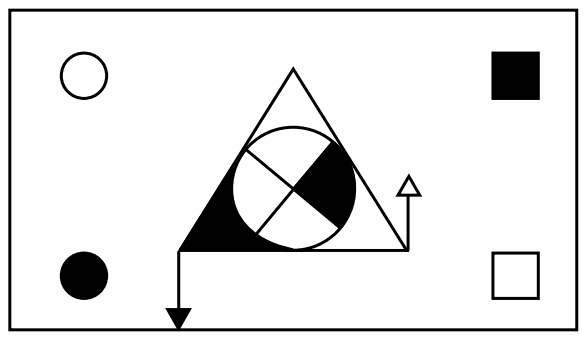
Find the mirror image of the following figure, when the mirror is placed at 'AB' line as shown below.

A rectangle with a triangle holding a divided circle, a filled up arrow at the left end of its base and an open down arrow at the right end. Corners: filled square top left, open circle top right, open square bottom left, filled circle bottom right. Mirror line AB on the right.

Exam Year(s)

CBSE Assistant Secretary - 2024,

Answer: C

The mirror image is figure 3.

The mirror line AB is vertical and stands at the right edge, so the reflection swaps left and right and keeps top and bottom. The four corner symbols therefore change sides in their rows: the filled square goes from top left to top right, the open circle from top right to top left, the open square from bottom left to bottom right and the filled circle from bottom right to bottom left. Inside the triangle, the black wedge at the lower right moves to the lower left, the black sector on the left of the circle moves to the right, the filled up-arrow moves from the left end of the base to the right end and the open down-arrow from the right end to the left.

Figure 1 flips the arrows and corners but leaves the wedge and the circle's black sector on their original sides. Figure 2 has the right positions but swaps the fills of the two arrows. Figure 4 turns the corner symbols through 180 degrees instead of reflecting them, so the symbols sit in the wrong rows.

Please log in or register to report this question.

2.

What will be the mirror image of the following figure?

A square crossed by a rising diagonal, with a short vertical line from the top edge turning into a sloping line towards the right edge

Exam Year(s)

DSSSB - 2023,

Answer: C

Option (C) is the mirror image. A mirror at the side of the figure swaps left and right and leaves top and bottom unchanged. The given figure has a diagonal rising from the bottom left to the top right, and a short vertical line from the top edge near the left that turns into a sloping line running down to the right edge. After reflection the diagonal runs from the top left to the bottom right, and the vertical line sits near the top right and turns into a line sloping down to the left edge. That is the square in option (C). Option (A) puts the bent line at the bottom right and option (B) at the bottom left, so they do not show the bend at the top. Option (D) has no bend at all.

Please log in or register to report this question.

3.

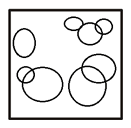
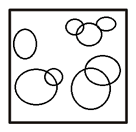
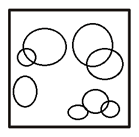
Select the correct mirror image of the given figure when the mirror is held at MN.

A square holding circles and ellipses beside a mirror line MN

Exam Year(s)

DSSSB - 2023,

Answer: A

The mirror MN is a vertical line at the right of the figure, so the image is the figure turned over from left to right, with the same heights and the same sizes. The ellipse that lies at the upper right of the figure therefore appears at the upper left of the image, and the pair of small circles at the top left goes to the top right. Option (A) shows exactly this. Option (D) is the figure turned upside down instead, and options (B) and (C) change the sizes or the positions of some of the circles, so they are not the mirror image. The answer is option (A).

Please log in or register to report this question.

4.

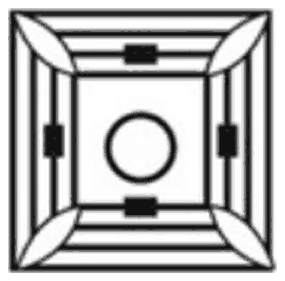
Select the correct mirror image of the given figure when the mirror is held at the right side.

Given figure of concentric squares with a central circle

Exam Year(s)

DSSSB TGT - 2023,

Answer: A

The keyed answer is option (A). When a mirror is held at the right side of a figure, the image is reversed left to right while the top and bottom stay in place, so every feature on the left of the original appears on the right of the image. Among the four drawings only the first matches that lateral reversal, according to the official key. Option (C) is partly cut off in the booklet itself, and the other two drawings keep some features on their original side, which is what a mirror at the right does not do.

Please log in or register to report this question.

5.

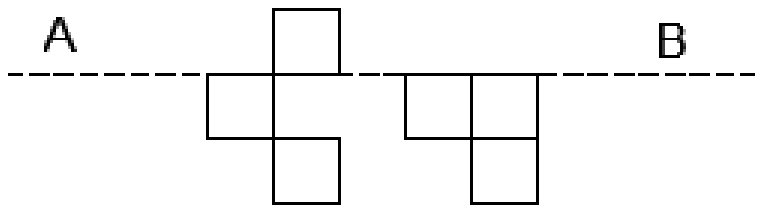
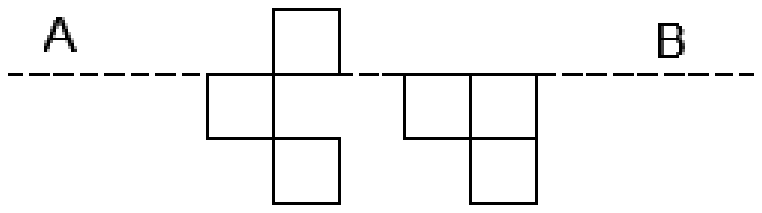
The least number of squares to be added in the figure to make AB a line of symmetry is

Unit squares drawn along a horizontal dashed line AB: one square above the line and five squares below it in two groups

Exam Year(s)

GATE AE - 2024,

Answer: A

At least 6 squares must be added.

Look carefully at the drawing. Above the line AB there is one square. Below the line there are five: in the left group a square to the left of the vertical column and a square at the bottom of that column; in the right group two squares side by side with one more below the right-hand one. The cell directly below the upper square is not a square: it has no right-hand side, so it is only the gap between drawn squares.

For AB to be a line of symmetry, every square must have a mirror image on the other side. Each of the five squares below needs a partner above (5 squares), and the square above needs a partner directly below it, which is missing (1 square). That makes 6.

5 is the answer you get if you read the open cell below the upper square as a square; 4 and 7 do not match any count of the figure.

Please log in or register to report this question.

6.

The least number of squares to be added in the figure to make AB a line of symmetry is

A dashed line AB with six unit squares: on the left, one square above the line and two below it in staggered positions; on the right, three squares below the line in an L shape

Exam Year(s)

GATE AG - 2024,

Answer: A

The least number of squares is 6.

For AB to be a line of symmetry, every square must have a mirror-image square on the other side of AB at the same distance. Check each of the six squares in the figure:

  • Left group: the square above the line needs a partner directly below it, the square below the line at the far left needs a partner above it, and the lower square two rows down needs a partner two rows up. None of these partners is present: 3 squares.
  • Right group: all three squares lie below the line (two in the first row, one in the second), and none has a partner above: 3 squares.

No existing square is already the mirror image of another, so all six need partners, and 3 + 3 = 6 squares must be added. 4 and 5 leave some square unmatched, and 7 adds more than necessary.

Please log in or register to report this question.

7.

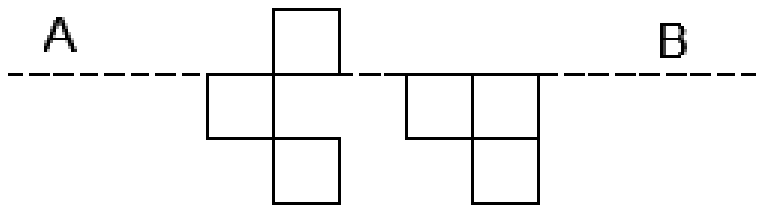
The least number of squares to be added in the figure to make AB a line of symmetry is

A dashed line AB with six unit squares: one square above the line and five below it, in two separate groups

Exam Year(s)

GATE CS - 2024,

Answer: A

The least number of squares to add is 6.

For AB to be a line of symmetry, every square must have its mirror image across AB. Number the columns 1 to 4 from A to B. The figure has one square above the line, in column 2. Below the line it has squares in columns 1, 3 and 4 of the first row, and in columns 2 and 4 of the second row.

  • The square above the line in column 2 needs a mirror in the first row below: 1 square.
  • The first-row squares below in columns 1, 3 and 4 need mirrors in the first row above: 3 squares.
  • The second-row squares below in columns 2 and 4 need mirrors in the second row above: 2 squares.

That is 1 + 3 + 2 = 6. Mirroring only the five squares below the line, and forgetting the square already above it, gives 5.

Please log in or register to report this question.
8.

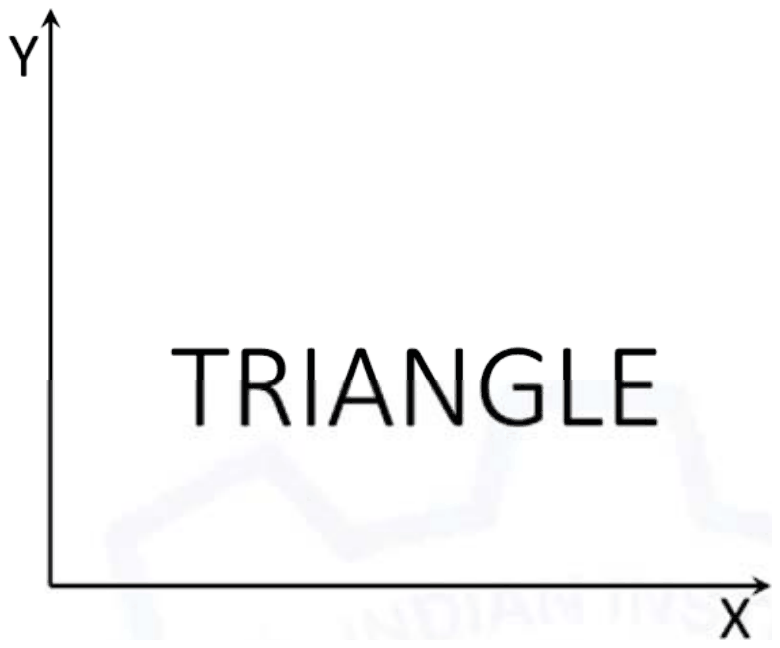
The word TRIANGLE written upright above the x-axis, with the y-axis on its left

The mirror image of the above text about the x-axis is

Exam Year(s)

GATE Chemistry - 2021,

Answer: B

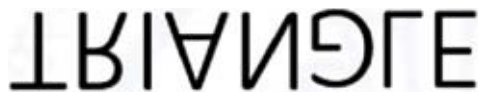
The correct mirror image is (B).

Reflecting in the x-axis turns the text upside down without reversing left and right: every letter keeps its left-to-right order and is flipped top to bottom. So T becomes an inverted T, the bowl of R moves to the bottom, the diagonal of N runs the other way, and E, which is symmetric top to bottom, looks unchanged.

Option (B) shows exactly this. In the other options one letter is wrong: the G in (A) is rotated rather than reflected, the N in (C) has not been flipped, and the E in (D) is reversed left to right, which a reflection in the x-axis cannot do.

Please log in or register to report this question.

9.

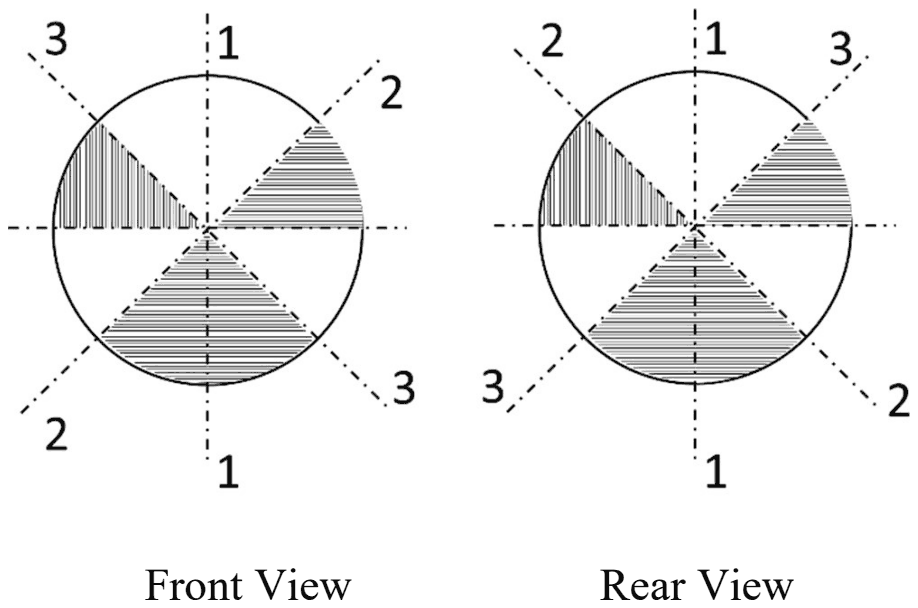
The figure below shows the front and rear view of a disc, which is shaded with identical patterns. The disc is flipped once with respect to any one of the fixed axes 1-1, 2-2 or 3-3 chosen uniformly at random.

What is the probability that the disc DOES NOT retain the same front and rear views after the flipping operation?

Front and rear views of a disc with axes 1-1 (vertical), 2-2 and 3-3 (diagonal) and three hatched sectors

Exam Year(s)

GATE Mathematics - 2022,

Answer: C

The probability is 2/3.

The disc shows the same pattern on both faces, and the rear view is that pattern as seen from behind. Flipping about an axis in the plane of the disc brings the back face to the front, reflected in that axis. Seen from the front, the new front view is the old pattern reflected first in the vertical line (because it was the back face) and then in the chosen axis.

For axis 1-1, which is vertical, the two reflections are the same and cancel, so the views are unchanged. For the diagonal axes 2-2 and 3-3, two reflections in different lines combine into a rotation of the disc, and the hatched sectors (a vertically hatched one upper left, horizontally hatched ones upper right and at the bottom) do not look the same after such a rotation.

So the views are lost for 2 of the 3 equally likely axes, giving 2/3. Answering 1/3 counts the one axis that keeps the views; 0 and 1 would need all or none of the axes to work.

Please log in or register to report this question.
10.

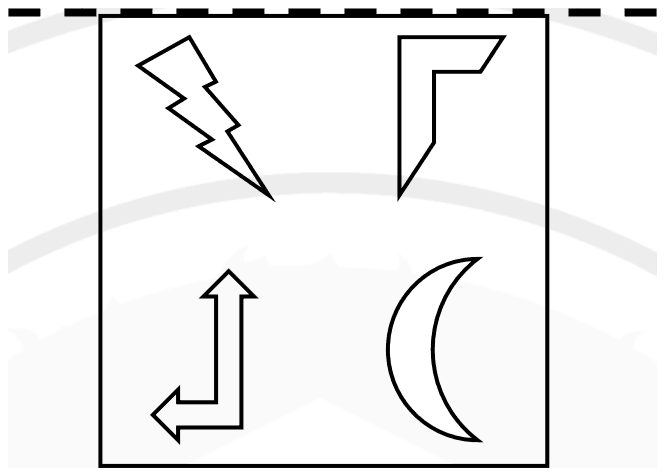
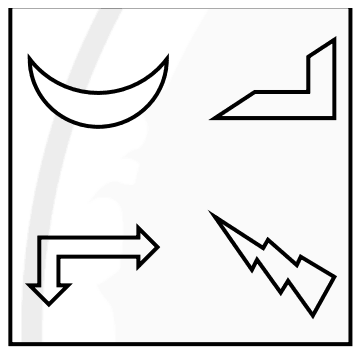
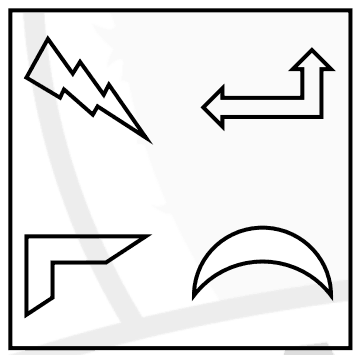
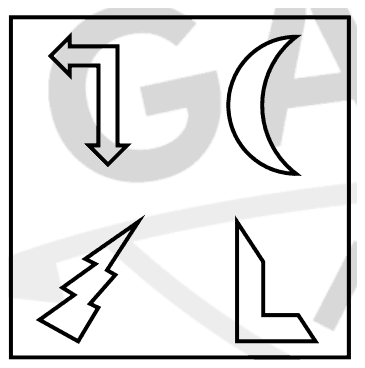
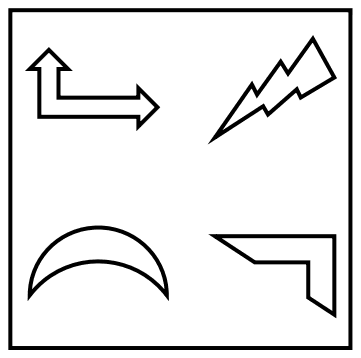
The given figure is reflected about the horizontal dashed line and then rotated clockwise by 90° about an axis perpendicular to the plane of the figure.

Which one of the following options correctly shows the resultant figure?

Note: The figures shown are representative.

Square under a dashed line: bolt top left, bent bar top right, bent arrow bottom left, crescent bottom right

Exam Year(s)

GATE ME - 2025,

Answer: B

The resultant figure is (B).

Reflecting about the horizontal dashed line swaps the top and bottom rows and flips each shape upside down: the bent arrow and the crescent move to the top, and the lightning bolt and bent bar to the bottom. Rotating clockwise by 90° then carries top left to top right, top right to bottom right, bottom right to bottom left, and bottom left to top left.

So the lightning bolt ends top left, the arrow top right, the bent bar bottom left, and the crescent bottom right, now opening downward. That is (B). (A), (C) and (D) place the shapes in other corners or orientations.

Please log in or register to report this question.
Loading…