
Machine-translated by Google. Questions are authored in English.
Top

Mensuration Questions and Answers

Important Instructions
31.

A wire is in the shape of a rectangle whose area is 7260 \(\text{cm}^2\) and sides are in the ratio 5 : 3. The same wire is bent to form a circle. What is the area (in \(\text{cm}^2\)) of the circle? (Use \(\pi = \frac{22}{7}\))

Exam Year(s)

DSSSB - 2023,

Answer: C

The area of the circle is 9856 cm². Let the sides of the rectangle be 5k and 3k. Then 15k² = 7260, so k² = 484 and k = 22, and the sides are 110 cm and 66 cm. The wire has length equal to the perimeter:

\[ 2(110 + 66) = 352 \text{ cm} \]

Bent into a circle, 2πr = 352, so with π = 22/7, r = 56 cm.

\[ \text{Area} = \frac{22}{7} \times 56^2 \]

\[ = 22 \times 448 = 9856 \text{ cm}^2 \]

The options 7304, 7546 and 12474 are not the area of a circle of radius 56 cm, so the third option is correct.

Please log in or register to report this question.
32.

The perimeters of a circle, a square and an equilateral triangle are equal. Which one of the following statements is true?

Exam Year(s)

GATE Mathematics - 2018, GATE ME - 2018, GATE AE - 2018,

Answer: A

The circle has the largest area.

Give all three shapes the same perimeter P and compare their areas:

  • circle: radius \(P/2\pi\), area \(P^{2}/4\pi \approx 0.0796P^{2}\)
  • square: side \(P/4\), area \(P^{2}/16 = 0.0625P^{2}\)
  • equilateral triangle: side \(P/3\), area \(\frac{\sqrt{3}}{4}(P/3)^{2} \approx 0.0481P^{2}\)

The circle wins, and this is a general rule: among all plane figures with a given perimeter, the circle encloses the most area. The square comes second and the triangle last, so the statements naming the square or the triangle are false, and the areas are clearly not equal.

Please log in or register to report this question.
33.

A wire would enclose an area of 1936 m2, if it is bent into a square. The wire is cut into two pieces. The longer piece is thrice as long as the shorter piece. The long and the short pieces are bent into a square and a circle, respectively. Which of the following choices is closest to the sum of the areas enclosed by the two pieces in square meters?

Exam Year(s)

GATE Mathematics - 2018, GATE ME - 2018, GATE AE - 2018,

Answer: C

The closest sum is 1243 square metres.

A square of area 1936 m2 has side 44 m, so the wire is \(4 \times 44 = 176\) m long. Split in the ratio 3 : 1, the pieces are 132 m and 44 m.

\[ \begin{aligned} \text{square: side} &= 132/4 = 33,\ \text{area } 1089 \\ \text{circle: } 2\pi r &= 44 \\ \text{area} &= \frac{44^{2}}{4\pi} \approx 154 \\ \text{total} &\approx 1089 + 154 = 1243 \end{aligned} \]

2486 is exactly double the right answer. 1096 and 1111 are only a little more than the square on its own, so they leave out most of the circle's 154 m2.

Please log in or register to report this question.

34.

A rectangular paper sheet of dimensions 54 cm × 4 cm is taken. The two longer edges of the sheet are joined together to create a cylindrical tube. A cube whose surface area is equal to the area of the sheet is also taken.

Then, the ratio of the volume of the cylindrical tube to the volume of the cube is

Exam Year(s)

GATE AE - 2024,

Answer: A

The ratio is 1/π.

Joining the two 54 cm edges makes a tube 54 cm long whose circumference is the short side, 4 cm. So its radius is \(r = 4/(2\pi) = 2/\pi\) cm.

\[ \begin{aligned} V_{tube} &= \pi r^{2} h = \pi \cdot \frac{4}{\pi^{2}} \cdot 54 = \frac{216}{\pi} \\ 6a^{2} &= 54 \times 4 = 216 \Rightarrow a = 6 \\ V_{cube} &= 6^{3} = 216 \end{aligned} \]

The ratio is \(\frac{216/\pi}{216} = \frac{1}{\pi}\).

Rolling the sheet the other way (circumference 54 cm, length 4 cm) would give a much larger volume, \(2916/\pi\), and none of the listed ratios; the 2/π, 3/π and 4/π options come from slips such as using the diameter for the radius.

Please log in or register to report this question.

35.

A rectangle has a length L and a width W, where L \(\gt\) W. If the width, W, is increased by 10%, which one of the following statements is correct for all values of L and W?

Exam Year(s)

GATE Chemistry - 2025, GATE AE - 2025,

Answer: C

The correct statement is Area increases by 10%.

The area is \(LW\). With the width increased by 10% it becomes \(L(1.1W) = 1.1\,LW\), an increase of exactly 10% whatever L and W are.

The perimeter \(2(L + W)\) becomes \(2(L + 1.1W)\), a fractional increase of \(0.1W/(L + W)\), which is less than 10% because only one pair of sides grows. The diagonal \(\sqrt{L^{2} + W^{2}}\) also grows by less than 10%. The shape becomes a square only in the special case \(L = 1.1W\), not for all L and W.

Please log in or register to report this question.

36.

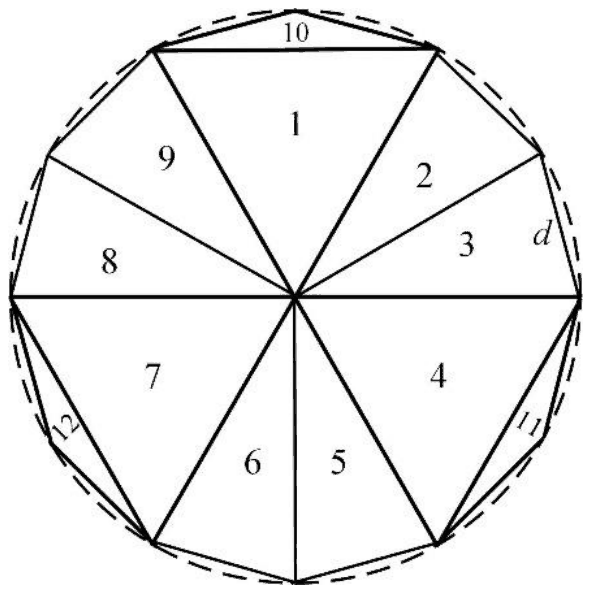
A regular dodecagon (12-sided regular polygon) is inscribed in a circle of radius r cm as shown in the figure. The side of the dodecagon is d cm. All the triangles (numbered 1 to 12) in the figure are used to form squares of side r cm and each numbered triangle is used only once to form a square.

The number of squares that can be formed and the number of triangles required to form each square, respectively, are:

Note: The figure shown is representative.

A regular dodecagon in a dashed circle, cut into triangles 1 to 12: triangles 1 to 9 meet at the centre, and 10, 11 and 12 are thin triangles along the edge

Exam Year(s)

GATE AE - 2025,

Answer: A

The answer is 3 squares, each made from 4 triangles.

A regular dodecagon inscribed in a circle of radius r is made of 12 central triangles, each with two sides r and apex angle 30°:

\[ \begin{aligned} \text{Area} &= 12 \times \tfrac{1}{2}r^{2}\sin 30^{\circ} \\ &= 3r^{2} \end{aligned} \]

So the 12 triangles together have the area of exactly 3 squares of side r, and using every triangle once gives 3 squares of 12/3 = 4 triangles each. In the figure each square is made of one equilateral triangle of side r (such as 1), two 30° isosceles triangles (such as 2 and 3) and one of the thin edge triangles (10, 11, 12):

\[ \begin{aligned} &\tfrac{\sqrt{3}}{4}r^{2} + 2 \cdot \tfrac{1}{4}r^{2} \\ &+ \left(\tfrac{1}{2} - \tfrac{\sqrt{3}}{4}\right)r^{2} = r^{2} \end{aligned} \]

Four squares would need area \(4r^{2}\), and 3 or 2 triangles per square would leave triangles unused.

Please log in or register to report this question.

37.

An equilateral triangle, a square and a circle have equal areas.

What is the ratio of the perimeters of the equilateral triangle to square to circle?

Exam Year(s)

GATE ME - 2022,

Answer: B

The ratio is \(\sqrt{3\sqrt{3}} : 2 : \sqrt{\pi}\).

Give each figure area 1. For the equilateral triangle of side \(s\), \(\frac{\sqrt{3}}{4}s^{2} = 1\), so \(s^{2} = 4/\sqrt{3}\) and its perimeter is \(3s = \sqrt{36/\sqrt{3}} = 2\sqrt{3\sqrt{3}}\). The square has side 1 and perimeter 4. The circle has \(\pi r^{2} = 1\), so its perimeter is \(2\pi r = 2\sqrt{\pi}\).

\[ \begin{aligned} &2\sqrt{3\sqrt{3}} : 4 : 2\sqrt{\pi} \\ &= \sqrt{3\sqrt{3}} : 2 : \sqrt{\pi} \end{aligned} \]

The option \(\sqrt{3\sqrt{3}} : 4 : 2\sqrt{\pi}\) halves only the triangle's term, and the one ending in \(2\sqrt{\pi}\) halves only the square's. \(3\sqrt{3} : 2 : \sqrt{\pi}\) forgets the outer square root.

Please log in or register to report this question.

38.

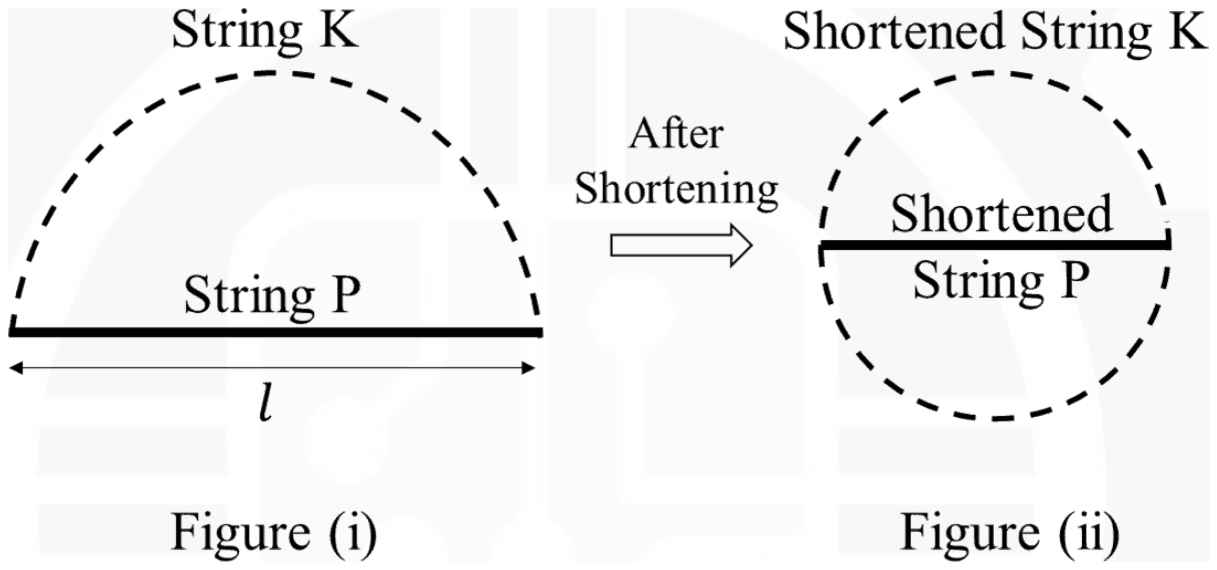
Consider a string P of length \(l\) that is laid out as a straight-line segment. Another string K is laid out as a semicircular arc with string P as its diameter, as represented in Figure (i). When both the strings are shortened by a length \(x\) they can be re-arranged such that the shortened string K forms a full circle with the shortened string P as its diameter, as represented in Figure (ii). The value of \(x/l\) is __________

Figure (i): string K as a dashed semicircle on string P of length l as diameter. Figure (ii): after shortening, K is a full dashed circle with shortened P as its diameter

Exam Year(s)

GATE ME - 2026,

Answer: C

The value is \(\frac{\pi}{2(\pi - 1)}\).

A semicircle on a diameter of length \(l\) has length \(\frac{\pi l}{2}\), so string K is \(\pi l/2\) long. After shortening, P has length \(l - x\) and K, \(\pi l/2 - x\), must equal the circumference of a circle of diameter \(l - x\):

\[ \begin{aligned} \frac{\pi l}{2} - x &= \pi(l - x) \\ \pi x - x &= \frac{\pi l}{2} \\ \frac{x}{l} &= \frac{\pi}{2(\pi - 1)} \end{aligned} \]

That is about 0.73, a sensible fraction of \(l\). \(\pi\) and \(\frac{\pi}{\pi - 1}\) exceed 1, which would shorten the strings by more than P's whole length, and \(\frac{\pi - 1}{2\pi}\) is not a solution of the equation.

Please log in or register to report this question.

39.

A thin wire is used to construct all the edges of a cube of 1 m side by bending, cutting and soldering the wire. If the wire is 12 m long, what is the minimum number of cuts required to construct the wire frame to form the cube?

Exam Year(s)

GATE Physics - 2025,

Answer: A

The minimum number of cuts is 3.

Think of the cube frame as a graph: 8 corners, each joined to 3 edges. Each piece of wire, bent at corners, traces a continuous path along edges. A path can pass through a corner using two of its edges, so every corner where an odd number of edge-ends meet must be an end of some piece. All 8 corners have 3 edges (odd), so the frame needs at least 8 piece-ends, that is at least 4 pieces.

Four pieces are also enough: pair the eight corners up, and the edges of any connected frame with 2k odd corners can be split into exactly k continuous paths. Cutting a single 12 m wire into 4 pieces takes 3 cuts.

4 cuts would give 5 pieces, more than needed; 6 and 12 correspond to cutting the wire much more finely, up to one piece per edge.

Please log in or register to report this question.

40.

The cross-section of a canal is trapezium in shape. The canal is 12 m wide at the top and 8 m wide at the bottom. If the area of the cross-section is 840 sq. m, the depth of the canal is:

Exam Year(s)

HPPSC HPAS - 2021,

Answer: D

The depth of the canal is 84 m.

The area of a trapezium is half the sum of the parallel sides times the distance between them, which here is the depth.

\[ \begin{aligned} \tfrac{1}{2}(12 + 8) \times h &= 840 \\ 10h &= 840 \\ h &= 84 \end{aligned} \]

The figure is unrealistic for a real canal, but the arithmetic is what the question tests. 83 m and 82 m are near misses that do not satisfy 10h = 840, and 8.75 m is 840 divided by \(12 \times 8\), which multiplies the two widths instead of averaging them.

Please log in or register to report this question.

Loading…

Topics

    No topic!
Tags: Mensuration Questions and Answers || Mensuration MCQ Questions and Answers || Mensuration GK Questions and Answers || Mensuration GK MCQ Questions || Mensuration Multiple Choice Questions and Answers || Mensuration GK || GK on Mensuration || Quantitative Aptitude Questions and Answers || Quantitative Aptitude MCQ Questions and Answers || Quantitative Aptitude GK Questions and Answers || GK on Quantitative Aptitude