Machine-translated by Google. Questions are authored in English.
Top

Permutations & Combinations Questions and Answers

Important Instructions
11.

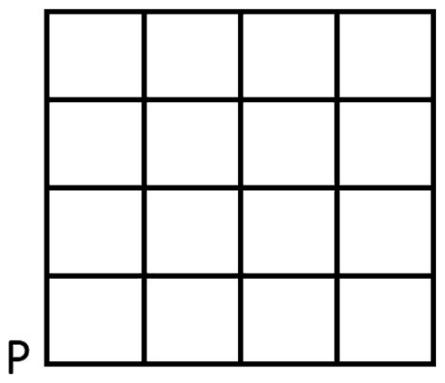
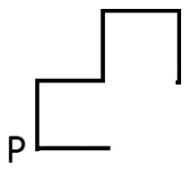
A 4 by 4 grid with P at its bottom-left corner

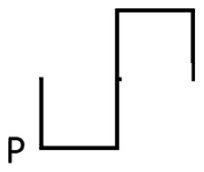
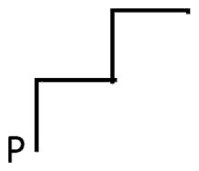
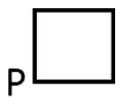
An ant is at the bottom-left corner of a grid (point P) as shown above. It aims to move to the top-right corner of the grid. The ant moves only along the lines marked in the grid such that the current distance to the top-right corner strictly decreases.

Which one of the following is a part of a possible trajectory of the ant during the movement?
Exam Year(s)

GATE Mathematics - 2022,

Answer: C

The possible trajectory is (C).

The ant starts at the bottom-left corner and the target is the top-right corner, which is up and to the right. A step up or a step to the right along a grid line moves it closer to that corner, while a step down or to the left moves it away. So every allowed path is a staircase made only of up and right moves.

Path (C) goes up, right, up, right, so its distance to the target keeps falling. Path (A) ends with a step down, and path (B) also turns down after its last move right, so the distance grows on those steps. Path (D) is a closed loop that returns to P, which must include moves down and left.

Please log in or register to report this question.
12.

A ‘frabjous’ number is defined as a 3 digit number with all digits odd, and no two adjacent digits being the same. For example, 137 is a frabjous number, while 133 is not. How many such frabjous numbers exist?

Exam Year(s)

GATE Mathematics - 2023, GATE Life Sciences - 2023, GATE XE - 2023,

Answer: D

There are 80 frabjous numbers.

The odd digits are 1, 3, 5, 7, 9. The first digit can be any of the 5. Each later digit must be odd and differ from the digit just before it, leaving 4 choices:

\[ 5 \times 4 \times 4 = 80 \]

Only adjacent digits must differ, so the first and third may be equal (as in 131). 125 = 53 ignores the 'no two adjacent equal' rule, and 60 = 5 × 4 × 3 wrongly forbids repeats of non-adjacent digits as well.

Please log in or register to report this question.
13.

Ankita has to climb 5 stairs starting at the ground, while respecting the following rules:

1. At any stage, Ankita can move either one or two stairs up.
2. At any stage, Ankita cannot move to a lower step.

Let F(N) denote the number of possible ways in which Ankita can reach the Nth stair. For example, F(1) = 1, F(2) = 2, F(3) = 3.

The value of F(5) is ___.

Exam Year(s)

GATE Mathematics - 2023, GATE Life Sciences - 2023, GATE XE - 2023,

Answer: A

F(5) is 8.

The last move onto stair N is either a single step from stair N - 1 or a double step from stair N - 2, so:

\[ F(N) = F(N-1) + F(N-2) \]

With F(1) = 1, F(2) = 2 and F(3) = 3, this gives F(4) = 3 + 2 = 5 and F(5) = 5 + 3 = 8, the Fibonacci numbers.

Listing by the number of double steps confirms it: no double step (1 way), one double step among four moves (4 ways), two double steps among three moves (3 ways), total 8. 5 is F(4), one stair short.

Please log in or register to report this question.

14.

How many pairs of sets (S,T) are possible among the subsets of {1, 2, 3, 4, 5, 6} that satisfy the condition that S is a subset of T?

Exam Year(s)

GATE ME - 2023,

Answer: A

There are 729 such pairs.

Decide, element by element, where each of the six numbers goes when S is a subset of T. Each element has exactly three possibilities: it is in neither set, it is in T but not in S, or it is in both S and T. (It cannot be in S without being in T.) The choices are independent, so

\[ 3^{6} = 729 \]

728 leaves out one pair, such as the pair of two empty sets, which is a valid pair since the empty set is a subset of itself. 665 is \(729 - 64\), which drops the 64 pairs where S equals T; but 'S is a subset of T' includes equality. 664 makes both of those deductions.

Please log in or register to report this question.

15.

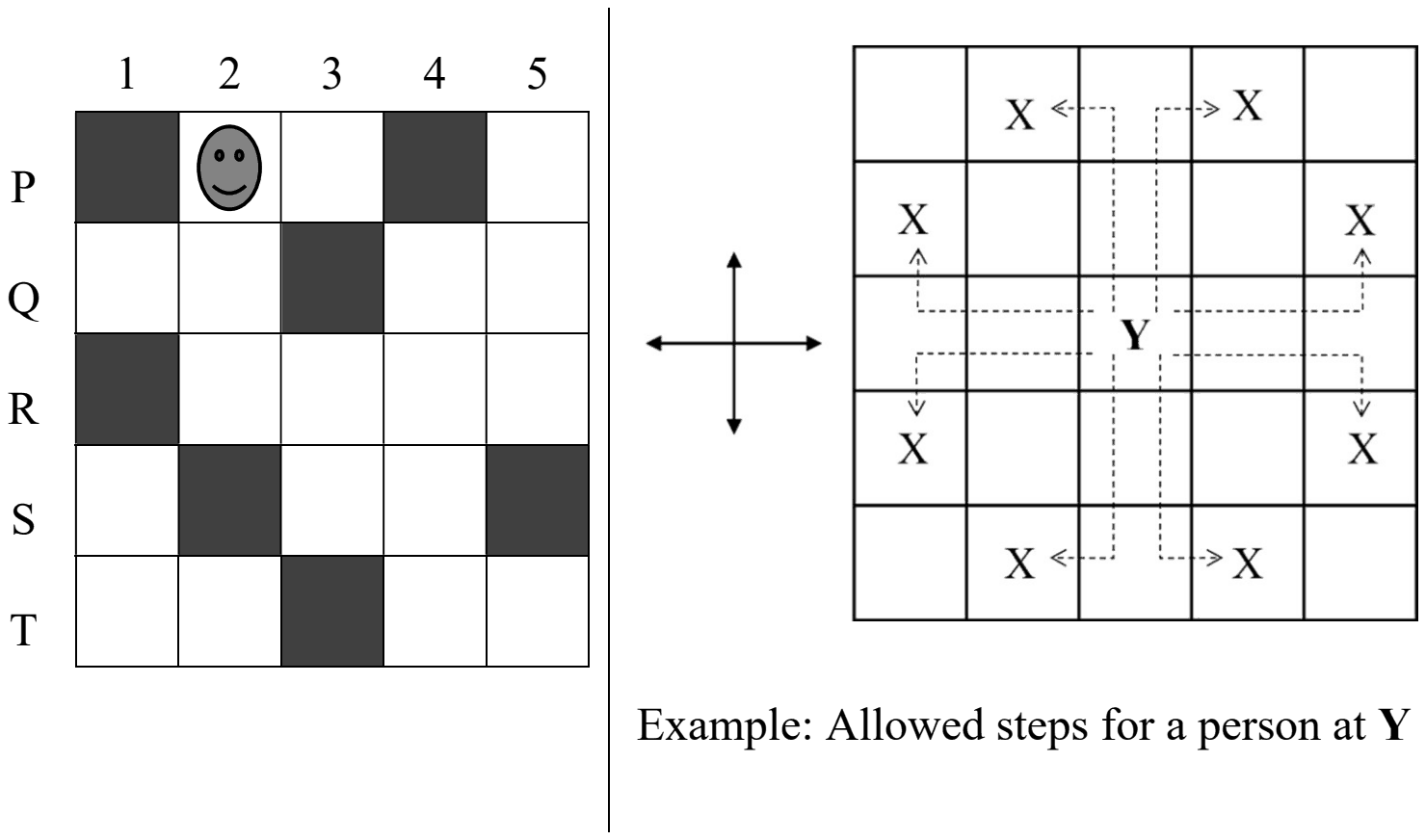
In the square grid shown on the left, a person standing at P2 position is required to move to P5 position.

The only movement allowed for a step involves, “two moves along one direction followed by one move in a perpendicular direction”. The permissible directions for movement are shown as dotted arrows in the right.

For example, a person at a given position Y can move only to the positions marked X on the right.

Without occupying any of the shaded squares at the end of each step, the minimum number of steps required to go from P2 to P5 is

Left: a 5 by 5 grid, rows P to T and columns 1 to 5, with a person at P2 and shaded squares at P1, P4, Q3, R1, S2, S5 and T3. Right: an example grid showing the eight squares reachable from Y

Exam Year(s)

GATE Physics - 2022,

Answer: B

The minimum number of steps is 5.

Each step is a chess knight's move (two squares one way, one square at right angles), and no step may end on a shaded square (P1, P4, Q3, R1, S2, S5, T3). One shortest route is

P2 → Q4 → R2 → P3 → R4 → P5

Every move is a legal knight's move and every square it ends on is unshaded.

Fewer steps are impossible. The target P5 can be entered only from R4, because its other knight neighbour, Q3, is shaded. Working outward from P2, the squares reachable in one step are Q4 and R3; in two steps R2, S3, Q1, Q5, S1, T2 and T4; in three steps P3, S4, T1, Q2, R5 and T5. R4 is first reached on the fourth step, so P5 needs a fifth. That rules out 4, and 6 or 7 are not minimal.

Please log in or register to report this question.

16.

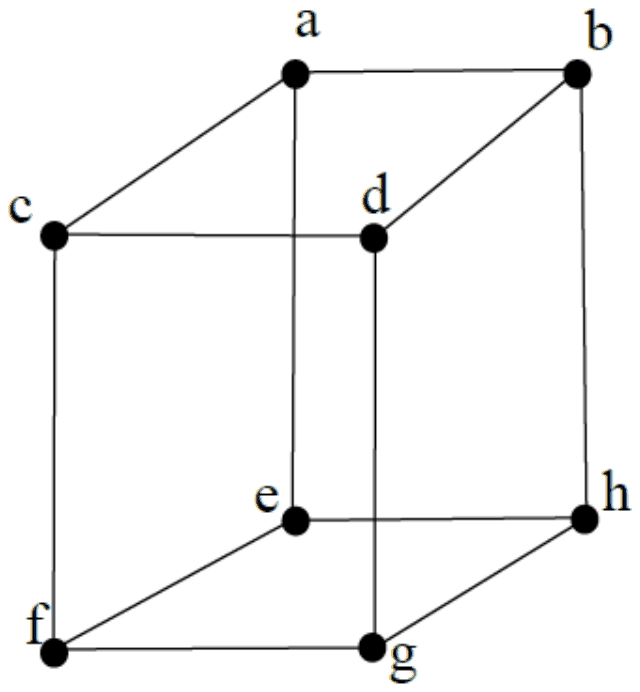
Consider the cube shown below with its 8 corners labelled a, b, c, d, e, f, g, and h. The figure is representative. All corners are to be colored such that any two corners that are connected by an edge must be of different colors. The minimum number of colors required to achieve this is ________

Cube with top face corners a, b, d, c and bottom face corners e, h, g, f, a above e, b above h, d above g and c above f

Exam Year(s)

GATE Physics - 2026,

Answer: D

The minimum number of colors is 2.

The corners and edges of a cube form a bipartite graph: every edge joins corners whose positions differ in exactly one coordinate. Colour a, d, h and f with one colour and b, c, e and g with the other. Then every edge (a-b, b-d, d-c, c-a on top; e-h, h-g, g-f, f-e at the bottom; and the verticals a-e, b-h, d-g, c-f) joins two different colours.

At least two colours are needed, since any edge has two ends that must differ, so 2 is the minimum. 3, 4 and 8 colours are all possible but not minimal; 8 would give every corner its own colour.

Please log in or register to report this question.

17.

By using digits 1 to 9 how many 4 digit numbers can be formed which has 5 as a unit digit? Repetition of digits is are not allowed.

Exam Year(s)

MP Lab Technician - 2015,

Answer: A

There are 336 such numbers.

The units digit is fixed as 5. The other three places are filled from the remaining 8 digits (1 to 9 without 5), with no repetition:

\[ \begin{aligned} \text{thousands} \times \text{hundreds} \times \text{tens} &= 8 \times 7 \times 6 \\ &= 336 \end{aligned} \]

There is no zero among the digits, so no case of a leading zero needs removing.

504 is \(9 \times 8 \times 7\), which wrongly lets 5 be used again in the first three places. 1400 matches no correct count, and 'None of these' is wrong because 336 is offered.

Please log in or register to report this question.

18.

How many 3-digit even numbers can be formed, using the digits 0, 1, 2, 3, 4, 5, if repetition of the digits is allowed :

Exam Year(s)

MPPSC State Service - 2024, MPPSC Forest Service - 2024,

Answer: A

90 three-digit even numbers can be formed.

With repetition allowed, count the choices for each place. The hundreds digit cannot be 0, so it has 5 choices (1-5). The tens digit can be any of the 6 digits. The units digit must be even, so it has 3 choices (0, 2, 4):

\[ 5 \times 6 \times 3 = 90 \]

216 = 6 × 6 × 6 counts all strings of three digits, including those starting with 0 and odd ones. 150 = 5 × 6 × 5 drops only the leading zero, and 75 does not correspond to a correct count.

Please log in or register to report this question.

19.

From a box of 20 balls, 8 balls are to be chosen. In how many ways can this be done ?

Exam Year(s)

Punjab Civil Service - 2018,

Answer: A

The number of ways is \({}^{20}C_{8}\).

Choosing 8 balls from 20 is a selection in which order does not matter: picking ball 1 and then ball 2 gives the same group as picking ball 2 and then ball 1. Selections are counted by combinations:

\[ {}^{20}C_{8} = \frac{20!}{8!\,12!} \]

\({}^{20}P_{8}\) counts ordered arrangements of 8 balls, which overcounts each group by 8! orderings. 20! is the number of ways to arrange all 20 balls in a row, and 8! the number of ways to arrange 8 balls, so neither counts selections of 8 from 20.

Please log in or register to report this question.

20.

How many natural numbers having at most five digits have a sum of their digits as at most six ?

Exam Year(s)

Punjab Civil Service - 2025,

Answer: A

There are 461 such numbers.

Write every number with at most five digits as five digits with leading zeros. We need the number of solutions of \(d_{1} + d_{2} + \dots + d_{5} \leq 6\) with each \(d_{i} \geq 0\) (no digit can exceed 6 here, so the limit of 9 never binds). Adding a slack variable makes this an equation in six unknowns summing to 6:

\[ \binom{6 + 5}{5} = \binom{11}{5} = 462 \]

This count includes 00000, which is not a natural number, so the answer is \(462 - 1 = 461\). Option 462 is the trap of forgetting to remove zero.

Please log in or register to report this question.

Loading…
Tags: Permutations & Combinations Questions and Answers || Permutations & Combinations MCQ Questions and Answers || Permutations & Combinations GK Questions and Answers || Permutations & Combinations GK MCQ Questions || Permutations & Combinations Multiple Choice Questions and Answers || Permutations & Combinations GK || GK on Permutations & Combinations || Quantitative Aptitude Questions and Answers || Quantitative Aptitude MCQ Questions and Answers || Quantitative Aptitude GK Questions and Answers || GK on Quantitative Aptitude