
Machine-translated by Google. Questions are authored in English.
Top

Geometry (Lines, Angles, Triangles, Polygons) Questions and Answers

Important Instructions
171.

Consider the following statements:

1. The sum of any two sides of a triangle is always greater than the third side.
2. A rectangle is a special type of square in which all sides are equal.
3. The area of a circle with radius 'r' is 2πr.

How many of the statements given above are correct?

Exam Year(s)

Haryana Civil Services - 2026, HPSC - 2026,

Answer: A

Only one statement is correct.

Statement 1 is the triangle inequality, which holds for every triangle: the sum of any two sides exceeds the third.

Statement 2 is reversed. A square is a special rectangle (one with all sides equal); a rectangle in general does not have all sides equal.

Statement 3 gives the circumference, \(2\pi r\), not the area, which is \(\pi r^{2}\).

So only statement 1 is right, and 'Only two' requires accepting one of the two common confusions.

Please log in or register to report this question.

172.

The radius of a circle is 6 cm. The perpendicular distance from the centre of the circle to the chord which is 8 cm in length is?

Exam Year(s)

ISRO Assistant - 2023,

Answer: B

The distance is \(2\sqrt{5}\) cm.

The perpendicular from the centre bisects the chord, so it meets a radius and half the chord (4 cm) in a right triangle:

\[ d = \sqrt{6^{2} - 4^{2}} = \sqrt{20} = 2\sqrt{5} \]

\(\sqrt{5}\) would come from halving the result. \(2\sqrt{7}\) is \(\sqrt{36 - 8}\), using the whole chord without squaring, and \(\sqrt{7}\) is half of that.

Please log in or register to report this question.

173.

In the following figure, ABCD is a cyclic quadrilateral in which AC and BD are its diagonals. If ∠ DBC = 55° and ∠ BAC = 45°, then the value of ∠ BCD will be :

Cyclic quadrilateral ABCD inscribed in a circle, with diagonals AC and BD drawn

Exam Year(s)

MPPSC Forest Service - 2023,

Answer: C

The value of ∠ BCD is 80°.

Angles in the same segment of a circle are equal. ∠ BAC and ∠ BDC both stand on the chord BC, so ∠ BDC = ∠ BAC = 45°. In triangle BCD the angles add up to 180°:

\[ \begin{aligned} \angle BCD &= 180^\circ - (55^\circ + 45^\circ) \\ &= 80^\circ \end{aligned} \]

90° would assume BD is a diameter, which nothing in the question says. 65° and 70° do not follow from the given angles.

Please log in or register to report this question.

174.

In the following figure, lines PQ and RS intersect each other at point O. If ∠ POR : ∠ ROQ = 5 : 7, then the value of ∠ POS will be :

Line PQ crossing the vertical line RS at O, with S at the top and R at the bottom, P to the left and Q to the right

Exam Year(s)

MPPSC Forest Service - 2023,

Answer: A

The value of ∠ POS is 105°.

∠ POR and ∠ ROQ lie on the straight line PQ, so they add up to 180°. Splitting 180° in the ratio 5 : 7:

\[ \begin{aligned} \angle POR &= \tfrac{5}{12} \times 180^\circ = 75^\circ \\ \angle ROQ &= \tfrac{7}{12} \times 180^\circ = 105^\circ \end{aligned} \]

∠ POS and ∠ ROQ are vertically opposite angles, so ∠ POS = 105°. 75° is ∠ POR (and its opposite ∠ SOQ), not ∠ POS; 150° and 210° double the parts.

Please log in or register to report this question.
175.

Which of the following quadrilateral ABCD cannot be constructed ?

Exam Year(s)

MPPSC Forest Service - 2022,

Answer: C

The quadrilateral that cannot be constructed is AB = 3, BC = 5, AC = 6, AD = 3, CD = 2.

The diagonal AC splits the quadrilateral into triangles ABC and ADC, and each must satisfy the triangle inequality. In this option, triangle ADC has sides 3, 2 and 6, but 3 + 2 = 5 is less than 6, so the triangle, and hence the quadrilateral, cannot be drawn.

In every other option both triangles are possible: 3, 5, 4 with 6, 6, 4; 2, 4, 4 with 5, 5, 4; and 3, 5, 6 with 3, 5, 6.

Please log in or register to report this question.

176.

In the given figure, ABCD is a parallelogram. Then which of the following is true about x and y?

Parallelogram ABCD with sides extended; the angle outside C between the extended sides is 70 degrees, x is the angle at A and y the angle at D

Exam Year(s)

MPPSC Forest Service - 2023,

Answer: B

The answer is x = 70°, y = 110°.

The 70° angle at C lies between the extensions of sides BC and DC beyond C, so it is vertically opposite the interior angle BCD. Hence angle C = 70°.

In a parallelogram opposite angles are equal, so the interior angle at A is also 70°, which is x. Adjacent angles are supplementary, so the interior angle at D is 180° - 70° = 110°, which is y.

Option A swaps the two values, option C makes adjacent angles equal, and option D gives a pair that does not add up to 180°.

Please log in or register to report this question.

177.

In a ΔABC, if \(AB \lt BC \lt CA\), then which of the following is true?

Exam Year(s)

MPPSC Forest Service - 2023,

Answer: A

The true statement is \(AB + BC \gt CA\).

By the triangle inequality, the sum of any two sides of a triangle is greater than the third side. That applies in particular to the two shorter sides compared with the longest, CA.

If AB + BC were less than or equal to CA, the three points could not form a triangle. The Pythagorean relation in option D holds only for a right angle at B, which the given information does not establish.

Please log in or register to report this question.

178.

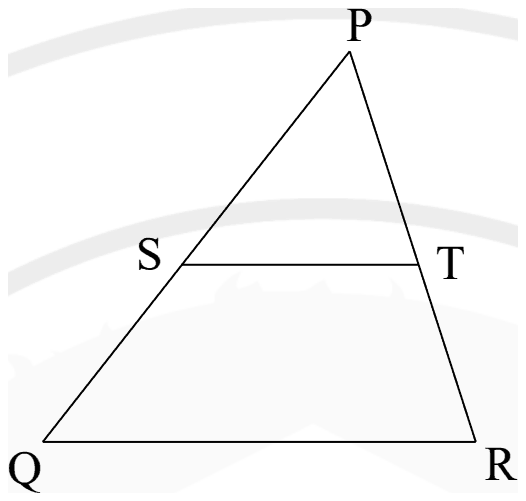
In the diagram, the lines QR and ST are parallel to each other. The shortest distance between these two lines is half the shortest distance between the point P and line QR. What is the ratio of the area of the triangle PST to the area of the trapezium SQRT?

Note: The figure shown is representative.

Triangle PQR with apex P at the top and base QR; S on PQ and T on PR, with ST drawn parallel to QR

Exam Year(s)

GATE Mathematics - 2025, GATE CS - 2025,

Answer: A

The ratio is \(\dfrac{1}{3}\).

Let the distance from P to QR be h. ST is parallel to QR at distance h/2 from it, so it is also h/2 from P. Triangles PST and PQR are therefore similar with ratio 1 : 2, and areas of similar figures scale as the square of the ratio:

\[ \begin{aligned} \frac{[PST]}{[PQR]} &= \left(\frac{1}{2}\right)^{2} = \frac{1}{4} \\ [SQRT] &= [PQR] - [PST] = \frac{3}{4}[PQR] \\ \frac{[PST]}{[SQRT]} &= \frac{1/4}{3/4} = \frac{1}{3} \end{aligned} \]

1/4 is the ratio of the small triangle to the whole triangle, not to the trapezium. 1/2 confuses the ratio of lengths with the ratio of areas, and 2/5 matches no step of the working.

Please log in or register to report this question.

179.

Each angle of a rectangle is

Exam Year(s)

MPPSC Forest Service - 2023,

Answer: C

Each angle of a rectangle is a right angle.

A rectangle is a quadrilateral whose four angles are all equal. Since the angles of any quadrilateral add up to 360°, each angle is 360°/4 = 90°, a right angle.

An acute angle is less than 90° and an obtuse angle more than 90° (but less than 180°), so neither can be an angle of a rectangle. A straight angle is exactly 180°, which would flatten the figure into a line.

Please log in or register to report this question.

180.

An object of height 90 cm is moved away from the base of lamp post at a speed of 1.2 m/s. If the lamp is 3.6 m above the ground, then the length of the shadow of object after 4 seconds will be

Exam Year(s)

MPPSC Forest Service - 2023,

Answer: A

The shadow is 1.6 m long.

After 4 seconds the object is 1.2 × 4 = 4.8 m from the lamp post. Let the shadow length be x. The lamp, the top of the object and the tip of the shadow lie on one line, so the triangles formed by the lamp post and by the object are similar:

\[ \begin{aligned} \frac{3.6}{4.8 + x} &= \frac{0.9}{x} \\ 3.6x &= 0.9x + 4.32 \\ 2.7x &= 4.32 \\ x &= 1.6\ \text{m} \end{aligned} \]

Check: the lamp is four times as high as the object, so the shadow is one third of the distance walked, 4.8/3 = 1.6 m. 4.8 is the distance walked (and is printed in cm), and 0.9 m is the object's height.

Please log in or register to report this question.

Loading…
Tags: Geometry Lines, Angles, Triangles Questions || Polygons MCQ Questions and Answers || Geometry Quantitative Aptitude || Angles and Triangles GK Questions || Quantitative Aptitude Geometry GK