
Machine-translated by Google. Questions are authored in English.
Top

Growth and Nutrition of Bacteria Questions and Answers

1.

A rich medium is inoculated with a bacterium that divides every 30 minutes. The number of bacteria at the end of 50 hours is

Exam Year(s)

GATE Life Sciences - 2012,

Answer: D

The number of bacteria is \(1 \times 2^{100}\).

A division every 30 minutes means two generations per hour, so in 50 hours there are \(50 \times 2 = 100\) generations. Starting from one bacterium, the count doubles each generation:

\[ \begin{aligned} N &= N_{0} \times 2^{n} = 1 \times 2^{100} \\ &\approx 1.27 \times 10^{30} \end{aligned} \]

\(2 \times 10^{10}\) and \(2 \times 10^{20}\) are far too small, since \(2^{100}\) is about \(10^{30}\), and \(1 \times 10^{50}\) is far too large. (In practice the culture would run out of nutrients long before, but the question asks for unrestricted growth.)

Please log in or register to report this question.
2.

Ten bacteria were inoculated into a rich medium. If at the end of ten hours the total number of cells is 104, then the number of elapsed generations and the generation time respectively is

Exam Year(s)

GATE Life Sciences - 2012,

Answer: B

The answer is 10, 60 minutes.

Exponential growth gives \(N = N_{0} \times 2^{n}\):

\[ \begin{aligned} 10^{4} &= 10 \times 2^{n} \\ 2^{n} &= 1000 \\ n &= \frac{\log 1000}{\log 2} = 9.97 \approx 10 \end{aligned} \]

Ten generations in ten hours means a generation time of 600/10 = 60 minutes. 120 minutes would mean only five generations; 20 and 40 generations would give \(10 \times 2^{20} \approx 10^{7}\) or more cells, far above \(10^{4}\).

Please log in or register to report this question.

3.

Match the correct mode of cell division with respective bacteria.

Bacteria

(P) Streptomyces species
(Q) Rhodopseudomonas acidophila
(R) Bacillus subtilis
(S) Nocardia species

Mode of cell division

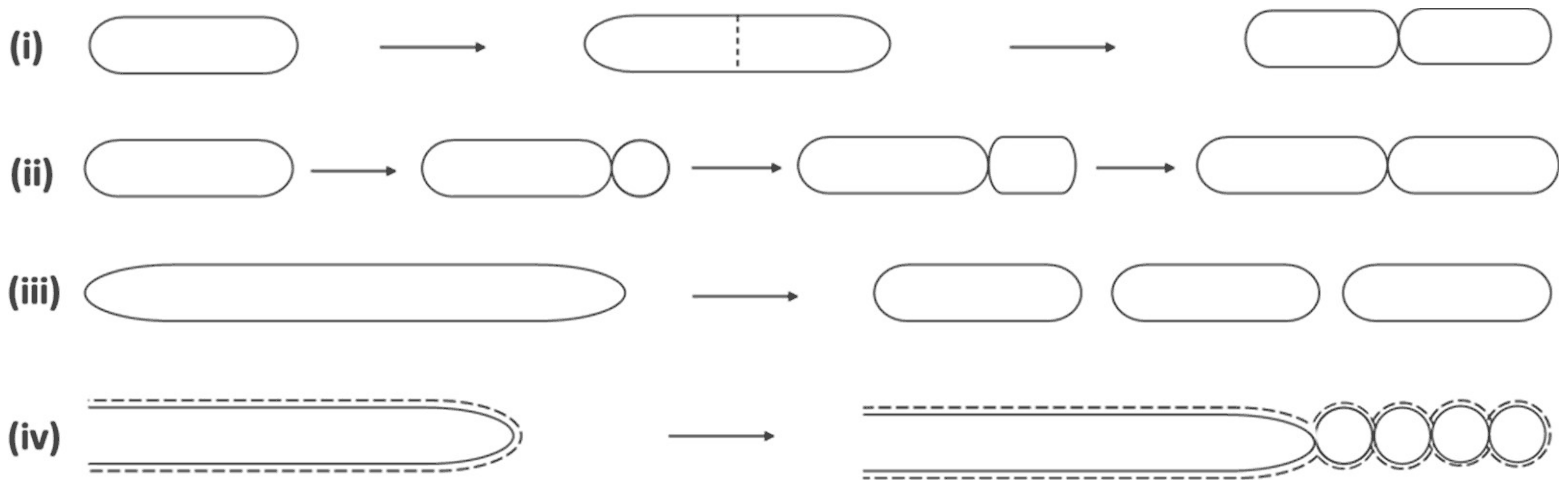
Four modes of cell division: (i) a rod elongates and splits into two equal cells; (ii) a rod forms a small bud at one end that grows into a second cell; (iii) a long filament breaks into three separate rods; (iv) a sheathed hypha forms a chain of round spores at its tip

Exam Year(s)

GATE Life Sciences - 2022,

Answer: C

The correct match is (P)-(iv), (Q)-(ii), (R)-(i), (S)-(iii).

  • Streptomyces grows as branched hyphae; its aerial hyphae lay down septa at the tip and break into chains of spores, the picture in (iv).
  • Rhodopseudomonas acidophila, a purple non-sulfur bacterium, divides by budding: a small bud forms at one end and grows into a daughter cell, as in (ii).
  • Bacillus subtilis divides by ordinary binary fission, a septum splitting the cell into two equal halves, as in (i).
  • Nocardia forms a mycelium that fragments into rod-shaped and coccoid cells, as in (iii).

Options A, B and D all deny Streptomyces its spore chains (iv): A and B give it budding and D gives it binary fission. B also gives binary fission to Rhodopseudomonas, which buds.

Please log in or register to report this question.

Answer: D

The statement that is NOT correct is the rate of generation of new cells during exponential growth phase is constant.

In exponential growth the specific growth rate and the generation time are constant, but the population doubles every generation, so the number of new cells produced per unit time keeps increasing. A constant rate of producing new cells would describe linear, not exponential, growth.

The other statements are accepted. Stationary-phase cells need longer to adapt to fresh medium, so their lag phase is longer. Death often follows a logarithmic (exponential) decline. In stationary phase some cells grow on nutrients released by others that die, which is called cryptic growth.

Please log in or register to report this question.

5.

The organisms that obtain energy from inorganic compounds are known as

Exam Year(s)

GATE Life Sciences - 2023,

Answer: C

Such organisms are lithotrophs.

The prefix litho- (rock) refers to the source of electrons or energy: lithotrophs obtain energy by oxidising inorganic compounds such as ammonia, nitrite, hydrogen sulfide, ferrous iron or hydrogen, as nitrifying and sulfur-oxidising bacteria do.

Organotrophs obtain energy from organic compounds. Phototrophs obtain it from light. Autotrophs are defined by their carbon source, \(CO_{2}\), not by their energy source; many lithotrophs are also autotrophs, but the term for using inorganic energy sources is lithotroph.

Please log in or register to report this question.

6.

Correctly match the bacterial type in Column I with their corresponding environmental niche in Column II.

Column IColumn II
P. Psychrophilei. Pressure greater than 380 atm
Q. Barophileii. Temperature between 15°C and 45°C
R. Mesophileiii. Temperature below 15°C
S. Halophileiv. pH less than 3.0
v. Salt concentration greater than 2M

Exam Year(s)

GATE Life Sciences - 2025,

Answer: A

The correct match is P - iii; Q - i; R - ii; S - v.

  • A psychrophile grows best at low temperature, below about 15 °C.
  • A barophile (piezophile) thrives under high hydrostatic pressure, such as the deep sea, here more than 380 atm.
  • A mesophile grows at moderate temperatures, roughly 15 to 45 °C, the range of most human pathogens.
  • A halophile requires high salt, over about 2 M NaCl for extreme halophiles.

Item iv, pH below 3.0, describes an acidophile and matches none of the four. The other options give the barophile low temperature or acidity, or the halophile high pressure, which mismatches the names.

Please log in or register to report this question.

7.

A penicillin sensitive Escherichia coli population is exposed to a lethal dose (200 µg/ml) of penicillin. Assuming density-independent mortality, which one of the following relationships would describe the number of surviving bacteria (N) over time (T)?

Exam Year(s)

GATE Life Sciences - 2025,

Answer: A

The survivors decline exponentially.

Density-independent mortality means each cell has the same chance of dying per unit time, regardless of how many cells remain. The death rate is then proportional to the number of survivors:

\[ \begin{aligned} \frac{dN}{dT} &= -kN \\ N &= N_{0}\,e^{-kT} \end{aligned} \]

The same fraction is killed in each interval, which is why antibiotic killing curves are straight lines on a log scale. A linear fall would need a constant number killed per unit time; a sigmoidal curve describes density-dependent growth with a limit; and a parabola does not arise from a constant per-cell death rate.

Please log in or register to report this question.

Loading…
Tags: Growth and Nutrition of Bacteria Questions and Answers || Growth and Nutrition of Bacteria MCQ Questions and Answers || Growth and Nutrition of Bacteria GK Questions and Answers || Growth and Nutrition of Bacteria GK MCQ Questions || Growth and Nutrition of Bacteria Multiple Choice Questions and Answers || Growth and Nutrition of Bacteria GK || GK on Growth and Nutrition of Bacteria || Microbiology Questions and Answers || Microbiology MCQ Questions and Answers || Microbiology GK Questions and Answers || GK on Microbiology