
Machine-translated by Google. Questions are authored in English.
Top

Algebra Questions and Answers

Important Instructions
41.

If \(x^{2} + x - 1 = 0\) what is the value of \(x^{4} + \frac{1}{x^{4}}\)?

Exam Year(s)

GATE Physics - 2018, GATE AG - 2018,

Answer: C

The value is 7.

Divide \(x^{2} + x - 1 = 0\) by \(x\) (\(x \ne 0\)) to get \(x + 1 - \frac{1}{x} = 0\), so \(x - \frac{1}{x} = -1\). Square twice:

\[ \begin{aligned} x^{2} + \frac{1}{x^{2}} &= \left(x - \frac{1}{x}\right)^{2} + 2 = 3 \\ x^{4} + \frac{1}{x^{4}} &= 3^{2} - 2 = 7 \end{aligned} \]

9 forgets to subtract 2 in the last step, and 1 and 5 do not follow from the given equation.

Please log in or register to report this question.
42.

Consider the following inequalities.

(i) \(3p - q \lt 4\)
(ii) \(3q - p \lt 12\)

Which one of the following expressions below satisfies the above two inequalities?

Exam Year(s)

GATE Chemistry - 2022, GATE AG - 2022,

Answer: A

The expression that follows is \(p + q \lt 8\).

Add the two inequalities, which is allowed because both point the same way:

\[ \begin{aligned} (3p - q) + (3q - p) &\lt 4 + 12 \\ 2p + 2q &\lt 16 \\ p + q &\lt 8 \end{aligned} \]

So every pair \((p, q)\) satisfying both inequalities has \(p + q\) strictly less than 8. The other options all allow \(p + q \ge 8\), which the sum rules out: \(p + q = 8\) would need \(2(p + q) = 16\), but the sum must be strictly less than 16.

Please log in or register to report this question.
43.

The coefficient of \(x^{4}\) in the polynomial \((x - 1)^{3}(x - 2)^{3}\) is equal to _______.

Exam Year(s)

GATE Physics - 2023, GATE AG - 2023,

Answer: A

The coefficient is 33.

Write the product as a cube: \((x - 1)(x - 2) = x^{2} - 3x + 2\), so the polynomial is \((x^{2} - 3x + 2)^{3}\). An \(x^{4}\) term comes from choosing one term from each of the three factors in two ways:

\[ \begin{aligned} x^{2} \cdot x^{2} \cdot 2 &: \ 3 \times 2 = 6 \\ x^{2} \cdot (-3x) \cdot (-3x) &: \ 3 \times 9 = 27 \\ \text{total} &= 6 + 27 = 33 \end{aligned} \]

Each case has 3 arrangements, because the odd factor out can be any of the three. Taking \((-3)^{2}\) as -9 gives 6 - 27 = -21, whose size is the distractor 21, and counting each case only once gives 2 + 9 = 11, so the factor 3 for the arrangements matters.

Please log in or register to report this question.

44.

If two distinct non-zero real variables x and y are such that (x + y) is proportional to (x − y) then the value of \(\dfrac{x}{y}\)

Exam Year(s)

GATE AG - 2024,

Answer: D

The ratio \(x/y\) is a constant.

Proportionality means \(x + y = k(x - y)\) for some fixed constant k. Collect the terms:

\[ \begin{aligned} x + y &= kx - ky \\ y(1 + k) &= x(k - 1) \\ \frac{x}{y} &= \frac{k + 1}{k - 1} \end{aligned} \]

The right-hand side contains only the constant k, so \(x/y\) takes the same value whatever the individual values of x and y (and \(k \neq 1\), since y is non-zero). It therefore does not depend on \(xy\), on x alone or on y alone.

Please log in or register to report this question.

45.

If a, b, and c are the roots of \(2x^{3} - 3x^{2} + px - 1 = 0\) and sum of the two roots is 1, the value of \(p\) is:

Exam Year(s)

GATE AG - 2025,

Answer: C

The value is \(p = 3\).

For \(2x^{3} - 3x^{2} + px - 1 = 0\), the sum of the roots is \(-(-3)/2 = 3/2\). If two of the roots add up to 1, the third root is \(3/2 - 1 = 1/2\). Substituting \(x = 1/2\):

\[ \begin{aligned} 2\left(\tfrac{1}{8}\right) - 3\left(\tfrac{1}{4}\right) + \tfrac{p}{2} - 1 &= 0 \\ \tfrac{1}{4} - \tfrac{3}{4} - 1 + \tfrac{p}{2} &= 0 \\ \tfrac{p}{2} = \tfrac{3}{2}, \quad p &= 3 \end{aligned} \]

With \(p = 2\), \(p = 1\) or \(p = 1/3\), \(x = 1/2\) would not satisfy the equation, so no pair of roots would sum to 1.

Please log in or register to report this question.

46.

If two distinct non-zero real variables \(x\) and \(y\) are such that \((x + y)\) is proportional to \((x - y)\) then the value of \(\dfrac{x}{y}\)

Exam Year(s)

GATE CS - 2024,

Answer: D

The value of \(x/y\) is a constant.

Proportionality means \(x + y = k(x - y)\) for a fixed constant k. Rearranging:

\[ \begin{aligned} x + y &= kx - ky \\ y(1 + k) &= x(k - 1) \\ \frac{x}{y} &= \frac{k + 1}{k - 1} \end{aligned} \]

The right side involves only the constant k, so \(x/y\) is fixed and does not depend on x, on y, or on their product. (k cannot be 1, since that would force y = 0, and x and y are non-zero.)

Please log in or register to report this question.

47.

For positive real numbers S and K, the function \(H_{K}(S)\) is defined as: \(H_{K}(S) = \max(S-K, 0)\). The max function is defined as:

\[ \max(a,b) = \begin{cases} a, & \text{when } a \gt b \\ b, & \text{when } a \le b \end{cases} \]

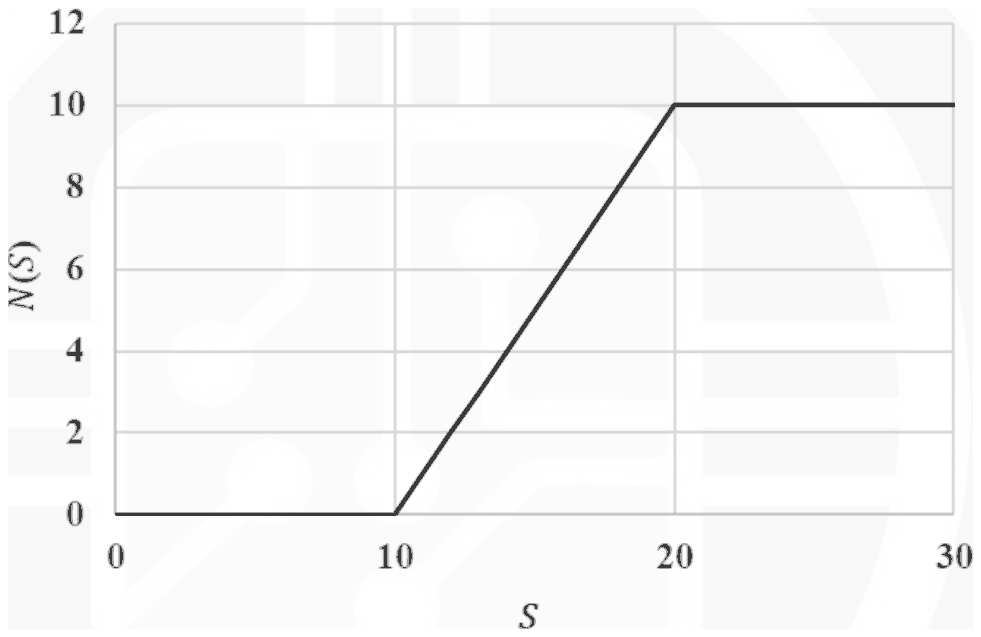
The graph below shows the plot of a function N(S) versus S.

Graph of N(S) against S: 0 for S from 0 to 10, rising in a straight line from 0 at S = 10 to 10 at S = 20, then constant at 10 for S from 20 to 30

N(S) can be expressed as ___.

Exam Year(s)

GATE CS - 2026,

Answer: A

N(S) is \(H_{10}(S) - H_{20}(S)\).

Each \(H_{K}(S)\) is zero up to S = K and then rises with slope 1. Check \(H_{10} - H_{20}\) on the three pieces of the graph:

\[ \begin{aligned} S \le 10:&\quad 0 - 0 = 0 \\ 10 \lt S \le 20:&\quad (S-10) - 0 = S - 10 \\ S \gt 20:&\quad (S-10)-(S-20) = 10 \end{aligned} \]

This is zero until 10, rises to 10 at S = 20, and stays at 10, exactly as plotted.

\(H_{10} - 2H_{20}\) would fall with slope -1 after S = 20. \(-H_{10} + H_{20}\) is the plotted function turned upside down, going down to -10. \(H_{15} - H_{20}\) starts rising only at 15 and levels off at 5.

Please log in or register to report this question.

48.

In a quadratic function, the value of the product of the roots (α, β) is 4. Find the value of

\[ \frac{\alpha^{n} + \beta^{n}}{\alpha^{-n} + \beta^{-n}} \]

Exam Year(s)

GATE CS - 2016,

Answer: B

The value is \(4^{n}\).

Rewrite the denominator over a common denominator:

\[ \begin{aligned} \alpha^{-n} + \beta^{-n} &= \frac{\alpha^{n} + \beta^{n}}{(\alpha\beta)^{n}} \\ \frac{\alpha^{n} + \beta^{n}}{\alpha^{-n} + \beta^{-n}} &= (\alpha\beta)^{n} = 4^{n} \end{aligned} \]

Only the product of the roots matters, which is why the question gives nothing else. \(n^{4}\) swaps base and exponent. \(2^{2n-1} = 4^{n}/2\) and \(4^{n-1} = 4^{n}/4\), so both fall short of the correct value by a constant factor.

Please log in or register to report this question.

49.

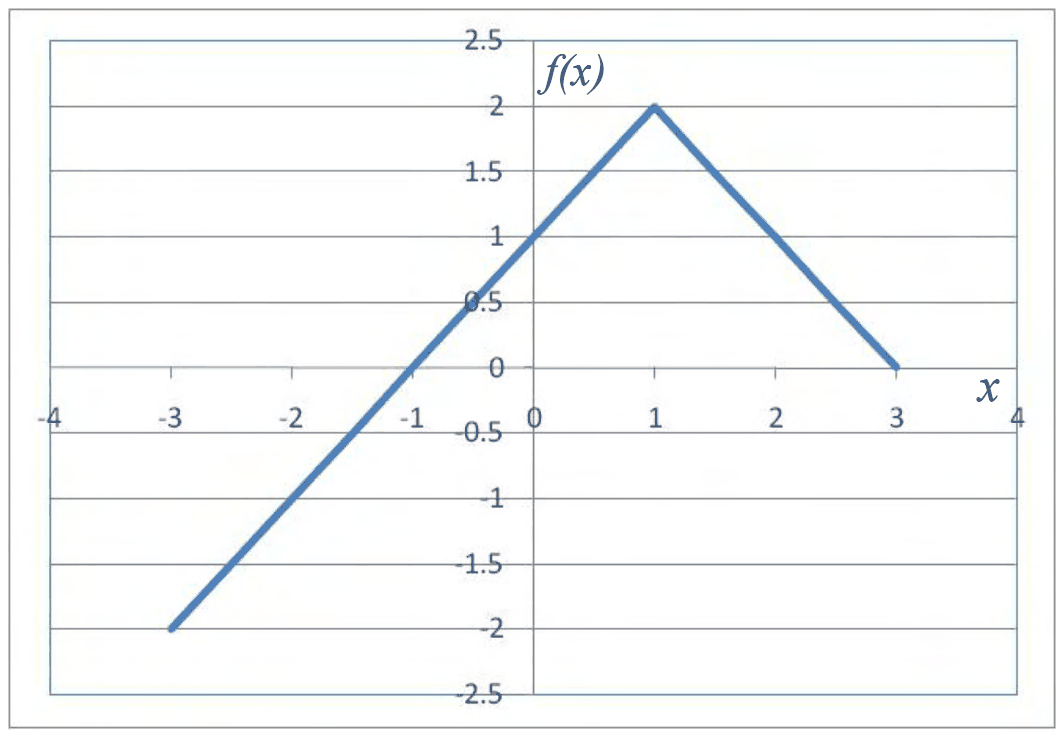
Graph of f(x) against x: a straight line rising from (-3, -2) through (-1, 0) and (0, 1) to a peak at (1, 2), then a straight line falling to (3, 0)

Choose the correct expression for \(f(x)\) given in the graph.

Exam Year(s)

GATE CS - 2016,

Answer: C

The graph is \(f(x) = 2 - |x - 1|\).

The graph is an inverted V with its peak at (1, 2) and slopes of +1 and -1. A function \(c - |x - h|\) has exactly that shape, with its peak at \((h, c)\), so \(h = 1\) and \(c = 2\).

Check points: \(f(0) = 2 - 1 = 1\), \(f(3) = 2 - 2 = 0\) and \(f(-3) = 2 - 4 = -2\), all on the graph.

\(1 - |x - 1|\) has the right shape but peaks at 1. The two expressions with \(+|x - 1|\) form an upright V, with a minimum, not a maximum, at \(x = 1\).

Please log in or register to report this question.

50.

If \(Pe^{x} = Qe^{-x}\) for all real values of \(x\), which one of the following statements is true?

Exam Year(s)

GATE CS - 2025,

Answer: A

The true statement is \(P = Q = 0\).

Multiply both sides by \(e^{x}\): the equation becomes \(Pe^{2x} = Q\) for every real \(x\). The right side is a constant, while \(e^{2x}\) takes every positive value as \(x\) varies. A constant can equal \(Pe^{2x}\) for all \(x\) only if \(P = 0\), and then \(Q = 0\) too.

\(P = Q = 1\) would require \(e^{x} = e^{-x}\), true only at \(x = 0\). \(P = 1, Q = -1\) gives \(e^{x} = -e^{-x}\), impossible since both sides have opposite signs. \(P/Q = 0\) needs \(P = 0\) with \(Q \neq 0\), and then the equation would say \(Qe^{-x} = 0\), which fails for every \(x\).

Please log in or register to report this question.

Loading…
Tags: Algebra Questions and Answers || Algebra MCQ Questions and Answers || Algebra GK Questions and Answers || Algebra GK MCQ Questions || Algebra Multiple Choice Questions and Answers || Algebra GK || GK on Algebra || Quantitative Aptitude Questions and Answers || Quantitative Aptitude MCQ Questions and Answers || Quantitative Aptitude GK Questions and Answers || GK on Quantitative Aptitude