Machine-translated by Google. Questions are authored in English.
Top

Pipes & Cistern Questions and Answers

Important Instructions
101.

A tap having diameter 'd' can empty a tank in 84 min. How long another tap having diameter '2d' take to empty the same tank?

Answer: A

Flow through a pipe is proportional to its cross-sectional area, which varies as the square of the diameter.

\[ \frac{(2d)^{2}}{d^{2}} = 4 \]

Four times the flow means a quarter of the time:

\[ \frac{84}{4} = 21 \text{ minutes} \]

Halving the time to 42 minutes would assume flow proportional to diameter rather than to area.

Please log in or register to report this question.

102.

Two pipes A and B can fill a tank in 10 hours and 30 hours respectively. Due to a leak in the tank, it takes 2.5 hours more to fill the tank. How much time would the leak alone will take to empty the tank ?

Answer: C

 Let the capacity of the tank be LCM (10, 30) = 30 units
=> Efficiency of pipe A = 30 / 10 = 3 units / hour
=> Efficiency of pipe B = 30 / 30 = 1 units / hour
=> Combined efficiency of both pipes = 4 units / hour
Now, total time taken by A and B working together to fill the tank if there was no leak = 30 / 4 = 7.5 hours
=> Actual time taken = 7.5 + 2.5 = 10 hours
 
The tank filled by A and B in these 2.5 hours is the extra work done to compensate the wastage by the leak in 10 hours.
=> 2.5 hours work of A and B together = 10 hours work of the leak
=> 2.5 x 4 = 10 x E, where ‘E’ is the efficiency of the leak.
=> E = 1 unit / hour
 
Therefore, time taken by the leak alone to empty the full tank = 30 / 1 = 30 hours

Please log in or register to report this question.

103.

A tap can fill a tub in 24 hours. Due to a leak at the bottom of the tub, the tap fills the tub in 36 hours. If the tub is full, how much time will the leak take to empty it?

Answer: A

Work in rates: a pipe that fills a tank in \( n \) units of time fills \( \tfrac{1}{n} \) of it per unit, and rates add (an emptying pipe counting negative).

\[ \frac{1}{24} - \frac{1}{L} = \frac{1}{36} \]

\[ \frac{1}{L} = \frac{3 - 2}{72} = \frac{1}{72} \quad\Longrightarrow\quad L = 72 \text{ hours} \]

Please log in or register to report this question.

104.

Two pipes can fill a tank in 20 and 24 minutes respectively and a waste pipe can empty 3 gallons per minute. All the three pipes working together can fill the tank in 15 minutes. The capacity of the tank is:

Answer: C


Work done by the waste pipe in 1 minute = 1 - 1 + 1
15 20 24


    = 1 - 11
15 120


    = -  1 .    [-ve sign means emptying]
40


 Volume of 1 part = 3 gallons.
40

Volume of whole = (3 x 40) gallons = 120 gallons.

Please log in or register to report this question.

105.

One pipe can fill a tank three times as fast as another pipe. If together the two pipes can fill the tank in 36 minutes, then the slower pipe alone will be able to fill the tank in .. ?

Answer: C

Let the slower pipe take \( x \) minutes; the faster one is three times as quick and so takes \( x/3 \). Their rates add:

\[ \frac{1}{x} + \frac{3}{x} = \frac{4}{x} = \frac{1}{36} \quad\Longrightarrow\quad x = 144 \text{ minutes} \]

Seen another way, the two pipes contribute in the ratio 1 : 3, so the slower one does a quarter of the work and needs four times the joint time: \( 4 \times 36 = 144 \). The faster pipe alone would take 48 minutes.

Please log in or register to report this question.

106.

A cistern has two taps attached to it. Tap B can empty the cistern in 45 minutes. But Tap A can fill the cistern in just 30 minutes. Rohit started both taps unknowingly but realized his mistake after 30 minutes. He immediately closed Tap B. Now after this, in how much time will the cistern be filled?

Answer: D

Work in rates: a pipe that fills a tank in \( n \) units of time fills \( \tfrac{1}{n} \) of it per unit, and rates add (an emptying pipe counting negative).

For the first 30 minutes both taps run:

\[ \frac{1}{30} - \frac{1}{45} = \frac{3 - 2}{90} = \frac{1}{90} \text{ per minute} \]

\[ 30 \times \frac{1}{90} = \frac{1}{3} \text{ filled} \]

With Tap B closed, the remaining \( \tfrac{2}{3} \) is filled at \( \tfrac{1}{30} \) per minute:

\[ \frac{2}{3} \times 30 = 20 \text{ minutes} \]

Please log in or register to report this question.

107.

Pipe P can fill a tank in 4 hours, pipe Q in 8 hours and pipe R in 24 hours. If all the pipes are open, in how many hours will the tank be filled?

Answer: B

Work in rates: a pipe that fills a tank in \( n \) units of time fills \( \tfrac{1}{n} \) of it per unit, and rates add (an emptying pipe counting negative).

\[ \frac{1}{4} + \frac{1}{8} + \frac{1}{24} = \frac{6 + 3 + 1}{24} = \frac{10}{24} = \frac{5}{12} \]

\[ t = \frac{12}{5} = 2.4 \text{ hours} \]

Please log in or register to report this question.

108.

A tap can fill a tank in 6 hours. After half the tank is filled then 3 more similar taps are opened. What will be total time taken to fill the tank completely.

Answer: D

Half tank will be filled in 3 hours

Lets calculate remaining half,

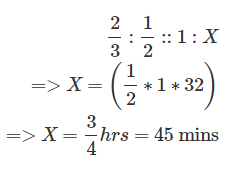
Part filled by the four taps in 1 hour = 4 × (1/6) = 2/3

Remaining part after 1/2 filled = 1-1/2 = 1/2

capture Dup 5 -72357528

Total time = 3 hours + 45 mins = 3 hours 45 mins

Please log in or register to report this question.

109.

Working alone, two pipes A and B require 9 hours and 6.25 hours more respectively to fill a pool than if they were working together. Find the total time taken to fill the pool if both were working together.

Answer: D

Let the time taken if both were working together be ‘n’ hours.
=> Time taken by A = n + 9
=> Time taken by B = n + 6.25
 
In such kind of problems, we apply the formula :
n2 = a x b, where ‘a’ and ‘b’ are the extra time taken if both work individually than if both work together.
Therefore, n2 = 9 x 6.25
=> n = 3 x 2.5 = 7.5
 
Thus, working together, pipes A and B require 7.5 hours.

Please log in or register to report this question.

110.

To fill a cistern, pipes A, B and C take 20 minutes, 15 minute and 12 minutes respectively. The time in minutes that the three pipes together will take to fill the cistern is:

Answer: A

A can do a piece of work in x minutes
B can do a piece of work in y minutes
C can do a piece of work in z minutes
Minute’s work of each of the three is 1/x +1/y + 1/z
1 minutes work of each of the three pipes = 1/20 + 1/15 + 1/12
= 1/5 or = 5 minutes

Please log in or register to report this question.

Loading…
Tags: Pipes & Cistern Questions and Answers || Pipes & Cistern MCQ Questions and Answers || Pipes & Cistern GK Questions and Answers || Pipes & Cistern GK MCQ Questions || Pipes & Cistern Multiple Choice Questions and Answers || Pipes & Cistern GK || GK on Pipes & Cistern || Quantitative Aptitude Questions and Answers || Quantitative Aptitude MCQ Questions and Answers || Quantitative Aptitude GK Questions and Answers || GK on Quantitative Aptitude