
Machine-translated by Google. Questions are authored in English.
Top

Geometry (Lines, Angles, Triangles, Polygons) Questions and Answers

Important Instructions
81.

The difference of two complementary angles is 40°. If smaller of these angles is y, then the value of \((2y + 15^{\circ})\) is

Exam Year(s)

CTET - 2024,

Answer: D

The value of (2y + 15°) is 65°.

Complementary angles add up to 90°. Let the larger be a and the smaller y:

\[ \begin{aligned} a + y &= 90^{\circ},\ a - y = 40^{\circ} \\ y &= 25^{\circ} \\ 2y + 15^{\circ} &= 65^{\circ} \end{aligned} \]

The angles are 65° and 25°, and they do add to 90° and differ by 40°. Note that 2y + 15° happens to equal the larger angle, a useful check. Any other value of y breaks one of the two conditions, so 45°, 50° and 55° are wrong.

Please log in or register to report this question.
82.

Which of the following figures do not have equal number of lines of symmetry?

Exam Year(s)

CTET - 2024,

Answer: B

The pair that does not have an equal number of lines of symmetry is Kite and parallelogram.

  • Isosceles triangle: 1 line; kite: 1 line, so pair A is equal.
  • Kite: 1 line; a general parallelogram: 0 lines, so pair B is unequal.
  • Rectangle: 2 lines; rhombus: 2 lines (its diagonals), so pair C is equal.
  • Kite: 1 line; isosceles trapezium: 1 line, so pair D is equal.

A parallelogram has rotational symmetry of order 2 but, unless it is a rectangle or rhombus, no line of symmetry.

Please log in or register to report this question.

83.

S is a point on side QR of a triangle PQR such that \(PS \perp QR\) and PS is the bisector of \(\angle QPR\). Then, which of the following statements is true?

Exam Year(s)

CTET - 2024,

Answer: B

The true statement is ΔPQS ≅ ΔPRS, by ASA.

In triangles PQS and PRS:

  • ∠QPS = ∠RPS, because PS bisects ∠QPR (angle);
  • PS = PS, the common side (side);
  • ∠PSQ = ∠PSR = 90°, because PS is perpendicular to QR (angle).

So the triangles are congruent by ASA, with P matching P, Q matching R and S matching S, which is written ΔPQS ≅ ΔPRS. RHS cannot be used because it needs the hypotenuses PQ and PR to be known equal, which is not given. Writing ΔPSR matches Q with S, the wrong correspondence.

Please log in or register to report this question.

84.

Which of the following can be the length of the third side of a triangle whose two sides are of lengths 19 cm and 15 cm?

Exam Year(s)

CTET - 2024,

Answer: C

The third side can be 33 cm.

By the triangle inequality, each side must be less than the sum and greater than the difference of the other two:

\[ 19 - 15 \lt c \lt 19 + 15,\ \text{so}\ 4 \lt c \lt 34 \]

Only 33 cm lies strictly between 4 cm and 34 cm. A side of 4 cm or 34 cm would make the three points lie on one straight line, so no triangle forms, and 3 cm is too short to close the triangle.

Please log in or register to report this question.

85.

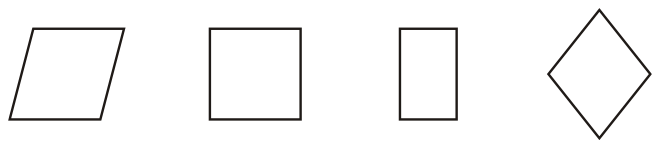
For the given shapes, which one of the following statements is not correct?

Four shapes in a row: a slanting parallelogram, a square, an upright rectangle and a rhombus standing on one corner

Exam Year(s)

CTET - 2018,

Answer: B

The statement that is not correct is 'One of them is not a parallelogram'.

The four shapes are a slanting parallelogram, a square, a rectangle and a rhombus. A parallelogram is any quadrilateral with both pairs of opposite sides parallel, and squares, rectangles and rhombuses all qualify. So all four are parallelograms, and the claim that one is not is false.

The other statements are correct: all are parallelograms; two are rhombuses (the square and the rhombus, since a square has four equal sides); and two are rectangles (the square and the rectangle, since a square has four right angles).

Please log in or register to report this question.

86.

Which one of the following 3D shapes does not have a vertex?

Exam Year(s)

CTET - 2018,

Answer: D

The shape without a vertex is the sphere.

A vertex is a corner point where edges meet. A sphere has one continuous curved surface, with no edges and no corners at all.

A pyramid has an apex and the corners of its base, a prism has the corners of its two bases (a triangular prism has 6), and a cone has one vertex at its tip, even though its base is a curved edge.

Please log in or register to report this question.

87.

ΔABC and ΔADB are on the common base AB and on the same side of AB. DA⊥AB, CB⊥AB and AC = BD. Which of the following is true ?

Exam Year(s)

CTET - 2019,

Answer: C

The true statement is ΔABC ≅ ΔBAD.

Since DA ⊥ AB and CB ⊥ AB, both triangles are right-angled: ΔABC at B and ΔBAD at A. Their hypotenuses are equal (AC = BD) and they share the side AB. By the RHS congruence rule the triangles are congruent.

The correspondence must match equal parts: the right angle B of ΔABC goes to the right angle A, the vertex A goes to B, and C goes to D. So A ↔ B, B ↔ A, C ↔ D, written ΔABC ≅ ΔBAD. The other orderings pair the right angles or the hypotenuses wrongly, even though they name the same two triangles.

Please log in or register to report this question.

88.

The sides of four triangles are given in the options.

Which of them forms a right triangle ?

Exam Year(s)

CTET - 2019,

Answer: C

The right triangle is (iii), with sides 11 cm, 60 cm and 61 cm.

By the converse of Pythagoras' theorem, a triangle is right-angled when the square of the longest side equals the sum of the squares of the other two:

\[ \begin{aligned} 11^{2} + 60^{2} &= 121 + 3600 = 3721 \\ 61^{2} &= 3721 \end{aligned} \]

The others fail: \(20^{2} + 22^{2} = 884 \ne 576\); \(15^{2} + 32^{2} = 1249 \ne 1369\); \(19^{2} + 40^{2} = 1961 \ne 1681\). The familiar triple 9, 40, 41 has 9, not 19, so (iv) is a near miss.

Please log in or register to report this question.

89.

The angles of a quadrilateral are in the ratio 3 : 5 : 7 : 9. What is the difference between the least and the greatest angles of the quadrilateral ?

Exam Year(s)

CTET - 2019,

Answer: D

The difference is 90°.

The angles of a quadrilateral add up to 360°. With the ratio 3 : 5 : 7 : 9:

\[ \begin{aligned} 3 + 5 + 7 + 9 &= 24\ \text{parts} \\ 1\ \text{part} &= 360^{\circ}/24 = 15^{\circ} \\ 9 \times 15 - 3 \times 15 &= 135 - 45 = 90^{\circ} \end{aligned} \]

The angles are 45°, 75°, 105° and 135°. Using 180° (the triangle sum) instead of 360° would halve every angle and give 45°, which is not offered; 60° and 72° do not follow from the ratio.

Please log in or register to report this question.

90.

The perimeter of a triangle is 12 cm. If all the three sides have lengths (in cm), in integers, then how many such different triangles are possible ?

Exam Year(s)

CTET - 2019,

Answer: B

3 such triangles are possible.

Let the integer sides be a ≤ b ≤ c with a + b + c = 12. The triangle inequality requires a + b > c, so c < 6, while c must be at least 4 (the largest side is at least a third of the perimeter). Checking c = 4 and c = 5:

  • c = 4: (4, 4, 4).
  • c = 5: (2, 5, 5) and (3, 4, 5).

c = 6 fails because a + b = 6 would not exceed it (a degenerate, flat triangle). So there are 3 triangles. Counting (1, 5, 6) or (2, 4, 6) wrongly gives 4 or 5.

Please log in or register to report this question.

Loading…
Tags: Geometry Lines, Angles, Triangles Questions || Polygons MCQ Questions and Answers || Geometry Quantitative Aptitude || Angles and Triangles GK Questions || Quantitative Aptitude Geometry GK