
Machine-translated by Google. Questions are authored in English.
Top

Basic Concepts of Polymers Questions and Answers

Direction for [ Question No: 1 To 1 ] :

In tensile testing of carbon fiber reinforced epoxy composite samples, the following data were recorded:

gauge length = 4 cm
cross-section = 0.8 cm × 0.3 cm
increase in gauge length at the break point = 0.03 cm
breaking load = 50 kg

1.

Considering the stress-strain curve to be linear up to the break point, the tensile strength is

Exam Year(s)

GATE XE - 2012,

Answer: B

The tensile strength is 208.3 kg/cm2.

Tensile strength is the breaking load divided by the original cross-sectional area:

\[ \begin{aligned} \sigma &= \frac{50}{0.8 \times 0.3} = \frac{50}{0.24} \\ &= 208.3\ \text{kg/cm}^{2} \end{aligned} \]

The stress-strain curve being linear to the break matters for the next part, the modulus, not for the strength. The other options would need a different area or load; 535.5, for example, is far too high for a 50 kg load on 0.24 cm2.

Please log in or register to report this question.
Direction for [ Question No: 2 To 3 ] :

The stress relaxation equation for polymers is given by, \(\sigma = \sigma_{0}e^{-t/\tau}\), where σ is the stress at any time instant t, σ0 is the initial stress and τ is the relaxation time. The relaxation process is temperature dependent and follows the Arrhenius law. For a rubber sample, the relaxation time is 60 days at 25°C.

2.

If the above sample is stressed to 2 MPa initially, then the time required to relax the stress to 1 MPa will be

Exam Year(s)

GATE XE - 2012,

Answer: B

The stress halves in about 41.6 days.

From the relaxation law, the time to fall from 2 MPa to 1 MPa is

\[ \begin{aligned} \frac{\sigma}{\sigma_{0}} &= e^{-t/\tau} = \frac{1}{2} \\ t &= \tau\ln 2 = 60 \times 0.693 = 41.6\ \text{days} \end{aligned} \]

This is the half-life of the stress, the same for any starting stress. After one relaxation time, 60 days, the stress would be down to 1/e, about 37 percent, which is already below 1 MPa, so 61.6 days is too long; 31.6 and 51.6 do not follow from the exponential law.

Please log in or register to report this question.
3.

If the activation energy for relaxation is 30 KJ/mol, the relaxation time at 35°C will be

Exam Year(s)

GATE XE - 2012,

Answer: C

The relaxation time at 35°C is about 40.5 days.

For an Arrhenius process the relaxation time falls as temperature rises:

\[ \begin{aligned} \frac{\tau_{2}}{\tau_{1}} &= \exp\left[\frac{E_{a}}{R}\left(\frac{1}{T_{2}} - \frac{1}{T_{1}}\right)\right] \\ &= \exp\left[\frac{30000}{8.314}\left(\frac{1}{308.15} - \frac{1}{298.15}\right)\right] \\ &= e^{-0.393} = 0.675 \end{aligned} \]

so \(\tau_{2} = 60 \times 0.675 = 40.5\) days. The faster molecular motion at 35°C relaxes the stress sooner. The other options either barely change the time or change it too much for a 10°C rise with this activation energy.

Please log in or register to report this question.
4.

Two miscible polymers A and B are blended in weight ratio of 30:70. If the glass transition temperature, Tg of polymer A is -50°C and that of polymer B is 100°C, then the Tg of the blend is

Exam Year(s)

GATE XE - 2012,

Answer: C

The Tg of the blend is about 37.5°C.

For a miscible blend the Fox equation weights the reciprocal glass transition temperatures (in kelvin) by mass fraction:

\[ \begin{aligned} \frac{1}{T_{g}} &= \frac{0.3}{223.15} + \frac{0.7}{373.15} \\ &= 0.0013444 + 0.0018759 = 0.0032203 \\ T_{g} &= 310.5\ \text{K} \approx 37.4^{\circ}\text{C} \end{aligned} \]

A simple linear rule of mixtures would give 0.3(-50) + 0.7(100) = 55°C, which is not offered. The other options do not follow from the Fox equation with these weight fractions.

Please log in or register to report this question.
5.

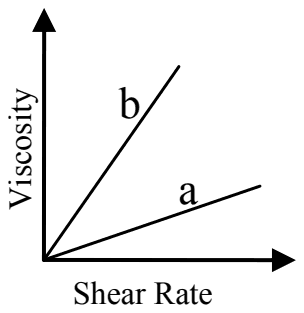
If the flow curves of two viscous fluids are represented by

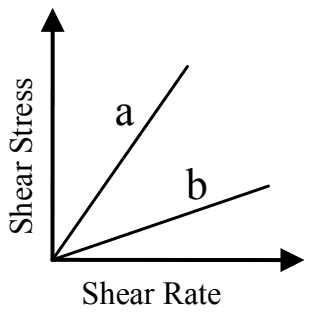
Shear stress against shear rate: two straight lines through the origin, a steeper than b

then, the viscosity plots of the fluids will be

Exam Year(s)

GATE XE - 2012,

Answer: A

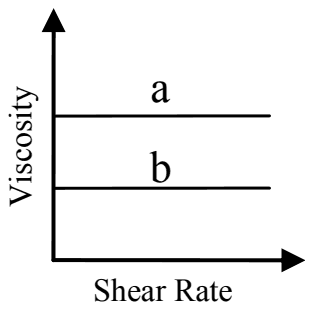
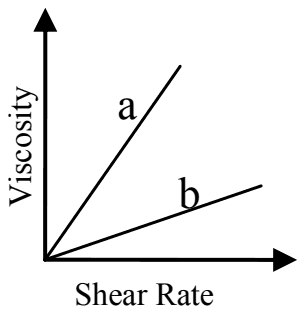
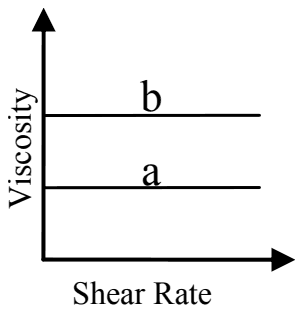
The viscosity plots are (A): two horizontal lines, with a above b.

Both flow curves are straight lines through the origin, so shear stress is proportional to shear rate: both fluids are Newtonian. Their viscosity, the slope \(\tau/\dot{\gamma}\), is a constant that does not change with shear rate, so each plots as a horizontal line on a viscosity against shear rate graph.

Fluid a has the steeper flow curve, so it has the higher viscosity and its line lies above b's. Plot (C) reverses the order. Plots (B) and (D) show viscosity rising with shear rate, which describes shear-thickening fluids, not straight-line flow curves through the origin.

Please log in or register to report this question.
6.

In a three-point bending mode for flexural test of a polymer sample with the following data:

load applied in the mid-span = 80 kg
width of the specimen = 3 cm
depth of the specimen = 2 cm
length of the specimen = 30 cm

the flexural strength will be

Exam Year(s)

GATE XE - 2012,

Answer: B

The flexural strength is about 29.4 MPa.

For three-point bending of a rectangular bar, the maximum stress at mid-span is \(\sigma = 3FL/(2bd^{2})\), with the 30 cm length taken as the span and the 80 kg load as a force of 784.8 N:

\[ \begin{aligned} \sigma &= \frac{3(784.8)(0.30)}{2(0.03)(0.02)^{2}} \\ &= \frac{706.3}{2.4 \times 10^{-5}} = 2.94 \times 10^{7}\ \text{Pa} \end{aligned} \]

that is 29.4 MPa. Using a rectangular section with width and depth swapped gives about 19.6 MPa, and forgetting to convert kilograms to newtons gives 3 MPa; neither is offered, and the other options do not follow from the formula.

Please log in or register to report this question.
7.

Storage modulus and tan δ of a polymer are experimentally measured by

Exam Year(s)

GATE XE - 2018,

Answer: D

They are measured by dynamic mechanical thermal analysis (DMTA, or DMA).

DMTA applies a small oscillating stress or strain and records the response over a range of temperature or frequency. The in-phase part gives the storage modulus E′, the out-of-phase part the loss modulus E″, and their ratio is tan δ, whose peak marks the glass transition.

Differential scanning calorimetry measures heat flow, thermogravimetric analysis measures mass change, and thermomechanical analysis measures dimensional change under a static load. None of them measures a modulus under oscillating load.

Please log in or register to report this question.
8.

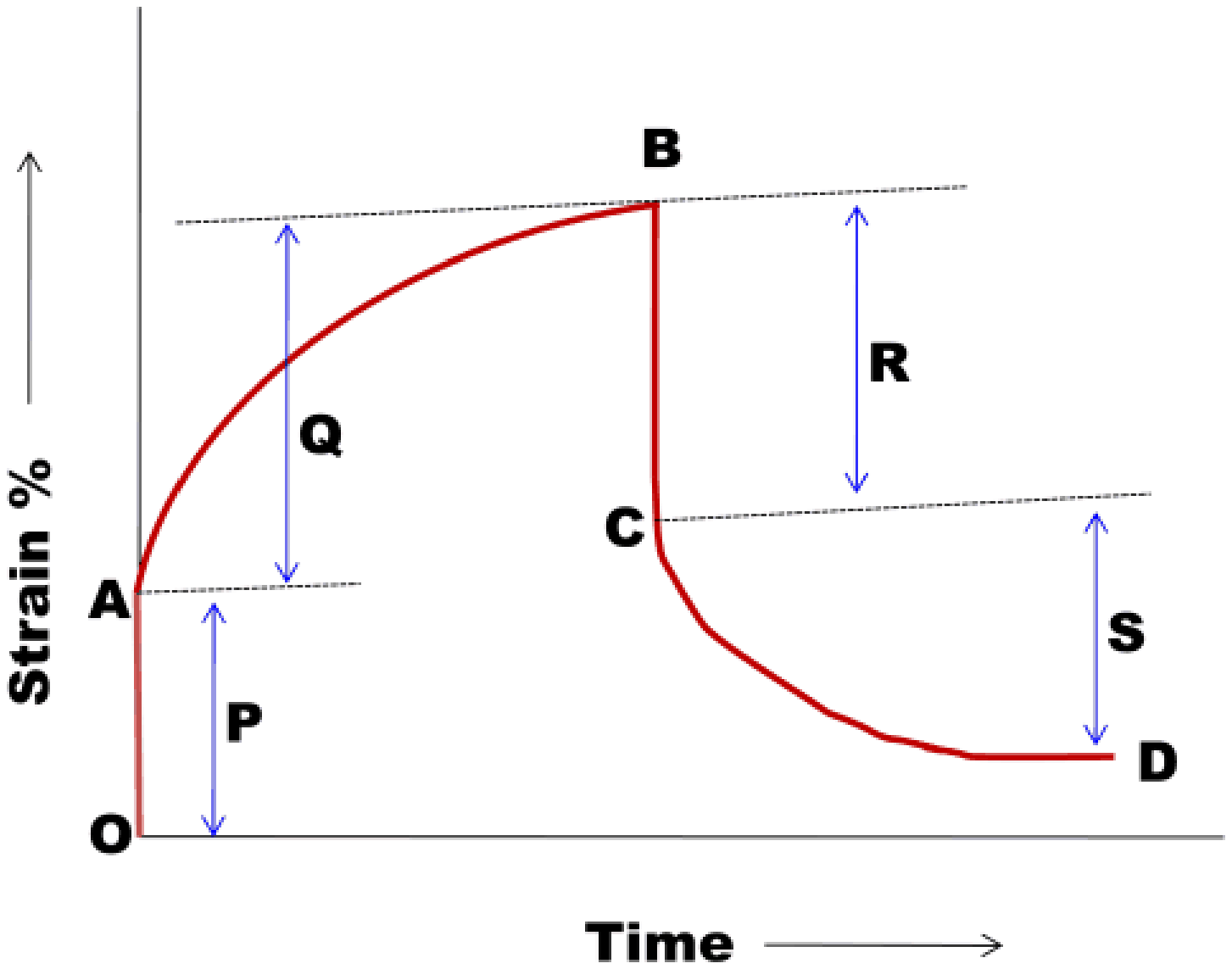
A plot of strain (%) versus time of a polymer is given below. Based on this plot and the properties as mentioned below, find out the correct combination.

Strain against time: an instant rise P from O to A, a gradual rise Q from A to B, an instant drop R from B to C when the load is removed, and a gradual fall S from C to D that levels off above zero

1 = Viscoelastic deformation; 2 = Elastic deformation
3 = Viscoelastic recovery; 4 = Elastic recovery

Exam Year(s)

GATE XE - 2018,

Answer: D

The match is P-2; Q-1; R-4; S-3.

The plot is a creep and recovery test on a viscoelastic polymer. When the load is applied, strain jumps at once from O to A: this instant part P is elastic deformation. Under constant load the strain then keeps rising with time from A to B: the time-dependent part Q is viscoelastic deformation.

When the load is removed at B, the strain drops at once from B to C: this instant part R is elastic recovery, equal in size to P. The strain then decreases slowly from C to D: S is viscoelastic recovery. The strain at D does not return to zero, which is the permanent (viscous) flow.

The other options swap instant and time-dependent parts, for example calling the vertical jump P viscoelastic.

Please log in or register to report this question.
9.

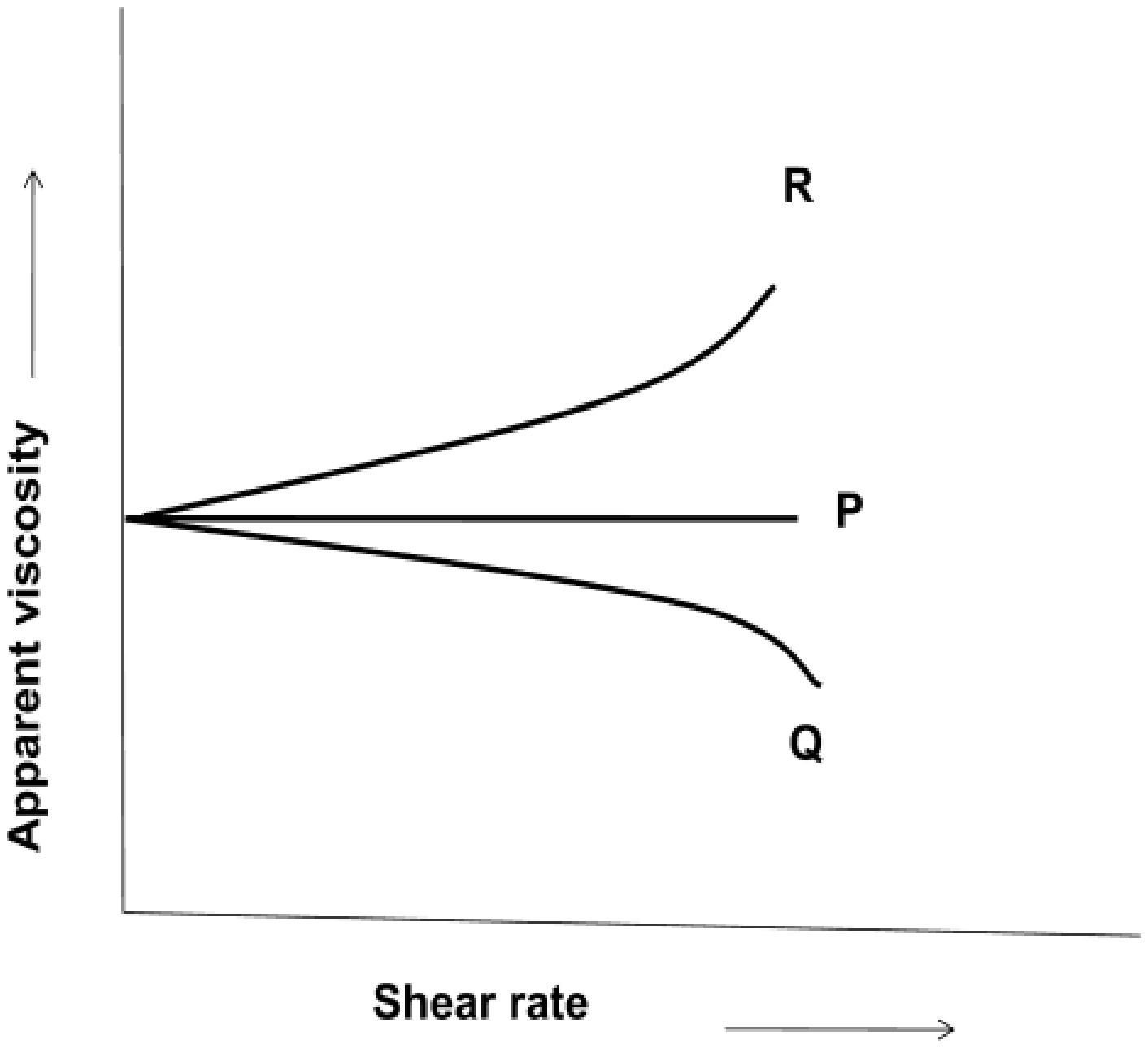
The plot shows apparent viscosity versus shear rate of Newtonian, Dilatent and Pseudoplastic fluids. Based on this plot and the fluid behaviour as mentioned below, find out the correct combination.

Apparent viscosity against shear rate for three fluids starting from the same value: R rises with shear rate, P stays constant and Q falls

1 = Dilatent fluid; 2 = Newtonian fluid, 3 = Pseudoplastic fluid

Exam Year(s)

GATE XE - 2018,

Answer: C

The match is P-2; Q-3; R-1.

A Newtonian fluid has a viscosity independent of shear rate: the horizontal line P. A pseudoplastic (shear-thinning) fluid's apparent viscosity falls as shear rate rises: the falling curve Q. A dilatant (shear-thickening) fluid's apparent viscosity rises with shear rate: the rising curve R.

'P-1; Q-2; R-3' calls the flat line dilatant, and 'P-3; Q-1; R-2' calls it pseudoplastic. The last option assigns Q twice and leaves R unassigned, so it cannot be a complete match.

Please log in or register to report this question.

10.

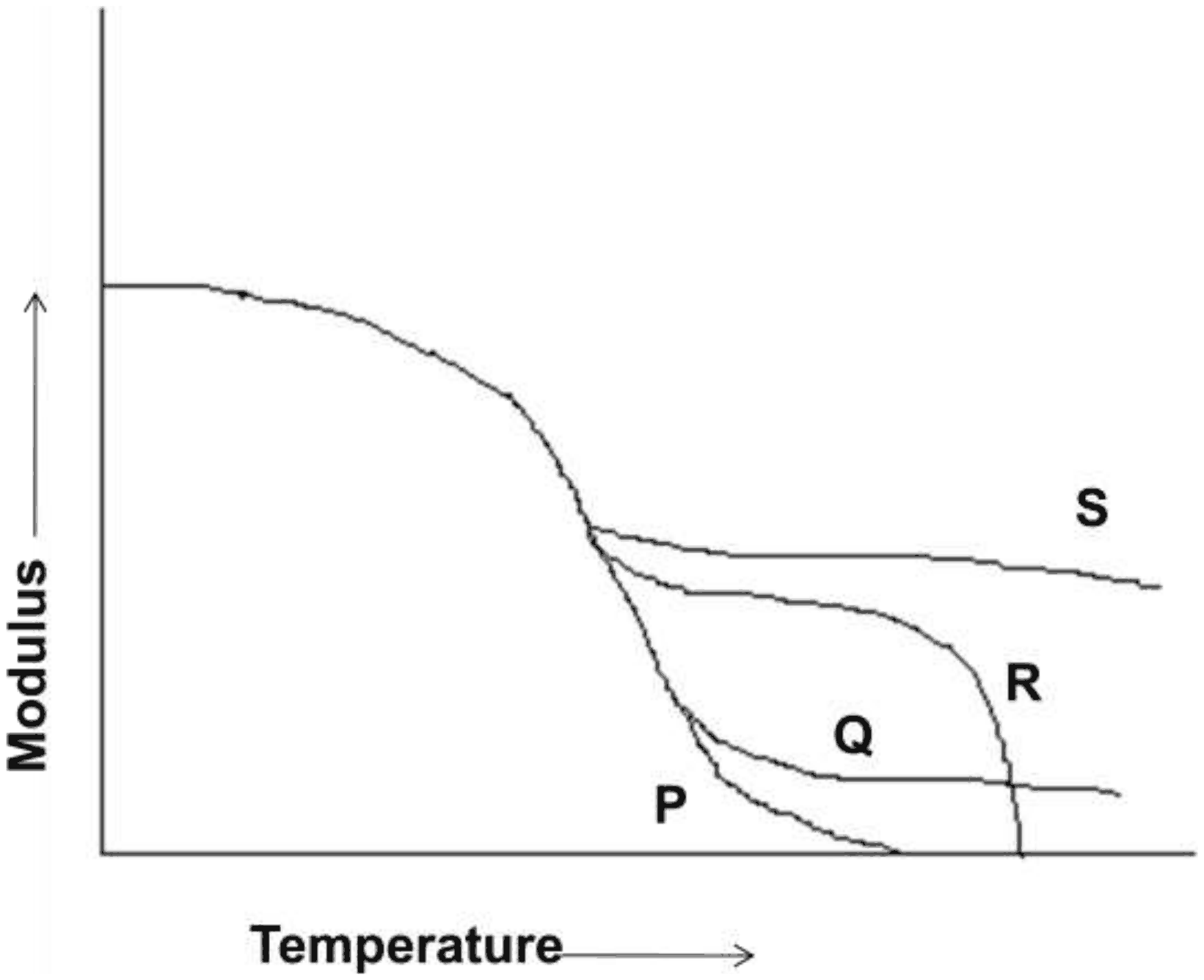
Plot of the modulus versus temperature of different types of polymers is given below. Based on this plot and the nature of the polymers as mentioned below, find out the correct combination.

Modulus against temperature: a common glassy plateau and drop, after which P falls to zero, Q levels at a low plateau, R holds a higher plateau then falls sharply to zero, and S keeps a high plateau

1 = An amorphous polymer of high molecular weight having entanglements
2 = An amorphous polymer of moderate molecular weight
3 = Highly crosslinked polymer
4 = Semi-crystalline polymer

Exam Year(s)

GATE XE - 2018,

Answer: C

The match is P-2; Q-1; R-4; S-3.

All four polymers share the glassy plateau and the fall in modulus through the glass transition. What follows tells them apart:

  • P drops straight to zero, flowing as soon as it softens: an amorphous polymer of moderate molecular weight, with too few entanglements for a rubbery plateau.
  • Q levels off at a low rubbery plateau before slowly declining: entanglements in a high molecular weight amorphous polymer act as temporary crosslinks.
  • R holds a higher plateau that ends abruptly: a semi-crystalline polymer, stiffened by its crystallites until they melt.
  • S keeps a high, nearly flat modulus to the highest temperatures: a highly crosslinked polymer, which cannot flow.

Options assigning the crosslinked polymer to R or the semi-crystalline polymer to S get the end of the plateau wrong.

Please log in or register to report this question.

Loading…
Tags: Basic Concepts of Polymers Questions and Answers || Basic Concepts of Polymers MCQ Questions and Answers || Basic Concepts of Polymers GK Questions and Answers || Basic Concepts of Polymers GK MCQ Questions || Basic Concepts of Polymers Multiple Choice Questions and Answers || Basic Concepts of Polymers GK || GK on Basic Concepts of Polymers || Polymer Chemistry Questions and Answers || Polymer Chemistry MCQ Questions and Answers || Polymer Chemistry GK Questions and Answers || GK on Polymer Chemistry