
Machine-translated by Google. Questions are authored in English.
Top

Polymerisation Techniques Questions and Answers

1.

Heat dissipation is most inefficient in

Exam Year(s)

GATE XE - 2012,

Answer: C

Heat dissipation is least efficient in Bulk polymerization.

In bulk polymerisation there is only monomer and initiator. Addition polymerisation is strongly exothermic, and as conversion rises the viscosity soars, so the heat cannot be stirred or conducted away. Local hot spots accelerate the reaction further (the gel or Trommsdorff effect) and can lead to runaway.

Solution polymerisation dilutes the system with a solvent that absorbs heat and keeps it fluid. Suspension and emulsion polymerisation disperse the monomer as droplets or particles in water, whose high heat capacity and low viscosity remove heat very efficiently.

Please log in or register to report this question.
2.

Match the following:

P. Butyl rubber1. Metallocene polymerization
Q. Cold SBR2. Cationic polymerization
R. Poly(ethylene terephthalate)3. Redox polymerization
S. Polypropylene4. Condensation polymerization

Exam Year(s)

GATE XE - 2018,

Answer: D

The match is P-2; Q-3; R-4; S-1.

  • Butyl rubber is made by cationic copolymerisation of isobutylene with a little isoprene, using a Lewis acid initiator at very low temperature.
  • Cold SBR is emulsion-polymerised at about 5 °C, which needs a redox initiator system to generate radicals at that temperature.
  • PET is a polyester made by condensation polymerisation of terephthalic acid (or its dimethyl ester) with ethylene glycol.
  • Polypropylene is made by coordination polymerisation, including with metallocene catalysts that control its tacticity.

Options assigning metallocene catalysts to butyl rubber or SBR, or condensation to polypropylene, mismatch the chemistry of at least two polymers.

Please log in or register to report this question.

3.

Interfacial polymerization can be used to prepare

Exam Year(s)

GATE XE - 2022,

Answer: B

Interfacial polymerization can be used to prepare Nylon 66.

Interfacial polymerization is a step-growth condensation at the boundary of two immiscible liquids: a diamine in water and a diacid chloride in an organic solvent. Hexamethylenediamine and adipoyl (or sebacoyl) chloride react at the interface to give nylon 66 (or 610); this is the classic 'nylon rope trick'.

Nylon 6 is made by ring-opening polymerization of caprolactam. Polyacrylonitrile and poly(butyl acrylate) are vinyl polymers made by free-radical chain-growth polymerization, not by condensation of two reactive monomers.

Please log in or register to report this question.

4.

Match the polymers to the polymerization method used for their synthesis

PolymerPolymerization method
P. Linear low density polyethylene1. Ring opening
Q. Nylon 62. Ziegler-Natta
R. Styrene-butadiene rubber3. Condensation
S. Aromatic polyamide4. Emulsion

Exam Year(s)

GATE XE - 2022,

Answer: A

The match is P-2; Q-1; R-4; S-3.

  • LLDPE is made by copolymerizing ethylene with an alpha-olefin on Ziegler-Natta (or metallocene) catalysts.
  • Nylon 6 is made by ring-opening polymerization of caprolactam.
  • Styrene-butadiene rubber is made mainly by emulsion polymerization.
  • Aromatic polyamides (aramids) are made by condensation of an aromatic diamine with an aromatic diacid chloride.

The other options agree on LLDPE but give nylon 6 a condensation route, or put SBR and the aramid in each other's places.

Please log in or register to report this question.

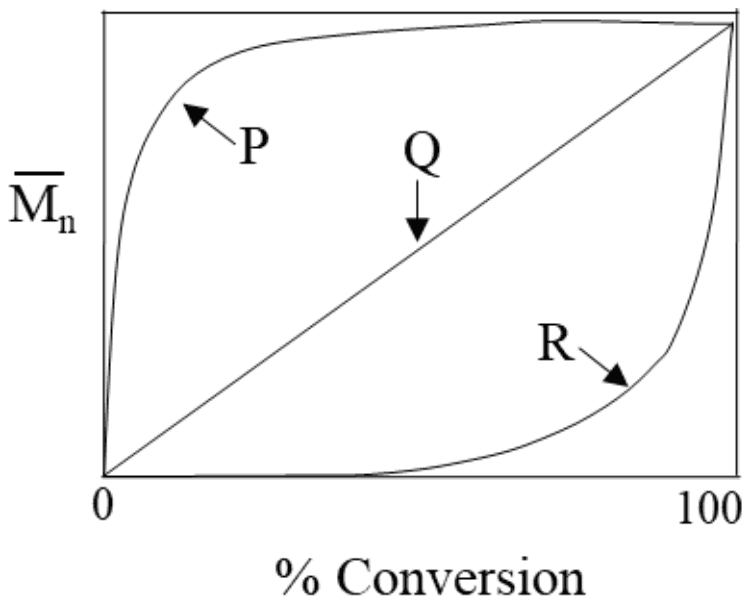
Answer: B

The correct correlation is P - chain growth; Q - living polymerization; R - step growth.

Chain growth (P): each chain starts, grows to full length in a fraction of a second and terminates. High molecular weight chains appear from the very start, so \(\overline{M}_{n}\) jumps up at low conversion and then stays roughly constant while more monomer is converted into more chains.

Living polymerization (Q): all chains start together and there is no termination, so every chain keeps growing as monomer is consumed. \(\overline{M}_{n}\) rises linearly with conversion.

Step growth (R): any two species can react, so monomers first form dimers, trimers and short oligomers. By the Carothers equation \(\overline{X}_{n} = 1/(1 - p)\), high molecular weight appears only at very high conversion, near 99%, hence the sharp rise at the end.

Options assigning the linear line to chain growth, or the late rise to chain growth, contradict these mechanisms.

Please log in or register to report this question.

6.

Select the correct option to match the Initiator(s) with the Method of polymerization from the table given below:

Initiator(s)Method of polymerization
PBF3/H2OIAnionic polymerization
Qn-C4H9LiIICationic polymerization
RFeCl2/K2S2O8IIICoordination addition polymerization
SMetallocene/methylaluminoxaneIVFree radical addition polymerization

Exam Year(s)

GATE XE - 2026,

Answer: D

The correct matching is P-II ; Q-I ; R-IV ; S-III.

  • BF3/H2O: a Lewis acid with a co-initiator that supplies a proton, the classic initiator for cationic polymerization (II).
  • n-Butyllithium: a carbanion source for anionic (living) polymerization (I).
  • FeCl2/K2S2O8: a redox pair in which Fe2+ reduces persulfate to sulfate radicals, starting free radical polymerization (IV).
  • Metallocene/methylaluminoxane: a single-site coordination catalyst for olefin polymerization (III).

Options A and C call butyllithium a coordination or cationic initiator, and option B makes BF3/H2O a radical initiator and the redox pair cationic.

Please log in or register to report this question.

Loading…
Tags: Polymerisation Techniques Questions and Answers || Polymerisation Techniques MCQ Questions and Answers || Polymerisation Techniques GK Questions and Answers || Polymerisation Techniques GK MCQ Questions || Polymerisation Techniques Multiple Choice Questions and Answers || Polymerisation Techniques GK || GK on Polymerisation Techniques || Polymer Chemistry Questions and Answers || Polymer Chemistry MCQ Questions and Answers || Polymer Chemistry GK Questions and Answers || GK on Polymer Chemistry