
Machine-translated by Google. Questions are authored in English.
Top

Normal and Oblique Shock Waves Questions and Answers

Answer: D

The statement that is NOT TRUE is Static pressure increases, total temperature decreases.

A shock wave is adiabatic and does no work on the gas, so the total enthalpy, and for a perfect gas the total temperature, is the same on both sides. Total temperature does not decrease.

The other statements are true. Across an oblique shock the flow is compressed, so static pressure and static temperature both rise, while the shock is irreversible, so entropy rises and total pressure falls. Each true statement pairs one of these increases with constant total temperature or falling total pressure.

Please log in or register to report this question.
Answer: B

The air's static temperature increases and its total temperature increases.

Across the shock the gas is compressed, so its static pressure and static temperature rise. In the shock tube the air was at rest and the shock sets it moving, so behind the shock it also has kinetic energy. The moving shock does work on the gas: in the laboratory frame the flow is unsteady, and total enthalpy is not conserved across a moving shock, so the total temperature rises too.

The total temperature is constant across a shock only in the frame moving with the shock, where the flow is steady; that is the trap in 'total temperature remains constant', in both options that say so. A fall in total temperature would need energy to be taken out of the gas, which a compression shock does not do.

Please log in or register to report this question.
103.

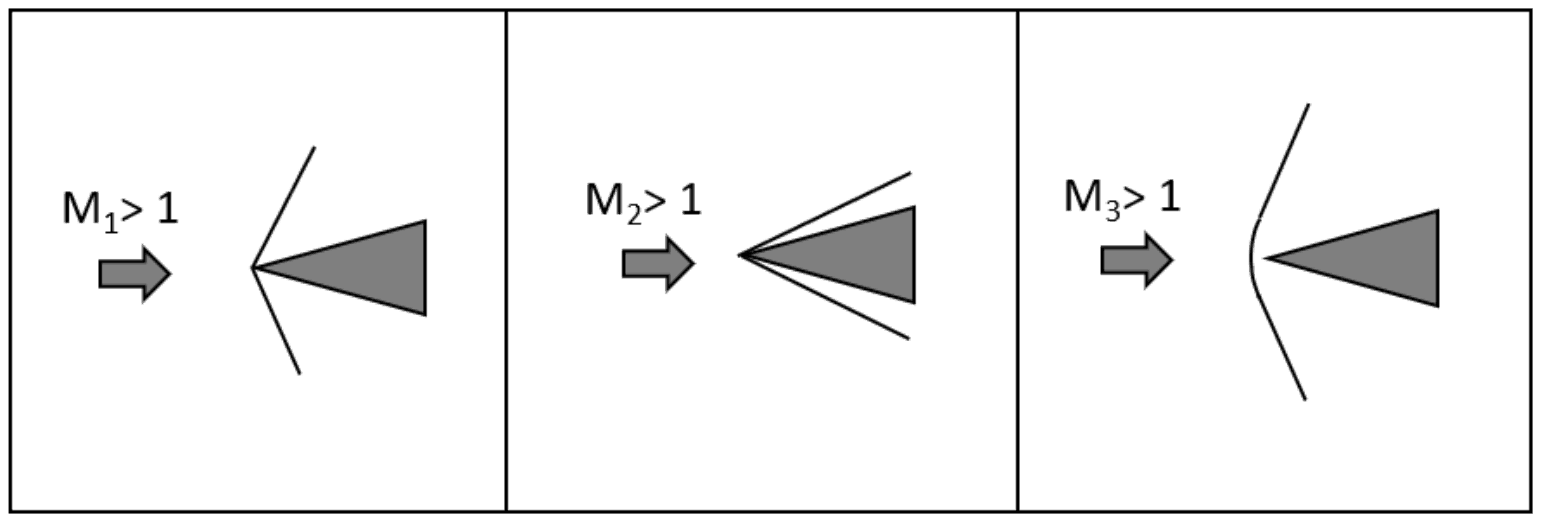
Shock structures for flow at three different Mach numbers over a given wedge are shown in the figure below. Assuming that only the weak shock solutions are possible for the attached oblique shocks, which one of the following options is TRUE?

The same wedge in three flows: at M1 an attached oblique shock at a steep angle, at M2 an attached shock lying close to the wedge, at M3 a detached curved shock ahead of the wedge

Exam Year(s)

GATE AE - 2024,

Answer: D

The correct order is \(M_{3} \lt M_{1} \lt M_{2}\).

For a fixed wedge angle, the weak oblique shock lies closer to the wedge surface (a smaller shock angle) as the Mach number rises, because the shock angle approaches the Mach angle, which shrinks with \(M\). As the Mach number falls, the shock angle grows until, below a certain Mach number, no attached shock can turn the flow through the wedge angle and the shock detaches into a curved bow shock standing ahead of the wedge.

In the figure, the flow at \(M_{3}\) has a detached shock, so \(M_{3}\) is the lowest. The shock at \(M_{2}\) hugs the wedge more closely than the shock at \(M_{1}\), so \(M_{2}\) is the highest. Any order that puts \(M_{3}\) above \(M_{1}\) or \(M_{1}\) above \(M_{2}\) contradicts these shapes.

Please log in or register to report this question.

104.

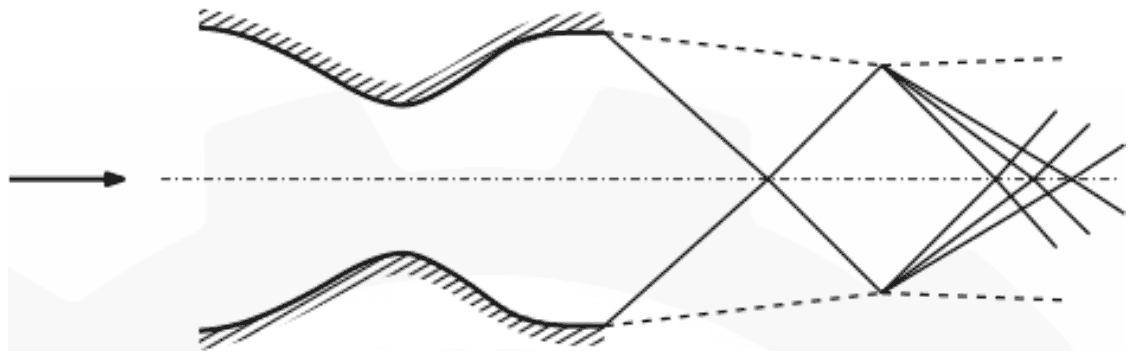
In the figure shown below, the flow at the nozzle exit is ________.

A convergent-divergent nozzle discharging to the right. Oblique shock waves start at both exit lips and cross on the axis, and the dashed jet boundary first narrows downstream of the exit

Exam Year(s)

GATE AE - 2026,

Answer: A

The flow at the exit is overexpanded.

In an overexpanded nozzle the exit pressure is below the ambient pressure, so the jet must be compressed to match it. Oblique shock waves therefore stand at the exit lips, turning the flow inward, and the jet boundary narrows just downstream of the exit, as in the figure. The shocks reflect from the axis and the pattern repeats as a chain of diamonds.

An underexpanded jet (exit pressure above ambient) starts instead with expansion fans at the lips and a jet that widens. An ideally expanded jet leaves with no waves at all. Shock and expansion patterns of this kind exist only in supersonic flow, so the exit flow cannot be subsonic.

Please log in or register to report this question.

Loading…
Tags: Normal and Oblique Shock Waves Questions and Answers || Normal and Oblique Shock Waves MCQ Questions and Answers || Normal and Oblique Shock Waves GK Questions and Answers || Normal and Oblique Shock Waves GK MCQ Questions || Normal and Oblique Shock Waves Multiple Choice Questions and Answers || Normal and Oblique Shock Waves GK || GK on Normal and Oblique Shock Waves || Aerodynamics Questions and Answers || Aerodynamics MCQ Questions and Answers || Aerodynamics GK Questions and Answers || GK on Aerodynamics