
Machine-translated by Google. Questions are authored in English.
Top

Shear Flow in Open and Closed Sections Questions and Answers

101.

The closed thin-walled rectangular channel shown in figure (i) is opened by introducing a sharp cut at the center of the bottom edge, as shown in figure (ii). Which one of the following statements is correct?
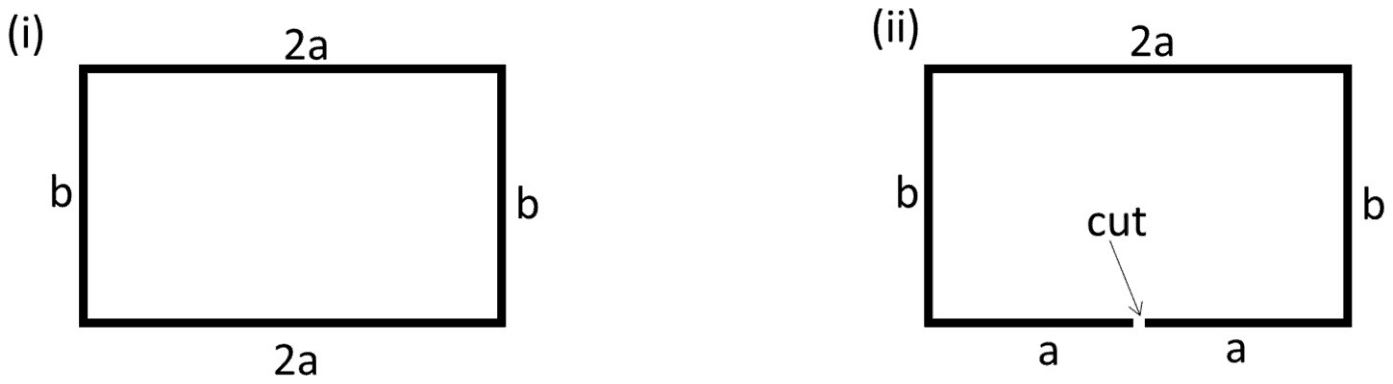
(i) a closed thin-walled rectangle 2a wide and b high; (ii) the same rectangle with a cut at the middle of the bottom edge, leaving two lengths a

Exam Year(s)

GATE AE - 2022,

Answer: A

The centroids coincide, while the shear centres do not.

A sharp cut removes a negligible amount of wall, so the material of the section, and hence its centroid, is unchanged. The closed rectangular tube is doubly symmetric, so its shear centre lies at the centroid. Cutting the bottom wall at its centre leaves an open section that is still symmetric about the vertical axis, so its shear centre lies on that axis, but the shear flow now has to start from zero at the cut. The resulting shear flow distribution is different, and the shear centre of the open section moves along the axis of symmetry, away from the centroid.

So the options saying the shear centres coincide (with or without the centroids) are wrong, and so is the option saying the centroids move.

Please log in or register to report this question.
102.

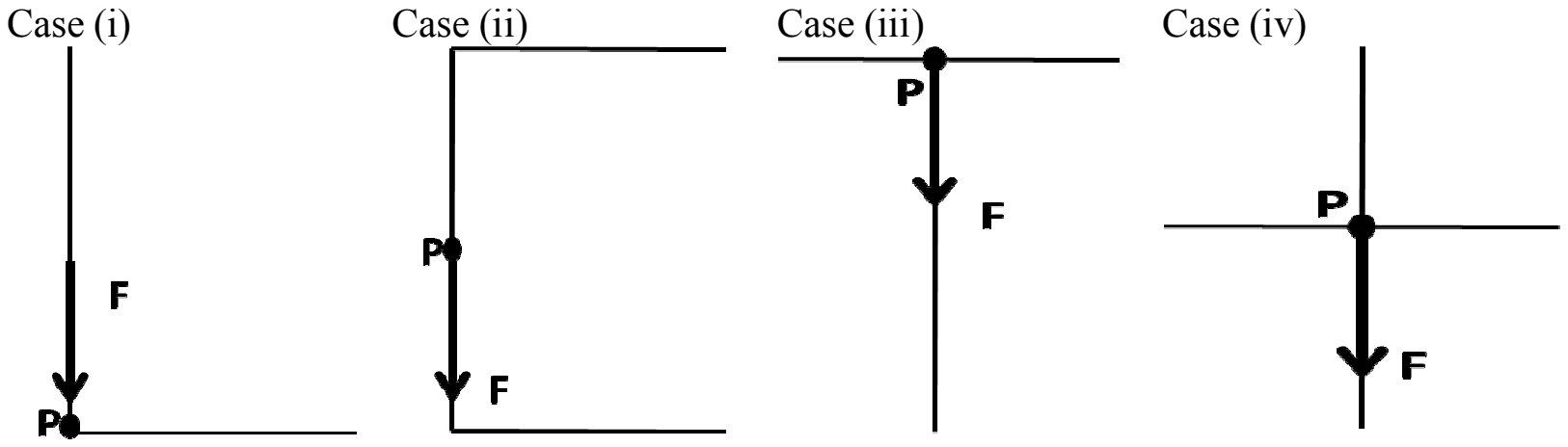
Consider four thin-walled beams of different open cross-sections, as shown in the cases (i-iv). A shear force of magnitude 'F' acts vertically downward at the location 'P' in all the beams. In which of the following case, does the shear force induce bending and twisting?

Four open sections with a downward force F at point P: (i) an angle with P at the corner; (ii) a channel with P at mid-height of the web; (iii) a T with P at the web-flange junction; (iv) a cross with P at the centre

Exam Year(s)

GATE AE - 2016,

Answer: B

The force causes both bending and twisting in case (ii).

A shear force produces bending only if its line of action passes through the shear centre of the section; otherwise it also twists the beam. For sections made of thin walls meeting at one point, the shear centre is that meeting point.

  • (i) Angle: the shear centre is at the corner where the legs meet, and P is at the corner, so there is no twist.
  • (iii) T: the shear centre is at the web-flange junction, where P is, so there is no twist.
  • (iv) Cross: the shear centre is at the centre, where P is, so there is no twist.
  • (ii) Channel: the shear centre lies outside the web, on the side away from the flanges. The force acts along the web, offset from the shear centre, so it twists the channel as well as bending it.

Please log in or register to report this question.

103.

Determine the correctness or otherwise of the following statements, [a] and [r]:

[a] A closed-section box beam configuration is used in aircraft wings.
[r] Closed-section box beam configuration is capable of resisting torsional loads.

Exam Year(s)

GATE AE - 2018,

Answer: A

Both [a] and [r] are true and [r] is the correct reason for [a].

A wing carries large torsional loads from the aerodynamic pitching moment, from the offset of the lift from the shear centre, and from control-surface loads. A closed section, such as the box formed by the front and rear spars with the upper and lower skins, carries torque through a constant shear flow around the closed cell (the Bredt-Batho relation), which makes it very stiff and strong in torsion. Open sections of the same material are far weaker in twist.

So the box beam is used in wings precisely because it resists torsion, and [r] explains [a]. That rules out the options saying either statement is false, and the option that accepts both but denies the link.

Please log in or register to report this question.

104.

A cantilever beam with an unsymmetric cross-section is subjected to a transverse shear force (P) at its free end. P acts at the shear center of the beam cross-section.

Which one of the following statements is TRUE about the deformation of this beam?

Exam Year(s)

GATE AE - 2026,

Answer: B

The beam undergoes only bending.

The shear centre is, by definition, the point in the cross-section through which a transverse load must act for the section to bend without twisting. For an unsymmetric section it generally does not coincide with the centroid, which is why a load through the centroid of a channel, for example, makes it twist. Here P is applied at the shear centre, so no torque about the shear centre arises.

The beam still bends because P is a transverse force on a cantilever, so 'neither torsion nor bending' is wrong. Torsion alone, or torsion with bending, would require the load to be offset from the shear centre.

Please log in or register to report this question.

Loading…
Tags: Shear Flow in Open and Closed Sections Questions and Answers || Shear Flow in Open and Closed Sections MCQ Questions and Answers || Shear Flow in Open and Closed Sections GK Questions and Answers || Shear Flow in Open and Closed Sections GK MCQ Questions || Shear Flow in Open and Closed Sections Multiple Choice Questions and Answers || Shear Flow in Open and Closed Sections GK || GK on Shear Flow in Open and Closed Sections || Aerospace Structures Questions and Answers || Aerospace Structures MCQ Questions and Answers || Aerospace Structures GK Questions and Answers || GK on Aerospace Structures