
Machine-translated by Google. Questions are authored in English.
Top

Extrusion Technology Questions and Answers

1.

Extrusion cooking is accomplished in four different stages, which are indicated as I, II, III and IV in the figure given below. Choose the correct option representing the name of each stage.
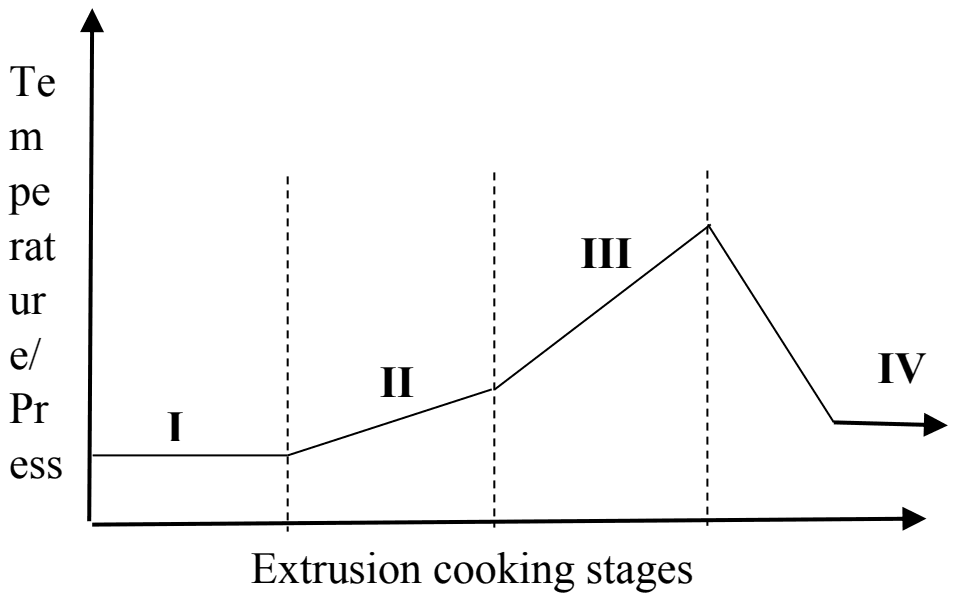
Temperature or pressure plotted against extrusion cooking stages. In stage I it is low and level; in stage II it rises gently; in stage III it rises steeply to a peak at the end of the stage; in stage IV it falls sharply and then levels off

Exam Year(s)

GATE XE - 2023,

Answer: C

The stages are I - Feeding, II - Kneading, III - Cooking, IV - Expansion.

In the extruder the raw material first enters and is conveyed at low temperature and pressure (feeding, I, the flat start of the curve). The screw then compresses and works it into a dough, raising temperature and pressure gently (kneading, II). Next, intense shear and barrel heat raise both steeply, gelatinizing the starch and denaturing proteins (cooking, III, ending at the peak just before the die). Finally the hot, pressurized melt leaves the die, the pressure drops suddenly and water flashes to steam, puffing the product (expansion, IV, the sharp fall).

Options putting cooking before kneading, or cooking first, do not fit the gradual-then-steep rise, and kneading cannot come before the material is fed.

Please log in or register to report this question.

2.

Extrusion cooking is accomplished in four different stages, which are indicated as I, II, III and IV in the figure given below. Choose the correct option representing the name of each stage.

[The figure plots Temperature/Pressure against Extrusion cooking stages: it is low and flat in stage I, rises gently in stage II, rises steeply to a peak in stage III, and drops sharply in stage IV.]

Exam Year(s)

GATE Life Sciences - 2023,

Answer: C

The stages are I - Feeding, II - Kneading, III - Cooking, IV - Expansion.

In an extruder the material first enters the feed section, where it is merely conveyed and temperature and pressure stay low and flat (I). In the kneading (compression) section it is compacted and worked into a dough, so temperature and pressure begin to rise (II). In the cooking (metering) section intense shear and heat drive both to a maximum, gelatinising starch and denaturing protein (III). At the die the melt exits to atmospheric pressure, and the sudden drop lets superheated water flash to steam and expand the product (IV).

The other options place cooking before kneading or kneading before feeding, which contradicts the rising temperature and pressure profile.

Please log in or register to report this question.

Loading…
Tags: Extrusion Technology Questions and Answers || Extrusion Technology MCQ Questions and Answers || Extrusion Technology GK Questions and Answers || Extrusion Technology GK MCQ Questions || Extrusion Technology Multiple Choice Questions and Answers || Extrusion Technology GK || GK on Extrusion Technology || Food Processing Technology Questions and Answers || Food Processing Technology MCQ Questions and Answers || Food Processing Technology GK Questions and Answers || GK on Food Processing Technology