
Machine-translated by Google. Questions are authored in English.
Top

Innate and Adaptive Immunity Questions and Answers

1.

In a population, the probability of a susceptible individual getting infected with SARS-CoV-2 is low when a majority of individuals in the population becomes immune to this virus. This phenomenon is known as _______.

Exam Year(s)

GATE Life Sciences - 2023,

Answer: D

The phenomenon is herd immunity.

When most of a population is immune, through infection or vaccination, a pathogen finds too few susceptible hosts to keep spreading, so even the people who are not immune are indirectly protected. That population-level protection is herd (community) immunity.

Innate immunity is the non-specific first defence every individual has from birth. Adaptive immunity is the specific response of lymphocytes and antibodies within one person. Active immunity is adaptive immunity a person develops after their own exposure or vaccination. All three describe protection inside an individual, not the reduced risk to susceptible people in an immune population.

Please log in or register to report this question.
2.

Phagocytosis was first described by

Exam Year(s)

GATE Life Sciences - 2023,

Answer: A

Phagocytosis was first described by Elie Metchnikoff.

In the 1880s Metchnikoff observed mobile cells in starfish larvae engulfing foreign particles, and went on to show that white blood cells engulf and digest bacteria. He named the process phagocytosis and founded the cellular theory of immunity, sharing the 1908 Nobel Prize with Paul Ehrlich.

Ehrlich championed the humoral (antibody) side of immunity. Robert Hooke described cells in cork in 1665, and Robert Koch established the germ theory of disease with his postulates; neither described phagocytosis.

Please log in or register to report this question.

3.

Match the immunological statements in Column I with the appropriate descriptions from Column II

Column IColumn II
P. Active acquired immunity(i) Complement proteins and interferons
Q. First line of defense(ii) Direct contact with pathogens that enter the body
R. Passive natural immunity(iii) Surface barriers
S. Second line of defense(iv) Antibodies pass through placenta

Exam Year(s)

GATE Life Sciences - 2023,

Answer: A

The match is P-(ii); Q-(iii); R-(iv); S-(i).

  • Active acquired immunity develops when the body itself meets a pathogen (or a vaccine) and mounts its own response: direct contact with pathogens that enter the body.
  • The first line of defence is the surface barriers: skin, mucous membranes and their secretions.
  • Passive natural immunity is the transfer of maternal antibodies across the placenta (or in milk).
  • The second line of defence is the internal innate response, including complement proteins and interferons, along with phagocytes and inflammation.

The other options confuse the placental transfer with active immunity or put complement in the first line of defence.

Please log in or register to report this question.

4.

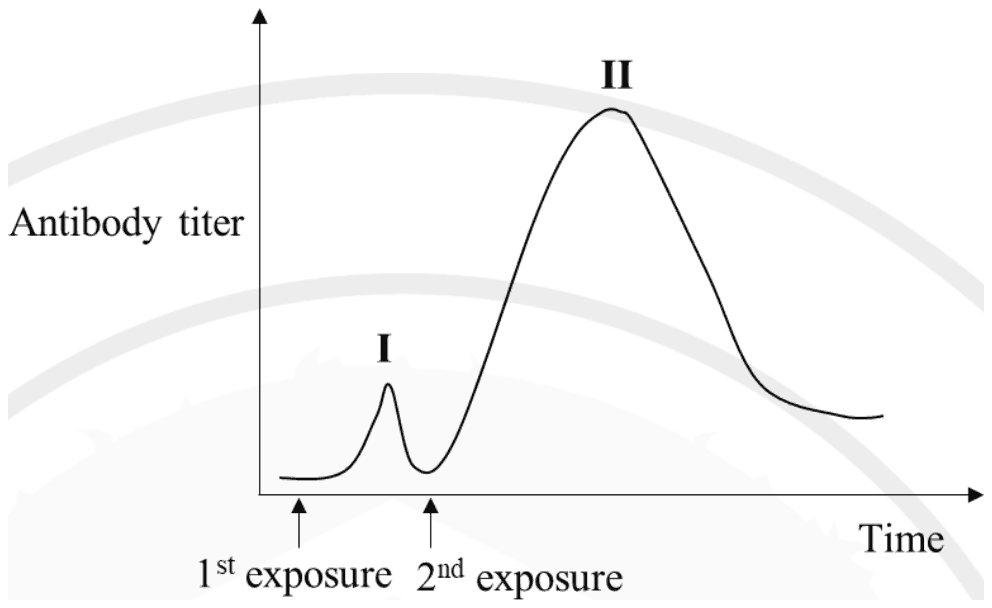
The adaptive immune response in an animal involves the generation of antibodies against an invading bacterial pathogen. The following graph represents antibody titer levels in a mammal exposed twice to the pathogen.

Antibody titer against time with arrows for the 1st and 2nd exposure: a small peak I follows the 1st exposure and a much higher, broader peak II follows the 2nd exposure

Which one of the following options correctly pairs antibodies to peak I and peak II in the graph?

Exam Year(s)

GATE Life Sciences - 2025,

Answer: B

The pairing is Peak I - IgM; Peak II - IgG.

Peak I is the primary response, after the first exposure: it is small and appears after a lag, and its antibody is mainly IgM, the first class made by naive B cells. During that response B cells undergo class switching and form memory cells.

Peak II is the secondary response. Memory B cells respond quickly to the second exposure and produce a much larger and longer-lasting titre, made up mainly of high-affinity IgG.

IgG first and IgM second reverses the order of class switching. IgE is the antibody of allergy and anti-parasite responses, not of the primary response to a bacterium. IgG for both peaks ignores the IgM that dominates a primary response.

Please log in or register to report this question.

Loading…
Tags: Innate and Adaptive Immunity Questions and Answers || Innate and Adaptive Immunity MCQ Questions and Answers || Innate and Adaptive Immunity GK Questions and Answers || Innate and Adaptive Immunity GK MCQ Questions || Innate and Adaptive Immunity Multiple Choice Questions and Answers || Innate and Adaptive Immunity GK || GK on Innate and Adaptive Immunity || Immunology Questions and Answers || Immunology MCQ Questions and Answers || Immunology GK Questions and Answers || GK on Immunology