
Machine-translated by Google. Questions are authored in English.
Top

Boundary Layer Theory Questions and Answers

Direction for [ Question No: 1 To 2 ] :

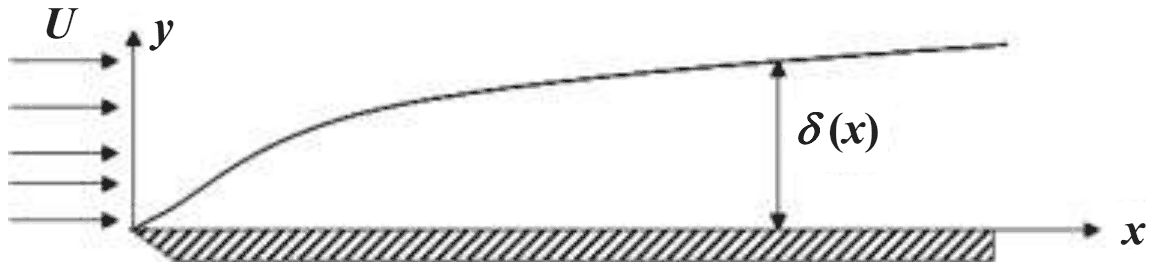
The hydrodynamic boundary layer over a flat plate is shown in the figure below. The velocity in the x-direction is approximated as \(u = a + by + cy^{2}\), where a, b and c are constants. U is the free stream velocity and \(\delta\) is the boundary-layer thickness at any point x on the plate.

Uniform stream U meeting a flat plate along the x axis; the boundary layer edge rises from the leading edge to height delta(x) above the plate

Answer: A

The profile is \(u/U = 2(y/\delta) - (y/\delta)^{2}\).

Apply the three boundary conditions: no slip at the wall, free-stream velocity at the edge, and a smooth join with the free stream (zero slope) at the edge.

\[ \begin{aligned} u(0) = 0 &\Rightarrow a = 0 \\ \left.\tfrac{du}{dy}\right|_{\delta} = 0 &\Rightarrow b + 2c\delta = 0 \\ u(\delta) = U &\Rightarrow b\delta + c\delta^{2} = U \end{aligned} \]

These give \(b = 2U/\delta\) and \(c = -U/\delta^{2}\). The '+' option gives u = 3U at the edge. The 1.5 and 0.5 coefficients belong to a cubic profile and do not satisfy the zero-slope condition for a quadratic.

Please log in or register to report this question.
2.

The displacement thickness (in mm) when \(\delta = 6\) mm, is

Exam Year(s)

GATE XE - 2012,

Answer: B

The displacement thickness is 2 mm.

With \(\eta = y/\delta\) and the profile \(u/U = 2\eta - \eta^{2}\):

\[ \begin{aligned} \delta^{*} &= \delta\int_{0}^{1}\left(1 - \frac{u}{U}\right)d\eta \\ &= \delta\int_{0}^{1}(1 - 2\eta + \eta^{2})\,d\eta \\ &= \delta\left(1 - 1 + \tfrac{1}{3}\right) = \frac{6}{3} = 2\ \text{mm} \end{aligned} \]

Displacement thickness measures the outward shift of the streamlines caused by the slowed fluid, so it must be positive and smaller than \(\delta\); the negative options are impossible. 2.25 mm would come from a different (cubic) profile.

Please log in or register to report this question.
3.

Which method is commonly used to delay the transition from a laminar to turbulent boundary layer on an aircraft wing?

Exam Year(s)

DSSSB - 2023,

Answer: C

The transition from laminar to turbulent boundary layer on a wing can be delayed by implementing suction through the surface, the key says. Suction removes the slow fluid near the wall, so the boundary layer becomes thinner and more stable. Increasing the angle of attack and adding roughness elements and vortex generators bring on or increase turbulence and so do the opposite.

This is the principle of laminar flow control on experimental wings, where the surface is perforated and a little air is drawn in through it.

Please log in or register to report this question.
4.

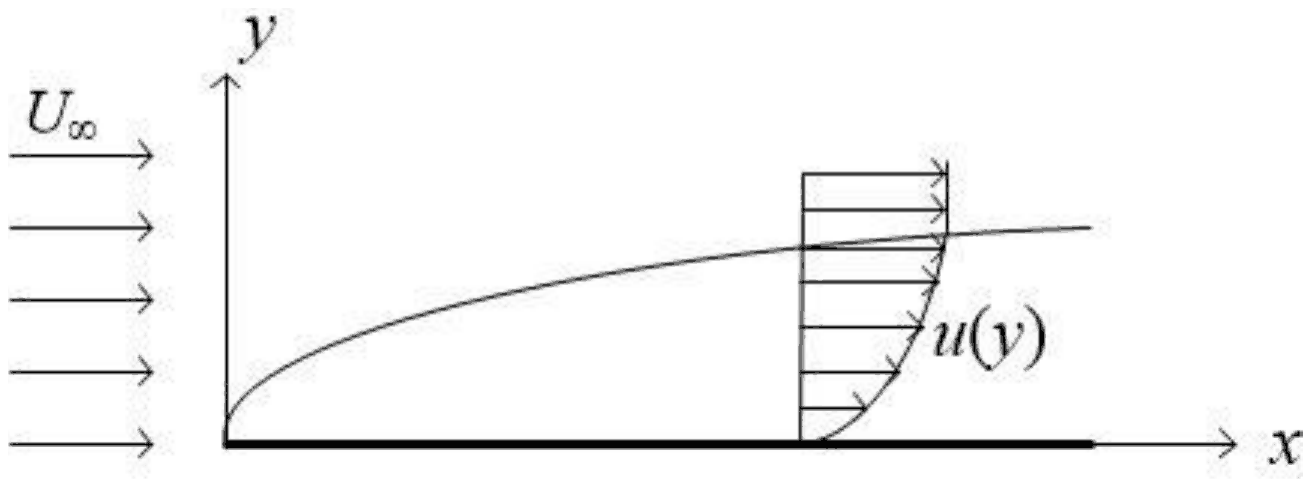
The velocity profile inside the boundary layer for flow over a flat plate is given as \(\frac{u}{U_{\infty}} = \sin\left(\frac{\pi y}{2 \delta}\right)\), where \(U_{\infty}\) is the free stream velocity and \(\delta\) is the local boundary layer thickness. If \(\delta^{*}\) is the local displacement thickness, the value of \(\frac{\delta^{*}}{\delta}\) is

Exam Year(s)

GATE ME - 2017,

Answer: B

The ratio is \(1 - \frac{2}{\pi}\).

The displacement thickness is the integral of the velocity deficit across the boundary layer. With \(\eta = y/\delta\):

\[ \begin{aligned} \frac{\delta^{*}}{\delta} &= \int_{0}^{1}\left[1 - \sin\left(\tfrac{\pi\eta}{2}\right)\right]d\eta \\ &= 1 - \frac{2}{\pi} \approx 0.363 \end{aligned} \]

since \(\int_{0}^{1}\sin(\pi\eta/2)\,d\eta = 2/\pi\). \(2/\pi\) is that integral alone, the flow carried rather than the deficit; \(1 + 2/\pi\) has the sign wrong, and 0 would mean no boundary layer.

Please log in or register to report this question.

5.

An incompressible fluid flows over a flat plate with zero pressure gradient. The boundary layer thickness is 1 mm at a location where the Reynolds number is 1000. If the velocity of the fluid alone is increased by a factor of 4, then the boundary layer thickness at the same location, in mm will be

Exam Year(s)

GATE ME - 2012,

Answer: C

The boundary layer becomes 0.5 mm thick.

At a Reynolds number of 1000 the flow is laminar, and the Blasius result for a flat plate is:

\[ \delta = \frac{5x}{\sqrt{Re_{x}}} \propto \frac{1}{\sqrt{U}} \]

At the same location, x is fixed, so increasing the velocity four times divides the thickness by \(\sqrt{4}=2\): 1 mm becomes 0.5 mm.

0.25 mm assumes thickness inversely proportional to velocity, and 2 or 4 mm have the thickness growing with velocity, the wrong direction. A faster stream thins the boundary layer.

Please log in or register to report this question.

6.

Air (density = 1.2 kg/m3, kinematic viscosity = 1.5×10⁻⁵ m2/s) flows over a flat plate with a free-stream velocity of 2 m/s. The wall shear stress at a location 15 mm from the leading edge is \(\tau_{w}\). What is the wall shear stress at a location 30 mm from the leading edge?

Exam Year(s)

GATE ME - 2023,

Answer: D

The wall shear stress at 30 mm is \(\tau_{w}/\sqrt{2}\).

First check the regime with the local Reynolds number:

\[ \begin{aligned} Re_{x} &= \frac{Ux}{\nu} \\ &= \frac{2 \times 0.015}{1.5 \times 10^{-5}} \\ &= 2000 \\ Re_{x}(30\ \text{mm}) &= 4000 \end{aligned} \]

Both are far below the transition value of about \(5 \times 10^{5}\), so the boundary layer is laminar and the Blasius result applies:

\[ \begin{aligned} \tau_{w} &= \frac{0.332\,\rho U^{2}}{\sqrt{Re_{x}}} \\ &\propto x^{-1/2} \end{aligned} \]

Doubling the distance from 15 mm to 30 mm divides the shear stress by \(\sqrt{2}\). \(\tau_{w}/2\) would need \(\tau_{w} \propto 1/x\). \(\sqrt{2}\,\tau_{w}\) and \(2\,\tau_{w}\) make the stress grow downstream, but it falls, because the boundary layer thickens and the velocity gradient at the wall weakens.

Please log in or register to report this question.

7.

A typical boundary layer over a flat plate has a linear velocity profile with zero velocity at the wall and freestream velocity, \(U_{\infty}\), at the outer edge of the boundary layer. What is the ratio of the momentum thickness to the thickness of the boundary layer?

Exam Year(s)

GATE XE - 2022,

Answer: C

The ratio is \(\frac{1}{6}\).

With \(u/U_{\infty} = \eta = y/\delta\), the momentum thickness is

\[ \begin{aligned} \theta &= \delta\int_{0}^{1} \eta(1 - \eta)\,d\eta \\ &= \delta\left(\frac{1}{2} - \frac{1}{3}\right) = \frac{\delta}{6} \end{aligned} \]

\(1/2\) is the displacement thickness ratio for the same profile, \(\int_{0}^{1}(1 - \eta)\,d\eta\), and \(1/3\) and \(1/4\) do not come from either integral.

Please log in or register to report this question.

Answer: C

The momentum thickness is \(\int_{0}^{\infty} \frac{u}{U_{\infty}}\left(1 - \frac{u}{U_{\infty}}\right) dy\).

Momentum thickness \(\theta\) is the thickness of a layer of free-stream fluid whose momentum flux equals the momentum flux lost because the boundary layer slows the fluid. The mass actually passing through a strip \(dy\) is \(\rho u\,dy\), and each unit of it has lost velocity \(U_{\infty} - u\), so

\[ \begin{aligned} \rho U_{\infty}^{2}\theta \\ = \int_{0}^{\infty} \rho u (U_{\infty} - u)\,dy \end{aligned} \]

which gives the expression above.

\(\int (1 - u/U_{\infty})\,dy\) is the displacement thickness, the mass-flux deficit. \(\int (1 - u^{2}/U_{\infty}^{2})\,dy\) is the energy-type form wrongly built from \(u^{2}\) alone, and \(\int u/U_{\infty}\,dy\) diverges, because \(u \to U_{\infty}\) outside the layer.

Please log in or register to report this question.

9.

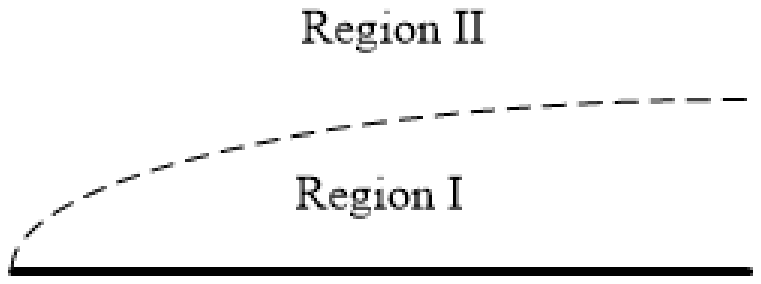
Consider steady incompressible flow over a flat plate, where the dashed line represents the edge of the boundary layer, as shown in the figure. Which one among the following statements is true?

A flat plate with a dashed line rising from its leading edge to mark the edge of the boundary layer; Region I lies between the plate and the dashed line, Region II lies above it

Exam Year(s)

GATE XE - 2023,

Answer: D

The true statement is Bernoulli’s equation cannot be applied in Region I.

Region I is inside the boundary layer. There viscous stresses are significant and the flow is rotational, so mechanical energy is dissipated along a streamline and the inviscid assumption behind Bernoulli's equation fails. It cannot be used there either between arbitrary points or along a streamline.

Region II, outside the boundary layer, is effectively inviscid and, coming from a uniform stream, irrotational. There Bernoulli's equation holds, and because the flow is irrotational it holds between any two points, not only along one streamline. That rules out the statement that it cannot be applied in Region II, and both statements claiming it can be applied in Region I.

Please log in or register to report this question.

10.

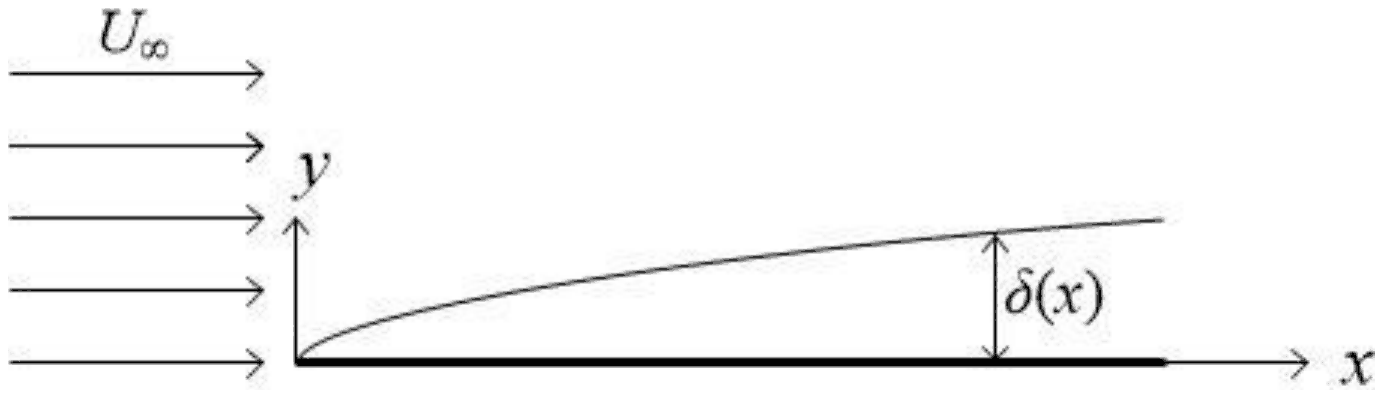
Consider steady incompressible flow of a Newtonian fluid over a horizontal flat plate, as shown in the figure. The boundary layer thickness is proportional to

Uniform stream U infinity meeting the leading edge of a horizontal flat plate along the x-axis; the boundary layer thickness delta(x) grows with distance x

Exam Year(s)

GATE XE - 2023,

Answer: B

The boundary layer thickness grows as \(x^{1/2}\).

For laminar flow over a flat plate, an order-of-magnitude balance of inertia and viscous diffusion in the boundary layer gives \(\frac{U_{\infty}}{x} \sim \frac{\nu}{\delta^{2}}\), so \(\delta \sim \sqrt{\nu x/U_{\infty}}\). The Blasius solution makes this exact:

\[ \begin{aligned} \delta &\approx \frac{5x}{\sqrt{Re_{x}}} = 5\sqrt{\frac{\nu x}{U_{\infty}}} \\ &\propto x^{1/2} \end{aligned} \]

\(x^{-1/2}\) is how the local skin friction coefficient varies, not the thickness, which must grow downstream. \(x^{2}\) grows far too fast, and \(x^{1/4}\) has no basis here; a turbulent layer grows faster, as about \(x^{4/5}\).

Please log in or register to report this question.

Loading…
Tags: Boundary Layer Theory Questions and Answers || Boundary Layer Theory MCQ Questions and Answers || Boundary Layer Theory GK Questions and Answers || Boundary Layer Theory GK MCQ Questions || Boundary Layer Theory Multiple Choice Questions and Answers || Boundary Layer Theory GK || GK on Boundary Layer Theory || Fluid Mechanics Questions and Answers || Fluid Mechanics MCQ Questions and Answers || Fluid Mechanics GK Questions and Answers || GK on Fluid Mechanics