
Machine-translated by Google. Questions are authored in English.
Top

Brakes and Dynamometers Questions and Answers

1.

A force of 400 N is applied to the brake drum of 0.5 m diameter in a band-brake system as shown in the figure, where the wrapping angle is 180°. If the coefficient of friction between the drum and the band is 0.25, the braking torque applied, in N.m is
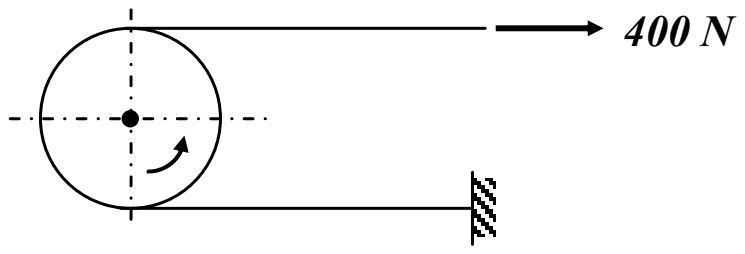
A band wrapped half way round the left side of a drum: the upper end of the band is pulled to the right with 400 N and the lower end is anchored to a fixed support

Exam Year(s)

GATE ME - 2012,

Answer: B

The key's answer is 54.4 N.m.

The band wraps 180° (\(\pi\) rad) with \(\mu = 0.25\), so the tension ratio is:

\[ \frac{T_{1}}{T_{2}} = e^{\mu\theta} = e^{0.25\pi} = 2.193 \]

The key takes the 400 N pull as the tight-side tension T1 and the anchored end as the slack side:

\[ \begin{aligned} T_{2} &= 400/2.193 = 182.4\ \text{N} \\ T &= (T_{1}-T_{2})r = (217.6)(0.25) \\ &= 54.4\ \text{N.m} \end{aligned} \]

Read strictly, the drum's rotation as drawn drags the band towards the anchored end, which would make that end the tight side: its tension would be 877 N and the torque 119.3 N.m. That value is not among the options; the key's 54.4 N.m is the torque with the 400 N side tight. 100.6, 22.1 and 15.7 N.m do not follow from either reading.

Please log in or register to report this question.

Answer: D

A dynamometer is used to measure power of an engine.

A dynamometer absorbs or transmits the engine's output while measuring the torque T at a known speed N, and the brake power follows as \(P = \frac{2\pi N T}{60}\). Rope brakes, Prony brakes, hydraulic and eddy current dynamometers all work on this principle.

Balancing to reduce vibration is done with balancing masses, fuel supply is regulated by the governor and the fuel system, and brakes in an automobile stop the vehicle rather than measuring anything.

Please log in or register to report this question.

3.

Which of the following brakes is commonly used in motor cars ?

Exam Year(s)

RSMSSB JE - 2025, RSMSSB - 2025,

Answer: A

The brake commonly used in motor cars is the internal expanding shoe brake.

In this drum brake, two curved shoes inside a drum attached to the wheel are pushed outwards against the drum's inner surface by a cam or hydraulic cylinder. Its compact, enclosed construction suits vehicle wheels, which is why it has long been the standard car brake, particularly on rear wheels.

Band brakes and band and block brakes are used on hoists, winches and cranes, and the external shoe (block) brake is typical of railway wagons and some machinery, not of cars.

Please log in or register to report this question.

4.

Which of the following brakes is commonly used in trains?

Exam Year(s)

RSMSSB JE - 2025, RSMSSB - 2025,

Answer: B

The brake commonly used in trains is the shoe brake.

Railway vehicles use shoe (block) brakes: a cast iron or composite block is pressed against the tread of the wheel by air pressure through the brake rigging.

Band brakes and band and block brakes are used on hoists, winches and cranes, and internal expanding shoe brakes on road vehicles such as cars and motorcycles.

Please log in or register to report this question.

Loading…
Tags: Brakes and Dynamometers Questions and Answers || Brakes and Dynamometers MCQ Questions and Answers || Brakes and Dynamometers GK Questions and Answers || Brakes and Dynamometers GK MCQ Questions || Brakes and Dynamometers Multiple Choice Questions and Answers || Brakes and Dynamometers GK || GK on Brakes and Dynamometers || Theory of Machines Questions and Answers || Theory of Machines MCQ Questions and Answers || Theory of Machines GK Questions and Answers || GK on Theory of Machines