Answer: A
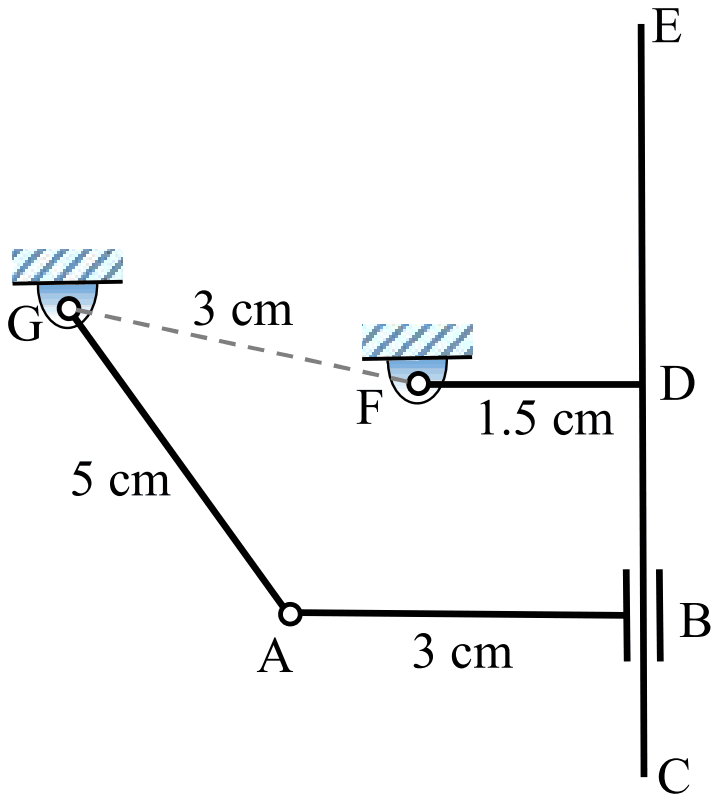
The mechanism is a Grashof chain with links AG, AB and CDEF completely rotatable about the ground link FG.
Because AB and FD are both perpendicular to CE, the bar CE is always a line lying 3 cm from A and 1.5 cm from F, on the same side of both (as drawn). Such a line is a common tangent to a circle of radius 3 cm about A and a circle of radius 1.5 cm about F, and a common tangent of that kind exists whenever the distance FA is at least the difference of the radii, 1.5 cm.
As AG turns about G, A moves on a circle of radius 5 cm. F lies 3 cm from G, inside that circle, so FA always lies between \(5 - 3 = 2\) cm and \(5 + 3 = 8\) cm, never below 1.5 cm. The assembly is therefore possible in every position: AG turns through a full revolution, and because F is inside A's path the direction FA, and with it the direction of CE, also turns through 360°. So the T-shaped link CDEF and the link AB (fixed at right angles to CE) rotate fully too.
That rules out a non-Grashof chain, a chain in which AG and CDEF only oscillate, and a change-point (border) case, which would need FA to reach exactly 1.5 cm.