
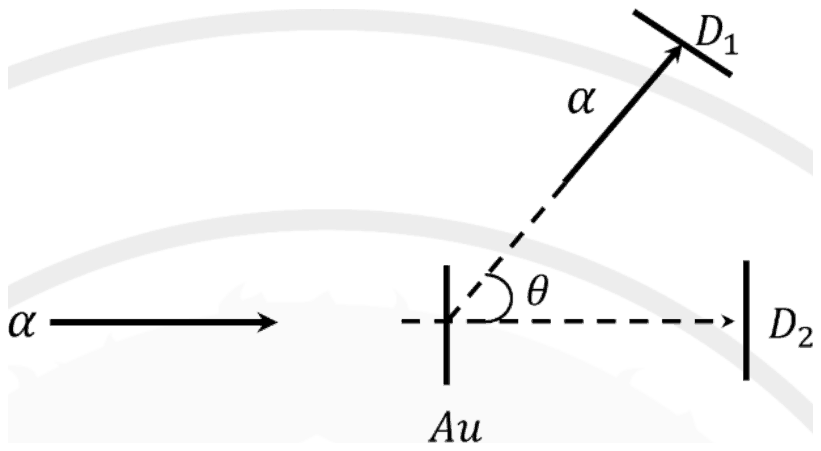
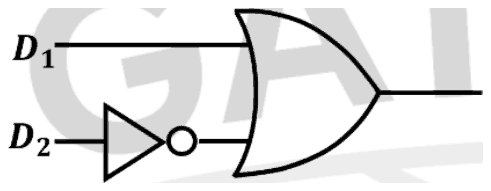
An \(\alpha\) particle is scattered from an Au target at rest as shown in the figure. \(D_{1}\) and \(D_{2}\) are the detectors to detect the scattered \(\alpha\) particle at an angle \(\theta\) and along the beam direction, respectively, as shown. The signals from \(D_{1}\) and \(D_{2}\) are converted to logic signals and fed to logic gates. When a particle is detected, the signal is 1 and is 0 otherwise. Which one of the following circuits detects the particle scattered at the angle \(\theta\) only?
GATE Physics - 2025,
Answer: A
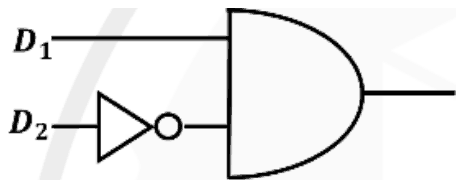
The required circuit is (A): \(D_{1}\) AND (NOT \(D_{2}\)).
'Scattered at angle \(\theta\) only' means \(D_{1}\) fires and \(D_{2}\) does not. The output must be 1 exactly when \(D_{1} = 1\) and \(D_{2} = 0\), which is \(D_{1}\cdot\overline{D_{2}}\): invert \(D_{2}\) and AND it with \(D_{1}\).
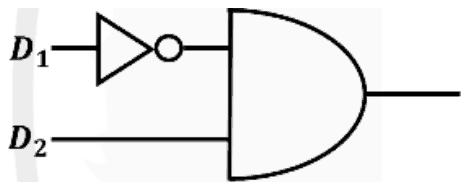
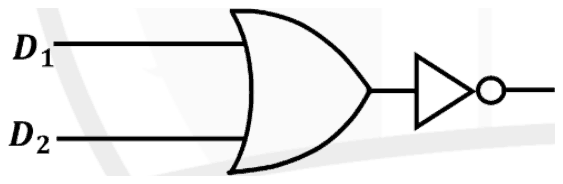
(B) gives \(\overline{D_{1}}D_{2}\), which selects the unscattered particles going straight to \(D_{2}\). (C) is a NOR, \(\overline{D_{1} + D_{2}}\), which is 1 only when neither detector fires. (D), \(D_{1} + \overline{D_{2}}\), is also 1 when nothing is detected at all.
Please log in or register to report this question.