
Machine-translated by Google. Questions are authored in English.
Top

Partition Function Questions and Answers

1.

Consider a non-interacting gas of spin 1 particles, each with magnetic moment \(\mu\), placed in a weak magnetic field \(B\), such that \(\frac{\mu B}{k_{B}T} \ll 1\). The average magnetic moment of a particle is

Exam Year(s)

GATE Physics - 2022,

Answer: A

The average moment is \(\frac{2\mu}{3}\left(\frac{\mu B}{k_{B}T}\right)\).

A spin-1 particle has three orientations, \(m = +1, 0, -1\), with energies \(-\mu B\), 0 and \(+\mu B\). Writing \(x = \mu B/k_{B}T\), the Boltzmann average is

\[ \begin{aligned} \langle \mu_{z} \rangle &= \mu\frac{e^{x} - e^{-x}}{1 + e^{x} + e^{-x}} \\ &= \mu\frac{2\sinh x}{1 + 2\cosh x} \end{aligned} \]

For \(x \ll 1\), \(\sinh x \approx x\) and \(\cosh x \approx 1\), so \(\langle \mu_{z} \rangle \approx \mu\frac{2x}{3}\). The factor 2/3 is the Curie-law factor \(J(J+1)/3\) for \(J = 1\). The other coefficients, \(\frac{1}{2}\), \(\frac{1}{3}\) and \(\frac{3}{4}\), do not come from the three-level sum; a spin-1/2 particle, for comparison, would give \(\mu x\).

Please log in or register to report this question.
2.

A simple harmonic oscillator with an angular frequency \(\omega\) is in thermal equilibrium with a reservoir at absolute temperature \(T\), with \(\omega = \frac{2k_{B}T}{\hbar}\). Which one of the following is the partition function of the system?

Exam Year(s)

GATE Physics - 2023,

Answer: A

The partition function is \(\frac{e}{e^{2} - 1}\).

For a quantum oscillator with levels \(E_{n} = (n + \frac{1}{2})\hbar\omega\), the sum is geometric:

\[ \begin{aligned} Z &= \sum_{n=0}^{\infty} e^{-(n + 1/2)x} = \frac{e^{-x/2}}{1 - e^{-x}} \\ x &= \frac{\hbar\omega}{k_{B}T} = 2 \end{aligned} \]

So \(Z = e^{-1}/(1 - e^{-2})\); multiplying top and bottom by \(e^{2}\) gives \(e/(e^{2} - 1)\).

The \(+1\) in the denominator would come from an alternating series, which the oscillator does not have, and \(e/(e - 1)\) is what \(x = 1\) would give, forgetting the factor 2 in \(\omega = 2k_{B}T/\hbar\).

Please log in or register to report this question.
3.

Consider a two-level system with energy states \(+\varepsilon\) and \(-\varepsilon\). The number of particles at \(+\varepsilon\) level is \(N_{+}\) and the number of particles at \(-\varepsilon\) level is \(N_{-}\). The total energy of the system is \(E\) and the total number of particles is \(N = N_{+} + N_{-}\). In the thermodynamic limit, the inverse of the absolute temperature of the system is (Given: \(\mathrm{ln}\, N! \simeq N\mathrm{ln}\, N - N\))

Exam Year(s)

GATE Physics - 2025,

Answer: A

The answer is \(\frac{k_{B}}{2\varepsilon}\ln[\frac{N-E/\varepsilon}{N+E/\varepsilon}]\).

From \(N = N_{+} + N_{-}\) and \(E = \varepsilon(N_{+} - N_{-})\), \(N_{\pm} = \frac{1}{2}(N \pm \frac{E}{\varepsilon})\). The entropy, with Stirling's formula, is

\[ \begin{aligned} S = k_{B}[&N\ln N - N_{+}\ln N_{+} \\ &- N_{-}\ln N_{-}] \end{aligned} \]

Since \(\frac{dN_{\pm}}{dE} = \pm\frac{1}{2\varepsilon}\):

\[ \begin{aligned} \frac{1}{T} = \frac{\partial S}{\partial E} &= \frac{k_{B}}{2\varepsilon}(\ln N_{-} - \ln N_{+}) \\ &= \frac{k_{B}}{2\varepsilon}\ln\frac{N - E/\varepsilon}{N + E/\varepsilon} \end{aligned} \]

Option (D) misses the factor \(\frac{1}{2}\) from \(\frac{dN_{\pm}}{dE}\), and the \(\ln N\) options do not depend on \(E\), so they cannot give a temperature that changes with energy. For \(E \gt 0\) the result is negative, the familiar negative temperature of a population inversion.

Please log in or register to report this question.
4.

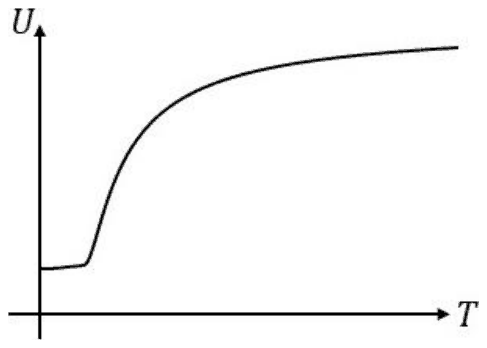
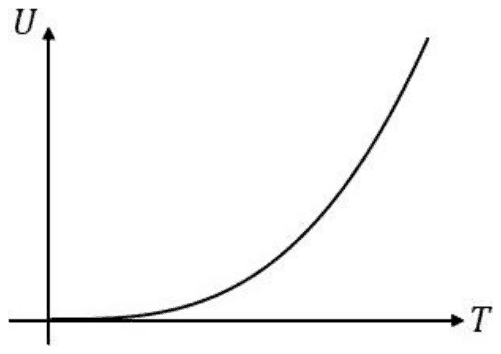
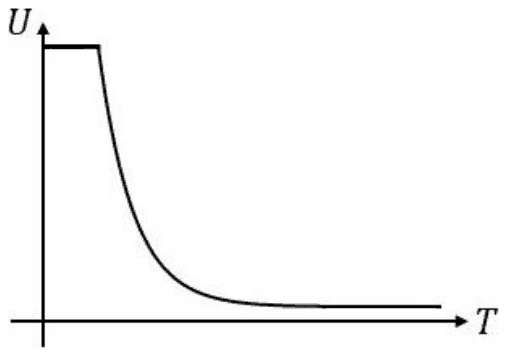
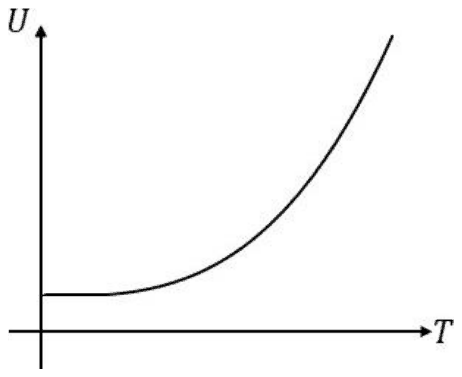
A gas of \(N\) classical particles that can occupy energy levels, \(\epsilon_{1}\) and \(\epsilon_{2} = \epsilon_{1} + \Delta\) is in equilibrium with a reservoir at temperature \(T\). From the schematics shown below, choose the correct dependence of the internal energy \(U\) on \(T\).

Exam Year(s)

GATE Physics - 2026,

Answer: A

The correct dependence is (A): U starts flat at a non-zero value, rises, and levels off.

For a classical two-level system the occupation follows the Boltzmann factor, so

\[ \begin{aligned} U &= N\epsilon_{1} + N\Delta\,p_{2} \\ p_{2} &= \frac{e^{-\Delta/k_{B}T}}{1 + e^{-\Delta/k_{B}T}} \end{aligned} \]

At low T almost every particle is in the lower level, so \(U \approx N\epsilon_{1}\), and the rise is exponentially slow until \(k_{B}T\) approaches \(\Delta\). At high T the two levels become equally occupied, so U saturates at \(N(\epsilon_{1} + \Delta/2)\) instead of growing without limit.

(B) and (D) keep rising ever more steeply, as for a system with unlimited levels. (C) has U falling as T rises, which would mean a negative heat capacity.

Please log in or register to report this question.
5.

Consider an ensemble of systems having only two energy levels having energies 0 and ε respectively. The average energy of the system at temperature T is :

Exam Year(s)

MH SET - 2018, SET Exam - 2018,

Answer: B

The average energy is \(\frac{\epsilon}{e^{\epsilon/kT} + 1}\).

With levels 0 and \(\epsilon\), the partition function is \(Z = 1 + e^{-\epsilon/kT}\). The mean energy is the Boltzmann-weighted average:

\[ \begin{aligned} \langle E\rangle &= \frac{0\cdot 1 + \epsilon\, e^{-\epsilon/kT}}{1 + e^{-\epsilon/kT}} \\ &= \frac{\epsilon}{e^{\epsilon/kT} + 1} \end{aligned} \]

Check the limits: at T = 0 it gives 0, and at high T it tends to \(\epsilon/2\), as both levels become equally occupied. The form with \(-1\) in the denominator is the mean energy of a harmonic oscillator mode (Planck's formula), which has infinitely many levels. The forms with \(e^{-\epsilon/kT}\) give the wrong limits, and the one with \(-1\) even becomes negative.

Please log in or register to report this question.

6.

The partition function of a two-dimensional oscillator whose energy \( E_{n_{x}n_{y}} = (n_{x} + n_{y} + 1)\hbar\omega \), \( n_{x} = 0, 1, 2, \ldots \); \( n_{y} = 0, 1, 2, \ldots \), is :

Exam Year(s)

MH SET - 2018, SET Exam - 2018,

Answer: C

The partition function is \( \frac{e^{\hbar\omega/k_{B}T}}{\left(e^{\hbar\omega/k_{B}T} - 1\right)^{2}} \).

The two quantum numbers are independent, so the sum factorises into two geometric series, with \( x = e^{-\hbar\omega/k_{B}T} \):

\[ \begin{aligned} Z &= x \sum_{n_{x}} x^{n_{x}} \sum_{n_{y}} x^{n_{y}} = \frac{x}{(1 - x)^{2}} \\ &= \frac{e^{\hbar\omega/k_{B}T}}{\left(e^{\hbar\omega/k_{B}T} - 1\right)^{2}} \end{aligned} \]

the last step multiplying top and bottom by \( x^{-2} \). The options with \( 2k_{B}T \) in the exponents halve the level spacing \( \hbar\omega \), and the option with \( +1 \) has the wrong sign in the denominator; none of them is the sum of these geometric series.

Please log in or register to report this question.

7.

Consider a system with only two energy levels with energies \(E_{0} = 0\) and \(E_{1} = 1.3806 \times 10^{-23}\) J. The level \(E_{0}\) has degeneracy 2 and the level \(E_{1}\) has degeneracy 3. The partition function at T = 1 K is (\(K_{B} = 1.3806 \times 10^{-23}\) JK\(^{-1}\)) :

Exam Year(s)

MH SET - 2020, SET Exam - 2020,

Answer: A

The partition function is \(z = 2e^{0} + 3e^{-1}\).

The partition function sums the Boltzmann factor of each level, weighted by its degeneracy: \(z = \sum g_{i}e^{-E_{i}/k_{B}T}\). At T = 1 K, \(k_{B}T = 1.3806 \times 10^{-23}\) J, exactly \(E_{1}\), so \(E_{1}/k_{B}T = 1\):

\[ \begin{aligned} z &= 2e^{-0} + 3e^{-1} \\ &= 2 + 3e^{-1} \approx 3.10 \end{aligned} \]

The options with 6 multiply the two degeneracies together, which would be the rule for combining two independent systems, not for summing over the levels of one system.

Please log in or register to report this question.

8.

In a two-state system, one with energy 0 and other with energy \(\varepsilon \gt 0\). The system will have both the levels equally occupied when :

Exam Year(s)

MH SET - 2023, SET Exam - 2023,

Answer: B

The two levels are equally occupied when T is infinite.

In thermal equilibrium the ratio of occupations is given by the Boltzmann factor:

\[ \frac{N_{\varepsilon}}{N_{0}} = e^{-\varepsilon/k_{B}T} \]

For any \(\varepsilon \gt 0\) this ratio is less than 1 at every finite temperature, and it reaches 1 only in the limit \(T \rightarrow \infty\). At T = 0 all particles are in the lower level, and at very low temperature nearly all are. At a very high but finite temperature the populations approach equality without reaching it, which is why 'very high' is not exact.

Please log in or register to report this question.

9.

Consider a system of two Ising spins \(S_{1}\) and \(S_{2}\) taking values ±1 with interaction energy \(E = -JS_{1}S_{2}\). For large temperature T, the average energy of the system varies as \(C/(k_{B}T)\) with C given by :

Exam Year(s)

MH SET - 2023, SET Exam - 2023,

Answer: A

The constant is \(C = -J^{2}\).

The four configurations have energy -J (both spins equal, two states) or +J (opposite, two states). The partition function and mean energy are

\[ \begin{aligned} Z &= 2e^{\beta J} + 2e^{-\beta J} = 4\cosh\beta J \\ \langle E\rangle &= -\frac{\partial\ln Z}{\partial\beta} = -J\tanh\beta J \end{aligned} \]

At high temperature \(\beta J\) is small and \(\tanh\beta J \approx \beta J\), so

\[ \langle E\rangle \approx -\frac{J^{2}}{k_{B}T} \]

The negative sign reflects the slight preference for the lower-energy aligned states. \(+J^{2}\) has the wrong sign, and \(-2J^{2}\) or \(4J^{2}\) would follow from miscounting the states.

Please log in or register to report this question.

10.

Average energy of a Planck's oscillator of frequency v is :

Exam Year(s)

MH SET - 2024, SET Exam - 2024,

Answer: C

The average energy is \(E = \frac{\hbar v}{e^{\hbar v/kT} - 1}\).

Planck assumed the oscillator energy is quantised in steps of \(h\nu\) (the paper writes \(\hbar v\) for the quantum). Weighting each level \(nh\nu\) with the Boltzmann factor gives the mean energy:

\[ \begin{aligned} \langle E \rangle &= \frac{\sum nh\nu\,e^{-nh\nu/kT}}{\sum e^{-nh\nu/kT}} \\ &= \frac{h\nu}{e^{h\nu/kT} - 1} \end{aligned} \]

A single quantum or \(n\) quanta is the energy of a particular state, not the thermal average, and \(mc^{2}\) is rest energy. At high temperature the expression tends to \(kT\), the classical value.

Please log in or register to report this question.

Loading…
Tags: Partition Function Questions and Answers || Partition Function MCQ Questions and Answers || Partition Function GK Questions and Answers || Partition Function GK MCQ Questions || Partition Function Multiple Choice Questions and Answers || Partition Function GK || GK on Partition Function || Statistical Mechanics Questions and Answers || Statistical Mechanics MCQ Questions and Answers || Statistical Mechanics GK Questions and Answers || GK on Statistical Mechanics