
Machine-translated by Google. Questions are authored in English.
Top

Puzzle Test Questions and Answers

Important Instructions
281.

The symbols ○, ✱, △, and □ are to be filled, one in each box, as shown below.

The rules for filling in the four symbols are as follows.

1) Every row and every column must contain each of the four symbols.
2) Every 2×2 square delineated by bold lines must contain each of the four symbols.

Which symbol will occupy the box marked with '?' in the partially filled figure?

[The figure is a 4 × 4 grid; bold lines divide it into four 2×2 squares, rows 1-2 and 3-4 by columns 1-2 and 3-4. Empty boxes are left blank.]

 ? △
 ○✱ 
  □✱
✱ △○

Exam Year(s)

GATE ME - 2023,

Answer: B

The box takes ✱ (the star).

Number the rows and columns 1 to 4 from the top left; '?' is in row 1, column 2.

  1. In the top-right 2×2 square, row 2, column 4 cannot be ○ (row 2 already has ○) and cannot be △ or ✱ (both are already in that square), so it is □.
  2. That leaves ○ for row 1, column 3, the last empty box of the top-right square.
  3. Row 1 now has ○ and △, so its two empty boxes take ✱ and □. Column 1 already has ✱ in row 4, so row 1, column 1 is □ and '?' is ✱.

○ and △ are already in row 1, so they cannot repeat there, and □ is forced into column 1, leaving the star as the only symbol for the marked box.

Please log in or register to report this question.
282.

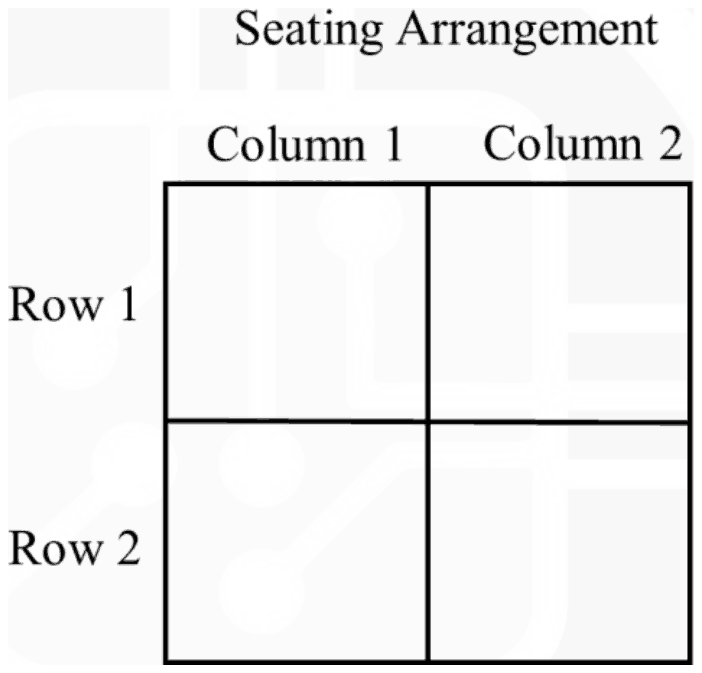
The Roman senator Meritorius, his brother, his son, and his daughter have varying oratory skill levels. They are seated in rows and columns as shown in the figure with exactly one person sitting in each box. It is known that

(i) Meritorius' daughter and his brother are seated in the same column.
(ii) His son is seated diagonally across the sibling of the worst orator.
(iii) The best and worst orators are seated in the same row.

Who is the best orator?

Seating Arrangement: an empty 2 by 2 grid of boxes with rows Row 1 and Row 2 and columns Column 1 and Column 2

Exam Year(s)

GATE ME - 2026,

Answer: B

The best orator is Meritorius' brother.

The sibling pairs are Meritorius and his brother, and the son and the daughter. Condition (ii) puts the son diagonally across the sibling of the worst orator.

If the worst orator were the brother, the son would sit diagonally across Meritorius, leaving the daughter and the brother in the other two boxes, which lie in different columns; this breaks (i). If the worst were Meritorius, the son sits diagonally across the brother, so the daughter must take the box in the brother's column, and Meritorius sits in the brother's row. If the worst were the son, the son sits diagonally across his sister, and by (i) the brother takes the other box in her column, which is in the son's row.

In both possible cases, (iii) puts the best orator in the worst orator's row, and that person is the brother. So Meritorius, the son and the daughter are not the best.

Please log in or register to report this question.

283.

A bag contains Violet (V), Yellow (Y), Red (R), and Green (G) balls. On counting them, the following results are obtained:

(i) The sum of Yellow balls and twice the number of Violet balls is 50.
(ii) The sum of Violet and Green balls is 50.
(iii) The sum of Yellow and Red balls is 50.
(iv) The sum of Violet and twice the number of Red balls is 50.

Which one of the following Pie charts correctly represents the balls in the bag?

Exam Year(s)

GATE XE - 2025,

Answer: A

The correct pie chart is V 10%, R 20%, Y 30%, G 40%.

Check each chart against the four conditions, taking the percentages as counts out of 100:

  • (i) Y + 2V = 30 + 20 = 50
  • (ii) V + G = 10 + 40 = 50
  • (iii) Y + R = 30 + 20 = 50
  • (iv) V + 2R = 10 + 40 = 50

All four hold. Solving directly gives the same: (i) and (iv) give Y + 2V = V + 2R, so Y = 2R - V; with (iii), 3R - V = 50, and with (iv), V = 50 - 2R, so R = 20, V = 10, Y = 30 and G = 40. The total is 100, so the counts are also the percentages.

The other charts fail at once: V 40% and Y 20% give Y + 2V = 100; V 30%, Y 10% gives 70; V 20%, Y 40% gives 80.

Please log in or register to report this question.

284.

Consider a five-digit number PQRST that has distinct digits P, Q, R, S, and T, and satisfies the following conditions:

\(P \lt Q\)
\(S \gt P \gt T\)
\(R \lt T\)

If integers 1 through 5 are used to construct such a number, the value of P is:

Exam Year(s)

GATE Life Sciences - 2025, GATE XE - 2025,

Answer: C

P is 3.

Combine the conditions: R < T, T < P, P < S and P < Q. So R and T are smaller than P, and S and Q are larger.

With the digits 1 to 5, exactly two are below P and two above, so P must be the middle value, 3. Then R = 1, T = 2, and S and Q are 4 and 5 in some order (for example 34152).

P = 1 or 2 would leave too few digits below it for R and T, and P = 4 too few above it for S and Q.

Please log in or register to report this question.

285.

A coin with heads facing up is shown as (H) and a coin with tails facing up is shown as (T).

Six coins are placed in the Starting Arrangement, as shown in the figure below. A “step” is defined as interchanging a pair of adjacent coins without flipping them. The minimum number of steps needed to go from the Starting Arrangement to the Final Arrangement, as shown in the figure, is ___.

Starting Arrangement: (H) (H) (H) (T) (T) (T)
Final Arrangement: (T) (T) (T) (H) (H) (H)

Exam Year(s)

GATE Life Sciences - 2026, GATE XE - 2026,

Answer: C

The minimum number of steps is 9.

Each step swaps two adjacent coins, so it can change the relative order of only that one pair. In the starting row every one of the 3 heads is to the left of every one of the 3 tails, and in the final row every head is to the right of every tail. So each of the 3 × 3 = 9 head-tail pairs must be reversed, and at least 9 steps are needed.

9 steps are enough: move the leftmost tail three places left (3 steps), then the next tail three places (3 steps), then the last (3 steps). 3 and 6 steps cannot reverse all 9 pairs, and 12 is more than necessary.

Please log in or register to report this question.

286.

In the 4 \(\times\) 4 array shown below, each cell of the first three rows has either a cross (X) or a number.

1X43
X554
3X6X
    

The number in a cell represents the count of the immediate neighboring cells (left, right, top, bottom, diagonals) NOT having a cross (X). Given that the last row has no crosses (X), the sum of the four numbers to be filled in the last row is

Exam Year(s)

GATE Life Sciences - 2024,

Answer: A

The sum is 11.

Each new number counts the neighbouring cells without a cross. The last row has no crosses, and the row above it reads 3, X, 6, X.

  • Cell 1: neighbours 3 (no cross), X, and cell 2 of the last row: 2.
  • Cell 2: 3, X, 6 above, cells 1 and 3 beside: 4.
  • Cell 3: X, 6, X above, cells 2 and 4 beside: 3.
  • Cell 4: 6 and X above, cell 3 beside: 2.

\[ 2 + 4 + 3 + 2 = 11 \]

The other totals come from counting a cross as clear or forgetting the diagonal neighbours.

Please log in or register to report this question.

287.

L, M, N, O and P are five important cities of our country out of which, three are industrial cities, two are port cities, one is a hill station and three cities have a university each. Every hill city has a university but has no port. 'O' is not a port city. No port city has a university. 'M' is a port city. Two industrial cities have universities and 'N' and 'O' are not industrial cities. The industrial cities with universities don't have ports. None of the industrial cities is a hill station. 'O' is a hill station and 'P' has a university.

Which city has industries as well as a port but does not have a university?

Exam Year(s)

HPPSC HPAS - 2021,

Answer: C

CityIndustrialPortHillUniversity
Lyesnonoyes
Myesyesnono
Nnoyesnono
Ononoyesyes
Pyesnonoyes

Why: N and O are not industrial, so the three industrial cities are L, M and P. O is the hill station and so has a university. M is a port, and no port has a university, so M has none; the two industrial cities with universities are therefore L and P. That makes three universities (L, O, P). The second port cannot be O (not a port) or L or P (they have universities), so it is N.

The city with industries and a port but no university is M. 'L and O' and 'O and M' both include O, the hill station, which is not industrial and has no port. N is a port but not industrial.

Please log in or register to report this question.

288.

There are four married couples in a family. Each couple deals in different types of business, i.e., Furniture, Garments, Jewellery and Publishing. The male members of the couples are Ashutosh, Prem, Rajiv and Pappu. The female members are Rosy, Rinku, Rupu and Nitu. Once they were invited to my house on the occasion of my son's birthday. Each couple came one after another.

(i) Rajiv arrived immediately after the couple who deals in Garments but immediate before Rupu.
(ii) Prem arrived immediately before Rosy.
(iii) Pappu deals in Books.
(iv) Ashutosh arrived immediately before Rinku (who does not deal in Furniture). Rinku arrived immediately before the couple which deals in Jewellery.

Who came after Ashutosh?

Exam Year(s)

HPPSC HPAS - 2021,

Answer: C

The order of arrival works out uniquely as:

OrderHusbandWifeBusiness
1AshutoshNituFurniture
2PremRinkuGarments
3RajivRosyJewellery
4PappuRupuBooks

Why: Rajiv's couple has the Garments couple just before it and Rupu's couple just after it, so Rajiv is second or third. Ashutosh's couple is followed by Rinku's, which is followed by the Jewellery couple, so Ashutosh is first or second. Prem comes just before Rosy, so Prem cannot be last.

If Rajiv were second, Ashutosh would be first, Rinku would be Rajiv's wife and the third couple would deal in Jewellery. Prem would then be third and Pappu fourth with Books, leaving Furniture for Rajiv and Rinku, which clue (iv) forbids. So Rajiv is third and Rupu's couple fourth. Ashutosh cannot then be second, because Rinku would be third and the fourth couple, Pappu's, would have to deal in Jewellery though Pappu deals in Books. So Ashutosh is first, Rinku's couple second (Garments), Rajiv's third (Jewellery) and Pappu's fourth (Books). Prem must be second, with Rosy in the third couple as Rajiv's wife, and Nitu is Ashutosh's wife.

The arrival right after Ashutosh's couple was Prem and Rinku, as clue (iv) states directly. Rajiv and Rosy came third and Pappu fourth, so none of them came immediately after Ashutosh.

Please log in or register to report this question.

289.

Ajay would do five tasks: A, B, C, D and E: starting at 9 am in the morning. A is the first task and takes 2 h. B can be done after A is complete and requires 1 h. Work on C which would take 1 h can start only after A and B are complete. Ajay can do task D along with B and C and would take 3 h for that. Activity E with duration of 1 h can start on completion of A, B, C and D.

What is the earliest time when Ajay would complete C?

Exam Year(s)

HPPSC HPAS - 2021,

Answer: C

The tasks run as follows: A from 9 to 11 a.m. (2 h); B after A, from 11 a.m. to 12 noon (1 h); C after A and B, from 12 noon to 1 p.m. (1 h); D alongside B and C, so from 11 a.m., for 3 h, to 2 p.m.; and E only after A, B, C and D are all done.

So the earliest completion of C is 1 p.m. 11 a.m. is when A ends, and 12 noon is when B ends and C can begin. 2 p.m. is when D ends; C does not have to wait for D, because D runs alongside it.

Please log in or register to report this question.

290.

The letters L, M, N, O, P, Q, R, S, and T in their order are substituted by nine integers 1 to 9 but not in that order. 4 is assigned to P. The difference between P and T is 5. The difference between N and T is 3. What is the integer assigned to N?

Exam Year(s)

HPPSC HPAS - 2021,

Answer: C

The integer assigned to N is 6.

P is 4. T differs from P by 5, so T is 9 or −1; only 9 lies between 1 and 9, so T = 9.

N differs from T by 3, so N is 6 or 12. Only 6 is in range, so N = 6.

4 is already taken by P, so it cannot also belong to N. 5 and 7 differ from T = 9 by 4 and 2, not 3.

Please log in or register to report this question.

Loading…
Tags: Puzzle Test Questions and Answers || Puzzle Test MCQ Questions and Answers || Puzzle Test GK Questions and Answers || Puzzle Test GK MCQ Questions || Puzzle Test Multiple Choice Questions and Answers || Puzzle Test GK || GK on Puzzle Test || Reasoning Questions and Answers || Reasoning MCQ Questions and Answers || Reasoning GK Questions and Answers || GK on Reasoning