
Machine-translated by Google. Questions are authored in English.
Top

Oscillations and Waves Questions and Answers

21.

The frequency of the periodic wave for the following figure is
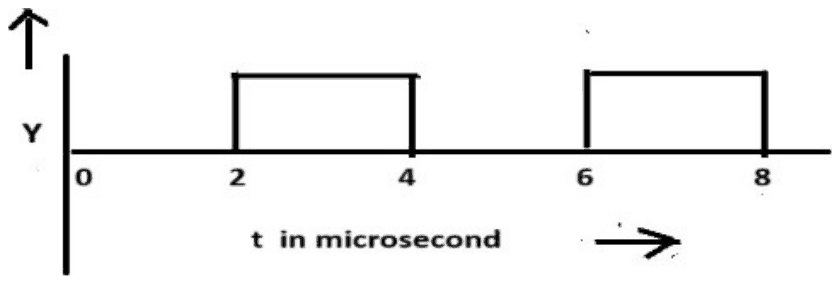
A rectangular wave, Y plotted against t in microseconds; Y is zero from t = 0 to 2, high from 2 to 4, zero from 4 to 6 and high again from 6 to 8

Exam Year(s)

KEAM - 2025,

Answer: B

The frequency is 0.25 MHz.

The waveform repeats every time it returns to the same point in its cycle. One pulse rises at t = 2 microseconds and the next rises at t = 6 microseconds, so one full cycle (one high part plus one low part) lasts 4 microseconds:

\[ \begin{aligned} T &= 6 - 2 = 4\ \mu\text{s} \\ f &= \frac{1}{T} = \frac{1}{4 \times 10^{-6}} \\ &= 2.5 \times 10^{5}\ \text{Hz} = 0.25\ \text{MHz} \end{aligned} \]

The common mistake is to take the width of a single pulse, 2 microseconds, as the period, giving 0.5 MHz. A period of 1 microsecond would give 1 MHz, which does not fit the figure.

Please log in or register to report this question.

22.

If the period of the simple pendulum of length \(l\) is 5 second, then the period of the pendulum of length \(\frac{l}{4}\) is

Exam Year(s)

KEAM - 2025,

Answer: C

The new period is 2.5 s.

The period of a simple pendulum is \(T = 2\pi\sqrt{\frac{l}{g}}\), proportional to \(\sqrt{l}\):

\[ \begin{aligned} T' &= 5\sqrt{\frac{1}{4}} = 5 \times \frac{1}{2} \\ &= 2.5\ \text{s} \end{aligned} \]

1.25 s, from dividing by 4, is not offered; the other options do not follow from the square-root law.

The period depends only on length and \(g\), not on mass or (for small swings) amplitude, so quartering the length halves the period.

Please log in or register to report this question.

23.

If the ratio of the Young's modulii and densities of two rods of different materials are respectively, 3 : 2 and 3 : 1, then the ratio of the velocities of sound in the rods is

Exam Year(s)

KEAM - 2025,

Answer: D

The ratio of the speeds of sound is 1 : \(\sqrt{2}\).

For longitudinal waves in a rod, \(v = \sqrt{\frac{Y}{\rho}}\):

\[ \begin{aligned} \frac{v_{1}}{v_{2}} \\ &= \sqrt{\frac{Y_{1}}{Y_{2}}\cdot\frac{\rho_{2}}{\rho_{1}}} \\ &= \sqrt{\frac{3}{2}\cdot\frac{1}{3}} \\ &= \frac{1}{\sqrt{2}} \end{aligned} \]

\(\sqrt{2} : 1\) inverts the density ratio, and 1 : 2 omits the square root.

Please log in or register to report this question.

24.

If the speed of the transverse wave in a wire under certain tension \(T\) is \(v\) , then its speed under tension \(2T\) (in ms-1 ) is

Exam Year(s)

KEAM - 2025,

Answer: C

The speed becomes \(\sqrt{2}v\).

The speed of a transverse wave on a string is \(v = \sqrt{\frac{T}{\mu}}\), where \(\mu\) is the mass per unit length, which does not change.

\[ v' = \sqrt{\frac{2T}{\mu}} = \sqrt{2}\,v \]

2v treats the speed as proportional to the tension rather than its square root. \(\frac{v}{\sqrt{2}}\) and \(\frac{v}{2}\) make the wave slower under greater tension, which is backwards.

Please log in or register to report this question.

25.

A musician hits a drum 90 times in a minute. The time period of hit is

Exam Year(s)

KEAM - 2025,

Answer: E

The time period is 0.67 s.

90 hits in 60 s means the frequency is \(\frac{90}{60} = 1.5\) Hz. The period is its reciprocal.

\[ T = \frac{60}{90} = \frac{2}{3} \approx 0.67\ \text{s} \]

1.5 s is the frequency in hertz mistaken for the period. 1.34 s doubles the period, and 0.33 s halves it.

Please log in or register to report this question.

26.

If the time period of a particle executing SHM is 8 s, then the time period of the potential energy of this particle is

Exam Year(s)

KEAM - 2025,

Answer: B

The period of the potential energy is 4 s.

In SHM \(x = A\sin\omega t\), and the potential energy is \(U = \frac{1}{2}kx^{2} = \frac{1}{2}kA^{2}\sin^{2}\omega t\).

\[ \sin^{2}\omega t = \frac{1 - \cos 2\omega t}{2} \]

The energy therefore oscillates at twice the angular frequency, with half the period: \(\frac{8}{2} = 4\) s. It peaks at both extremes of each oscillation, x = +A and x = -A. 8 s is the period of the displacement itself, and 16 s doubles instead of halving.

Please log in or register to report this question.

Answer: B

In simple harmonic motion, the motion is periodic.

SHM repeats itself after a fixed time period \(T = \frac{2\pi}{\omega}\); every SHM is periodic (though not every periodic motion is simple harmonic).

The velocity is not constant: it is greatest at the mean position and zero at the extremes. The acceleration is proportional to displacement, not velocity, and it is directed opposite to the displacement, towards the mean position (\(a = -\omega^{2}x\)). Oscillations such as a torsional pendulum are angular SHM, so the motion need not be along a straight line.

Please log in or register to report this question.

Answer: A

The principle states that the net displacement is the vector sum of individual displacements.

When two or more waves overlap, the resultant displacement at any point and instant is the (vector) sum of the displacements each wave would cause on its own. It holds for all linear waves, travelling or standing, sound or light.

Waves pass through each other and occupy the same space; interference redistributes energy rather than destroying it; and the principle is not limited to sound or standing waves.

Please log in or register to report this question.

29.

The number of nodes and antinodes in a guitar string vibrating in the third harmonic is:

Exam Year(s)

KEAM - 2025,

Answer: B

The string has 4 nodes and 3 antinodes.

A string fixed at both ends vibrating in its nth harmonic has n loops. Each loop has one antinode at its middle, and the nodes are at the ends and between loops, giving n + 1 of them. For n = 3: 3 antinodes and 4 nodes.

5 nodes and 4 antinodes is the fourth harmonic, 3 nodes and 2 antinodes the second, and 2 nodes with 3 antinodes is impossible for a string fixed at both ends.

Shortcut: in the nth harmonic of a string fixed at both ends there are n antinodes and n + 1 nodes, so the answer can be read off without a sketch.

Please log in or register to report this question.

Answer: A

In Huygens' construction the secondary wavelets move in all directions.

Huygens' principle treats every point on a wavefront as a source of secondary wavelets that spread out in all directions at the speed of the wave. The new wavefront is the forward envelope (common tangent) of these wavelets; the backward part is simply ignored in the construction.

The wavelets are not restricted to radial, backward or perpendicular directions.

Huygens' construction explains both reflection and refraction: the envelope of the wavelets drawn from each point of an incident wavefront gives the reflected or refracted wavefront.

Please log in or register to report this question.

Loading…
Tags: Oscillations and Waves Questions and Answers